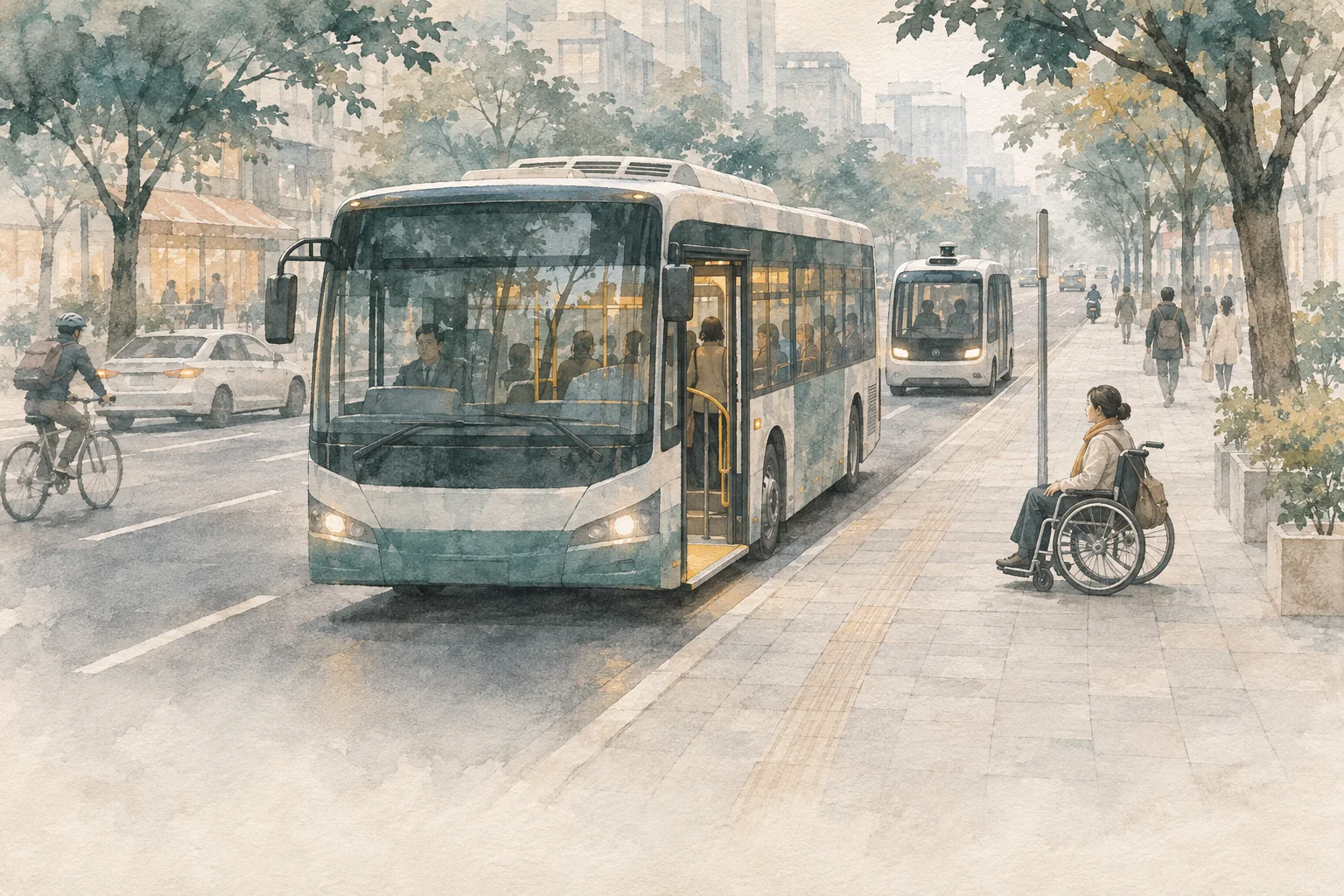
Decision year: 2029 · World: fictional metropolis · transport · Assumption level: Extension · Decision type: Allocation · Decision actor: City Transport Committee · Deadline: 45 days until the road restructuring construction
The autonomous vehicle operator states that a dedicated lane is needed to lower the service unit cost, but that lane is already in use by buses and delivery vehicles. Considering together the door-to-door travel of wheelchair users, bus capacity, and concerns about expanding boarding and alighting space for pedestrians, how should road space be allocated?
The three options on the table are a dedicated autonomous vehicle lane, maintaining bus and pedestrian priority, and time- and segment-based sharing. Two unknowns remain before anyone in the room can judge which one costs least: how much the new service takes riders from buses rather than from private cars, and whether boarding and alighting in the mixed segment is safe. Neither has been observed.
Present state of the record: Before the deadline; awaiting the check.
1The street in 2029
Synthetic scene
The meeting room is on an upper floor, and the table in the middle of it is longer than it needs to be. The chairs have been moved twice already that morning to make room for a drawing sheet that keeps curling at one end. A clerk holds down the corner with a coffee cup that has gone cold. There is a second sheet underneath, folded, waiting.
On the top sheet is a lane, drawn in plan. The line work is heavy where the lane already carries use, and lighter where the new construction would begin. Buses run along it. Delivery vehicles use the same lane.
The chair asks the transport officer to confirm what is already there. The officer puts a pen on the sheet and leaves it there.
The same lane is used by buses and delivery vehicles.
The pen stays on the drawing for a while. The officer explains that the lane is not empty and has not been empty. Whatever is built here is built on top of movement that is already running, on a timetable, with people waiting at stops along the way. The officer taps the heavy line twice and then takes the pen away.
The operator's representative has asked to speak early. They read from a prepared statement rather than looking up. The substance is short: without a dedicated lane, the service cannot reach the unit cost the operator believes it needs to reach. The representative says this twice, in almost the same words, the way people do when they are reading and not arguing.
The autonomous vehicle operator states that a dedicated lane is needed to lower the service unit cost.
The chair lets the statement finish, then asks a plain question. The claim is a claim. What has been observed? The room is quiet in the way rooms go quiet when the honest answer is that nothing has been observed yet. The substitution rate — whether the new service would take riders from buses or from private cars — has not been measured. Nobody in front of the sheet has a number to offer. The operator's representative says the company will produce evidence, and does not say when.
The chair then asks for the other submissions. There are two, and they have been read aloud in the minutes taker's hand that morning and set on top of the folded sheet.
The first concerns wheelchair users. Their concern is stated plainly. It is for door-to-door travel: not a route that begins and ends at a stop, but a journey that carries the rider from where they are to where they need to be, without a transfer that requires walking. The accessibility officer reads out what has been submitted on their behalf and does not editorialise.
The second concerns pedestrians. Their concern is not the service itself. It is the ground beside the service. They want to know how much boarding and alighting space the new operation would need, where that space would come from, and who would be standing in it when the vehicles stopped. One member of the committee asks whether the pedestrian group's objection and the wheelchair user's request are the same objection, pointed in opposite directions. Nobody in the room answers that with a verdict.
Wheelchair users want door-to-door travel, while pedestrians are concerned about expanding boarding and alighting space.
What is on the table, then, is one lane with three claims on it. A private operator wants it emptied of its current users for part of the day so the cost of the service can come down. Public buses and delivery vehicles already use it and have stops and timetables attached to it. A wheelchair user wants the door-to-door journey that a dedicated lane might make possible. A group of pedestrians wants the pavement beside that same lane to stop being negotiated away.
The chair writes three words on the sheet in the margin: capacity, access, pavement. Then crosses them out and writes one: allocation. The question in front of the committee is not whether the new service is good. It is how road space is divided among the autonomous mobility service, public transport, and pedestrians, in a construction that starts in forty-five days.
The mandate is narrow and the members keep checking it. The committee sets public lane and bus stop layout. It cannot set the price of a private vehicle, and it cannot set the operator's fare. Whatever the operator's unit cost turns out to be, this committee is not the body that will fix it. The chair says this aloud when the discussion drifts toward what the service should charge, and the drift stops.
Near the end of the sitting the clerk lays the folded second sheet on the table. It is the road restructuring drawing: the version that begins the construction work. On the new drawing, the heavy line runs where the construction would begin, and lighter line work runs where the lane's existing use continues. The chair looks at both sheets without touching either, and says that the drawing will be checked against the conditions set before it is approved.
The room clears slowly. The coffee cup is lifted off the corner of the sheet, and the paper rolls back on itself at the end, the way it has all morning. Outside the window, the lane the sheet describes is running: buses, delivery vehicles, and the people waiting for them. Nothing on the street has been decided yet. The clock has started.
2The question on the table
2.1Who decides, and by when
The committee is the body that sets public lane and bus stop layout. Its decision covers the road restructuring that begins in forty-five days: which lane is drawn as a lane, where the bus stops sit, how much space beside the kerb is left as pavement, and how the new construction is drawn against the movement already running there. That is the whole of the decision's reach, and the members say so repeatedly, because the drift in the room is toward things this committee cannot touch.
What sits in front of them is one question: how should road space be allocated among the autonomous mobility service, public transport, and pedestrians? The question is not what to build. It is how the space is divided between the parties already standing on it.
The deadline is forty-five days until the road restructuring construction begins. Every condition the committee wants attached to an approval has to be written before that date, because after it the drawing is a construction drawing, not a proposal. Two questions sit inside those forty-five days as well, and the decision question asks whether they should also be confirmed. The first is the scope of the approval: what exactly the decision permits and what it does not. The second is the condition for reopening the decision: what has to be observed, by whom, and when, in order for the committee to change its mind after construction.
2.2Where the authority stops
The stopping point is price. The committee sets space. It does not set what a private vehicle costs, and it does not set what the autonomous mobility service charges its riders. When the operator's representative returns to the room and says the unit cost will fall once a dedicated lane exists, the chair writes one line in the margin: this is a claim about cost, and this committee does not set cost. The claim may still be right. It is simply not a claim this body can confirm or refute.
The same boundary runs in the opposite direction. A decision here does not authorise the service across the city, does not grant the operator permanent rights on any lane, and does not finalize the general operating policy of delivery vehicles, at least in the terms in which Decision Quality Review describes the scope of this approval. Everything that is approved is approved for a construction, at a location, with a start and an end to the conditions attached to it.
2.3Three options and what each costs
There are three options on the sheet. They are not three levels of ambition. They are three different ways of accepting a loss.
The first is a dedicated lane for the autonomous mobility service. The record names it in one line and prices it in one line:
Dedicated autonomous vehicle lane
Widens new access but reduces existing bus capacity.
The second keeps the priority order where it is. Its cost is stated in the same plain register:
Maintains high-volume movement but delays door-to-door access opportunities.
The third divides the lane by time and by segment, rather than by vehicle class:
Spreads demand but makes operating rules and enforcement complex.
Read side by side, the three costs land on different parties. The first cost is reduced existing bus capacity. The second cost is delayed door-to-door access opportunities. The third cost is that operating rules and enforcement become complex. Which of these losses to accept is not settled by listing them.
2.4Two unknowns before anyone can judge
Two things are not known, and the record says so directly.
The rate at which the new service substitutes for buses rather than private cars
Boarding and alighting safety in the mixed segment
The first unknown decides what a dedicated lane actually buys. If the new service mostly replaces private car trips, a dedicated lane removes road pressure. If it mostly takes riders off buses, a dedicated lane removes public capacity in order to serve trips that were already being made by road. Nothing in the record settles which of these would happen. The boundary line attached to the decision states the same point in shorter form:
Unknown remaining before judgment: the rate at which the new service substitutes for buses rather than private cars
The second unknown decides what a mixed segment would cost in safety terms. Wheelchair boarding and alighting, pedestrian circulation, delivery vehicles, and the new service would all occupy the same stretch of kerb at the same times. Whether that arrangement holds together has not been observed, and the operator's cost claim does not speak to it.
2.5Seven lines on what the decision does not do
Because the committee's authority is narrow, seven of the judgments describe the decision's scope in terms of what it does not reach. Each is written differently, and together they draw the same boundary.
It has no effect on private vehicle prices or autonomous vehicle service fares, and it is not a decision permanently banning autonomous vehicles from operating across the city.
Private vehicle prices and the operator's service price are not controlled, and conditional sharing approval does not automatically expand beyond the designated times and segments.
In times and segments where sharing is not approved, bus and pedestrian priority is maintained.
It must not be interpreted broadly as a decision granting permanent road access rights to a specific business.
The price, business model, or service unit cost of private autonomous vehicle services is not controlled or guaranteed by this decision.
Future sharing or exclusive operation is not permitted without a separate approval specifying particular times, segments, and bus stops.
Prices of private vehicles or fares or business models of the autonomous mobility service are not controlled, and no autonomous vehicle priority is granted to the city as a whole.
2.6The line the committee keeps returning to
A decision of this kind has to say who carries the loss when the benefit and the cost fall on different parties. The record states the norm plainly, and one of the judgments names it as the reason it chose as it did:
It applied the norm that benefits and losses are attributed to different parties.
This is the thread that runs through the next chapter. The operator's cost reduction, the bus rider's capacity, the wheelchair user's door-to-door journey, and the pedestrian's pavement are not gains and losses in the same account. Choosing an option means choosing which of them will be postponed, reduced, or carried quietly for a while. The committee's authority can settle the drawing. It cannot settle who pays for the drawing's effects, and it does not claim to. What it can fix now is what will be observed afterwards, and that is the subject of the chapter that follows.
3The prediction
3.1Thirteen choices, side by side
Thirteen AI-generated judgments were written against this same record, and thirteen decisions came back. None of them selects the dedicated lane. That is the first thing the room has to see before it argues about anything else. The second thing is that the thirteen do not settle into one answer. They settle into a spread, and the spread has a shape.
The four judgments that hold the base plan read like this:
In this road restructuring, it is decided to adopt “Maintain bus and pedestrian priority.”
Dedicated autonomous vehicle lanes and permanent shared lanes are not approved; they are decided again through a separate procedure only when subsequent observation would materially change the cost.
It does not approve the Dedicated autonomous vehicle lane, and Time- and segment-based sharing is decided separately after substitution demand and boarding and alighting safety are verified.
The City Transport Committee decides to maintain bus and pedestrian priority in this road restructuring and not to approve a Dedicated autonomous vehicle lane.
One judgment holds that same base and then bolts something to it. It keeps the priority order and leaves a door open, but it is explicit about which door and on what terms:
However, where prior conditions are met, shared operation may be approved on a small-scale, reversible basis within designated times and segments; this is decided as a verification step attached to O2, not as full adoption of O3.
The eight remaining judgments revise the third option instead. They keep bus and pedestrian priority as the default, and they open the lane to the autonomous mobility service only where the committee has said so in advance:
Bus operation and pedestrian and bus stop safety are the base priority, and entry of the autonomous mobility service is permitted only in designated non-peak times and segments.
Because the key substitution rate and safety are still unconfirmed, permanent allocation across the city is not decided.
For autonomous mobility services, passage and boarding and alighting space are permitted reversibly only during pre-approved times and segments.
Bus and pedestrian priority is maintained as the default, and autonomous mobility services are permitted shared access only at designated times, segments, and boarding and alighting points.
The City Transport Committee decides on the O3 revised plan that maintains bus and pedestrian priority as the default while allowing the autonomous mobility service only at designated times and segments.
It decides on time- and segment-based sharing (O3) as a 90-day conditional pilot plan.
The permanent Dedicated autonomous vehicle lane O1 is not approved in this construction, and shared operation is limited for 90 days to a verifiable stage that can be withdrawn.
The City Transport Committee does not adopt a full dedicated autonomous vehicle lane, and decides on a time- and segment-based limited sharing plan with bus and pedestrian priority as the default.
Read in this order, the spread looks wider than it is. Every one of the thirteen sentences contains the same clause: bus and pedestrian priority stays as the default. Every one of them refuses the permanent dedicated lane. Every one keeps the decision inside the committee's authority over public lanes and bus stops, and leaves prices alone.
3.2What the thirteen converge on
Four agreements hold across all of them.
The first is that the dedicated lane is not approved now. Not one judgment says the operator's unit-cost claim has been confirmed as a public benefit. Several say so in plain terms: the claim is a statement by a party inside a synthetic setting, not an observation.
The second is that the default stays where it is. The lane already carries buses and delivery vehicles, and the pavement beside it already carries people waiting. Whatever is opened is opened on top of that, in designated times and segments, by prior approval, not by default.
The third is that the decision is spatial. Every judgment limits its effect to public lanes and bus stop layout, and denies that it sets private vehicle prices, operator fares, or the service's business model.
The fourth is that re-judgment is not optional. Each judgment writes the two unknowns into the approval as conditions: what will be observed, by whom, when, and what result would change the cost of the options. No judgment treats the decision as settled once the drawing is fixed.
3.3Where they split, and on what each side rests
The split is five to eight: five hold the base plan, and eight revise it into time- and segment-based sharing. The reason for it is not disagreement about facts. There are no facts yet. The reason is which loss each side is willing to carry first.
The five that hold at O2 rest on a single inference: because the substitution rate is unverified, and because the same lane is already carrying public capacity, the committee should not convert that capacity first and measure afterwards. Their conditions follow the same shape. Before construction is approved, the drawings must specify bus priority functions, safe boarding and alighting space, and access provisions for wheelchair users. Before any shared or dedicated operation is signed off, the committee must designate in writing, for U1 and U2 separately, the observation indicators, the person in charge, the comparison criteria, and the confirmation periods. Where the drawings would remove existing bus lane or bus stop use, or convert pedestrian space into an autonomous vehicle boarding and alighting zone without an approved safety review, the execution of that segment stops. Where the observation person in charge or the confirmation period is lost and re-judgment becomes impossible, preparation of the sharing plan stops too.
Their stop conditions are written as segment-by-segment, reversible rules. A test run that is not separated from pedestrian circulation stops and reverts to the priority placement. Data that cannot be compared stops the expansion judgment. Safety records that are missing stop the test, because the inability to judge is treated as a reason not to continue, not as a reason to keep going.
Their counterposition is not hidden. The strongest opposing view for Evidence and Sources Review is that a dedicated lane would lower operating costs and expand door-to-door access for wheelchair users faster. The judgment says why it does not follow that view now: the substitution rate and mixed-segment safety are unverified, so the benefit cannot be adopted as an observed fact.
The eight that revise to time- and segment-based sharing rest on a different inference: because both losses are unverified, the allocation should be reversible, and reversibility is bought with complexity. That division is the one set out in chapter 2. Their conditions are heavier by design. Permitted times and segments must be fixed in writing. Bus priority rules must be fixed. Boarding and alighting locations must be fixed. The procedure for reclaiming lanes in case of violation must be fixed. Wheelchair boarding and alighting circulation must be approved, and pedestrian circulation must be protected. Where the on-site control method for the overlap between pedestrian circulation and wheelchair boarding and alighting circulation is not approved, that segment does not begin.
Their stop conditions are correspondingly stricter in number. A boarding and alighting accident causing injury stops that segment immediately. Repeated obstruction of pedestrian or wheelchair passage above a pre-set threshold stops expansion. A casualty incident stops sharing for that time and segment and returns operations to O2. Two consecutive confirmation windows showing that the service substitutes buses rather than private cars stop expansion and return the segment to bus and pedestrian priority. Enforcement failure stops the pilot. Missing observation data stops the pilot's extension.
One judgment states the operational logic of that choice directly, and it is worth reading as the reason the split exists:
The strongest opposing option is to maintain only bus and pedestrian priority, which is O2 from the start, on grounds of uncertainty and enforcement complexity.
That is the eight's own account of the alternative they are choosing against. They know the alternative is simpler. They accept its cost in order to avoid its other cost.
3.4What each side accepts losing
The losses are stated in the judgments themselves, and they are not the same losses.
It also accepts the possibility that it may not fully meet the door-to-door travel needs of wheelchair users, but does not leave this unaddressed, instead retaining it as a task for supplementary improvement of bus stop and boarding and alighting design.
That is the O2 family's account. It accepts the delay and it does not pretend the delay is small. It carries the wheelchair user's door-to-door demand forward as a design task attached to the construction, rather than as a lane granted now.
It accepts the complexity of the schedules, signs, and enforcement rules needed for the sharing plan, and the loss that door-to-door access of the autonomous mobility service is permanently limited.
That is one sharing judgment's account of what it gives up. The lane stays limited. The door-to-door journey does not get the fast expansion a dedicated lane would promise. In exchange, the committee carries administration.
However, it does not accept the loss of permanently shrinking bus capacity and pedestrian space without verification.
It does not accept, however, the loss of permanently reducing bus capacity or transferring unverified boarding and alighting risks to pedestrians.
Those two name the line the sharing judgments will not cross. They will bear rules, signs, review schedules, and enforcement work. They will not bear the permanent conversion of public space on unverified grounds.
The pattern is consistent. The O2 family accepts a delay that it cannot easily reverse back, and it accepts it openly. The O3 family accepts an administrative burden that it can review and stop. Neither family claims its loss is smaller. Both say, in different words, that the loss is worth accepting for now.
3.5The uncertainty each judgment carries
Every one of the thirteen names the same two unknowns and none upgrades them.
Therefore confidence is medium, and if U1·U2 observations are obtained and the losses per option change, the decision is reopened.
The largest unresolved assumption is whether the autonomous mobility service reduces private cars or instead takes away bus users, and that rate is currently unverified.
Therefore, it cannot be concluded that a dedicated lane raises overall road efficiency or that shared operation is safe.
Therefore it is not currently asserted that limited sharing improves traffic volume, access gaps, or safety.
Mere identity of input is not regarded as constituting an independent test or a fair comparison.
Therefore, confidence that conditional sharing is superior to other options is low, and if observation results change the allocation of costs, the decision is reopened.
Eleven of these judgments rate their own confidence medium. Two rate it low, and both low ratings attach to a revised time- and segment-based sharing plan rather than to the plain priority plan. Neither judgment has earned high confidence, and both say so before anything is built.
3.6Conditions, stop conditions, milestones
Taken together, the thirteen judgments do not offer competing predictions about what the street will look like. They offer competing conditions for approving the drawing, and competing rules for reversing it. The conditions divide into three kinds: what must be drawn before construction, what must be written down before any sharing begins, and what must be observed before the decision can be reconsidered.
The first kind concerns the construction itself. Bus priority functions must appear on the drawings. Pedestrian boarding and alighting space must appear on the drawings. Wheelchair access provisions must appear on the drawings. Where the drawing would remove existing bus lane or bus stop use, or convert pedestrian space without an approved safety review, that segment stops before it starts.
The second kind concerns any shared operation. The permitted times must be fixed. The permitted segments must be fixed. The bus priority rules must be fixed. The boarding and alighting points must be fixed. The enforcement responsibility must be fixed. The return procedure must be fixed. If any one of the person in charge, the recording method, or the confirmation windows is missing, sharing does not begin and the default priority state holds.
The third kind concerns re-judgment. For each unknown, the committee must designate the observation, the person in charge, and the confirmation window. It must decide in advance what result would count as a change in the cost of the options. Without those, the record's own reopen conditions cannot be met, and the decision stays where it is.
The milestones below are the judgments' own execution schedules, laid over each other. They are written as the judgments wrote them: future plans, not observations. None of these windows has closed. None of these results exists yet.
Day 10 after the decision — responsibility fixed. "Within 10 days after the decision, the person in charge and observation design for U1·U2 are finalized" — Review Coordination, Reopen when.
Day 15 after the decision — indicators approved. "Within 15 days after the decision, the committee approves indicators, persons in charge, confirmation windows, and segment-by-segment restoration procedures for the two unverified items." — Domain Analysis, Reopen when.
Day 25 after the decision — drawings reviewed. "within 25 days, the bus and pedestrian priority drawings and accessibility provisions are reviewed" — Review Coordination, Reopen when.
Day 40 after the decision — conditions confirmed. "within 40 days, whether conditions are met and the restoration procedure in case of stoppage are confirmed" — Review Coordination, Reopen when.
Day 45, the construction deadline — scope finally approved. "The first milestone is to specify in the construction and operating plan the shared times and segments, boarding and alighting placement, observation persons in charge, and confirmation windows within the 45-day construction deadline." — Judgment Synthesis, Reopen when.
First 30-day window after operation begins — material reviewed. "When shared operation begins, at the end of the first 30 days and 90 days, U1·U2 material is reviewed to decide whether to maintain, reduce, stop, or re-examine the dedicated lane plan; this schedule is a plan, not a current observation result." — Evidence and Sources Review, Reopen when.
30 days after opening — safety reviewed first. "At 30 days after opening, it reviews mixed-segment boarding and alighting safety; at 90 days, it reviews how much the new service has substituted private cars and buses respectively, and if the verification results change the cost of the options, it re-judges O1, O2, and O3." — Decision-Maker's View, Reopen when.
Read in order, the schedule divides the decision in two. The first forty-five days are the committee's: responsibility, indicators, drawings, conditions, and a final approval that is limited to this construction. Everything after day forty-five belongs to the observations. One judgment separates the two unknowns into different windows: its schedule reviews mixed-segment boarding and alighting safety at thirty days and the substitution rate at ninety days, and it gives a reason for holding the gap — the day-30 signals are initial, and the expansion decision is deliberately held rather than taken on them. The other judgments that set review windows report both unknowns together at thirty days and at ninety days, with the safety indicator and the bus function reviewed alongside the substitution rate.
3.7What the prediction is actually predicting
The thirteen judgments do not predict that the autonomous mobility service will succeed, or that it will fail, or that buses will hold their riders. They predict that if this committee approves a drawing, the drawing will need rules attached to it, and the rules will need someone to hold them. That is the whole of the shared prediction.
Where they diverge is over whether the rules should be written now and the lane kept as it is, or whether the lane should be opened in designated places so that the rules can be tested against something real. The first position carries the risk that a door-to-door journey stays closed longer than it had to. The second carries the risk that the rules turn out to be unenforceable, and that the space taken to run the test does not come back.
Neither judgment in that split claims the other is unreasonable. Both name the other's reason. The committee's job, as all thirteen write it, is not to pick the forecast that feels right. It is to decide which loss it is willing to carry, and then to write down what would change its mind before the forty-five days are up.
4The branches
The record does not present the future of this lane as one path ending in one answer. It carries two event cards, and it is precise about what they are. Both diverge from the same initial state: one lane, three claims on it, a forty-five-day deadline, two unknowns. The record's own policy line states that the two event cards are alternative branches diverging from the same initial state, that they do not occur automatically in sequence, and that they do not indicate an observation schedule or a correct answer. They are read separately, and whatever follows from them is read as an application of rules already written — not as a result that has arrived.
The two branches are these:
The operator proposes to accept a minimum supply obligation for wheelchair vehicles.
In the pilot segment, empty-vehicle trips occur more often than expected.
Neither branch settles the allocation question. Each one stresses a different part of the conditions, stop conditions and reopening tests fixed in the chapters before. What follows is where each stress falls, whose rule it presses on, and what it would force the committee to look at again.
4.1Branch B1 — the operator offers a supply obligation
Synthetic scene
The chair has called a later sitting, the kind that fills a room at quarter past and empties it on the hour. The operator's representative has asked for the floor early again, and this time there is no prepared statement. They put one page on the table, weighted at the near corner, and read from it. The substance is short. The company proposes to accept a minimum supply obligation for wheelchair vehicles: a written commitment, attached to the service, to make wheelchair vehicles available at a set standard, and to accept that the commitment can be written into the approval rather than into a policy.
The chair asks three things in order. What does the obligation cover. How would the committee verify it. What happens if it is not met. The representative answers the first, and offers that the second and third can be drafted together with the approval conditions. Then the representative says what they believe the room has been missing: not the lane, the guarantee. The chair writes one word in the margin — offer — and asks the members to hold the page without marking it.
What the branch is actually offering is not road space. It is a promise about who the road space will be for, and it arrives at exactly the point where the O2 family of judgments carries its cost. Those judgments accept that door-to-door access for wheelchair users may not be met fast enough, and they carry that acceptance as a design task attached to the construction: bus stop layout, boarding and alighting space, access provisions drawn before the construction starts. A minimum supply obligation moves part of that burden from the committee's drawing to the operator's promise. It does not move it out of the road.
The first rule to bind is Review Coordination's segment-level stop:
If the construction plan removes existing bus lane and bus stop use, or converts pedestrian space into an autonomous vehicle boarding and alighting zone without an approved safety review, the execution of the affected segment is stopped.
Read against the branch, this rule answers a question the offer quietly raises. If the service supplies wheelchair vehicles, it will need somewhere to stop and let riders board and alight. If that somewhere comes out of the pavement beside the stop, the conversion still needs an approved safety review, whatever the operator has promised in writing. The offer does not create the review and does not substitute for it. A commitment made by a party inside the setting is the same kind of material as the unit-cost claim, and the record already treats the unit-cost claim as a claim.
The second rule to bind is Domain Analysis's safety line:
If boarding and alighting in the mixed segment is confirmed not to meet the safety criteria set in advance, sharing in that segment is immediately stopped and bus and pedestrian priority is restored.
This is where the branch does the most work on the committee's own conditions. A supply obligation speaks to availability. It does not speak to whether a wheelchair rider can board or alight safely at the kerb beside moving buses, delivery vehicles and the new service. The record's second unknown — boarding and alighting safety in the mixed segment — is a question about the ground, and no amount of supply changes what the ground does. The safety criteria set in advance stand on their own. The offer is judged against them, not instead of them.
The third rule is the branch's worst case, and it is worth holding in view even though the branch does not trigger it:
If a casualty incident involving loss of life related to the sharing arrangement is confirmed, or a pre-set boarding and alighting safety threshold is exceeded, sharing for that time and segment is stopped immediately and operations return to O2.
This is the line the sharing judgments drew to protect themselves from the consequence of opening the lane. A supply obligation does not move that line, and the committee's obligation is not to let the offer move it. If the obligation is accepted and the segment is opened, this is the rule that ends the opening.
What the branch reopens is narrower than it first appears. It does not reopen the allocation itself on the strength of a promise. It reopens the bus stop and boarding and alighting design conditions: whether the committee's drawing provisions are sufficient for the access that the obligation now makes more visible, and whether wheelchair boarding and alighting circulation needs to be re-drawn rather than merely permitted. It also touches the boundary the committee set for itself. The committee's authority is public lane and bus stop layout; a private supply commitment is not layout, and the committee cannot set the operator's service price by accepting it. If the committee wishes the offer to have effect, it has to be converted into something the committee can actually approve — a condition on the construction, written into the drawings, reviewable by the same person in charge who holds the safety record.
The branch also pressures one judgment's counterposition directly. Evidence and Sources Review named as its strongest opposing view the argument that a dedicated lane lowers operating costs and expands door-to-door access for wheelchair users faster. A minimum supply obligation is a partial substitute for that argument. If the committee treats it as a substitute for lane space, it is adopting a party's offer as an observed effect, which none of the thirteen judgments permits at this stage. The offer may well be real. The record's position is that it is not yet material.
The branch ends where the branch began: with a page on a table, and a committee that has not yet said yes or no.
4.2Branch B2 — empty-vehicle trips in the pilot segment
Synthetic scene
The review meeting is held at the end of the first confirmation window, in a room with less furniture in it than the main sitting uses. The trip logs are on the table, printed, and several members have already marked them in pencil before the sitting starts. The demand-data person in charge opens with the plain statement the committee asked for: the records show that in the pilot segment, empty-vehicle trips occur more often than expected — vehicles moving along the segment without carrying a rider. Nobody in the room says what caused them yet, because the records do not say. The chair asks only what the logs can and cannot show, and the answer takes longer than the question.
This branch is not, first of all, a safety branch. It is a substitution-and-enforcement branch, and it arrives at a specific weakness in the observation design. The two unknowns the committee fixed in writing are the rate at which the new service substitutes for buses rather than private cars, and boarding and alighting safety in the mixed segment. Empty runs are neither. They are a third claim on the lane — movement that adds no rider — and they may fall outside both measures if the measures were built to count only journeys that begin in a private car or on a bus. The judgments that insisted on definitions fixed in advance insisted on exactly this: how autonomous service use was shifted from private cars and buses respectively, defined before the window opens, not after the surprises arrive. The branch is the reason that condition was worth writing.
The first rule to bind is Evidence and Sources Review's threshold line:
If a collision or near-miss involving pedestrians or wheelchair users occurs during conditional sharing, or the pre-set thresholds for bus delay, capacity loss, or enforcement failure are exceeded, the sharing approval for that time and segment is immediately stopped and operations return to O2.
Empty trips bear on the middle of that sentence more than the front. An empty vehicle is still a vehicle in the lane, and it is still a vehicle at the kerb if it stops. The committee's pre-set thresholds for bus delay, capacity loss and enforcement failure were written to be counted against something; the branch makes the counting question concrete. If the logs cannot distinguish an empty run from a rider-carrying run reliably, the threshold cannot be applied, and the approval for that time and segment cannot be sustained.
The second rule to bind is Operations Planning's counting rule, which is the most mechanical of the thirteen and the most likely to be reached by this branch:
If the same circulation conflict or enforcement failure is recorded three or more times within a single 30-day confirmation window, expansion is stopped and the design is revised before the next confirmation window.
Here the branch turns on what counts as "the same circulation conflict." If empty runs are recorded as circulation conflicts, the threshold is reachable inside a single window and the design is revised before the next one. If they are recorded as something else — vehicle movements without passengers, not conflicts — the threshold may never be touched, however often the empty runs appear. This is not a technical detail. It is a decision about which loss the committee is willing to carry: administrative work to reclassify and re-record, or the risk that a visible problem is invisible to the rule written to stop it.
The third rule to bind is Improvement Design's bus-substitution line:
If the result that the autonomous mobility service substitutes buses more than private cars appears at two consecutive confirmation windows, or bus capacity decreases beyond the pre-set allowable range, expansion is stopped and that segment is returned to bus and pedestrian priority.
Empty trips do not substitute for bus trips, and this is the sharpest analytical point in the branch. A rule that waits for the substitution rate to cross a threshold will not fire on vehicles that carry nobody. The judgment that wrote this stop condition also wrote the condition that user journeys be classified by the mode of travel immediately preceding the autonomous trip — a rule built for occupied journeys. If the pilot produces movement without riders, the committee has two choices: extend the definitions to cover it, which is the reopening condition and costs review time; or leave it outside the stop rules, which means the lane carries a class of movement that nothing written so far can stop. The record does not choose between them. The committee does.
The fourth rule is the one that tells the committee what to do after anything in this branch has been stopped:
After a stoppage, it is not expanded to other segments until the cause and remedies are reviewed.
This is the branch's discipline. Empty trips appearing more often than expected is a cause question before it is a design question. The rule says that no other segment inherits the answer until the cause and the remedies have been reviewed. Applied to the branch, that means the pilot does not become the template for the rest of the network because the first window produced a surprise. The design is revised first; the scope stays where it was approved.
What the branch reopens is the premise underneath the whole allocation. The operator's claim is that a dedicated lane is needed to lower the service unit cost. Empty trips make the cost of lane use visible to the committee in a way the claim never was: the committee can see, in its own records, how much of the lane is being used without carrying anyone. The committee still cannot set the operator's price, and the record holds that line firmly. What it can decide is whether the lane drawn for this construction should carry movement that the observations do not explain, and whether the unit-cost argument, once the lane's real use is on the record, still points the way the operator says it points.
The branch also does something to the reopening condition itself. Chapter 3 already fixed the observation, the person in charge, the confirmation window, and the rule that a new confirmation re-judges the decision. The branch shows that the observation has to be defined before the window opens, and that definitions written around occupied journeys can be outflanked by movement without occupants. A reopening condition whose instrument cannot record what happens is not a reopening condition. That is the real cost of this branch: not the empty trips themselves, but the possibility that the committee's own verification design turns out to be smaller than the lane it is watching.
4.3What the two branches share
Read separately, the branches do not meet. Branch one puts a private promise on the table and asks whether a promise is the same as space. Branch two puts the committee's own records on the table and asks whether its rules can see what is actually happening. Neither branch decides the allocation, and neither branch is the answer the committee was hoping for.
What they share is that both arrive after the drawing has been fixed, and both are answered by rules that had to be written before day forty-five. Branch one is answered by a segment-level stop and a safety test that a commitment does not replace. Branch two is answered by thresholds that have to be defined before anyone knows what they will be applied to, and by a rule that no segment inherits a stoppage before the cause has been reviewed.
This is the practical reason the judgments spent so much of their length on conditions rather than on conclusions. The thirteen did not predict what the lane would look like after the construction. They wrote the rules that would be in force when something happened that none of them could specify — a proposal they had not seen, or a pattern in records that had not been opened yet. Whether those rules hold is the check the next chapter fixes. The committee's work before the deadline is to make sure the rules are written so that either branch can be answered without reopening the whole drawing, and so that the loss each rule accepts is stated where the committee's successors can find it. Neither branch tells the committee which loss to accept. Both branches show why the acceptance has to be written down in advance.
5The check
The record has no observation yet. What it has is the decision's own apparatus: the moments at which the committee will be required to look at something, the person who will be required to look at it, and the statement of what would make the committee think again. This chapter fixes those, so that when the window closes there is a written answer to "what were we going to check, and what did we say we would do if we found it."
5.1The two things the record asks the committee to designate
Everything else in the verification system hangs off two sentences, and both are written as instructions to the committee rather than as findings. The first concerns the substitution rate:
Determine the observation, person in charge, and confirmation window for confirming “the rate at which the new service substitutes for buses rather than private cars,” and re-judge if a new confirmation changes the cost of the option.
The second concerns the kerb:
Determine the observation, person in charge, and confirmation window for confirming “boarding and alighting safety in the mixed segment,” and re-judge if a new confirmation changes the cost of the option.
Notice what the record does not specify. It does not specify the observation itself. It does not specify who will hold it. Chapter 3 already recorded what the record leaves open here: the window, the comparison criteria, and what result counts as a change in the cost of the options. It asks the committee to decide those things, in writing, before the construction begins. Every one of the thirteen judgments writes the same request in its own words, which is why this chapter's first job is to record that the committee has not yet met it.
The substitution question is the one that decides what the lane buys. Chapter 2 has already set out what an opened lane buys in this direction. Chapter 2 has already set out what an opened lane gives up in the other direction. Chapter 4 has already fixed what the measure must use: the mode of travel immediately preceding the autonomous trip, not after it. Two of the judgments require exactly that classification, and Branch B2 is the record's own flag for that risk: in the pilot segment, empty-vehicle trips occur more often than expected.
The safety question is the one that decides what the kerb does. Mixed-segment boarding and alighting means wheelchair riders, pedestrians in motion, delivery vehicles and the new service occupying the same stretch at the same times. The measure has to record collisions and near-misses, and it has to record obstruction of pedestrian or wheelchair movement, and it has to keep wheelchair boarding and alighting separate from the pedestrian collision and avoidance signals so that the two losses are not averaged into one number.
5.2What has to be written down before anything is built
The verification instruments themselves have preconditions, and the judgments state them as gates rather than as recommendations. One gate concerns measurement:
Before starting conditional sharing, the City Transport Committee must document indicators for measuring U1's private car and bus substitution rates and U2's boarding and alighting safety, the person in charge of the material, confirmation periods, and prior thresholds.
Another concerns the operating rules:
Before starting sharing, the committee finalizes the permitted times and segments, bus priority rules, wheelchair boarding and alighting points, pedestrian circulation, and the procedure for reclaiming lanes in case of violation.
A third draws a line at the kerb itself:
Segments where the on-site control method for when pedestrian circulation and wheelchair boarding and alighting circulation overlap is not approved do not begin.
A fourth makes the instrument's owner a precondition of the whole exercise:
If the person in charge of measurement and the recording method are not designated, exception operation will not be approved.
A fifth requires the comparison to have something to be compared against:
It first retains a baseline for comparing bus operation and pedestrian space, and decides to record wheelchair boarding and alighting separately from pedestrian collision and avoidance signals.
Read together, these five say that the check is not a step that happens after construction. It is part of what construction is approved. A segment that cannot be measured is a segment that cannot be opened, and a window whose owner is unnamed is a window that cannot close with a result.
5.3The window schedule the judgments put on the table
Two of the judgments write the pre-deadline audit as a single act:
On day 30, the observation window is closed to audit the completeness and distinguishability of the materials, and on day 35, it re-judges whether new information changes the cost of the options.
The first milestone is an audit, before construction design finalization within 45 days, of whether indicators, baseline, person in charge, and confirmation window have been designated.
Two further the design review, and one fixes what happens at the deadline itself:
Within 30 days, candidate times and segments, boarding and alighting design, enforcement method, and the return procedure are reviewed.
On day 45, the construction deadline, only segments meeting the conditions are finally approved and the rest are maintained at bus and pedestrian priority.
After the construction, two judgments fix the review points, and both give safety the shorter window:
At 30 days after launch, it reviews boarding and alighting safety and the feasibility of rule enforcement; at 90 days, it re-decides on retention, revision, or rejection including the prior mode of travel ratios and bus and pedestrian impacts.
At 30 days and 90 days after operation begins, the private car substitution rate and the bus substitution rate are reported separately, and the mixed boarding and alighting safety indicator and the change in bus capacity are reviewed together.
The separation in that last sentence is the point of the whole design. A single blended figure for "substitution" cannot tell the committee whether the lane is taking riders off buses or taking cars off the road. Two numbers, reported separately, can.
5.4What is fixed to be observed
The table below is the record's verification plan laid out row by row. It gives no scores and no answer. Each row names what is to be observed, who checks it and when, which judgments that observation would bear out, and which parts of the decision it would reopen.
| What to observe | Who checks it, and when | If it is observed, which judgments it bears out | What it reopens |
|---|---|---|---|
| Private-car substitution rate in the first confirmation window | Committee's demand-data person in charge, 30-day window after launch | Bears out the O3-family judgments that sharing can be judged on reversibility; bears against Evidence and Sources Review's amendment if bus substitution dominates | Reopens O2 vs O3 vs limited O1 |
| Bus substitution rate and bus capacity change | The same person in charge, at the same window and again at 90 days | Bears out Operations Planning's and Improvement Design's stop rules; bears out Authority and Legal Review's hold at O2 | Reopens whether sharing continues on that segment |
| Mixed-segment boarding and alighting records (collisions, near-misses, obstruction of pedestrian or wheelchair passage) | Safety person in charge, recorded separately from the baseline | Bears out Review Coordination's and Domain Analysis's stop conditions; bears against Improvement Design's low-confidence pilot | Reopens the safety condition attached to any shared approval |
| Whether pedestrian circulation and wheelchair boarding and alighting overlap without a site-approved control method | On-site inspection before construction fix, per Operations Planning's condition | Bears out Operations Planning's and Independent Challenge's reversion to O2 | Reopens which segments may be shared at all |
| Enforcement failure or repeated circulation conflict within one 30-day window | Operations Planning's three-times threshold, reviewed at the window's end | Bears out Operations Planning's and Multi-Perspective Final Judgment's stop rules | Reopens design revision before the next window |
| Missing indicators, absent person in charge, or non-comparable records | Decision Quality Review's audit on day 30 | Bears out Outcome Review's and Independent Challenge's rule that inability to judge stops the test | Reopens whether any re-judgment can proceed at all |
| Bus lane or pedestrian space removed in the construction drawing itself | Review Coordination's segment-level stop, checked before day 45 | Bears out Review Coordination's approval conditions | Reopens the scope of the construction approval |
| Minimum supply obligation for wheelchair vehicles proposed by the operator | The committee, on the record's B1 branch, when the branch arrives | Bears out Decision Quality Review's task to treat wheelchair access as a separate benefit | Reopens the bus-stop and boarding-and-alighting design conditions |
| Empty-vehicle trips exceeding expectation in the pilot segment | The committee, on the record's B2 branch, when the branch arrives | Bears out Independent Challenge's and Improvement Design's conditions on substitution definitions | Reopens the unit-cost claim behind P1 |
Two rows are worth reading twice. The row on missing indicators and absent responsibility does not measure anything about the street. It measures whether the committee can judge at all, and several of the judgments treat the inability to judge as a reason to stop rather than as a reason to continue. The last two rows are not outcomes at all; they are the branches, entered here so that the committee reads its own verification design against the two things the record has already warned it may arrive.
5.5Present state
Nothing in the table has been checked. No window has opened, no person in charge has been named, no indicator has been written down, and no construction drawing has been approved or stopped. The conditions in 5.2 are gates, not findings. The windows in 5.3 are plans, not results.
Present state of the record: unchanged from chapter 1 — before the deadline.
The committee's remaining work inside the forty-five days is therefore not to decide the truth of the operator's cost claim or the safety of the mixed segment. It is to name the person who will look, write down what they will look at, fix the window in which they will look, and state in advance what result would move the options. That work is the check. Whether it produces a result that reopens the allocation, and if so which loss the committee then chooses to accept, is the subject of the chapters that remain open.
6The questions that remain
The record does not end with a decision. It ends with three questions it refuses to answer, and with the case each judgment wrote against itself. What follows hands both back to the reader. Nothing in this chapter settles which loss to accept; that is the reader's own work, in their own drawing, on their own deadline.
6.1Three questions the record leaves standing
The record gives the three watch questions no date and no set answer time. When each should be asked is left to the reader, and to the committee that adopts it.
Whose space does the time saved use?
The first does not ask whether time is saved. It asks who the saving belongs to. A lane drawn for one class of vehicle returns time to some parties and takes capacity from others, and the committee can tell which is which only after the substitution rate is reported.
Does rising demand narrow or widen the access gap?
The second concerns the parties the drawing is meant to serve. If the new service mostly replaces private cars, the access gap may narrow. If it takes riders off buses, the gap may widen, and the wheelchair user's door-to-door request may be granted on paper while bus capacity shrinks underneath it. The record does not settle which, and none of the three trade-offs resolves it.
How far does a stoppage of part of the network spread?
The third concerns the rules themselves. Every sharing judgment wrote a stop condition. One of them added a rule about the rest of the network: no other segment inherits a stoppage before the cause and remedies have been reviewed. What stays open is the spread: the buses that reroute, the people already waiting at the stop, the wheelchair rider whose vehicle turns back at the kerb. The rule is written. The answer is not.
6.2The counterpositions the reader can test
Each judgment in the record states the case against itself. These are not concessions. They are the conditions under which the judgment would be discarded, and they are the part of the record that travels furthest.
The strongest opposing view is the argument that Time- and segment-based sharing allows door-to-door access when bus demand is low while avoiding the fixed loss of a dedicated lane.
That is the case for opening the lane now: reversibility, quiet times, no permanent loss.
The strongest opposing view is the position that only O2 “Maintain bus and pedestrian priority” should apply until uncertainty is resolved.
The opposite case: uncertainty is a reason to keep the default, not to test it.
The strongest opposing view is the claim that O2 must be maintained as it is because unverified safety and the risk of bus substitution remain.
The same objection, grounded differently: safety unverified, enforcement complex, bus substitution risk untouched.
The strongest opposing view is the claim that a Dedicated autonomous vehicle lane or immediate sharing could increase door-to-door access for wheelchair users and lower service unit costs.
The access case, made on the operator's terms: dedicated space, faster door-to-door service, lower unit cost.
The strongest opposing view is the claim that Time- and segment-based sharing can widen door-to-door access for wheelchair users without fully surrendering bus space.
The compromise version: sharing as the way to serve two parties at once.
If U1 primarily shows private car substitution, U2 meets the safety standards set in advance, and no impairment of bus and pedestrian functions is confirmed, the current decision is discarded and O3 or a restricted O1 is decided again.
And the condition attached to that case, stated in full: this is what the committee must find before it may reverse itself.
Conversely, if private car substitution is dominant in U1 and satisfaction of safety standards together with preservation of bus function are both confirmed in U2, sharing expansion is deliberated, and O1 is reconsidered in a limited way only when additional evidence arises that its benefits offset the losses of the dedicated allocation.
The reverse condition, likewise in full: expansion is earned, never assumed, and O1 returns only if evidence outweighs the dedicated allocation's losses.
In this case, however, it was judged that door-to-door access opportunities for wheelchair users are worth testing in a restricted manner rather than being postponed entirely, and so the O3 revised plan with strict return conditions was decided.
The reason the sharing family chose a pilot at all: the access demand is worth testing, not postponing, and the return conditions are the price.
However, the unit cost reduction is only the operator's claim and not a confirmed result, and losses to the bus and delivery functions sharing the same lane also occur.
The reminder attached to the whole argument: the cost claim is still a party's claim, and the bus and delivery vehicles already on that lane take real losses.
6.3What the reader takes away
A committee in your own city, your own community, or your own organisation will one day meet a version of this room: a lane that is already carrying use, a party asking to have it back for its own purposes, a deadline that is not movable, and two things nobody has measured yet. The questions above apply unchanged.
So does the discipline. Before the deadline closes, name the observation, name the person who will hold it, fix the window, and write down what result would change your mind. Decide now which loss you are willing to carry, and say who carries it. Then check.
7Sources and notices
7.1What kind of case this is
Everything in the chapters above rests on one premise about the case itself, and the record states it before it states anything else:
All persons, institutions, events, figures, and future technologies in this case are a synthetic setting. The background document is a source for topic discovery and is not evidence of future facts or probabilities.
The committee, the operator, the wheelchair users' demand for door-to-door travel, the pedestrians' concern about boarding and alighting space, the forty-five-day deadline, the operator's unit-cost claim, the two unknowns and the two event branches are all parts of a constructed record. They are not observations of a real city. Where this piece describes a room, a drawing sheet or a review meeting, those details are scene material added to make the record's structure readable; they do not add facts to it.
7.2The two background documents
Two background documents sit behind the case. The first is UN-Habitat · World Cities Report, published 2024:
Addresses urban climate response, infrastructure, and inequality together. Is not material that observed fictional urban damage or the scale of migration.
Its stated use in this case is narrower still:
Background for the topic and institutional questions. Does not prove the future events, figures, or technological realization of the case.
The second is OECD · Strategic Foresight Toolkit, published 2025:
A method that reveals assumptions and constructs alternative futures to examine policy. Does not guarantee the probability of occurrence or technological realization in the cases below.
Background for the topic and institutional questions. Does not prove the future events, figures, or technological realization of the case.
Several of the judgments cite the second document as procedural background: they say it supports writing conditions, naming persons in charge and fixing confirmation windows in advance. None of them treats it as evidence that the mixed segment will be safe, that substitution will run one way or the other, or that a dedicated lane will lower any real cost. The record's background material carries no guarantee about this fictional city, and nothing in the thirteen judgments upgrades it into one.
7.3The material the author chose
Two further items were selected by hand rather than taken from the background documents, and both are labelled by the record as authorial rather than evidential.
The first is an exploratory frame, carried under the title "Roads and thresholds of ritual," whose question is which movements require permission and who guards that door:
An exploratory perspective chosen by the author. Does not assert supernatural truth or the superiority of any specific option.
One judgment used this frame explicitly and drew the limit itself:
FRAME-1 was used only as an exploration frame for checking who is permitted access to the road, and it does not prove the superiority of the option.
The second is the normative material at the centre of the argument — the line that the benefits and costs of the options are attributed to different parties, and that which loss to accept remains undecided:
The object to be argued by the decision-maker; the material author has no conclusion.
That is why this piece never recommends an option. The value material is the thing being argued, not the thing that has been argued already.
7.4How this piece was made
The thirteen judgments in chapter 3 are AI-generated. They were written on 2026-09-07, against an input whose hash is:
5f7e90349a23cd95514cd833370eaa6fb1510a49f58a3f29f9c01fce9d37fbf4
The record behind this piece is an English translation of a Korean original. This page is AI's expansion of that record: the scene material, the sequencing, the woven timeline in chapter 3 and the table in chapter 5 are editorial construction, while every quoted sentence — premises, options, unknowns, branches, judgments — is copied from the record without alteration. Where the judgments are paraphrased outside quotation marks, the paraphrase is this piece's, not theirs.
7.5Present state
Nothing in the record has been observed. Chapter 5 has already set out the same absence in detail. The judgments in chapter 3 are conditional positions, not forecasts that have come true, and the branches in chapter 4 are alternative possibilities, not a sequence.
As chapter 1 already states, the record stands before the deadline.