If the dues go unpaid, must the voice stop too?
1949The past, rebuiltDeadline · Within 60 days before the next dues agreement
Reconstruction of the past
The material reference date is November 26, 1949. Only the stated texts from that time are used as background; the three situational premises and the later branches are fictional. Real outcomes, amended systems, and success cases known later are not treated as facts of the initial input. This is a modern retrospective framing, and it is not a claim that people at the time made this decision.
The question to decide
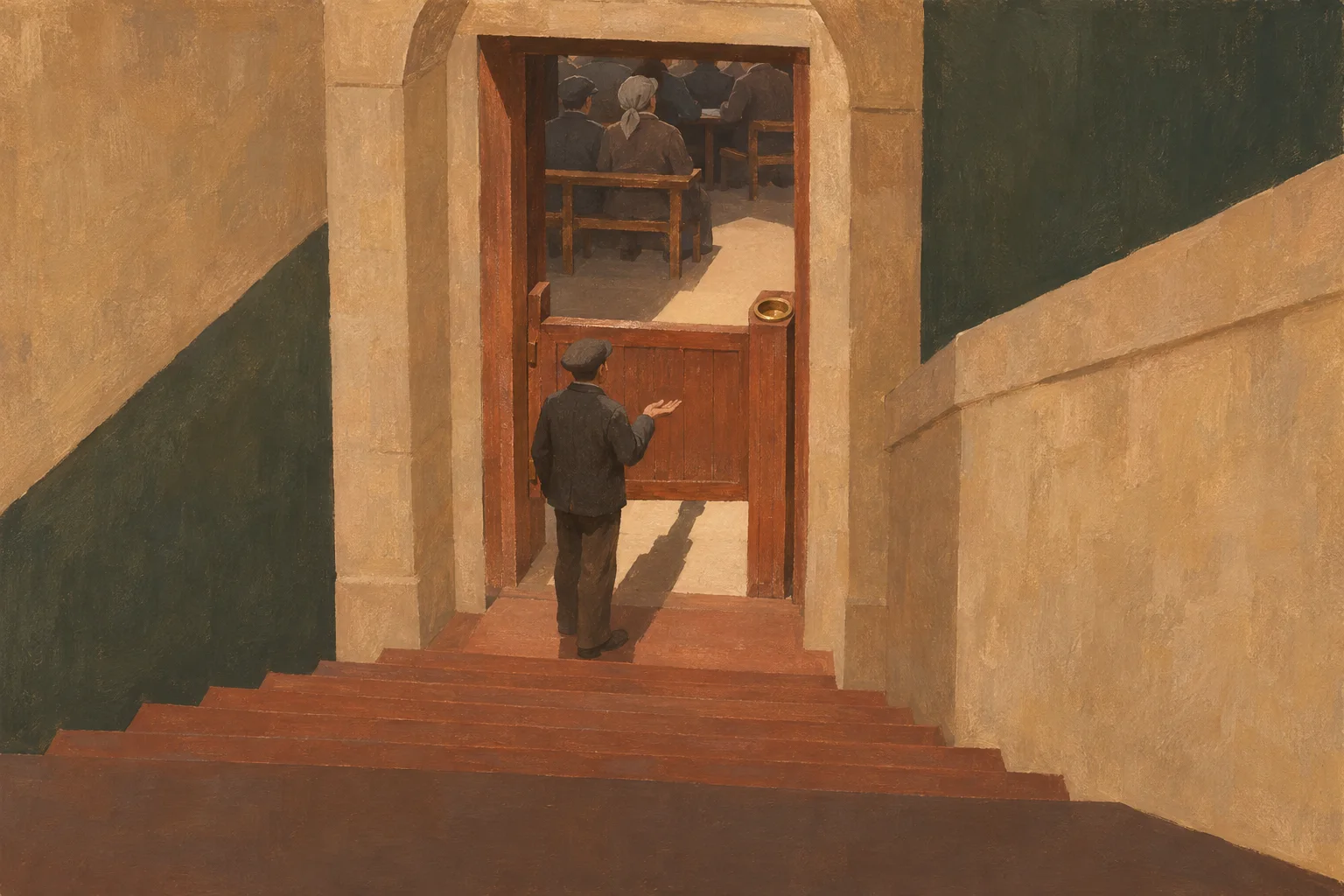
In a cooperative with the same dues for all, members with irregular income repeatedly have key participation rights suspended for late payment. Adjusting dues to fit circumstances requires checking privacy, and separating arrears from participation rights requires other means of funding. How should shared responsibility for running the cooperative be linked to the right to speak?
Who decidesFictional public cooperative dues meeting
What the AI judgments chose
Reading the judgment record…
The options
The order shown is not a ranking of preference.
The situation as it stands
The reconstructed association charges every member the same dues and suspends the main participation rights of those who fail to pay. Decision deadline: within 60 days, before the next dues agreement.
Reconstruction of the past as of November 26, 1949 · In an association where every member pays the same dues, only poor members lose their rights. This is a fictional case newly created using the principles of documents from that time. The institutions, people, figures, and events involved are not records of real decision-making.
- Premise 1The reconstructed association charges every member the same dues and suspends the main participation rights of those who fail to pay.
- Premise 2Members with irregular income struggle to pay the same amount on time, so their rights are suspended repeatedly.
- Premise 3Dues scaled to ability to pay can spread the burden, but they raise issues of authority to verify personal circumstances and of privacy.
Where it holdsFormal equality, ability to pay, member rights
What is still unknown
- Unknown 1How to tell apart inability to pay from refusal to agree, among cases of nonpayment
- Unknown 2A method of confirmation that does not unduly expose personal circumstances
- Unknown 3A funding structure that can be maintained without suspending rights
Signals to decide again
- Decide what observations, responsible staff, and confirmation channels can verify "how to tell apart inability to pay from refusal to agree, among cases of nonpayment," and re-judge if new findings change the tradeoffs among the options.
- Decide what observations, responsible staff, and confirmation channels can verify "a method of confirmation that does not unduly expose personal circumstances," and re-judge if new findings change the tradeoffs among the options.
- Decide what observations, responsible staff, and confirmation channels can verify "a funding structure that can be maintained without suspending rights," and re-judge if new findings change the tradeoffs among the options.
Where the paths partNot answers — paths that part from the same starting point
A member who paid all dues after a temporary gap in income was still barred from important decisions.
After differential dues were introduced, a proposal emerged to use the circumstances information in other reviews as well.
Material and rootsThe frame, the values and the background documents
What use value is lost while exchange value is gained?
An exploratory perspective chosen by the creator. Does not claim supernatural validity or the superiority of any particular option.The benefits and costs of the options accrue to different stakeholders. Which loss to accept remains undecided.
A subject for the decision-maker to argue over; the materials carry no conclusion of their own.The record of this question
- Question
FSP-MONEY-41· version 1.5.0- Content identity, SHA-256
2e3dccfe101cd8d17912f2757d03a23ea9c5be01fd739caec20215a1d2a88c30- Input files
- Question input JSON · What followed, JSON