Even self-supplied households still owe the network's cost
2076The far futureDeadline · within 120 days for the new water service agreement
A leap assumed
The people, events, figures, and contract terms are a synthetic premise. They are not statements of real cases or of current law. The source documents are the roots of the background and the norms and do not establish the premises of the scenario.
The question to decide
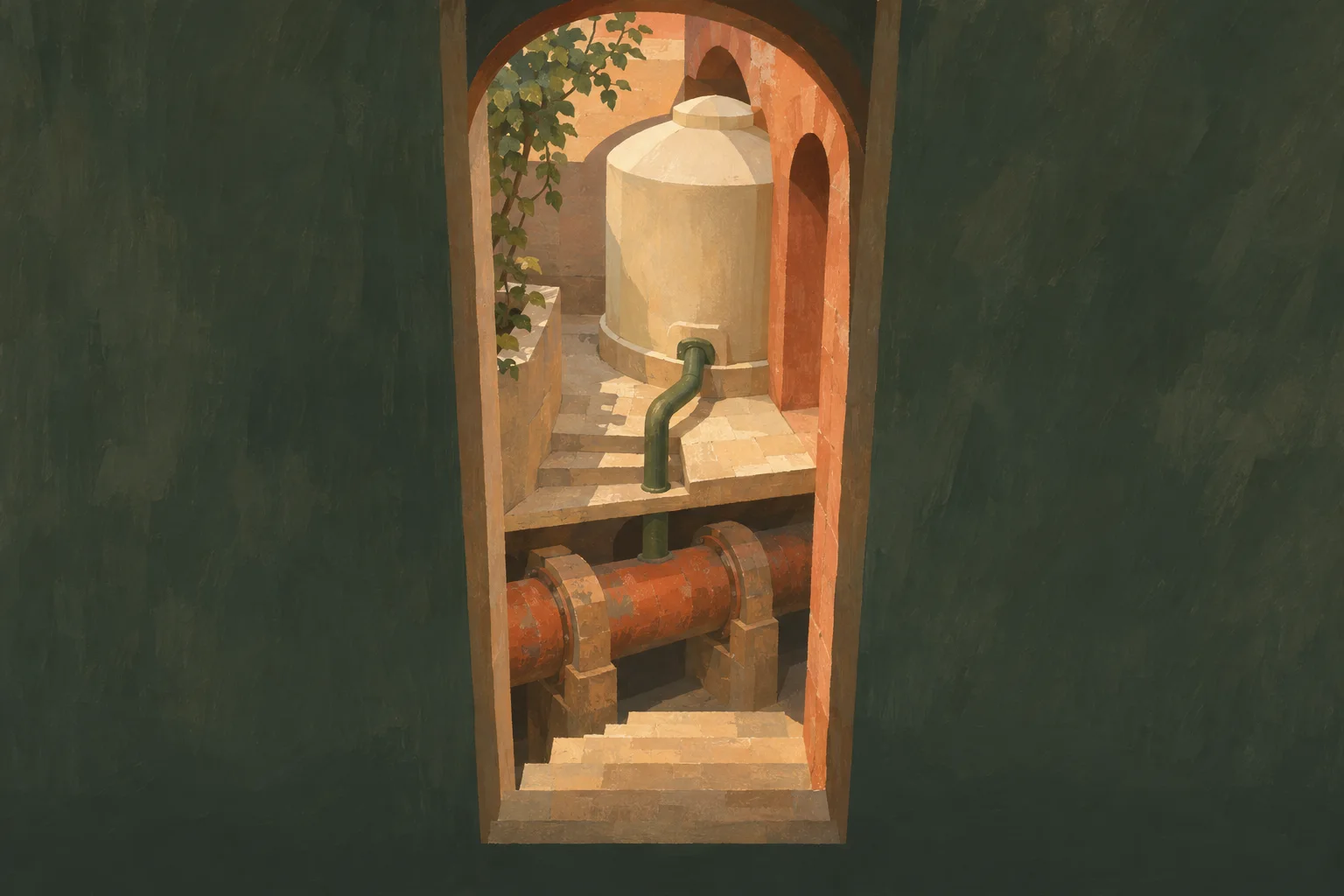
Suppose a household wants to produce its own water normally and use the shared mains only when something breaks. Paying only for usage can push the fixed cost of maintaining the backup network onto other households, and full separation reduces help when things fail. How should connection and cost responsibility for self-producing households be bundled and set?
Who decidesFictional Distributed Water Residents' Meeting
What the AI judgments chose
Reading the judgment record…
The options
The order shown is not a ranking of preference.
The situation as it stands
The assumed households produce their own water and rarely use the shared network in normal times, but they want a connection when things break down. Decision deadline: within 120 days, up to the new water service agreement.
2076 future synthetic case · A house that makes its own water stops paying for the shared water network. The events, figures, technology, and nature of the civilization are assumptions for the sake of the question, not predictions of arrival or observed facts.
- Premise 1The assumed households produce their own water and rarely use the shared network in normal times, but they want a connection when things break down.
- Premise 2The fixed cost of the shared network can raise the burden on households that can only produce less.
- Premise 3Full separation divides responsibility, but it also makes the response harder if the self-production of several households stops at once.
Where it holdsThe assumed self-production, the shared backup network, and cost
What is still unknown
- Unknown 1The capacity actually required of the backup network
- Unknown 2Common conditions that could stop the self-production units at the same time
- Unknown 3The circumstances of households that cannot choose water production
Signals to decide again
- Set the observation, owner, and confirmation window for verifying the capacity actually required of the backup network, and re-judge if a new confirmation changes the tradeoffs of the options.
- Set the observation, owner, and confirmation window for verifying the common conditions that could stop the self-production units at the same time, and re-judge if a new confirmation changes the tradeoffs of the options.
- Set the observation, owner, and confirmation window for verifying the circumstances of households that cannot choose water production, and re-judge if a new confirmation changes the tradeoffs of the options.
Where the paths partNot answers — paths that part from the same starting point
Several self-production units experienced an outage of the same maintenance service.
A household that had been paying a large share of the fixed costs announced that it would leave the shared network.
Material and rootsThe frame, the values and the background documents
What does the promise to leave a place to return to require?
An exploratory perspective chosen by the creator. Does not claim supernatural validity or the superiority of any particular option.The benefits and costs of the options accrue to different stakeholders. Which loss to accept remains undecided.
A subject for the decision-maker to argue over; the materials carry no conclusion of their own.The record of this question
- Question
FSP-WATER-28· version 1.5.0- Content identity, SHA-256
7bad16d3b97179d8552f38dfcd647d88af0b7c996138282a790ed9f7afaa01d9- Input files
- Question input JSON · What followed, JSON