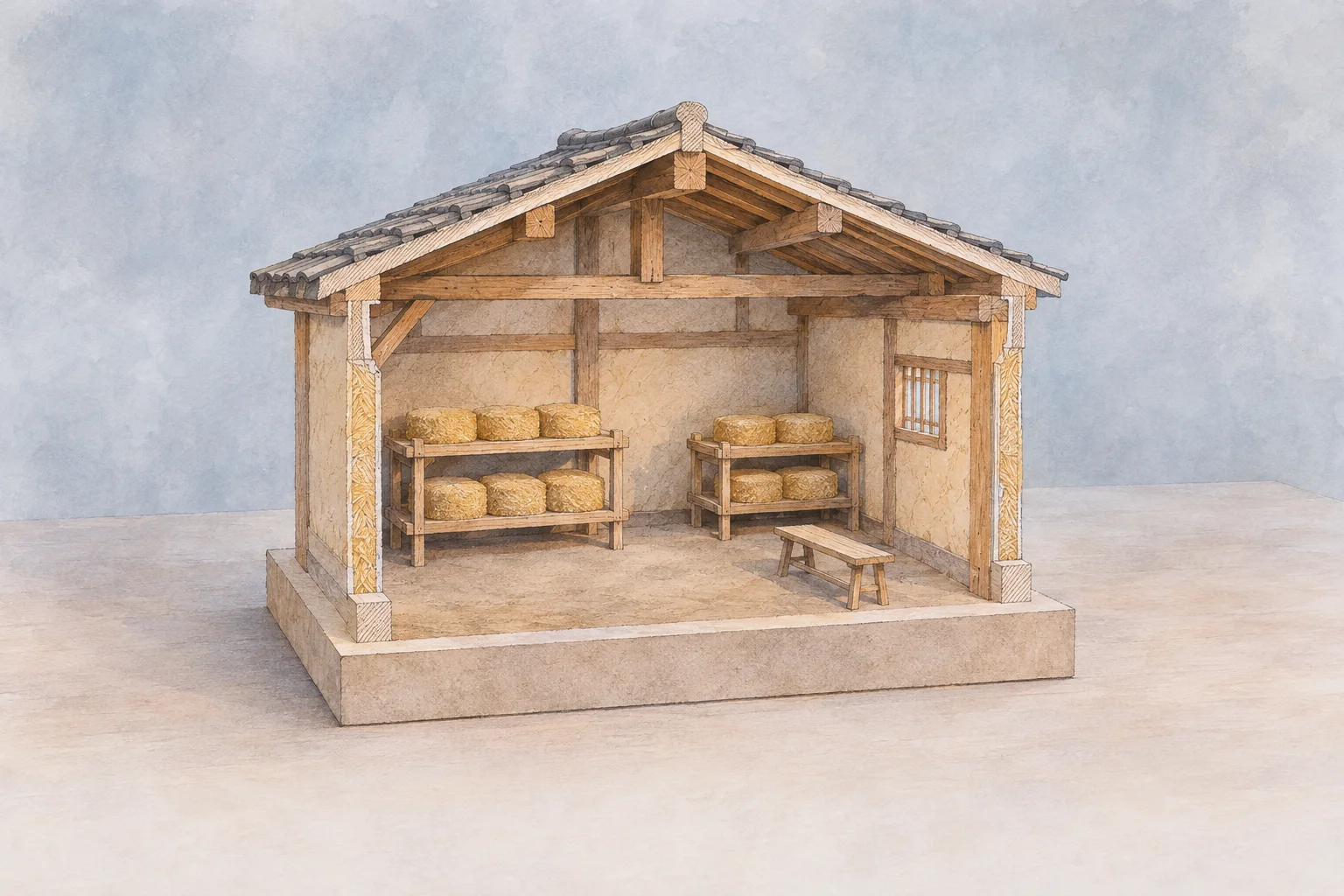
The scenes read in this chapter are synthetic. GAEKJU wrote them for comparison, and none is testimony from a pit, a farm, a factory, a canteen or a control room. The chapter treats them as reasoning about a measure, the counting of talk by its words, and it reads them for what they declare about their own making. It argues, against the background of the debate on thought experiments and vignettes, that the scenes are most careful where they say what they changed and least careful where they judge the ending they wrote.
1.1Data and method
GAEKJU's public library held 496 questions when this study fetched it, every record read one by one through the studio's public interface on 2026-10-06. The library sorts them into three kinds: 40 record readings, 51 outside cases and 405 synthetic scenes. It also sorts them into seven kinds of talk, idle talk being one, and each question carries one of three axes: domain, performance or era. GAEKJU's own description of the synthetic kind, in its English, is that synthetic scenes are written for comparison and are not testimony from those trades.
The selection follows one rule with one exclusion. The rule is every synthetic scene of the kind of talk GAEKJU calls idle talk. Before any reading, a script left out every synthetic scene whose evidence or readings refer to the figures of a source record. The exclusion is strict, and it removes most of the synthetic kind: 358 of the 405 scenes are left out and 47 remain. Of the 58 synthetic scenes of idle talk, 11 remain, and these eleven are the cases of this study. Nine ask the domain question, one the era question and one the performance question. Their settings run from a coal face in the 1980s to a railway control room supposed for 2030.
The exclusion does not remove every sentence that refers to a source record. This study quotes no sentence about a source record and repeats nothing of what such sentences say. It reads the scenes for how they are built, and the appendix leaves the same sentences out.
Each scene has the same parts. A setting and an era; a short paragraph of scene; a few lines of talk between named roles, a foreman, a newcomer, an interpreter; a list of terms; the evidence, which says what changes in the new setting and what the scene leaves unanswered; three readings, a lean towards one of them, a judgment that ends with the basis date 2026-09-25; a counter-condition that would show the judgment or a reading wrong; and a proposal. None of the eleven cites a published study.
Two forms of scene stand among the eleven, and the difference becomes important in section 1.3. Three scenes are short: their evidence opens with the label "Synthetic:", their readings are one sentence each, and their talk is two lines. Eight are long, with three or four lines of talk and readings of two or three sentences. A script counted the Korean words: the evidence of the short form averages 27 words and that of the long form 48; the three readings together average 18 words in the short form and 59 in the long.
The records are Korean. This study translated each one into English sentence by sentence, without additions, and each translated record carries the hash of the Korean original; the quotations are this translation. All counts in this paper come from a script that reads only the saved records and writes them into a numbers file kept with the study. GAEKJU's series repeats certain parts in every scene: three readings, a lean, a basis date, a counter-condition. These slots are the studio's form, and their presence in a scene is not a finding. A test of repeated five-word runs found no field of the eleven scenes formulaic against the synthetic kind, but runs of Korean words repeat less than English ones, since particles attach to words, so the test reads low. The study reads each scene's own sentences, not the slots. The note on Dancy's paper was read from the abstract of a reprint.
1.2What the scene says it changed
The strongest feature of the scenes is that each one says, in its own evidence, what it did to idle talk by moving it. Each scene named below is synthetic. A thought experiment, on Gendler's definition in Thought Experiments (2006), reasons about an imaginary scenario to confirm or disconfirm a hypothesis. The scenes do something narrower and more transparent. They name the condition that the new setting adds, the thing it takes away, and the question they will not answer. That makes each scene a controlled variation, of the kind Atzmüller and Steiner, in Experimental Vignette Studies in Survey Research (2010), describe when they vary the characteristics of a vignette level by level. The difference is that GAEKJU varies the setting, not for a respondent to judge, but to see what a way of counting would do with it.
The blasting shelter shows the method most plainly. A limestone working in the 2000s; workers wait in a concrete room for the midday blast; the foreman tells the same joke each time before he presses the switch. The scene names its new condition in one sentence and draws the consequence in the next:
What changes here is that the time at which danger comes is fixed. So the joke is placed not at any time but always at the same point in the order, and hardens like a ritual.
The variation is a single one, a danger with a timetable, and the scene follows it to a single result: talk that comes at a fixed point becomes a ritual. The scene then marks what it has not done:
Comparing it with blasts on days without the joke is homework this scene leaves.
This is the move Norton's question asks for. Where does the information in this scene come from? Not from any pit. It comes from the writer's choice of one condition and from what follows from that condition by reasoning. The scene does not claim that miners joke before blasts; it claims that if danger comes on a timetable, talk tied to it will behave like a ritual, and it declares the comparison it did not make.
The inspection bench varies a different condition: not when the talk comes but what it rests. Inspectors look all day through magnifiers for point defects; once an hour the leader tells them to lift their heads and asks about lunch. The evidence says:
What changes here is that what idle talk rests is the eyes more than the mind.
One of the three readings then turns this into a statement about counting, and it is the reading the scene leans to:
Which part of the body is rested differs by trade.
The judgment draws the conclusion in terms of the measure, not the inspectors:
If idle talk is counted only by the amount of words, the rest in such a workplace drops out entirely.
Here the scene shows what Gendler, in Galileo and the Indispensability of Scientific Thought Experiment (1998), credits to reasoning about particulars. A general statement that some idle talk serves rest would pass unnoticed. The particular, a leader's question about lunch, timed to give the eyes twenty seconds of distance, makes the gap in the measure visible: a count of words would score the most needed pause as the most pointless talk. Its evidence keeps the premise in view: a rise in detection after the pause is only the scene's assumption.
The calving night pushes the variation to the edge of the concept. A cow is in labour; the barn supervisor talks to her without stopping, and a second-year helper notices that the talk carries the time the waters broke and the way the feet are coming. The scene's question is whether this is idle talk at all, and its evidence names what the move takes away:
What disappears is the pair of a speaker and a listener.
A count of conversation needs two parties. Remove one, and the talk falls outside the measure while still doing work. The judgment says so as a warning about reading, not about barns:
Reading a workplace where much talk is not caught in records as a workplace of little talk is wrong.
The coal face does the same with the eye. In the 1980s, in a pit lit by a few safety lamps, the foreman calls each man by name with a joke at lunch and listens to the answer. The evidence again names the condition and stops at a stated point:
What changes inside the pit is the condition that it is hard to check on one another by eye. So the speed and voice of the reply to a joke become information telling a person's state. Leaving open whether gas or a headache was actually confirmed after that, it moved only as far as the slowness of a reply becoming a signal.
The words "only as far as" are the scene's own limit. It claims that in the dark a reply's speed can carry information; it does not claim that the joke caught a case of gas. The phrase is rare in the eleven; the coal face is the only one whose evidence uses it. But the habit it names is common. Ten of the eleven scenes say in their evidence what they do not answer, observe or measure, eight say what is lost or out of reach in the move, and seven name what changes. The set-up site is the only one to say that a condition, that of two languages, was newly added.
The other scenes vary other conditions. In the biosecure canteen, a pig farm where no one can leave the inner zone without a shower, the condition is that there is only one place to eat:
What changes at the pig farm is that one cannot choose a place.
In the nuruk room, a dark room where the songs of the night mark when to turn the fermenting starter, the condition is that talk becomes a clock, and the scene says what it took on trust:
Whether the intervals measured by song are as even as a clock, this scene left as an assumption.
The drivers' canteen sets competitors at one table, and the strawberry photo, a short scene, gives a photo that carries an observation of the field. In each the scene adds a condition and says that the condition is its own.
Read together, these scenes make a single kind of claim. They do not say what happens in mines or barns. They say that the work idle talk does depends on conditions a count of words cannot see: when danger comes, which part of the body tires, whether there is a listener, whether there is light, whether there is a second room. This is the contribution of the scenes to the debate as this study reads it. Dancy, in The Role of Imaginary Cases in Ethics (1985), allows an imaginary case to reveal the importance that certain features can have in a real case, and no more. GAEKJU's scenes keep to roughly that measure in their evidence. They reveal features that can matter, a fixed time of danger, a listener who cannot answer, and they decline in so many words to say what the features did. The finding is about the measure: where the counting of talk stops seeing.
The scenes also differ from the vignette as the methodological literature describes it. Aguinis and Bradley, in Best Practice Recommendations for Designing and Implementing Experimental Vignette Methodology Studies (2014), present carefully constructed, realistic scenarios as enhancing experimental realism for the participants who read them. GAEKJU's scenes are realistic in detail, a pork cutlet, a pager, a blackboard on a wall, but there is no respondent whose answer realism could improve. The realism serves the writer's own reasoning. That is a strength in the evidence, where the details carry the varied condition. Section 1.3 argues that it is a weakness in the judgment, where the same writer reads what the details were made to show.
1.3The ending the writer wrote
The scenes below are synthetic too, and what happens in them happened only in the writing. Each long scene ends its talk with a small event, and its judgment then reports that event as something that happened. This is the point at which the scenes stop being careful thought experiments and become stories that confirm themselves.
The set-up site shows the pattern clearly. In the mid-1990s two foreign engineers and a Korean team install semiconductor equipment with an interpreter for only a few hours a day; they clash twice over when to run the vacuum test. The set-up engineer asks the interpreter to ask about something other than work. The talk the scene supplies gives the answer at once:
He says they are. His family packed them for him, and he wanted to share them before he flies back on Friday. And before that he has to finish his part of the vacuum test too.
So that's why he kept asking to do the test first. We'll do the wiring first tonight. Call it payment for the biscuits.
The judgment then tells this as a result:
Why he hurried the vacuum test came out only at the end of talk about biscuits, and once the reason was known, the dispute over the order turned into dividing the work.
Nothing in the judgment goes beyond the talk. The reason came out because the writer had the interpreter say it; the dispute turned into a division of work because the writer had the engineer offer the wiring. The judgment reads the scene's ending as evidence for the reading the scene leans to, that what hardened first was the way the two sides read each other. In Norton's terms, the information in that judgment has a plain source, and it is the author. The scene cannot surprise its own judge.
The same shape recurs. All eight long scenes give their judgments in the past tense of the scene's own events. In the drivers' canteen the judgment reports a decision that the second driver made in the talk:
When the driver of fifteen years put out the construction section first, the driver of two years set his direction so as not to overlap.
In the nuruk room it reports a second-year's skill:
That the second-year linked the length of the story to the heat of the corner means that the clock had been learned in the body.
In the coal-face lunch it reports a rescue in motion:
A single slow, short reply moved the foreman, and the lead miner backed him up at once with the detector.
Each judgment is true of the scene and of nothing else. The reading leaned to is supported by an event the scene's own talk supplies; the other two readings stand beside it, but the talk gives them no event of their own. Gendler's argument in Galileo and the Indispensability of Scientific Thought Experiment (1998) is that reasoning about particulars can justify a conclusion the bare argument would not. This study reads that argument as having a condition the long scenes do not meet: the particulars must constrain the reasoner, and here the reasoner chose them. A scene in which the biscuit talk had revealed nothing, or the driver of two years had ignored the advice, was equally easy to write. That is the difference between the long scenes' evidence, which names what the writer added, and their judgments, which treat what the writer added as found.
The vignette literature names the same risk from another side. Hughes and Huby, in The Application of Vignettes in Social and Nursing Research (2002), begin their review with the difference between vignettes and real-life processes, and Jenkins and colleagues, in Putting It in Context: The Use of Vignettes in Qualitative Interviewing (2010), point to the different things that matter to someone weighing a scenario and to someone acting in a situation. In a survey, that difference sits between the vignette and the respondent's life. In GAEKJU's long scenes there is no respondent; the difference sits inside the record, between the evidence that admits the scene is written and the judgment that reads it as though it were observed.
The three short scenes answer the problem in their own way. Their judgments stop at the edge of the scene. The strawberry photo, in which a harvest worker spots an odd leaf in the corner of a boastful photo, says:
Whether it is really a sign of disease must be checked in the field, and from this scene alone no rise in productivity can be claimed.
The control room supposed for 2030, where a senior controller's greeting leads a newcomer to admit he does not understand a mark in an automatic document, says:
Even though a question came after the greeting, the greeting alone cannot guarantee the newcomer's understanding.
And the dough room, in which a joke about biscuits reminds a worker of a packaging change, keeps the possibility open without cashing it:
This scene, without converting idle talk straight into performance, leaves the possibility that a colleague's words found something to check.
These are the only three judgments among the eleven that say what cannot be claimed or leave a possibility open, and they are the three short scenes. The short form pays for its caution in other ways. Its talk is two lines, its readings one sentence each, and its counter-conditions say what would turn the judgment without saying where that could be seen. The strawberry photo's counter is a condition and nothing more. The long form gives more to read and more to check, and also more to believe too quickly. This study does not rank the forms. It notes that in the eleven, the form with the fuller scene is the form whose judgment is least guarded.
The counter-conditions are where both forms point outside themselves, and here the long scenes recover much of their care. Eight of the eleven counters name a log, a record, a roster, a schedule or a notebook from the setting against which the reading could be checked. The blasting shelter names the records of the blasts:
It is checked by gathering the misfire and delay entries of the blasting log together with the accounts of the people who were in the shelter.
The inspection bench names hourly figures:
It is checked by comparing the hourly detection records of each inspection bench.
The coal face names the colliery's safety log, and states plainly what result in it would make the scene's reading an exaggeration:
If in this mine's safety log of the same period bodily trouble showed up mostly not at lunch-box time but first in gas measurements during work, the reading that the joke served as a roll call is an exaggeration.
These counters are the scenes' most honest gesture and their strangest. The blasting log, the detection records and the safety log do not exist; the pit, the factory and the colliery are written. The counters describe where a test of the reading would have to be made if the scene were a place, and so they mark, without saying it, that the scene is not the place. Read, as this study reads them, through the trade-off Aguinis and Bradley describe, the scenes keep the control of the written scenario and say where the field would have to be consulted. Read through Dancy, the counters move from the importance a feature can have to the importance it did have, and they hand that second question to a record the scene cannot hold. The blasting shelter alone also asks for the accounts of the people who were there.
The proposals complete the pattern. Every one of the eleven moves time, a place or a task: it brings an explanation forward to the first day, fixes the pause for the eyes in the inspection sheet, shares the night's notes between two people, gives the canteen a second, quiet room. Six of the eleven scenes speak, in their readings, judgment or proposal, of a load that rests on one person. The coal face says it of the foreman's ear:
But this roll call was written in no procedure and rested on one person's ear.
and proposes to spread it:
Share out the check of voices at lunch-box time as a calling of one another in pairs. Even on days the foreman is worn out, there remain ears to hear the replies.
The proposals are GAEKJU's, written for scenes that GAEKJU wrote; this study reads them as part of the scenes' design, not as advice for any pit, farm or factory, and it takes no view on whether they would help. What they show about the form is consistent with the rest. The scenes find that idle talk, in each written setting, carries something a count of words misses, and the proposals answer by moving that something into a slot a schedule or a sheet can hold. The scenes never propose to listen to the talk itself.
The chapter's argument, then, has two halves. In what they declare, GAEKJU's scenes are careful thought experiments in Dancy's modest sense: they vary one condition, say what they added and what they cannot answer, and reveal features that can matter to the work talk does. In what they judge, the long scenes read their own invented endings as results, and only the short scenes refuse. The counters then hand every test to records that a written scene cannot contain.