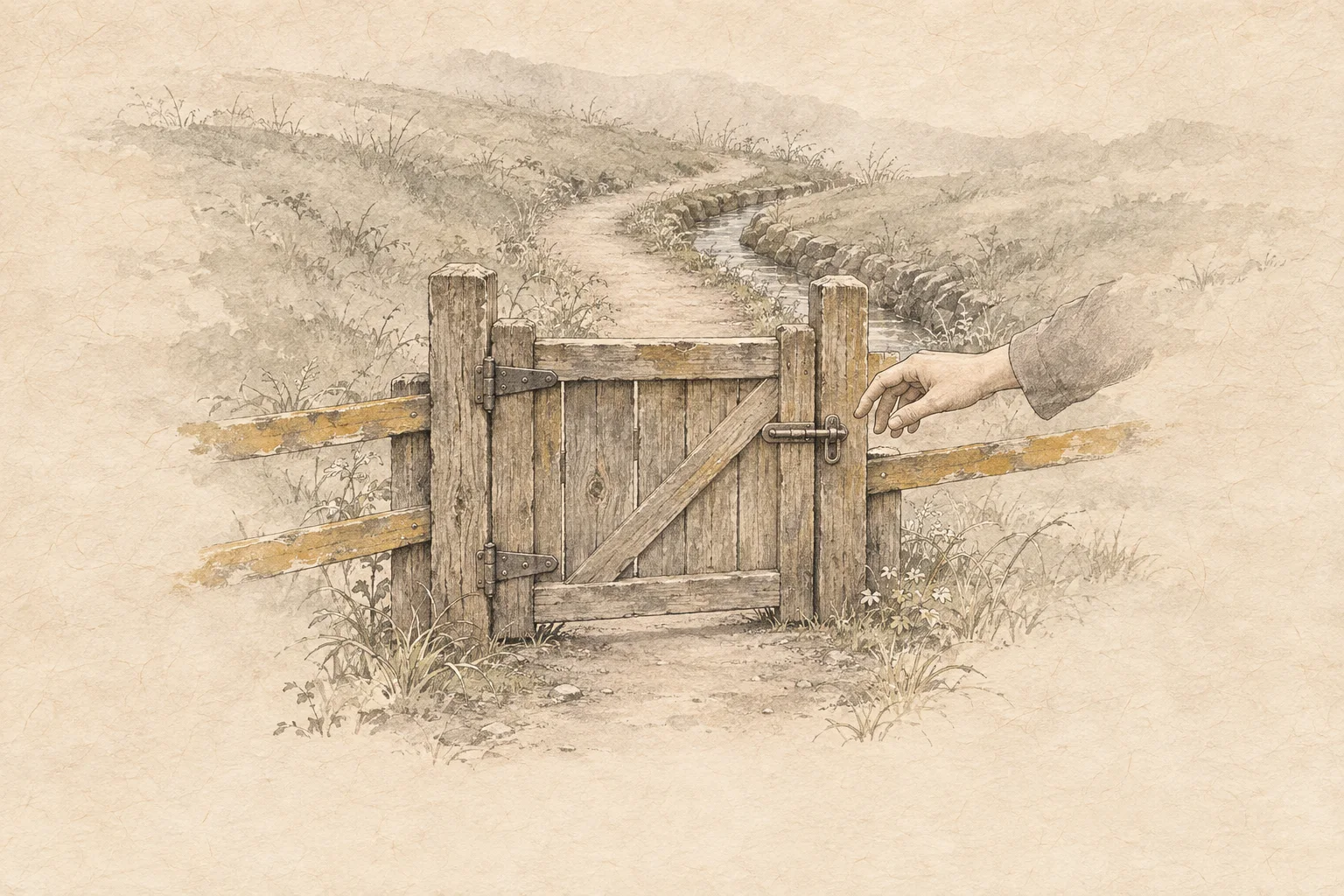
The intellectual-historical claim of this section is that Chesterton's parable, read in full, is not a rule of preservation. It places a burden of knowledge on whoever would remove an institution, names the findings that would discharge it, and in the same paragraph licenses departure from a convention by those who know why it exists. The section adds to the debate of Section 2.1 and 2.2 a reading of the maxim that its defenders and critics both shorten: the parable demands knowledge, not deference, and its own text points to the cases, purposes "no longer served", where the bureaucracy literature begins. It then reads the Purchase-Page Image, a synthetic scene in which a prohibition stands without a stated reason, and shows that the platform's reading moves the question from the fence's reason to the fence's scope and to who may move it.
4.1The paradox and its two reformers
The essay opens by distinguishing kinds of reform and then introduces the fence:
In the matter of reforming things, as distinct from deforming them, there is one plain and simple principle; a principle which will probably be called a paradox. There exists in such a case a certain institution or law; let us say, for the sake of simplicity, a fence or gate erected across a road. The more modern type of reformer goes gaily up to it and says, “I don’t see the use of this; let us clear it away.” To which the more intelligent type of reformer will do well to answer: “If you don’t see the use of it, I certainly won’t let you clear it away. Go away and think. Then, when you can come back and tell me that you do see the use of it, I may allow you to destroy it.”
Three features of this opening are lost when it is shortened to a maxim. First, both speakers are reformers. The parable is not a dialogue between a reformer and a conservative but between two kinds of reformer, the one who goes "gaily" up to the fence and the "more intelligent" one. The intelligent reformer is not against change. Second, the fence is an example chosen "for the sake of simplicity" of "a certain institution or law". The essay is about institutions; the fence is a figure. Third, and most often dropped, the intelligent reformer's last sentence ends in permission: "I may allow you to destroy it." The condition for removal is not that the fence be useless; it is that the remover know its use. A reformer who comes back understanding the fence may still destroy it.
The parable therefore sets a condition on the remover, not on the fence. It says nothing, in this paragraph, about what to do if the use cannot be found.
4.2Why the fence is presumed to have a reason
The second paragraph gives the ground of the presumption:
This paradox rests on the most elementary common sense. The gate or fence did not grow there. It was not set up by somnambulists who built it in their sleep. It is highly improbable that it was put there by escaped lunatics who were for some reason loose in the street. Some person had some reason for thinking it would be a good thing for somebody. And until we know what the reason was, we really cannot judge whether the reason was reasonable. It is extremely probable that we have overlooked some whole aspect of the question, if something set up by human beings like ourselves seems to be entirely meaningless and mysterious.
The argument is an inference from the fence's making to its having a reason. The sentence at its centre is carefully hedged: "Some person had some reason for thinking it would be a good thing for somebody." Each noun is indefinite. The person is unnamed, the reason unstated, the beneficiary unspecified. It does not claim that the reason was a good one, that it still holds, or that the somebody it served is anyone now present.
Chesterton's "somebody" is the person whose safeguard the fence was. Kaufman's question, whose protection cutting a rule drops (Kaufman 1977), is the same question asked in the present tense; the parable asks it in the past. Pierson marks the gap between the tenses: the reasons an institution was made need not be the reasons it lasts (Pierson 2004). Chesterton's inference secures a reason for the building; it does not secure one for the standing.
4.3The three findings that license removal
The paragraph then turns from presumption to verdict:
There are reformers who get over this difficulty by assuming that all their fathers were fools; but if that be so, we can only say that folly appears to be a hereditary disease. But the truth is that nobody has any business to destroy a social institution until he has really seen it as an historical institution. If he knows how it arose, and what purposes it was supposed to serve, he may really be able to say that they were bad purposes, or that they have since become bad purposes, or that they are purposes which are no longer served. But if he simply stares at the thing as a senseless monstrosity that has somehow sprung up in his path, it is he and not the traditionalist who is suffering from an illusion. We might even say that he is seeing things in a nightmare.
Here the parable names, in one sentence, three findings that would let a reformer say the fence should go: the purposes "were bad purposes", they "have since become bad purposes", or they "are purposes which are no longer served". This sentence is the parable's bridge to the literature it is usually set against.
The first finding is a rule that was wrong from the start. Bozeman's rule-inception red tape, a rule dysfunctional from the start, is its counterpart (Bozeman 2000). The second is a rule that became wrong as the world changed, the counterpart of rule-evolved red tape. The third is the case Merton describes, rules kept as ends after they have stopped serving their purpose (Merton 1940). Chesterton does not develop the third finding, but the sentence concedes much of the critics' ground: it says that a fence can be seen "as an historical institution" and still be found wanting.
What the sentence requires is history: "how it arose, and what purposes it was supposed to serve". It refuses the reformer's shortcut, the assumption "that all their fathers were fools", but it assumes that the history can be had. A reformer who goes away and thinks, and comes back still not knowing, has not been given a rule.
4.4The exception licensed by knowledge
The paragraph's last movement is the one most often omitted, and it bears directly on this article's pairing:
This principle applies to a thousand things, to trifles as well as true institutions, to convention as well as to conviction. It was exactly the sort of person, like Joan of Arc, who did know why women wore skirts, who was most justified in not wearing one; it was exactly the sort of person, like St. Francis, who did sympathize with the feast and the fireside, who was most entitled to become a beggar on the open road. And when, in the general emancipation of modern society, the Duchess says she does not see why she shouldn’t play leapfrog, or the Dean declares that he sees no valid canonical reason why he should not stand on his head, we may say to these persons with patient benevolence: “Defer, therefore, the operation you contemplate until you have realized by ripe reflection what principle or prejudice you are violating. Then play leapfrog and stand on your head and the Lord be with you.”
Two things happen here. The scope widens: the principle applies "to trifles as well as true institutions, to convention as well as to conviction". And the subject changes from removing a convention to departing from it. Joan of Arc does not abolish skirts; the Duchess does not repeal the rule against leapfrog; she plays. These are exceptions, not repeals.
The licence for the exception is the same as the licence for removal: knowledge. The person "who did know why women wore skirts" is "most justified in not wearing one". The Dean and the Duchess are told to defer until they have "realized by ripe reflection what principle or prejudice you are violating", and then to go ahead: "Then play leapfrog and stand on your head and the Lord be with you." The word "violating" matters: knowledge does not dissolve the rule; the informed Duchess still violates it, knowingly.
The parable thus holds, in a single paragraph, both halves of this article's question, and answers both the same way. The cost of removing a rule whose reason is unknown is the risk of having overlooked "some whole aspect of the question". The cost of breaking a rule is the same risk, and the same condition discharges it. What the parable does not say is who bears the cost when the knowledge is missing, or what happens when the one who wants to depart from the rule is not the one who knows its reason. Its examples are all persons acting on themselves: a saint, a duchess, a dean. None of them breaks a rule that someone else must answer for.
4.5The record: a prohibition and a request
The Purchase-Page Image is a synthetic scene. Its record is a single sentence:
An explanation appeared stating that images must not be changed at will, followed by a request to replace the purchase-page main image with a newly produced image.
In the Korean original:
이미지는 임의 변경하면 안 된다는 설명이 나온 가운데 새로 작업한 이미지로 구매단 메인도 교체해 달라는 요청이 이어졌다.
Two details of the Korean are worth marking; the glosses are this article's. The connective 가운데 says that the request came while the explanation stood, in its midst, rather than strictly after it. The particle 도 in 메인도 can be read as marking the main image as one more item to replace, and on that reading other images may already have been in the course of replacement. The English translation renders neither detail. This is this article's reading of one particle; the scene says nothing more about other images, and the article rests no argument on it.
The record does not say why images must not be changed at will. It does not say who gave the explanation, who made the request, or whether the request came from the same quarter as the prohibition. It does not set a deadline. It is, in Chesterton's terms, a fence across the road and a person asking to go through it, with no account of how the fence arose.
The platform assigns two roles to the scene in its readings: an image change approver and a purchase-page production owner. The roles are the platform's; the record names no one.
4.6The platform's question, reading and options
The record-inspired lens asks:
What approval must a request to change a purchase-page image under a prohibition on arbitrary changes include?
Its structural reading is:
who can change the sales screen is at stake even in requests that revise presentation
Neither asks why the prohibition exists. The question is about the form a legitimate request must take, and the reading is about authority. Where Chesterton's intelligent reformer says "Go away and think" about the fence's use, the platform says, in effect, go and find out who may move it. The fence's reason drops out; its owner comes in.
The lens's three options show the same turn. The first:
specify the replacement target and approval scope
Do not pass the uncertainty over the scope of the change prohibition and the approval status of this request on as a confirmed fact in the next step.
A confirmation wait may arise for the purchase-page production owner, so it must be set who answers and when.
The second option is to "Keep the existing image and present the replacement option first"; its risk is that the approver and the production owner "read different completion states". The third is to "Proceed first with the purchase-page production owner on a small scope and compare the results", with the risk that it "must first be set whether even a small scope can be rolled back".
Set against the parable, the three options correspond to three answers to the reformer who goes gaily up to the fence. The first is Chesterton's: do not go through until the facts are known. Its risk is one the parable does not mention: while the facts are being found, someone waits, and the record names who. The second keeps the fence and puts the alternative beside it, a course the parable does not consider. The third resembles the Duchess's leapfrog, a small departure to see what happens, and its risk is the one the Duchess does not face: a departure on someone else's sales screen may not be undoable.
In each option the unknown is not the fence's reason but its scope: "the scope of the change prohibition and the approval status of this request". The lens records this as what is missing:
scope of the change prohibition and the approval status of this request
4.7The judgment: authority and responsibility together
The judgment of the record-inspired lens reads in full:
The purchase-page image is an expression used to sell products, but it is not treated as a file that anyone can change. When a producer who has received a prohibition instruction receives a new replacement request, the producer must be able to ask again about the target and the approval scope. It is appropriate to clarify whether this request lifts the existing prohibition, changes only the main image, or also applies to other screens. If the producer decides by reading the situation, an unauthorized change structure is created that only becomes unauthorized when failure occurs. Conversely, requiring approval for each repeat replacement that has already been delegated turns confirmation into a bottleneck. The side that established the criteria must decide which changes it takes on and which changes it reviews again, so that authority and responsibility move together.
The judgment holds both sides of the debate in Section 2. Its first half is on the side of the fence. The image "is not treated as a file that anyone can change"; the producer "must be able to ask again". The sentence about an "unauthorized change structure" that "only becomes unauthorized when failure occurs" names a cost of breaking the fence that falls on the one who breaks it, and falls late: the producer who reads the situation and goes ahead is blameless until something goes wrong, and then is the one who acted without authority.
Its second half is on the other side. The judgment warns that "requiring approval for each repeat replacement that has already been delegated turns confirmation into a bottleneck". This is the burden that Bozeman calls red tape when the rule no longer serves its purpose (Bozeman 2000), and that Merton's officials would keep by treating the rule as its own end (Merton 1940). The judgment does not use the term; it says only that, for work already delegated, confirmation becomes a bottleneck.
The last sentence places the decision with "The side that established the criteria". This puts the burden of saying what the fence covers not on the one who wants to go through it, as Chesterton does, but on the one who built it. Chesterton's reformer must go away and think. In the platform's reading, it is the fence-builder who must say what the fence covers. The demand for knowledge is the same; the person who carries it has changed.
The lens's condition for revisiting is short:
reduce unnecessary re-approval when repeat replacement is already delegated work
It is a condition under which the fence should be narrowed, not removed. It names a kind of work, delegated repeat replacement, for which the prohibition should not demand approval again. In Kaufman's terms, it is a decision about whose protection to keep: the protection of the sales screen against arbitrary change stays; the protection against delegated, repeated change goes (Kaufman 1977).
4.8What differs in the hypothetical lenses
The seven hypothetical lenses follow the template described in Section 3.2 and quoted in Section 5. What differs in the Purchase-Page Image is the missing element they carry, already quoted, and the roles. One question is worth setting down, because it puts the parable's second move, departure, in the scene's terms. The once-only lens asks:
Purchase-page main image that cannot be changed at will — may the verification step be skipped once because it is urgent?
It is the Duchess's question with a deadline added, and asked by someone who does not own the rule. In every hypothetical lens the scene's own condition for revisiting, about delegated repeat replacement, is carried along with the template's condition; that carrying-along is also the template's.
4.9The ledger's reading
Both ledger runs read the scene as showing a restraint from a standing rule or principle, with no reason said in the scene, a removal condition named, and applying it resting with the holder or a third party; whether those who wait can see what it protects, both read as not said. The reading is consistent with what Sections 4.5 to 4.7 found in the words: a fence with no stated reason, a named condition for narrowing it, and that condition in the hands of the side that, in the judgment's words, "established the criteria".
4.10What this section adds
Chesterton's parable, read in full, joins the debate of Section 2 on both sides. It demands history before removal, and it concedes, in its sentence on the three findings, the ground of Merton and Bozeman. It licenses departure from a convention, not only preservation of it, on the same condition of knowledge. Its blind spot is one of persons: all its examples act on themselves. In the Purchase-Page Image, a synthetic scene, the platform's reading keeps the parable's demand for knowledge and moves it onto the fence's owner, and it adds a cost the parable does not count: the wait of the one who must ask, and the late blame of the one who did not.