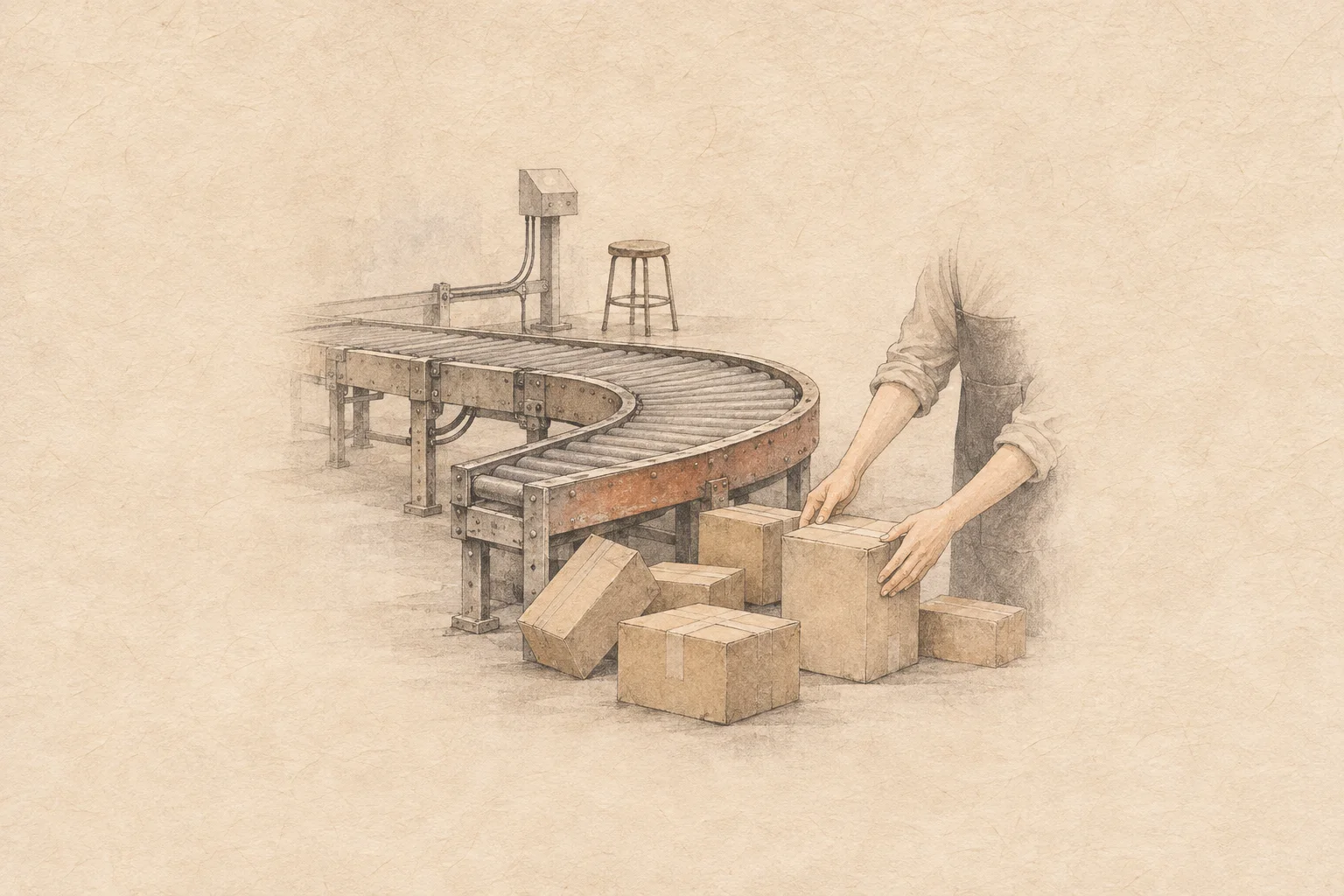
The claim of this section, about a synthetic modern scene and not a historical event, is that ARCHON's record of an order form received automatically but not split presents the situation Weber's passage leaves open: a decision whose responsibility lies somewhere above, an execution carried out by a system, and a person nearest the stop who must explain the delay to the customer without having decided or executed. The platform's readings, which are its own dated interpretations, separate the credit for a decision from the work that follows it, and they refuse, on a stated condition, to call the result a shift of cost. The section adds to the debate between du Gay and Lipsky a figure that neither side, as summarised, names: the person who faces the forum on behalf of a decision that was neither theirs nor executed by them. It is a reading of a modern summary written for a platform and says nothing about any real workplace.
6.1The record
The scene's record is one sentence:
Automatic intake status was created, but with no split order form, exchange dispatch came to a stop.
In the Korean original:
자동 접수 상태는 생겼지만 분리 주문서가 없어 교환 발송이 멈췄다.
The setting is dated 2023. The record does not say who designed the intake, who noticed the stop, how long it lasted, or how many orders were affected. It says three things: a status was created, a document was missing, and a dispatch stopped.
The record names no decider. Across the ledger's 186 cases, the records name a decider in none. This scene is no exception, and it matters for the comparison with Weber. The official's honour requires a commander, "des Befehlenden", to whom responsibility can be handed. In this scene the commander, if there is one, is a design embedded in a system, and the record does not say whose.
6.2The platform's question and its reading
ARCHON's first lens, the one inspired by the record, asks:
If automatic intake was completed but there is no split order form, whose failure does the system's success indicator cover?
Its structural reading, the platform's dated interpretation, is:
The name automatic hides mid-process failures in a normal flow
The question is about covering: a success indicator that is wrong covers a failure, and the question asks whose. The reading answers in terms of a name.
This is close to two of the positions in Section 2.3. Power describes audit as checking systems of control more than the work itself and producing a comfort that may be decoupled from what is done (Power 1997). Meyer and Rowan describe formal structures adopted because they are taken for granted as legitimate and decoupled from the work actually done (Meyer and Rowan 1977). A success indicator that shows intake complete while dispatch has not begun is a small instance of both: a check of the system's state that is not a check of the work, and a sign of completion decoupled from completion. The platform's question then adds what neither summary includes: it asks on whom the failure, once covered, falls.
6.3Three options and their costs
The first lens offers three options; two of them are read here. The first:
Confirm completion through order form creation
Do not carry the uncertainty of the final automated output over to the next step as an established fact.
The agent explaining customer delay may face a waiting period for confirmation, so it must be set who answers and when.
The gain is the refusal to pass an uncertainty on as a fact. The risk is that the agent waits, and the platform at once asks who answers and when.
The second:
Move incomplete intake to the exception list
There is room to divide the parts that can proceed from the parts that are not yet determined.
If the automated process designer and the agent explaining customer delay read different completion states, they fall out of alignment again.
Here the two roles appear together for the first time, and the risk is that they read the state of the work differently. In Weber's terms, the designer stands where the order is made and the agent where its consequences are met.
6.4The judgment
The platform's judgment on the first lens, dated 2026-09-20 and marked as an interpretation open to revision, reads in full:
Automatic intake may succeed, but if split order form creation fails, exchange dispatch will not begin. If an intermediate state is marked as success, the system looks normal, and only the agent explaining customer delay has to explain the delay to the customer. The completion standard must be connected through to the final automated output, and intermediate failures must be exposed in a separate list. However, even when an order form exists, inventory may be missing, so shipping can be delayed, and not all delays can be attributed to the intake logic. The value of automation lies in reducing manual work, but responsibility must not disappear between steps. Who can see the exception is the key.
Three sentences in it bear directly on Weber. The second says that when an intermediate state is marked as success, the system looks normal and only the agent explains the delay to the customer. The Korean has 상담원만, the agent only. The work named is explanation, and it falls on one role. The fifth says that responsibility must not disappear between steps. That is the condition Weber calls rule by officials, seen from below: a chain in which every step is done and no one answers. The fourth sentence is a caution against the platform's own reading: a delay may come from missing inventory, not from the intake logic. The condition for reconsidering the judgment repeats it:
If the cause of the shipping delay is inventory, fixing the intake logic alone will not solve it
The missing element is named:
The final automated output
6.5The agent before the forum
The agent in this scene does not fit either of Weber's figures. The agent did not decide how intake would be marked complete; the record gives that, in the platform's later lenses, to the automated process designer. The agent did not execute the intake; a system did. The agent is the person who stands before the customer and explains. In Bovens's terms, the customer is a forum and the agent is the one who must explain and justify (Bovens 2007). The agent has become the actor in an account for conduct that was neither theirs nor carried out by them.
Weber's pair cannot place this figure. The official executes on another's responsibility; the leader answers for what he does. The agent neither executes the order nor answers for it in Weber's sense of having consequences booked to their action. The agent performs the account. The responsibility may lie with the designer; the explanation, according to the platform's judgment, lies with the agent.
Lipsky's front line is closer, but the summary used here places the costs of front-line discretion on the people served (Lipsky 1980). In this scene the customer bears a delay and the agent bears the work of explaining it. The scene's readings name the second, which Lipsky's summary does not, and name no discretion the agent used: the agent's work is a consequence met at the point of contact.
6.6The cost of rollback: credit above, rework below
The fourth lens, marked hypothetical, sets the condition this article's question needs:
If the person who decided "confirm completion through order form creation" and the person who does the follow-up work are different, what must be recorded together?
Its supposition is stated plainly:
It is assumed that the credit for the decision goes to the automated process designer, while additional explanation and rework go to the agent explaining customer delay.
This is a hypothesis of the platform's, not a report of what happened. It is nonetheless exactly the division Weber's text leaves open, with one change. Weber's transfer moves responsibility upward. The platform's supposition moves credit upward and work downward. The lens keeps the two apart.
The options make the stakes concrete:
Link the decision record to follow-up waiting, rework, and the person in charge
So that the credit and the follow-up cost can be compared in the same choice.
If records turn into a per-person demerit board, the site can hide the cost.
The gain is to put credit and cost in one account. The risk, which is the platform's, is that a record of who bore the cost becomes a demerit board and the site hides the cost. Hood argues that rules and procedures can serve to spread or shift blame (Hood 2011); setting the platform's risk beside that argument, a record of bearers could serve the same end, and that link is drawn here, not by Hood.
The second option is to judge the agent by processing speed alone:
Evaluate only by the processing speed of the agent explaining customer delay
Mixes the workload created by the automated process designer with the site's ability to perform and evaluates them together.
The risk names what Weber's honour passage does not: a workload created above and performed below, and the danger that the two are read as one, so that the work the decision produced is counted against the person who did it.
The judgment on this lens reads:
To see whether a choice was rational, one must look not only at the benefit at the moment of decision but also at who had to work again afterward. The time used by the agent explaining customer delay is not a matter to be treated as a question of personal diligence alone. It is better to put handoff, waiting, and rework into the comparison table for "confirm completion through order form creation" and "move incomplete intake to the exception list," and to connect these to the decision that approved them. Even so, not all delays can be attributed to the fault of the decision-maker. It is necessary to distinguish whether the final automated output could have been confirmed at the time from circumstances that arose anew after the decision.
The first sentence states the article's question as a principle of review: look at who had to work again afterwards. The second refuses to treat the agent's time as a matter of personal diligence, which is the evaluation by speed that the second option risked. The last two sentences set a limit, and the limit is Weber's own. Weber's responsible actor answers for consequences "soweit er sie voraussehen konnte", so far as he could foresee them. The platform's judgment separates what could have been confirmed at the time from circumstances that arose after the decision. The two limits have the same shape: foreseeability bounds the booking of consequences.
The condition for revising this judgment goes further:
If follow-up work arose from changes that could not have been predicted at the time, do not conclude that the decision-maker shifted the cost. If the cause of the shipping delay is inventory, fixing the intake logic alone will not solve it.
The Korean for "shifted the cost" is 비용 전가, and 전가 is the ordinary word for laying a burden on someone else (this article's gloss). It is the same act that Weber's abwälzen names. The platform's condition says when the word must not be used: when the work arose from what could not be foreseen. In that case the decision-maker did not shift anything; the work simply fell where it fell.
The condition protects the decision-maker from an unfair charge. It also leaves the work where it fell. A cost that was not shifted is still a cost, and the agent still does the explaining. Here Weber's text and the platform's reading agree, and their agreement has a consequence neither states. Where foreseeability ends, the language of responsibility stops, on both accounts. The work does not stop.
6.7The other lenses on the same division
The remaining lenses are hypothetical, and their judgments follow the platform's template; only what differs is quoted.
The information threshold asks:
The final automated output, invisible to the agent explaining customer delay — who must disclose it first?
and supposes that the designer knows the basis for the judgment while the agent receives only the conclusion. One of its options, to have the agent check the raw data directly, carries this risk:
Without access rights and time, this becomes the passing down of the automated process designer's explanatory responsibility to a lower level.
The phrase "passing down" names a downward transfer of a duty to explain. Weber's official hands responsibility up. This option, in the platform's reading, hands the work of explaining down, under the appearance of giving the agent access.
Authority to stop asks:
In the order form received automatically but not split, who should have the authority to say "wait"?
and supposes that the agent found the problem but cannot stop the process without the designer's approval. Its judgment, in the part that differs from the template, favours a limited hold for the person who finds the problem, with the evidence for release left above:
Under this condition, priority should be given to a structure that grants the agent explaining customer delay a temporary hold authority limited to specific signs, and leaves the evidence for release with the automated process designer.
This is a reversal of Weber's official in one respect. The official who objects and is overruled executes. The agent, in this supposition, would be able to hold the process while the objection travels up. The platform's first option for this lens limits the hold at once, in its risk:
Without conditions for the hold and a response deadline, it effectively becomes an indefinite veto.
The last lens, evidence that overturns judgment, says of the whole set of readings that the card "does not fix what is in a person's mind" and that the structural reading is "a hypothesis for reading this scene". It adds one condition that points towards Weber's honour passage:
Conversely, if it is confirmed that a record exists saying that a warning about the final automated output was transmitted but ignored, weight can be placed on the exercise of authority rather than on insufficient information.
A warning transmitted and ignored is the first half of Weber's official's honour: an objection made and overruled. The platform's condition says that if such a record existed, the reading would move from information to authority. In Weber's terms, the responsibility would then lie clearly with the one who insisted. The platform does not say that such a record exists. It names it as what would change the reading.
6.8The ledger's reading
The study's ledger read this scene with its fixed questions, and the results can be stated in plain words. Both runs found a restraint, and both placed its source in a gap in a flow: a step that did not happen between two that did. Both found a condition for its removal named. Both read the record as leaving the application of that condition with whoever holds the restraint or with a third party, not with those who wait under it. On two questions the runs disagreed: whether the scene's own words say why the restraint exists, and whether those who wait can see what it protects and how far it reaches.
Across all 186 cases, on the general question of who bears the cost of waiting, the two runs agreed on 175, and where they agreed, the answer was overwhelmingly those nearest the stoppage, mostly inferred from the setting rather than stated. The study's first hypothesis, that the cost of waiting falls not on whoever decides but on those nearest the point where things stop, is unclear on the strict reading, because too few records state the bearer in their own words, and is supported on the lenient one. The records themselves never name a decider. These are readings of the platform's records, not of organisations, and the platform's template, which gives most scenes a role nearest the stop and a role above it, will have shaped them.
6.9What the record adds
The scene adds to the debate between du Gay and Lipsky a third figure beside the official and the client: the person who faces the forum for a decision that was neither theirs nor executed by them. du Gay's ethos protects citizens from arbitrary power through procedure (du Gay 2000). Lipsky's front line makes policy through discretion, and those served bear its costs (Lipsky 1980). The scene's agent uses no discretion that the record mentions and protects no one from arbitrary power. The agent explains. That work is what the platform's readings call follow-up, rework and explanation, and what its fourth lens supposes goes to one role while credit goes to another.
To Weber's text, the scene adds the distinction between answerability and work that the lecture implies and never draws, and, through the phrase "passing down", a downward direction of transfer that the honour passage does not consider.