4.1The claim
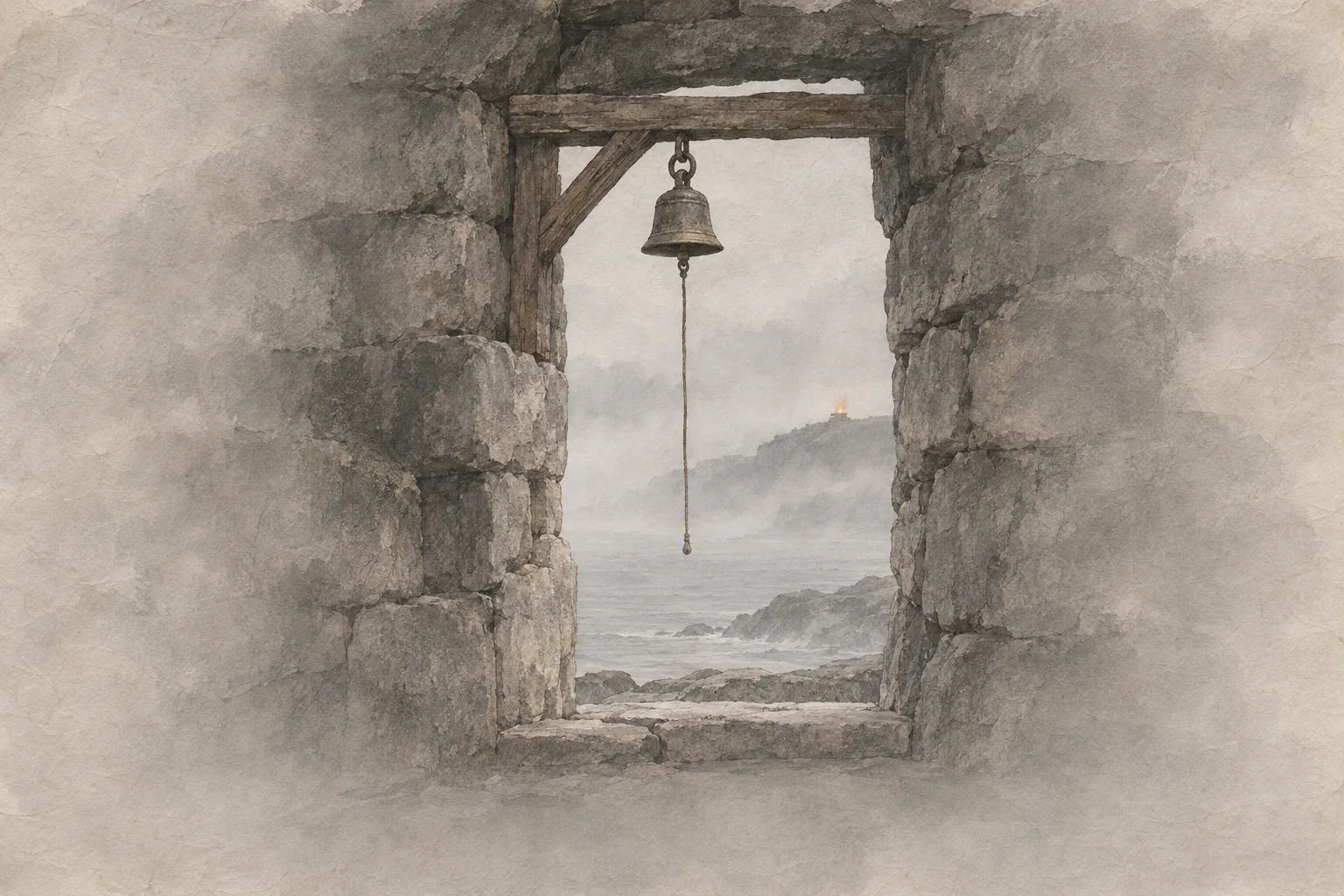
The Agamemnon opens with a problem of receipt. A watchman has waited a year for a fire that will mean Troy has fallen; the fire comes, passed from mountain to mountain; and the elders of Argos doubt it. The claim of this section is that the beacon episode shows a true signal, agreed in advance and relayed station by station, failing at credence for reasons that have nothing to do with noise: the elders doubt it because of who reports it. The section adds to the Wohlstetter and Betts debate a case in which discrimination succeeds and credence still fails, and then reads a record whose judgments build their procedures around receipt.
4.2The watchman and the agreed signal
The play begins in darkness with a watchman who has spent a year on the palace roof waiting, not for any fire, but for a fire that carries an agreed meaning:
And still I await the sign, the beacon pyre That bears Troy’s capture on a voice of flame Shouting o’erseas.
Here is a signal in the cleanest sense. The meaning was fixed before the message was sent; the receiver knows where to look; there is one channel and one message. Nothing in the sky competes with it. By the analogy drawn in Section 2, it works like a point of coordination, a fire whose meaning both ends settled in advance, and the watchman's task is simply to see it. When it comes, he sees it at once:
Ha! O kindler of the dark, O daylight birth Of dawn and dancing upon Argive earth For this great end! All hail!—What ho, within!
Yet even the watchman, at the moment of receipt, adds a condition. He calls for the queen to raise the women's cry of triumph
If verily, verily, Ilion’s citadel Is fallen, as yon beacons flaming tell.
The doubling of "verily" marks the gap between seeing a signal and believing what it says. The watchman has no doubt that he has seen the beacon. He has some doubt, which he voices in the same breath as his joy, about whether the beacon's message is true. Receipt and credence are already separate in the play's first speech.
4.3The relay, station by station
Asked for her evidence, Clytemnestra describes the relay from Mount Ida, across Lemnos and Athos, station by station. The speech dwells on the watchers' readiness:
Which swelled like some strange sun, till dim and far Makistos’ watchmen marked a glimmering star; They, nowise loath nor idly slumber-won, Spring up to hurl the fiery message on, And a far light beyond the Eurîpus tells That word hath reached Messapion’s sentinels. They beaconed back, then onward with a high Heap of dead heather flaming to the sky.
"They beaconed back": the relay includes something like an acknowledgment, a return signal that tells the sender the message has been caught before it is passed on. The speech ends with a claim about the integrity of the whole chain:
Torch-bearer after torch-bearer, behold The tale thereof in stations manifold, Each one by each made perfect ere it passed, And Victory in the first as in the last. These be my proofs and tokens that my lord From Troy hath spoke to me a burning word.
Clytemnestra offers the chain itself as proof: each station completed before the next began, the same message first and last. Her case for credence is an argument from the reliability of the channel. The message is true, she says in effect, because every link held.
The argument has a weakness: a reliable channel proves that the same signal reached Argos, not that the fire at Ida was lit for the agreed reason. Receipt is guaranteed; truth is not. In the play the message is true, and the elders' doubt, as the next passage shows, has another source.
4.4The elders' doubt
Before the speech, the Leader has asked for warrant ("What warrant hast thou? Is there proof of this?") and run through the possible sources of a false belief, a dream and a rumour. These are his candidates for noise, and Clytemnestra rejects each. After the relay speech, the Leader appears persuaded:
O Woman, like a man faithful and wise Thou speakest. I accept thy testimonies And turn to God with praising, for a gain Is won this day that pays for all our pain.
The acceptance is qualified in its first line: she speaks like a man. The credit given to her testimony is credit borrowed from another kind of speaker. And it does not last. After the second choral ode, divers elders voice the doubt again:
—The fire of good tidings it hath sped the city through, But who knows if a god mocketh? Or who knows if all be true?
—’Tis like a woman’s sceptre, to ordain Welcome to joy before the end is plain!
The ground of the doubt is now plain. It is not that the fire was faint, or confused with other fires, or ambiguous in meaning. Nothing in the elders' speeches suggests noise in Wohlstetter's sense. The ground is the reporter: a woman, and therefore, in the elders' prejudice, too ready to believe. This is a failure at credence produced by an expectation about the source, which is the kind of fitting of new information to prior belief that Jervis's note describes. The message has been received, recognised and understood. It is doubted because of who brought it.
Clytemnestra herself names the doubt when she next appears, recalling that mockers chid her:
And mockers chid me: “Because beacons show On the hills, must Troy be fallen? Quickly born Are women’s hopes!” Aye, many did me scorn;
What settles the matter is not a better signal but a different kind of messenger. The Leader announces him:
Soon surely shall we read the message right; Were fire and beacon-call and lamps of light True speakers, or but happy lights, that seem And are not, like sweet voices in a dream. I see a Herald yonder by the shore,
The Herald is a man, and he has come from Troy in person. His arrival is a second channel that confirms the first. The elders believe him.
There is an irony here that the play leaves for the audience. The elders end up right to believe the beacon, and right for the wrong reason: they believe it once a man repeats it. Their method of credence (trust the herald, doubt the queen) produces the correct belief about Troy. It will produce the wrong belief about the palace, where the queen is the danger and a woman is the one who warns.
4.5The broken line: the record's setting
Broken line interim authority is a record about a channel that has failed and must be replaced while it is repaired. Its setting is stated in the record's own words:
A gap in truce communications in the fictional Haeon waters shared-living domain. The organizations and events involved and all figures are synthetic, and the future institutions are assumptions.
The decision actor is a truce liaison council whose mandate covers only reception and relaying within a mutually agreed scope. The problem is one of receipt. The first premise states it:
The regular crisis communications line was stopped because of a flooding incident, and both institutions confirmed the occurrence of the outage separately. The substitute email has no receipt confirmation function, so neither side knows whether the civilian traffic schedule-change notification was received.
This is the watchman's case reversed: there, receipt was certain and truth in doubt; here, the content of routine civilian traffic notices is not in doubt, and the doubt is whether they arrived. The record asks its council to decide, by a fixed hour, how the interim line will receive and relay:
What operating method for interim reception and relaying, applicable during the restoration period of the regular communications line, will the Fictional Haeon Truce Liaison Council decide on by April 18, 2032, 6 p.m.? The benefit of reducing notice delay must be considered together with message interpretation authority, neutrality, and the burden falling on civilian communications resources.
The record's author attached Cassandra to this question as an interpretive frame:
How do unheeded warnings and false-alarm corrections fall under the same accountability?
The frame puts two failures side by side, a warning not heeded and a false alarm corrected, and asks whether one system of responsibility can cover both: whether an office that guarantees a warning arrived can also guarantee that its retraction arrived.
4.6Three options for a broken relay
The options are three ways of rebuilding a relay:
It can leave message interpretation authority with each party, but creates gaps in work coverage and delays in receipt confirmation, and increases the workload of liaison representatives.
It can preserve reception records consistently and reduce gaps, but depends on the intermediary's translation and classification, and concentrates neutrality disputes.
It can start routine reception with existing equipment, but requires reallocation of civilian guidance personnel and budget, and increases residents' service wait time.
The first two options trade receipt against interpretation. A direct window keeps each side's authority over its own messages and pays in gaps and delays; a neutral window keeps consistent records of receipt and pays by placing between sender and receiver a third party who translates and classifies: a single station that records every fire, and also describes what it saw.
Among the three things the record lists as unknown is the actual scale of translation disputes and reception delays under each method: precisely the quantity that would decide the trade.
4.7Receipt confirmed, meaning reserved
The staff synthesis chooses the single neutral window under conditions, and its decision states the principle that governs most of the thirteen judgments:
A window is established that traces responsibility from receipt through the counterparty's receipt confirmation, while the authority to interpret messages is left to the parties on both sides.
Its statement of scope draws the line that Section 1 described:
Translation and classification are marked as auxiliary information, the intermediary is barred from confirming meaning or withholding relay on criteria outside the agreement, and receipt confirmation is distinguished from consent to content.
Receipt confirmation is distinguished from consent to content. The independent challenger, who chooses the other option, writes the same principle in nearly the same words:
The original text and receipt times are preserved and access to personal information is restricted, and receipt confirmation is not treated as consent to the content.
This is the article's first finding about the records. Whatever option they choose, the judgments build their procedure around one station of a warning (receipt) and expressly decline to let that station decide another (what the message means, and whether the receiver accepts it). The relay office records that the fire was seen. It does not say whether Troy has fallen.
The synthesis secretary's conditions take up the author's Cassandra frame directly, in a sentence that answers the frame's question with a procedure:
Translation and corrections shall be retained as linked records without overwriting the original text, so that responsibility for warnings and for corrections of false alarms can be traced.
And the judgment made alone adds a check that the beacon relay never had, a check that a correction also arrived:
Warning notices and correction notices each leave a record of the original text and receipt confirmation, and it is checked whether the correction also reached the counterparty.
The source officer, for its part, confines the frame to a question about record responsibility and denies it any weight as grounds for the option chosen.
Clytemnestra offered her chain as proof of truth because every station held. The judgments refuse that inference: a chain that holds proves receipt, and they ask nothing more of it. Whether the content is believed is left to the parties.
4.8Where the thirteen part
Broken line interim authority is one of the thirteen cases among the fifty in which the published judgments chose more than one option. The independent challenger, the authority counsel and the operations planner chose the direct windows; every other judgment, including the staff synthesis and the judgment made alone, chose the neutral window. The split runs along exactly the line the beacon episode exposes. Those who chose the direct windows put interpretation first: each side should read its own messages, and where preferences for a neutral intermediary differ, the authority counsel will not assume that the parties have agreed to entrust translation and classification to one. Those who chose the neutral window put traceable receipt first. The staff synthesis records the minority's argument as the strongest objection and keeps it as a condition for switching:
If the intermediary institution's consent does not hold, or if relay objections lead to missed deadlines and O1's duty roster and receipt confirmation test support compliance with agreed deadlines, the decision is to switch to O1.
The disagreement is not between those who care about information and those who care about belief. Both sides agree that receipt must be confirmed and that meaning must stay with the parties. They disagree about whether a single station that records receipt can be trusted not to shade meaning by the way it translates and classifies. That is a question about the credibility of the relay itself, which the beacon episode raised and the elders answered by waiting for a second channel.
4.9What the case adds
The beacon episode adds to the debate a case in which a clean, pre-agreed signal is recognised at once and still doubted, because the receiver doubts the reporter rather than the message. That is consistent with Betts's placement of the obstacle after recognition, and the obstacle takes the form Jervis's note describes, a prior belief about the source. The record adds a design that separates receipt from credence on purpose: a relay that can prove a message arrived and is barred from deciding what it means. Whether that protects the parties' interpretation or hands credence back to them unaided is the question the record's own dissent leaves open.