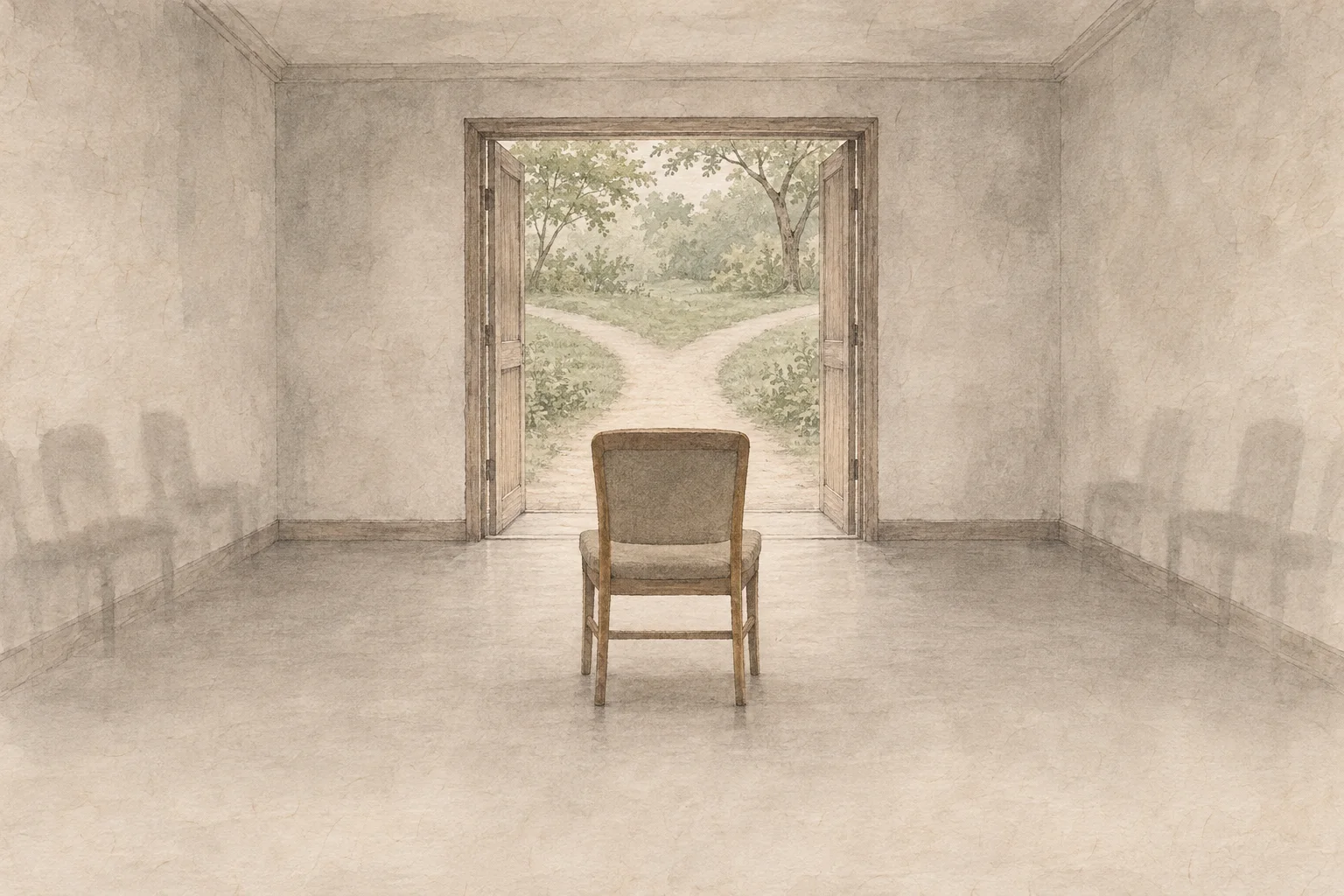
NADIR, a studio in the RISCON family, publishes short question–judgment pairs about decline. It files each pair by layer, by a phase of a research frame that runs from a decade of erosion to a collapse in 2026 and a turning point in 2027, and by horizon. Every pair carries the status of a hypothesis. The scenes are hypothetical exercises or synthetic transpositions of episodes, and the studio calls its judgments a model's conditional proposals, unreviewed as interpretations. This paper therefore treats no judgment as a finding about the world. It asks how the record set frames a decision in decline: who must decide what, by when, and what would reopen the judgment. It reads the fifteen pairs filed under power and the right to judge that fall in the collapse phase and set out options.
Three findings follow. First, the decider changes with the kind of authorship. In the hypothetical exercises the decider is a seat at an emergency meeting, and the question is who joins the judgment. In the transposed episodes the decider is a lone figure who must choose between exposure and withdrawal. Second, no pair says by when anything must be decided. The only clocks are a horizon label, which files the same collapse year as present in one batch and past in another, and the trigger moment of each scene. Third, what would reopen a judgment shifts. At one end it is an interpretation withdrawn as evidence; at the other it is a cue, usually an act by the other side, to switch to the next move. The paper adds to work on exit and voice, on how crisis narrows who decides, and on the time of decline.