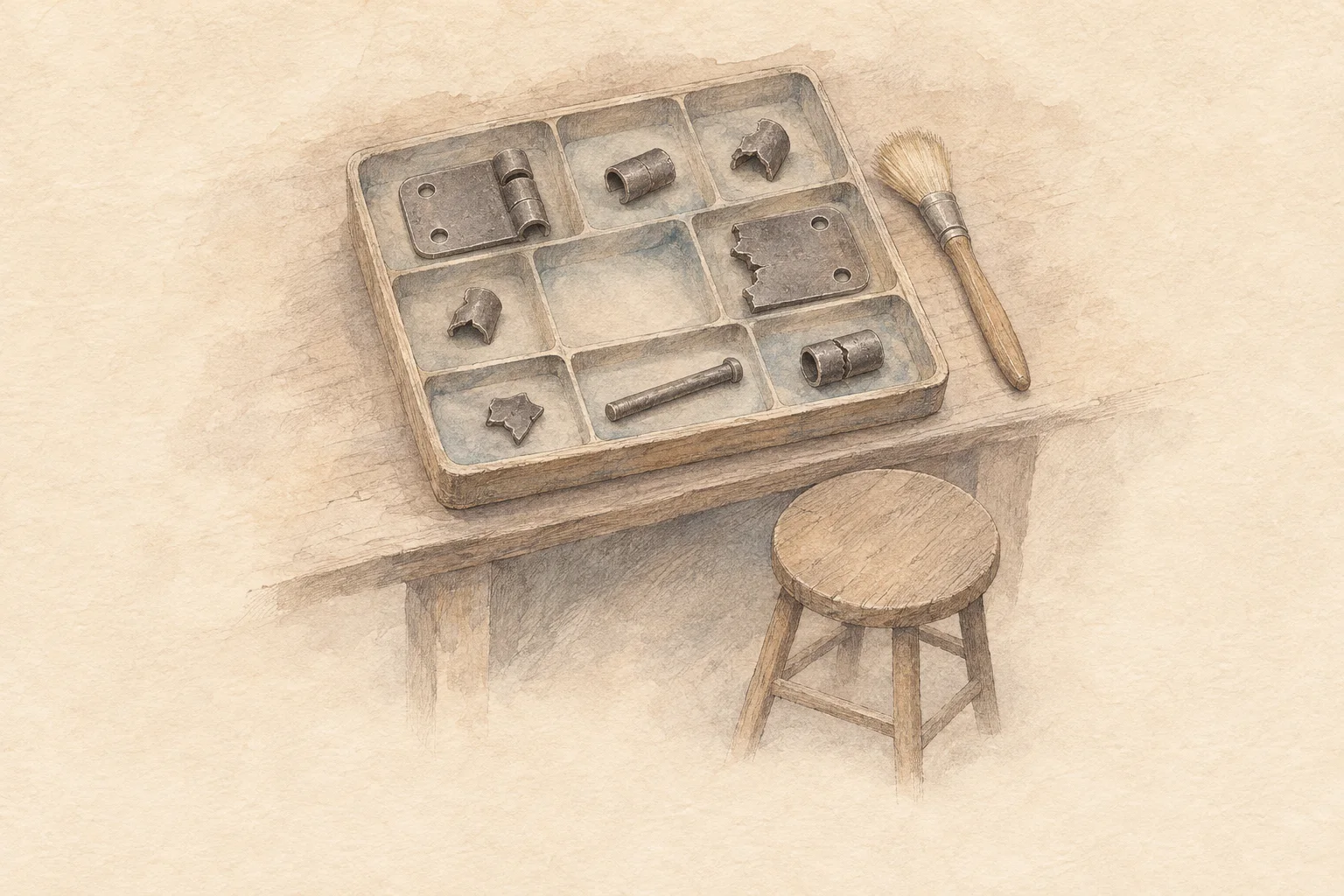
The eleven NADIR pairs this paper read, word for word in the English this study made from the Korean originals, each under the short title the paper gives it, with the question first and then each sentence of the judgment on its own. Every pair has the status of a hypothesis and is an unreviewed episode interpretation draft that the studio files under memory and learning, in the phase of collapse, with the horizon present; none names a real person, organisation or event, so no line has been withheld. The studio’s labels are given in the line under each title, not quoted.
The other paths
Pair nadir:human:059, an episode interpretation draft of edition 3, unreviewed, with the status hypothesis and no options.
The other paths that vanish when read again with eyes that know the ending
The outcome of the ending makes the events that led to failure easy to remember and tends to erase the events that showed a possibility of recovery.
To make ten years of experience into knowledge, the actual path and the other paths that were possible at the time must be kept together.
The last failure
Pair nadir:human:296, an episode interpretation draft of edition 4, unreviewed, with the status hypothesis and no options.
If only the last failure is analysed, can ten years of decline be understood?
The ending event happens on top of resources and relationships that had already shrunk.
The last shock must be distinguished from the cumulative process that made that shock impossible to withstand.
A judgment changed in crisis
Pair nadir:human:306, an episode interpretation draft of edition 4, unreviewed, with the status hypothesis and no options.
Can a judgment changed during a crisis still be explained later?
Urgent decisions tend to go ahead without a record, so afterwards they can look like caprice.
It is important to leave, even briefly, the facts newly learned at the time and the alternatives given up.
The simple cause
Pair nadir:human:316, an episode interpretation draft of edition 4, unreviewed, with the status hypothesis and no options.
Is a simple explanation of the cause believed all the more as events grow more pressing?
When the room to examine complex explanations shrinks, confident interpretations gain the advantage.
Whether clarity in a crisis is a simplification of the facts or a priority for action must be told apart.
The first to warn
Pair nadir:human:326, an episode interpretation draft of edition 4, unreviewed, with the status hypothesis and no options.
May the interpretation of the person who warned first be taken as right in every part?
Pointing accurately to some risks does not verify every explanation of the cause.
The warning's hitting the mark and the soundness of the solution that person proposed are assessed separately.
Who keeps the materials
Pair nadir:human:336, an episode interpretation draft of edition 4, unreviewed, with the status hypothesis and no options.
Who should choose the materials to be left for afterwards?
If the party responsible alone chooses the materials to be kept, there is a risk that a memory favourable to that party is what remains.
A perspective is needed that examines the criteria by which the record is selected and whether anything has been left out.
A record too smooth
Pair nadir:human:346, an episode interpretation draft of edition 4, unreviewed, with the status hypothesis and no options.
What is lost when the record of a failure is tidied too smoothly?
If contradictions and uncertainty are erased, why the choices of the time were hard can no longer be seen.
Conclusions that are easy to read and a record that preserves the actual process of judgment need a balance.
Silence as consent
Pair nadir:human:356, an episode interpretation draft of edition 4, unreviewed, with the status hypothesis and no options.
May all the silence of the time be recorded as consent?
In an unfavourable situation people may stay silent because they have neither the room nor the influence to speak.
When a record is interpreted, the positions that were expressed and the conditions under which they could have been expressed must be looked at together.
Ordinary causes
Pair nadir:human:366, an episode interpretation draft of edition 4, unreviewed, with the status hypothesis and no options.
Is an extreme outcome hiding causes that were ordinary?
It is easy to expect a large failure to have a special cause.
The path along which small concessions and omissions were repeated must also be examined with the same weight.
The centre of the record
Pair nadir:human:376, an episode interpretation draft of edition 4, unreviewed, with the status hypothesis and no options.
Does the memory of those who suffered less harm become the centre of the record?
Those who have time and resources left may get more chances to explain the events.
For the record to be representative, the experiences of those who had no room to speak must also be sought out.
Knowing and beginning
Pair nadir:human:386, an episode interpretation draft of edition 4, unreviewed, with the status hypothesis and no options.
Is knowing why it ended the same as being able to begin again?
Even when the causes are understood, there may be no capacity to build resources and relationships anew.
The completeness of an explanation and readiness for the next action must be seen as different stages.