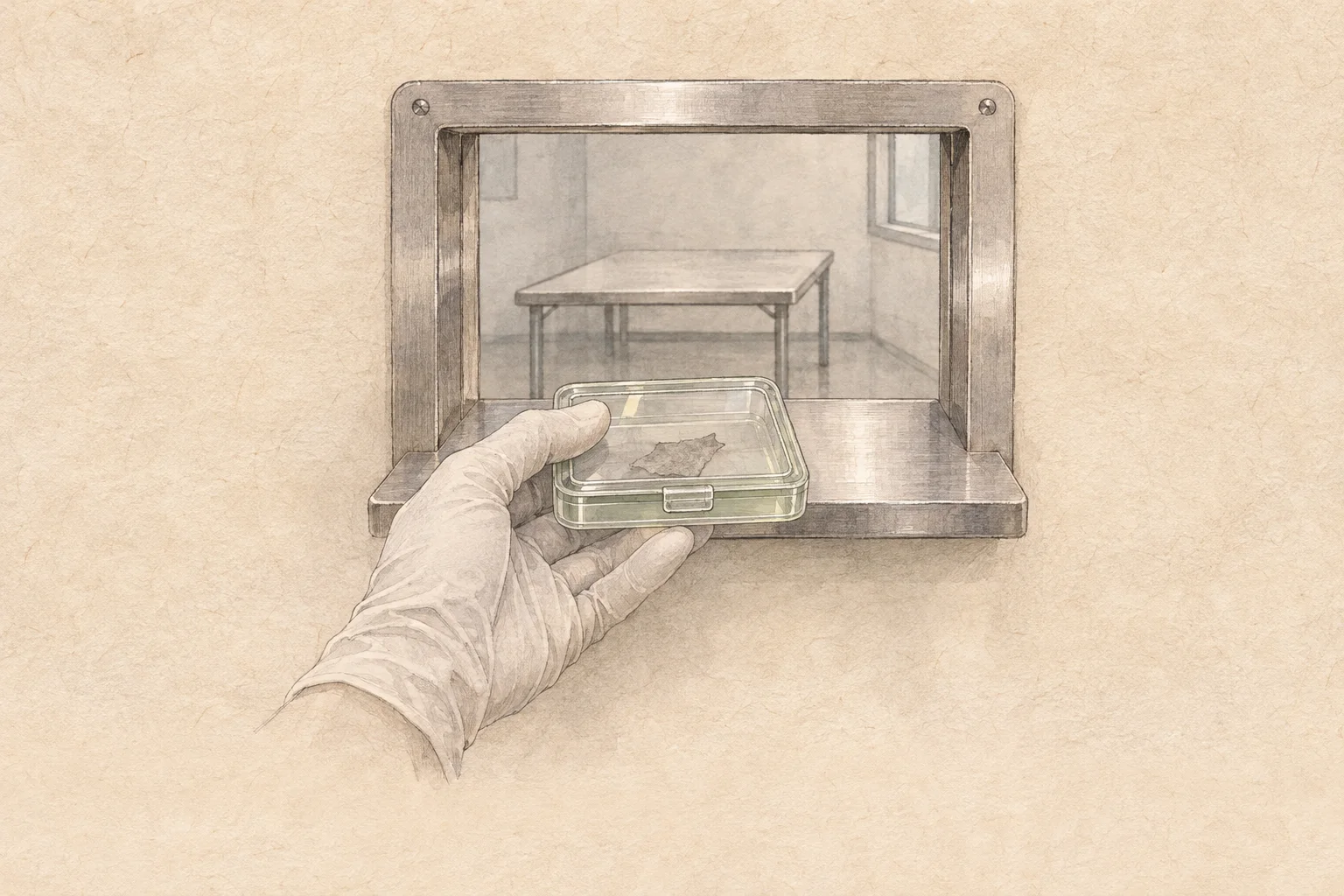
The fourteen records about evidence never ask what a piece of evidence proves. This chapter shows what they ask instead: by what route material reaches the court that will decide, whether the record that carries it can stand in for being there, what kind of thing it is, and who must move it. It adds to the institutional study of evidence a genre in which those questions are the whole subject, and to the study of proof as reasoning a case in which reasoning is left out.
1.1Data and method
The data are PRO SE's public library as it stood when it was read. The library list gives 483 questions in four sections: 122 on scope, 121 on documents, 120 on timing and 120 on the courtroom. All 483 are marked synthetic. The list carries the notice "General information, not legal advice" and an editorial reference date, which it says is not a case date and does not confirm current law. Each question's page data were fetched and kept as snapshots, which agree word for word with the library's English text. The snapshots hold, in English and Korean, five fields that this study reads: the question; the evidence, which says what material is examined; the readings, always two; the judgment, which in this library is itself a question; and the revisit condition, which says when the matter would be looked at again. The English text is PRO SE's own; nothing was translated.
The selection rule is one sentence: every question in the Courtroom section whose English question contains the word evidence, outside the criminal-trial series that PRO SE marks with identifiers beginning court-crim-. The Courtroom section has 21 questions with the word; 7 belong to that series, which has 13 questions in all. The rule gives 14 records. It is lexical and confined to one section so that the records share a setting, the hearing. It leaves out 9 Documents questions and 1 Timing question with the same word, 31 in the library in all. It also leaves out 16 Courtroom questions outside the criminal series that name proof, a witness, an expert or an inspection without the word evidence. The fourteen records run to 1949 English words, 139 on average.
Some properties belong to the studio's form and would be found in any record. Every one of the 483 has exactly two readings, every judgment is written as a question and every record has a condition for looking again. These are the library's shape, not findings. The fourteen keep the library's most common phrasing less often than the section does. Across the Courtroom section, 86 of 120 records (72%) open both readings with "One interpretation holds" or a close variant; here 7 of 14 do. Across the section 79 records (66%) open their condition for looking again with "The matter is looked at again" or the same words with analysis in place of matter; here 7 do. To see how much of the wording is repeated phrasing, the study measured, for each field across all 483 records, the share of five-word runs that recur in at least 25 records. In the fourteen the share is 0% in the questions, 2% in the evidence, 2% in the readings, 0% in the judgments and 10% in the revisit conditions. By the 30% threshold this series of studies uses, no field here is formula.
Every count in this paper comes from a script that reads only the snapshots: whether a question asks about a route, a time, a cost or a form, or about how much something proves; whether a record names the court acting or a party applying; what its condition for looking again turns on. The counts describe the records, not courts or parties. This study draws no fact about any law, court or person from them, and nothing in it is advice about what evidence to offer, where to apply or how to object. What it studies is the frame.
1.2The route, the record and the form
The first finding is an absence. None of the fourteen questions asks how much a piece of evidence proves, how strongly, or how credibly. Eleven ask about a route, a court, a time, a cost or a way of treating material: where it was investigated, before which court an application goes, whether an order falls when costs go unpaid, when late material is cut off. The other three ask what kind of thing the material is, an inspection or a document, an admission or evidence, or which passage of it is in view. In the whole set of fourteen records, the word weight appears once, and there it is weight given to a procedure abroad, not to an item of proof. No record names the dispute behind its evidence: none mentions a payment, a sale, a contract, a loss, an injury or goods. The nearest is a debtor company and its many suppliers, named as the two sides of an action, with nothing said of what is owed. Where people appear they appear as roles, and where a company appears it appears as a party or as the keeper of data, a ledger or funds. Each record is a synthetic practice material, published by PRO SE as general information, not legal advice, and the absence belongs to that genre. It is still a choice of frame.
The clearest case of the route is the record on evidence investigated outside the court. Its question asks whether such evidence carries the same effect as investigation in court, and its second reading gives the reason the question arises:
It is also thought that, because a court that did not directly observe the investigation may assess it only on the record, the vividness of the investigative scene may vary.
The sentence holds three things apart. There is the investigation, which happened somewhere; there is the court that will decide, which was not there; and there is the record, which goes from one to the other. What may be lost on the way is named in a single word, vividness. The reading does not say the deciding court will judge worse, only that it receives the scene as the record holds it. The first reading answers that such an investigation is still the court's own, and because its record is conveyed to the trial court, it can be examined within the same procedure. Where the judgment would stand, the record asks:
To what extent may an investigation result conveyed through the record be treated as equivalent to investigation in court?
The word that carries the question is conveyed. Damaška, Evidence Law Adrift (1997), sets the concentrated trial, in which everything is heard in one sitting, against proceedings that are episodic, and this study reads the record's question as the episodic setting's own: if evidence is gathered in one episode and decided on in another, what passes between them is a record, and the question is how far the record may count as the thing itself. The record does not settle it.
The record on a witness examined to preserve evidence asks the same question about a person. One reading holds that where nobody asks for the witness to be examined again, reviewing the record of the earlier examination at the hearing is enough. The other reading turns:
Another interpretation holds that once a party requests it, the court must examine the witness again, so the record alone cannot take its place.
Here presence has a defender, and the defender is a party's request. The record "alone" cannot take the place of the witness once someone asks. One reading lets the record stand in; the other says when it stops. What the record examines is not the witness's words but "the record of notice of the preservation hearing and whether the opposing party took part", and its question in place of a judgment follows that lead:
In the main action, how should an examination held without the opposing party be distinguished from one held with that party present?
The distinction the record asks for is not between a truthful and an untruthful witness. It is between an examination at which the other side was present and one at which it was not. Langbein, The German Advantage in Civil Procedure (1985), locates the trouble with a lawyer-dominated procedure in leaving to partisans the work of gathering and producing the facts. This study reads the record as concerned with a reverse condition: what becomes of material gathered while one side was absent.
Two more records carry material across a greater distance. The record on evidence abroad asks how evidence and testimony located abroad can be examined in a domestic proceeding, and says that materials are needed to identify "the route of the foreign investigation, the record of the video examination, and the author and manner of preparation of the foreign documents". Its readings divide on where to look:
Emphasizing that validity is retained provided that the requirements of domestic procedure are met, it is seen as examining with the domestic record at the center.
The other reading attaches weight, in its own words, "to the process of letters rogatory and inquiry", the route the request took abroad and the source of the documents. This is the one place among the fourteen where weight appears, and it is weight given to a path. The question in place of a judgment asks which material should be looked at first "for the course of the procedure to become clearest".
The record on which court preserves evidence makes the route a matter of place. Its two readings set the court that will use the evidence against the court that is near it:
One interpretation holds that once the main action has been brought, the procedure should continue before the court of the instance that will use the evidence.
The other reading holds that where the matter is urgent, it is better for the district court near the person or the object to examine the evidence first. The question in place of a judgment asks the reader to take into account "the route by which the record reaches the main action". Again the record is the traveller. What the record examines is whether an action has been brought "between the debtor company and its many suppliers", the residence of the person and the location of the object, never what the person might say or the object show.
The record on preserving evidence when no opponent can be named pushes the route back to a time when the opposing party cannot yet be named. What it examines is "the electronic records showing the movement of funds and the materials confirming where they are stored". Its question in place of a judgment reads:
When the remaining records do not reveal who is responsible, what must be settled first?
The sentence is the nearest any of the fourteen comes to the inside of proof, because it imagines records that might reveal who is responsible. It still asks about order, what comes first, and its second reading turns at once to the other side's absence: because the opposing party can hardly take part, safeguards such as appointing a special representative should be examined to keep the procedure fair. In the five records on investigation outside the court, abroad or in preservation, the decider is elsewhere and the material moves to it in a record.
The second part of the frame is form. Three records ask what kind of thing a piece of material is, and a fourth asks which part of it is in view. The record on a printout of accounting data sets out two readings that disagree about what the evidence is:
One interpretation holds that because a printout merely renders the data readable, the examination should be treated as an examination of the storage media themselves.
Another interpretation holds that once a printout is submitted, the printout itself becomes evidence and should be treated much like a document.
Read together, the readings ask where the evidence is: in the stored data, of which the paper is only a readable face, or in the paper, which becomes a thing of its own once it is handed in. The question in place of a judgment asks what more must be shown "to establish that the stored information and the printout are the same". It asks about sameness across forms, not about whether the accounts are true. Damaška, Free Proof and Its Detractors (1995), names the ramifications of technological and scientific advances as one challenge to free proof. This study reads the printout record as a related strain felt before any weighing: someone must first decide what object the accounts are.
The record on inspection makes the same move with a ledger. One reading holds that where the entries are in issue, the ledger is documentary evidence and its content is read; the other that where the physical condition of the object is in issue, such as signs of alteration on the original ledger, it is a matter for inspection. The record asks:
What should decide whether the object of the inquiry is the content of a document or the physical condition of the object itself?
The same object is two kinds of evidence depending on the question put to it, and the record leaves that question open, ahead of any reading of what the ledger says.
The record on pointing to a passage is the most modest of the fourteen and the most telling. Its question asks how to make clear which passage of the documentary evidence everyone at trial is looking at. One reading holds that checking the marks on the copy together with the surrounding sentences lets the listeners be taken to be viewing the same passage. The other reading doubts it:
Because the same mark may lead to different passages depending on the edition or the layout of the screen, there is also room to view it differently.
The problem is not what the passage proves but whether everyone in the room is reading it. The record's question in place of a judgment asks from which part of the explanation the meaning became unclear, if the listeners were looking at different passages. Pennington and Hastie, Explaining the Evidence (1992), describe judgments formed once at the end of a case and judgments formed item by item. On this study's reading, the pointer record concerns a condition both kinds of judgment take for granted: that the item in front of the decider is the item the speaker means.
The record on a party's own words names, more plainly than any other, where weighing goes once the route and the form are settled. Its question asks whether what a party says in person in court is an admission or evidence, and its readings divide on remarks made in a party examination: evidence only, even where they match what the other side asserts, or an admission where the intention to accept the other side's assertion outright is clear. The record then asks:
Which remarks amount to an admission made in court and which remain only material from which the court forms its view?
The sentence sets two fates for the same words: an admission made in court, or what remains "only material from which the court forms its view". The record names the weighing and gives it to the court in the same breath, and it says nothing about how the view is formed. Damaška, Free Proof and Its Detractors (1995), takes up the idea that the law should not assign probative weight to items of information. This study reads the record's phrase as written inside that idea: what is left once the category is fixed is the court's own, and the record's reader is told only which side of the line the words fall on.
In these nine records on route and form, evidence is something that moves, something whose kind must be fixed, and something whose weighing belongs to someone else. Twining, Rethinking Evidence (2006), puts inferential reasoning at the centre of the subject and the rules around it. The records keep the frame and leave the centre empty.
1.3Who moves the proof, and when
The second group asks who must move the material. Five records concern the court acting on its own, the parties' applications, costs and lateness, and their pairs of readings divide the work of proof between judge and parties without settling the division.
The record on small claims states the division most fully. It asks how evidence taking led by the judge differs from the ordinary procedure, and it examines "who led the questioning of witnesses and how the written statements were submitted". Its two readings are worth reading whole:
One interpretation holds that because the judge may take evidence on the court's own motion, question witnesses directly and accept written statements instead, the center of the procedure has moved to the judge.
Another interpretation holds that taking evidence on the court's own motion, questioning by the judge and written statements only simplify the method, while the parties' applications and statements of opinion remain its backbone.
The readings list the same three things, evidence taken on the court's own motion, the judge questioning witnesses, written statements, and differ only on what they mean: a new centre, or a simpler method around the parties' backbone. This study reads the disagreement as touching the one Langbein, The German Advantage in Civil Procedure (1985), opens, over a procedure that leaves fact-gathering to partisans. Damaška, Epistemology and Legal Regulation of Proof (2003), holds that the best fact-finding arrangements depend on, among other things, the type of proceedings. The small claims record reads as that claim inside one system: a different type of proceeding raises again who gathers the facts, and the record's question in place of a judgment, how to decide whether the judge's lead or the parties' statements of opinion set the course, leaves it undecided.
The record on the court acting on its own asks when the court can examine evidence without being asked. Its first reading, in the first person, says the scope opens only within the limits of filling a shortage in the submitted evidence. Its second reading adds a sentence that is easy to pass over:
Even where the court may act on its own, it remains difficult to say that the position in which evidence must be produced has shifted.
The court may act, and yet, on this reading, the position of the party who must produce evidence has not moved. The material the record examines is "the content of the submitted evidence, the state of the judicial mind, and the occasion and the point in time" at which the court's own measure was raised. The state of the judicial mind is named as material to examine, not described.
The record on the sole evidence puts the parties' and the court's claims against each other in their starkest form:
If the court finds the submitted materials unnecessary, it may continue the proceedings without examining them.
If the materials are the sole ones supporting the asserted fact, their omission from examination appears impermissible.
The first reading gives the court a judgment about need. The second gives the party a protection that turns on counting: if these are the only materials for an asserted fact, leaving them out appears impermissible. Neither reading asks what the materials would show. The question in place of a judgment asks by what criterion one can determine whether the remaining materials are the sole ones.
Costs and the clock come last. The record on unpaid appraisal costs asks whether an order to examine evidence is revoked if the costs are not prepaid. One reading holds that the order may be revoked; the other separates two moments:
It is understood that the question of prepayment and the final burden are determined at separate stages.
Proof here waits on money, and the record splits the money in two: who pays now, and who bears the cost at the end. The record's question in place of a judgment asks whether it remains to be established to whom the prepayment was ordered and whether the failure to prepay is confirmed. The appraisal itself, and what it might find, never enters.
The record on late submissions sets the clock against the reasons for being late:
It is held that late submissions are in principle not accepted, so as to prevent delay in the litigation.
The other reading holds that where circumstances warranting it are shown, late submissions may be accepted. What the record examines is whether the preparatory hearing was closed, and "the timing and substance of the late arguments and requests for evidence". Its question in place of a judgment asks how the filing times shown in the record should be checked against what was shown to justify them. Damaška, Evidence Law Adrift (1997), sets concentrated trials against episodic proceedings and notes that pretrial proceedings have multiplied. This study reads the closing of a preparatory hearing, after which material may be cut off, as a point at which an episodic procedure gathers itself.
The counts bear out the reading of this group. Five of the fourteen records name the court or the judge acting on its own, by order or by leading; 11 name a party's application, request, submission or statement. Two set the court's or judge's action against the parties' in their very pair of readings, the records on small claims and on a witness heard twice. Three name costs, prepayment or a burden, and five name time, timing, lateness or urgency. Twelve conditions for looking again turn on a record, a submission, a request, a disclosure, a reply or materials; none turns on what the evidence proves, its weight or its credibility. What would reopen the matter is a new record or a changed procedure, never a new understanding of what happened.
The records not only make evidence a matter of passage; they make the passage someone's work and leave open whose. The judge may lead, act on its own, or find materials unnecessary; the parties apply, request, prepay and explain their lateness. Each pair of readings marks a line between the two, and no record says where it should fall.