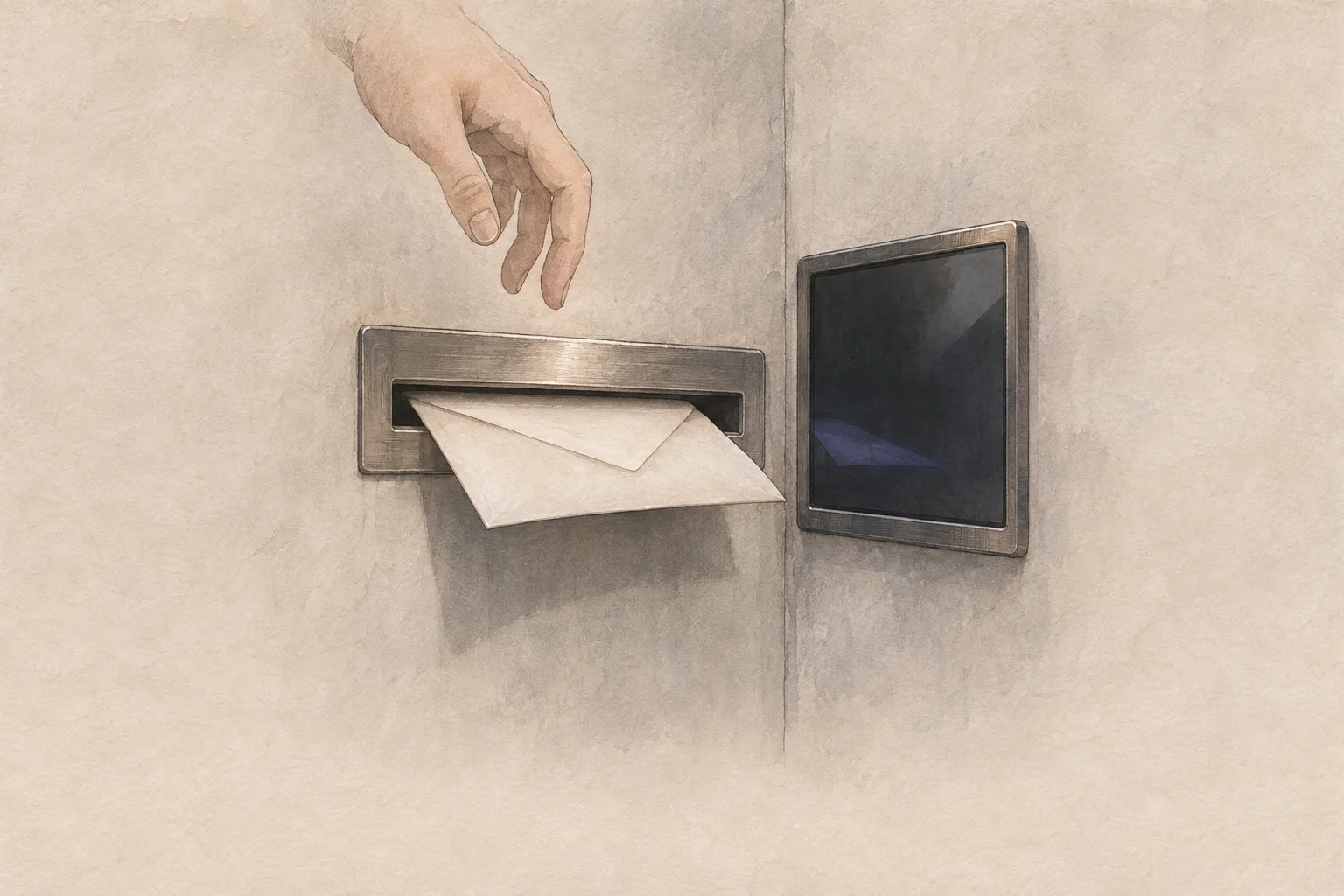
This study asked how public records written for people who go to court without a lawyer frame the movement of a court paper, from one side of a case to the other and from paper to screen. The answer is that they make arrival a matter of record. A paper's arrival is shown by another paper; the person who actually received or filed is set beside the person the record names; paper and the original stay inside electronic filing; and what reopens the matter is a new or changed record, never what a person learned. The records are synthetic practice materials, published as general information and not legal advice, and everything said here concerns how they frame the matter, not what any law provides or any court does.
Discussion
The two arguments set out in the Introduction ask different questions of the court paper. The works on documents, Matthew S. Hull's Documents and Bureaucracy (2012) and Cornelia Vismann's Files: Law and Media Technology (2008) above all, ask what a paper does, and answer that it constitutes what it seems only to record. The works on online courts ask what changes when the paper becomes a screen: Richard Susskind's Online Courts and the Future of Justice (2019) answers with platforms and tools for users, and Catrina Denvir and Amanda Darshini Selvarajah's Safeguarding Access to Justice in the Age of the Online Court (2021) and Mireille Hildebrandt's Law as Information in the Era of Data-Driven Agency (2016) answer with warnings about exclusion and the contestability of legal effect.
The records answer the first question on the constitutive side, and they carry that answer into the second. On service, they treat the paper that says a paper arrived as the place to look, and they leave the person who received it as a status in a record, an absence, or an act of acceptance or refusal that can itself be recorded. The record on public notice in insolvency sets the two views openly against each other, and it holds both open. On electronic filing, the records do not treat the screen as having replaced the paper. They treat it as having multiplied the papers whose sameness must be shown: the printout and its identity marking, the clerk's converted document and the original, the file out of format and the required one, the name shown in the record and the entity that accessed the system. This study reads that as support, from an unexpected source, for Hull's argument in Documents and Bureaucracy (2012) that the study of paper documentation is of great value for the study of electronic forms.
That the records never ask whether a paper was read is not a fault that a reader should hold against them, and this study does not claim it is. A written aid prepared in advance for a person without a lawyer cannot know whether that person's opponent read a paper, and it cannot sit beside the person at the screen. What it can do is say what will be looked at when arrival is in question, and the records say it precisely: the service record, the notice to the court, the report, the gazette, the registered screen, the certificate, the designation of authority. This study reads that precision as the records' answer to their reader's position. Where Susskind's book imagines tools that help users understand the law and their options, these records offer a narrower help: they show what the file will hold, and they do not say which reading is right.
The fit of the works is uneven, and it should be said where. The works on documents, as their notes describe them, study bureaucrats and judges at work: Hull's Islamabad, with its bureaucrats among others, and Latour's judges in The Making of Law: An Ethnography of the Conseil d'Etat (2010). The records address a person outside the office, who must anticipate what the office will look at. Ben Kafka, The Demon of Writing (2012), calls paperwork one of the most ubiquitous and least understood forms of media; the records are paperwork about paperwork, written for someone who must handle it alone. The works on online courts look at systems and at who can use them; the records ask who is registered, who consented and who is a subject for service, not who has a device or the skill to use it.
Contributions
The study makes three contributions. First, it shows that written help for self-represented litigants on service and electronic filing, in this set of records, frames a paper's arrival as a matter of another paper: all 15 records say they examine a record, a report, a filing or some other paper, none says it examines what a person knew, and 14 of the 15 conditions for looking again turn on a new, changed or further record. Second, it shows that the records locate the hard questions where the person who acts and the person named can come apart, which in this set is mostly inside a company: 5 records set a person who actually received, read, accessed or refused beside the person the record names, and 10 name a company or a corporation. Third, it brings the debate over what documents do into contact with the debate over online courts at a point neither takes up: an aid written in advance for the person without a lawyer. Read from there, the move from paper to screen does not remove the question of which paper counts. It multiplies it, and 4 of the 8 records on electronic litigation keep paper, a printout or an original in their frame.
Limits
The limits are those of the material. The records are synthetic practice materials published as general information, not legal advice; they report no case, and nothing here describes how service or electronic filing works in any court or under any law. The set is fifteen records chosen by a lexical rule within one section; questions with the same words in other sections, 12 on timing among them, and questions on sending papers in the same section without those words were left out by design, and a different rule would give a different set. The fifteen also depart from the library's most common phrasing more than most records do, so what is read here may not stand for the library as a whole. The counts come from a script matching words, which can miss or wrongly catch a phrase; many counts are printed with the identifiers they rest on. The English is PRO SE's, and where it reads oddly, as in "the document is unfolded again", this study reads it as it stands and draws nothing from the Korean. The works are read through reading notes made from abstracts and catalogue descriptions, some of them short, and this study says nothing about them beyond those notes; its readings of the records through them are its own.
Further research
Three lines of work follow. The first is to read the 12 timing questions of the same library whose wording names service or electronic litigation, to see whether questions about time also place arrival in the record, or whether time brings the person back in. The second is to compare this frame with written help from other sources, asking whether it belongs to this studio's form or to written help on service as such. The third, which this study cannot undertake, would ask readers. Denvir and Selvarajah's attention to digital capability and support, and the view of Katsh and Rabinovich-Einy in Digital Justice (2017) that on-demand justice should be a natural part of an on-demand society, both point to a study of people: whether a person without a lawyer who has learned to look at the service record and the registered screen finds that knowledge useful, and whether it changes what that person does when a paper does not arrive.