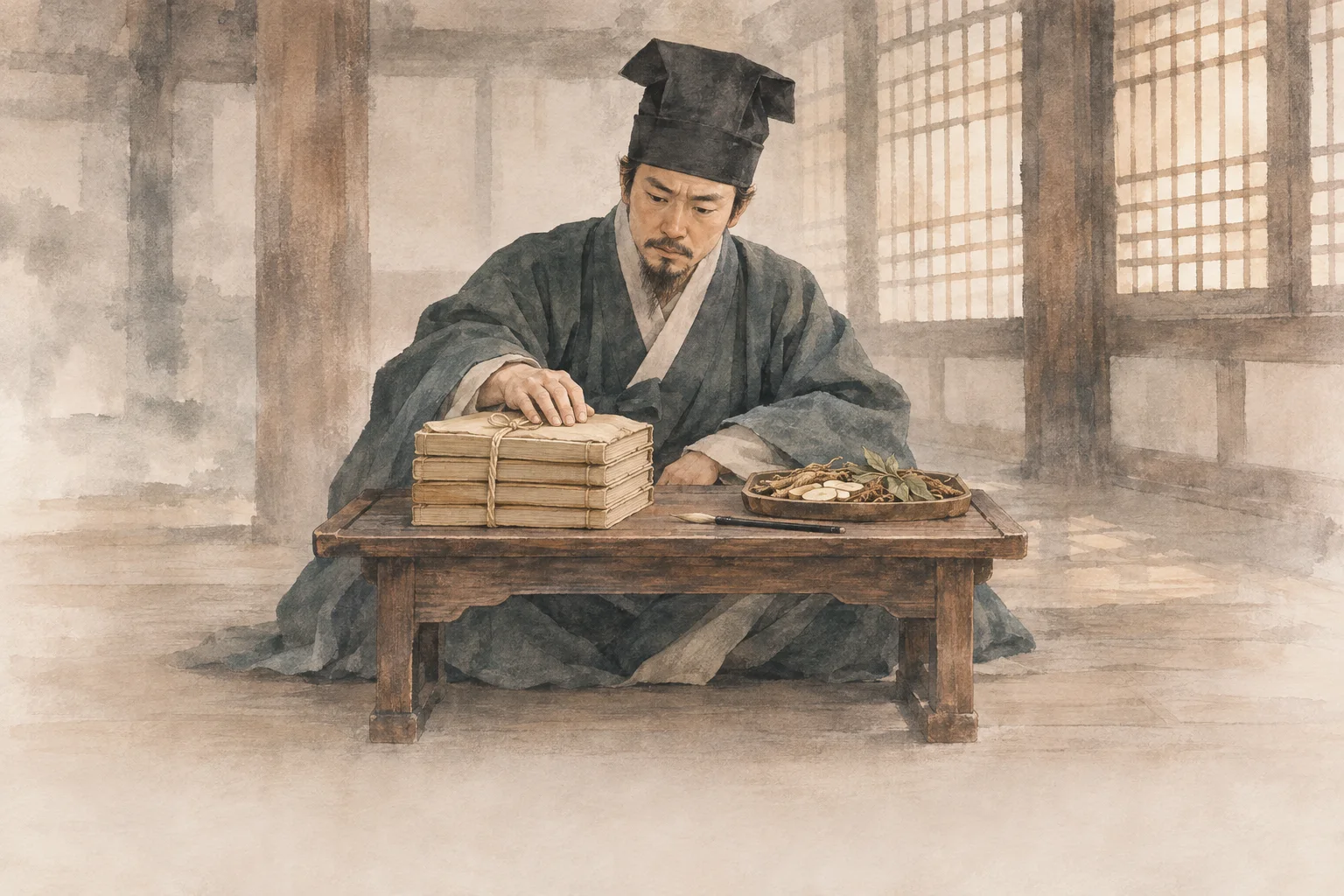
6.1Two commands after a loss
Both commands begin with loss and count none of it. The ordinance names the death of a great part of the people, the masters' straits and a feared lack of ploughmen; the first Joseon command names villagers who died young without physicians, and its completion was marked by war, dispersal and a king's death.
They answer the loss differently. The ordinance takes the scarce resource, labour, and freezes it by compulsion. The Dongui Bogam takes a resource made scarce by distance and confusion, medical knowledge, and multiplies it by selection, classification and print.
6.2What each command took as its standard
Both commands take a past as their standard, and both temper it with the local. The ordinance takes the wages of the twentieth year of the reign, but in each place. The Dongui Bogam takes the ancient books, but selected, and supplements them with local names, places and seasons. In Koselleck's terms, both bind the horizon of expectation to the space of experience: what will be paid is what was paid; what will be known is what was known, sorted.
They differ over the present. The ordinance treats the servants' present demands as the problem the past corrects. The Dongui Bogam treats present conditions, poor households, the constitutions of "今人", people now, the medicines that grow in the country, as reasons to adjust what it inherited. The ordinance has such a clause only for food.
6.3How each command expected to see
The ordinance sees through a chain of local agents, from two faithful men to the court of the place, with justices to be assigned behind them. The text designs the instrument; Putnam's records show such laws enforced in their first decade (Putnam 1908).
The Dongui Bogam's command contains no enforcement. It has no penalty, only a reward, a horse for the compiler. Its way of reaching the people is the printed book, distributed within and beyond the capital. The court does not ask to see the villages; it sends them a mirror. Yi's four conditions place the decisive step in transmission: if it is not wide, the benefit does not spread.
Read against both, Scott's argument fits in part. The ordinance shows a state that simplifies through a uniform standard and still cannot see without local agents; its simplification is real but depends on local knowledge for its content and its enforcement. The Dongui Bogam shows a state that simplifies books and doses and records local practice in the same act, and whose stated aim is to make knowledge legible to its subjects. Neither is the high-modernist scheme on which Scott's claim of failure rests, and neither text records an outcome by which success or failure could be judged.
6.4Expression and instrument
Cohn's reading of the labour laws as expressions of fear and contempt fits the ordinance's preamble and alms clause closely. It has no counterpart in the Dongui Bogam, whose attitude to its intended readers is one of solicitude: the king grieves over the people's sufferings; the principles worry about poor households. A reader who wanted to test Cohn's claim beyond labour laws would find, in this pair, that the attitude a command expresses towards those it addresses varies with what it asks of them. The ordinance asks for labour against the labourers' interest and describes them as idle. The Dongui Bogam offers help and describes its readers as suffering. That is a contrast between two texts, not a test of Cohn's comparative argument, which concerns labour laws across western Europe.
Putnam's question, whether a law was enforced, has a counterpart in the Dongui Bogam: whether the book was printed and distributed as ordered. The record answers the printing, from its registration source, and not the distribution. For the ordinance neither text nor record speaks to enforcement.
6.5What the records keep and lose
Both platform records are careful and narrow. One forestalls the likeliest modern misreading of the ordinance; the other refuses medical judgment and keeps to the edition. Neither keeps the command's reason, its standard or its method. On the ledger's question of who bore the cost while the act waited, both records are silent and both source texts speak: the ordinance fears a lack of ploughmen, and the first Joseon command names villagers who died without physicians. The ledger's codings are codings of the records and remain correct for them; the texts show what such a coding cannot reach. The gaps in time differ as well. The ordinance's record names none, and its text says only that the pestilence has "now" taken a great part of the people. The Dongui Bogam's record names the gap between compilation and printing, and the preface adds the longer one between first command and completion.
6.6What the evidence cannot carry
The two texts are commands and an account of a command. They show what their authors required, presumed and feared. They do not show what happened. The ordinance cannot show whether labourers served at the old wages, whether employers paid them, or whether justices were assigned and acted; Putnam's sources speak to that, and they are not among this article's. The preface cannot show how widely the book was distributed or used, or what it did for villagers without physicians.
The comparison of the two texts is a comparison of form. It shows two states commanding in response to loss, one compelling labour and one compiling knowledge, one seeing through neighbours and one offering a mirror. It does not show that either was the better way to govern after a loss, and this article does not say so. The platform records add dates and, for the Dongui Bogam, the existence of the printed sets; they do not add evidence of effect.