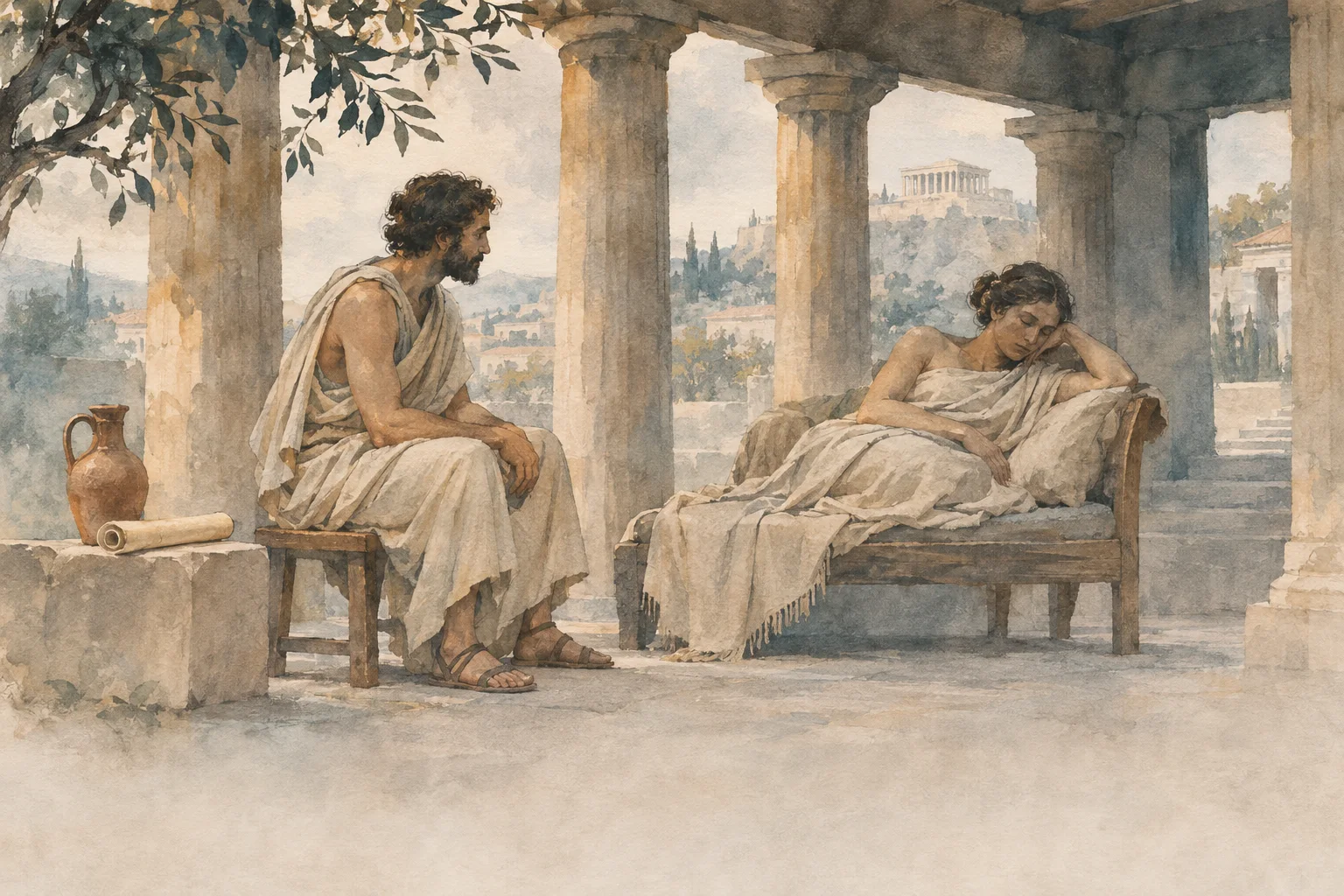
The historical claim of this section is that Thucydides's account of the plague is a description of a disease's course and setting, written by a survivor for someone who might meet it again, and that it separates with care what the author saw from what was said. That bears on the Athenian dispute in a specific way: the account is built for recognition by experience, not identification by name, and its own markers of selection and hearsay set the limits that Morens and Littman found.
4.1The date and the first report
Thucydides dates the outbreak by the war and by the season, not by any year a modern reader would recognise. The passage opens at the end of the first year of the war:
"In the first days of summer the Lacedaemonians and their allies, with two-thirds of their forces as before, invaded Attica, under the command of Archidamus, son of Zeuxidamus, King of Lacedaemon, and sat down and laid waste the country. Not many days after their arrival in Attica the plague first began to show itself among the Athenians."
The time is relative: the beginning of summer, the invasion, and then not many days. The year 430 BC is a modern conversion of the second year of the war. Nothing in the passage gives a month or a day. That matters for any argument about seasonality, and it matters for the modern record, which adopts "430 BCE" and says nothing finer.
The next sentence separates the report of others from what was remembered:
"It was said that it had broken out in many places previously in the neighbourhood of Lemnos and elsewhere; but a pestilence of such extent and mortality was nowhere remembered."
The first clause is hearsay, and marked as such. The second is a claim about memory, and a negative one: no one remembered anything like it. Two sentences later comes the origin, again marked: "It first began, it is said, in the parts of Ethiopia above Egypt, and thence descended into Egypt and Libya and into most of the King’s country." The Greek marker is ὡς λέγεται, as it is said. Thucydides attaches it to the disease's distant origin and its route, which the historian could not have seen.
4.2Physicians, ignorance and the purpose of the account
Before the purpose comes the failure of medicine:
"Neither were the physicians at first of any service, ignorant as they were of the proper way to treat it, but they died themselves the most thickly, as they visited the sick most often; nor did any human art succeed any better."
In the Greek the physicians fail through ignorance: "οὔτε γὰρ ἰατροὶ ἤρκουν τὸ πρῶτον θεραπεύοντες ἀγνοίᾳ", which in this article's English reads: for neither did the physicians at first avail, treating it in ignorance. The word ἀγνοίᾳ, ignorance, is worth holding on to, because it returns a few lines later in the sentence where Thucydides states the purpose of the account.
Between the two comes the first explanation the city offered. In Crawley's English: "Suddenly falling upon Athens, it first attacked the population in Piraeus—which was the occasion of their saying that the Peloponnesians had poisoned the reservoirs, there being as yet no wells there—and afterwards appeared in the upper city, when the deaths became much more frequent." The rumour of poisoning is reported, not endorsed; it is what people said. In Rosenberg's terms it is an explanation that manages randomness by giving the disease an agent and an enemy (Rosenberg 1992). The Greek reads "ὡς οἱ Πελοποννήσιοι φάρμακα ἐσβεβλήκοιεν ἐς τὰ φρέατα· κρῆναι γὰρ οὔπω ἦσαν αὐτόθι", which in this article's English reads: that the Peloponnesians had thrown poisons into the wells; for there were not yet fountains there. Crawley's reservoirs and wells stand where the Greek has wells and fountains. The difference is small, but it is the first of several.
Then the purpose. In Crawley's English:
"All speculation as to its origin and its causes, if causes can be found adequate to produce so great a disturbance, I leave to other writers, whether lay or professional; for myself, I shall simply set down its nature, and explain the symptoms by which perhaps it may be recognized by the student, if it should ever break out again. This I can the better do, as I had the disease myself, and watched its operation in the case of others."
The Greek opens the sentence with a permission: "λεγέτω μὲν οὖν περὶ αὐτοῦ ὡς ἕκαστος γιγνώσκει καὶ ἰατρὸς καὶ ἰδιώτης", in this article's English: let each, physician or layman, say about it what each knows. The purpose follows: "ἐγὼ δὲ οἷόν τε ἐγίγνετο λέξω, καὶ ἀφ’ ὧν ἄν τις σκοπῶν, εἴ ποτε καὶ αὖθις ἐπιπέσοι, μάλιστ’ ἂν ἔχοι τι προειδὼς μὴ ἀγνοεῖν, ταῦτα δηλώσω αὐτός τε νοσήσας καὶ αὐτὸς ἰδὼν ἄλλους πάσχοντας." In this article's English: But I shall tell what it was like, and I shall make plain the things from which a person who looks for them, if it should ever fall upon people again, would best be able, knowing something beforehand, not to fail to know it; having myself been sick, and myself having seen others suffer.
Three features of the Greek matter for what follows. First, the reader imagined is not a physician or a scholar. Crawley's "student" renders τις σκοπῶν, someone who looks or examines; the person is anyone who watches for the signs. Second, the aim is put negatively: μὴ ἀγνοεῖν, not to be ignorant, not to fail to know. The physicians failed through ἀγνοίᾳ, ignorance. The account is written so that the next person will not be in the physicians' position. Third, the authority claimed is double and personal: the historian was sick and saw others suffer. The author's own body and eyes stand behind what follows, and the causes are explicitly left to anyone else.
What Thucydides offers is a set of signs for recognition by experience. It is not an identification, and it declines to be one. Morens and Littman's conclusion that the account does not allow a firm identification (Morens and Littman 1992) is, read against this sentence, a conclusion the author had already drawn about the account's own purpose. A text that gives up the causes to others does not promise a name.
4.3The course of the disease, in two languages
The symptoms are the part of the text that the identification debates weigh most, and they are read here with the Greek beside the English where the two differ.
The year was otherwise healthy, and the historian reports this as agreed: "That year then is admitted to have been otherwise unprecedentedly free from sickness; and such few cases as occurred all determined in this." The Greek ὡς ὡμολογεῖτο, as was agreed, marks the healthiness as common opinion, not observation. The second clause says that other illnesses ended in this one, so the account cannot separate deaths from it and from other causes.
The onset follows:
"As a rule, however, there was no ostensible cause; but people in good health were all of a sudden attacked by violent heats in the head, and redness and inflammation in the eyes, the inward parts, such as the throat or tongue, becoming bloody and emitting an unnatural and fetid breath."
Then the descent:
"These symptoms were followed by sneezing and hoarseness, after which the pain soon reached the chest, and produced a hard cough. When it fixed in the stomach, it upset it; and discharges of bile of every kind named by physicians ensued, accompanied by very great distress."
Two things stand out. The account is a course, from head to chest to the inner organs, not a list. And the historian borrows the physicians' vocabulary for the bile, "of every kind named by physicians", even while declining to borrow their explanations.
Crawley's "stomach" translates "καὶ ὁπότε ἐς τὴν καρδίαν στηρίξειεν", where the Greek word is καρδίαν, which in ordinary Greek names the heart. This article does not settle which organ is meant; the English reader is given one organ, the Greek reader a word that can point to more than one.
Crawley's "ineffectual retching" renders λύγξ … κενή, which in this article's English is an empty hiccup. The skin follows:
"Externally the body was not very hot to the touch, nor pale in its appearance, but reddish, livid, and breaking out into small pustules and ulcers."
Then the timing of death, where the English and the Greek part company on a number:
"The body meanwhile did not waste away so long as the distemper was at its height, but held out to a marvel against its ravages; so that when they succumbed, as in most cases, on the seventh or eighth day to the internal inflammation, they had still some strength in them."
The Greek of the Oxford text reads "ὥστε ἢ διεφθείροντο οἱ πλεῖστοι ἐναταῖοι καὶ ἑβδομαῖοι ὑπὸ τοῦ ἐντὸς καύματος", which in this article's English reads: so that most perished on the ninth and seventh day from the inner burning. Crawley's seventh or eighth stands where the Greek has ninth and seventh. The timing of death is one of the features that an epidemiological reading of the account must use, and this is a case where a reader of the English and a reader of the Greek would enter different numbers. The difference decides nothing about the disease; it shows that a translation can move a figure the debate weighs.
Those who passed that stage faced a second danger in the bowels, and those who survived carried marks: "for it settled in the privy parts, the fingers and the toes, and many escaped with the loss of these, some too with that of their eyes. Others again were seized with an entire loss of memory on their first recovery, and did not know either themselves or their friends."
4.4The sign from the animals, and the admission of selection
The account then offers what it calls a proof. In Crawley's English:
"All the birds and beasts that prey upon human bodies, either abstained from touching them (though there were many lying unburied), or died after tasting them. In proof of this, it was noticed that birds of this kind actually disappeared; they were not about the bodies, or indeed to be seen at all. But of course the effects which I have mentioned could best be studied in a domestic animal like the dog."
The Greek introduces the evidence with "τεκμήριον δέ", a proof, a sign from which something can be inferred. Here Thucydides uses the language of inference, and the inference is from animals: the disease differed from all ordinary disorders, and the proof is that carrion birds vanished. The sign is offered to the later reader as a way of telling this disease from others. It is a sign in the field, not at the bedside.
Then comes a sentence that the identification debates have to reckon with:
"Such then, if we pass over the varieties of particular cases which were many and peculiar, were the general features of the distemper."
The Greek is "πολλὰ καὶ ἄλλα παραλιπόντι ἀτοπίας", passing over many other strange things. The account is a composite. It is not a set of case histories but a general picture drawn after the author has set aside the many peculiar variations. A reader who treats the symptom list as a clinical record of one patient, or of every patient, reads it as something it says it is not. Morens and Littman's caution about identification has a textual basis here: the author tells the reader that the variety has been smoothed.
4.5Who fell ill, who was spared, and why
The next part of the account bears on the epidemiological features that Morens and Littman read: who caught the disease and whether survivors were protected. It begins with treatment:
"No remedy was found that could be used as a specific; for what did good in one case, did harm in another."
Care made no reliable difference: "Some died in neglect, others in the midst of every attention." Then the spread:
"By far the most terrible feature in the malady was the dejection which ensued when any one felt himself sickening, for the despair into which they instantly fell took away their power of resistance, and left them a much easier prey to the disorder; besides which, there was the awful spectacle of men dying like sheep, through having caught the infection in nursing each other. This caused the greatest mortality."
The Greek is "ἕτερος ἀφ’ ἑτέρου θεραπείας ἀναπιμπλάμενοι ὥσπερ τὰ πρόβατα ἔθνῃσκον", in this article's English: being filled, one from another, through tending, they died like sheep. Thucydides names the route as tending the sick, and names the consequence as the greatest of the mortality. This is a claim about transmission made without any theory of what passed between people. In Rosenberg's terms it reads the disease as contamination, a thing passing from one to another, without naming the thing (Rosenberg 1992).
The dilemma that followed is set out plainly: "On the one hand, if they were afraid to visit each other, they perished from neglect; indeed many houses were emptied of their inmates for want of a nurse: on the other, if they ventured to do so, death was the consequence." The households that emptied are the first bearers of the disease's cost that the text names, and they are named by their situation, not counted.
Then the survivors:
"Yet it was with those who had recovered from the disease that the sick and the dying found most compassion. These knew what it was from experience, and had now no fear for themselves; for the same man was never attacked twice—never at least fatally."
Thucydides's Greek reads "δὶς γὰρ τὸν αὐτόν, ὥστε καὶ κτείνειν, οὐκ ἐπελάμβανεν", in this article's English: for it did not seize the same person twice, so as to kill. The qualification matters, and Crawley keeps it: second attacks happened, but not fatal ones. The account records a protection after recovery, limits it at once, and adds that survivors "half entertained the vain hope that they were for the future safe from any disease whatsoever."
Here the account is closest to what a modern epidemiological reading would want, and here too it gives no count of the sick, the dead or the recovered.
4.6The setting: crowding, rites and law
The account then turns from the body to the city. The crowding is given as an aggravation:
"An aggravation of the existing calamity was the influx from the country into the city, and this was especially felt by the new arrivals. As there were no houses to receive them, they had to be lodged at the hot season of the year in stifling cabins, where the mortality raged without restraint."
The season is again relative, the hot time of the year. The new arrivals are the second group the text names as bearing the worst of it, and again they are named by their situation.
The rites came apart: "All the burial rites before in use were entirely upset, and they buried the bodies as best they could." Thucydides describes the shameless burials that followed, bodies thrown on others' pyres. The text names no burial place. It describes disorderly cremation and burial without saying where, so it can neither confirm nor exclude that any particular grave, the Kerameikos grave among them, held the plague's dead.
Law and religion came apart with the rites: "Fear of gods or law of man there was none to restrain them." The reason given is a calculation about time: no one expected to live to be tried. This is evidence of how the city lived through the disease, not of what the disease was.
4.7The verse, and memory fitted to suffering
The last part of the passage turns from the disease to memory, and it speaks most directly to recognition. The old men recalled a verse that a Dorian war would come and with it death, and a dispute arose:
"So a dispute arose as to whether dearth and not death had not been the word in the verse; but at the present juncture, it was of course decided in favour of the latter; for the people made their recollection fit in with their sufferings. I fancy, however, that if another Dorian war should ever afterwards come upon us, and a dearth should happen to accompany it, the verse will probably be read accordingly."
In the Greek the two words are λοιμός, plague, and λιμός, famine, a single vowel apart. The historian's comment is "οἱ γὰρ ἄνθρωποι πρὸς ἃ ἔπασχον τὴν μνήμην ἐποιοῦντο", in this article's English: for people made their memory according to what they suffered. The text that was written to help a later person recognise the disease closes with a warning about recognition: people read the past to fit their present. The historian predicts that a later generation, suffering famine, will remember the verse differently.
This article reads the passage as a statement about evidence that applies to the account itself. A person who meets a disease and looks for it in Thucydides is in the position of the Athenians who looked for their plague in the verse. Koselleck's terms fit the moment: an experience written down for an expected future, by an author who also knew that expectation shapes what is remembered (Koselleck 1985). The account carries its own caution against being fitted to whatever disease a reader has in mind.
The passage closes on geography: "For the plague broke out as soon as the Peloponnesians invaded Attica, and never entering Peloponnese (not at least to an extent worth noticing), committed its worst ravages at Athens, and next to Athens, at the most populous of the other towns. Such was the history of the plague." The pattern of spread is given in a sentence: it struck hardest where people were most numerous, and spared the enemy's country, as far as was worth noting.
4.8The record beside the text
Skeptron's record of the case condenses the account into a scenario. Its central sentences are these:
Writing that Thucydides too experienced the illness and observed other patients, the record notes the pattern so that similar situations can be recognized later. Changes in population density and in funeral and daily life order are also described.
The first sentence keeps the double authority, the illness and the observation, and keeps the purpose. It changes two things. Thucydides wrote that the symptoms were set down so that the disease might be recognised; the record speaks of a pattern, so that similar situations can be recognized. The object of recognition has widened from a disease to a situation. That widening is the record's own; it is not in the text. The second sentence gives the crowding in modern terms, population density, and the collapse of rites and law as changes in funeral and daily life order.
The record then states a boundary:
The content of the testimony can be confirmed, but it is not genetic identification data for the pathogen. Similarity of symptoms is distinguished from confirmation of the cause, and the exact onset time is not invented.
The question it answers is put plainly in the record:
Can this list of symptoms alone confirm a specific modern pathogen?
The record's answer takes the same position as Morens and Littman, in different words: the testimony stands as testimony, and similarity of symptoms is not confirmation of cause. It also refuses to invent an onset time, which matches the text's relative dating. The record does not mention the physicians' ignorance, the animals, the immunity of survivors, the admission that particular cases were passed over, or the verse. Its answer to the identification question is sound, but it reaches it by a rule (testimony is not genetic data), where the text reaches the same place by the author's own refusal to treat causes.
4.9What this case adds
The Athenian account adds to the dispute a precise statement of what the text commits to. It commits to a course of disease from head to bowels, a timing of death that differs between Crawley and the Greek, a route of spread through tending the sick, a protection after recovery against a second fatal attack, a sign from the animals, and a setting of crowding and heat. It declines causes, admits that it smooths the variety of cases, marks origin and route as hearsay, gives no count and names no burial place. Morens and Littman's conclusion matches the text's own position. The material dispute between Papagrigorakis and colleagues and Shapiro and colleagues cannot be helped or hurt by the text, which offers no grave and no number; it can only be measured against the account's features once an organism is proposed, and the account itself warns that people make their memory fit their suffering.