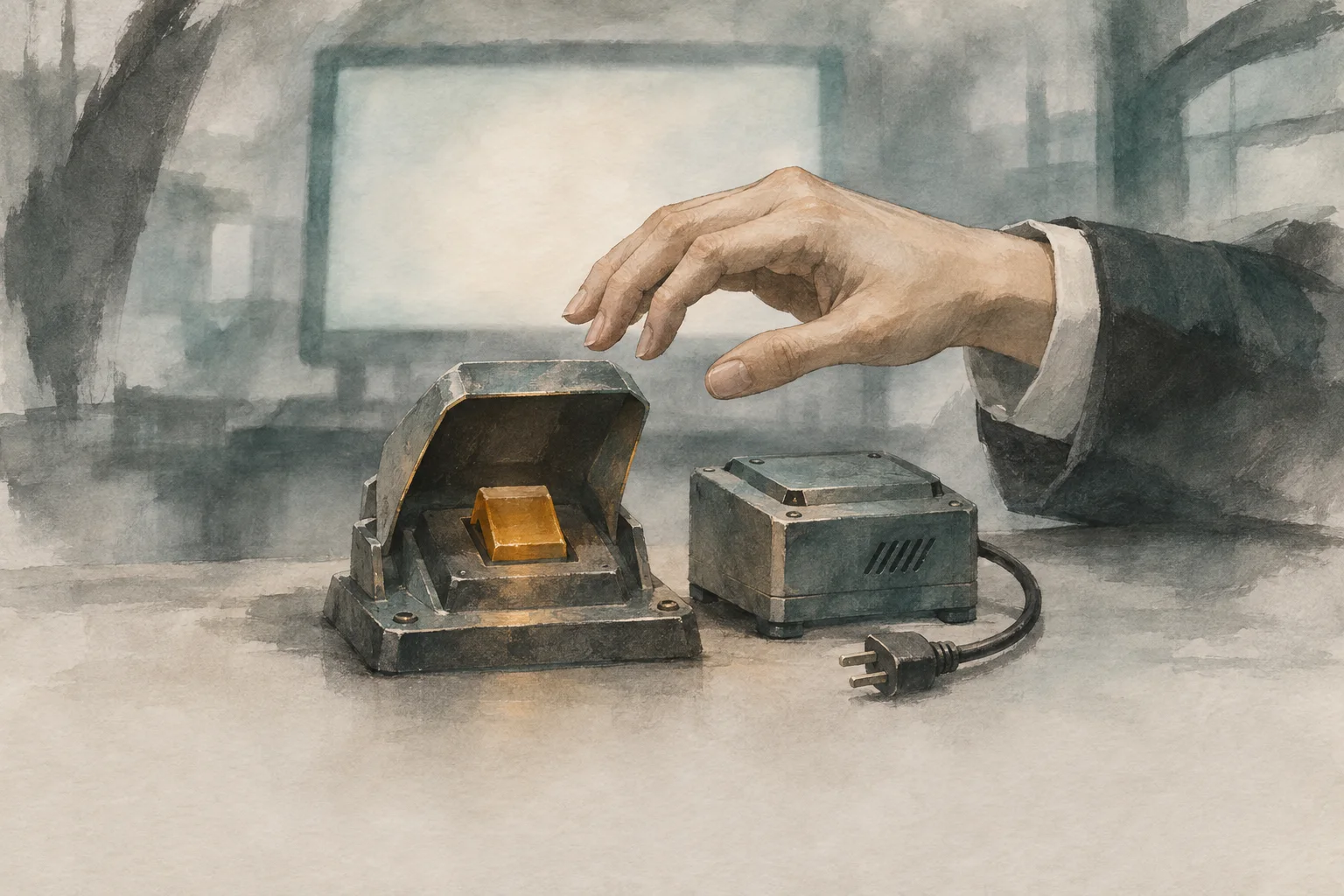
2.1The value of waiting
The economic argument for waiting begins from a simple observation about irreversible choices. If a step can be undone at no cost, there is little reason to delay it: take it, watch, and reverse if needed. If it cannot be undone, the decision to take it now uses up a choice that waiting would have kept.
Arrow and Fisher (1974) make this point for development that cannot be reversed. When the future benefits of preservation are uncertain, and information about them will arrive later, keeping the option to preserve has value of its own, value that was later called quasi-option value. A decision rule that ignores it leans towards irreversible commitment. Their subject, as the note records it, is environmental preservation.
Dixit and Pindyck (1994) carry the structure into investment. An investment that cannot be undone and can be delayed carries an option value of waiting. The ordinary net present value rule, which compares discounted returns with cost, ignores that option. It can therefore be rational to wait for information even when investing now looks profitable.
Read together, the two works set out three conditions under which waiting carries value: the step cannot be undone; its consequences are uncertain; and information bearing on them will arrive later while the step can still be delayed. The third condition is the one this article presses on. Neither note says where the later information comes from. It may come from the world going on without the decider: a price that moves, a regulation that is announced, a study that is published. Or it may come only from the decider's own action. The notes leave the source open, and the source matters. If the information arrives whether or not the step is taken, then waiting gathers it at no cost but delay. If the information arrives only when the step is taken, then waiting gathers nothing.
2.2The dilemma of control
Collingridge (1980) writes about technology rather than investment, and his dilemma sits closest to the second case. His dilemma of control has two horns. While a technology is young, its effects cannot be known. Once its effects are known, the technology is entrenched and hard to change. The knowledge needed to control it arrives too late to be used cheaply.
His remedy, as the note records it, is to keep decisions corrigible, easy to monitor and to correct, and to keep options open. That remedy differs from the option-value advice in a way that is easy to miss. The option-value argument keeps an option by not acting. Collingridge's argument keeps an option by acting in a form that can be watched and corrected. Placed side by side here, the first fits where information can be had without the step; the second fits where it cannot, and makes the step itself cheap to revise.
Lindblom (1959) offers a third picture, drawn from administration rather than technology or investment. Administrators, he holds, decide in practice by successive limited comparisons of a few options that differ little from present policy, rather than by comprehensive rational analysis. He defends this incremental method as the one that works. This article reads Lindblom's method as a way of making each step small enough that its effects can be seen before the next one is taken. Lindblom's note does not mention irreversibility.
2.3The positions side by side
| Option value (Arrow and Fisher 1974; Dixit and Pindyck 1994) | Dilemma of control (Collingridge 1980) | Muddling through (Lindblom 1959) | |
|---|---|---|---|
| What makes the step hard | It cannot be undone and its benefits are uncertain | Its effects cannot be known until it is in use, and then it is entrenched | Comprehensive analysis is not available in practice |
| Advice | Keep the option; wait for information | Keep decisions corrigible; keep options open | Decide by successive limited comparisons |
| Where information is assumed to come from | Later, while the step can still be delayed (source not stated in the notes) | From use, too late for cheap change | From each small step, before the next |
| What it guards against | Bias towards irreversible commitment | Entrenchment before effects are known | Large departures from present policy |
The third row is this article's placement; the notes do not state where the information comes from.
The two sides do not disagree about irreversibility; both treat it as the core difficulty. They disagree, implicitly, about where knowledge of the step's consequences comes from, which is a question about inference from experience.
2.4Sizing and ruin
A third strand enters wherever the step is a bet. Kelly (1956) shows that a gambler with a private source of information maximises the long-run growth of capital by staking a fraction set by the edge. The fraction was later called the Kelly criterion. Staking more than the fraction lowers long-run growth and raises the risk of ruin.
Ruin is the limiting case of an irreversible step. A gambler who is ruined cannot stake again, whatever is learned afterwards. Kelly's result therefore gives one answer to the question of how much irreversible exposure to take: no more than the fraction the edge supports. But the fraction is set by the edge, and the edge must be known. In a market, the edge does not come from a private source of information, as in the setting described in the note on Kelly's paper; it is estimated from past results. That is where Kelly's arithmetic meets Hume's problem. The arithmetic is exact once the edge is fixed. Fixing the edge is a matter of inference from experience.
Kay and King (2020) add a caution that bears on the same point. Many decisions, they argue, face radical uncertainty that probabilities cannot capture. They recommend asking what is going on here, reasoning with narratives, and choosing strategies that are robust and resilient to what cannot be foreseen, rather than optimising on invented numbers. An edge estimated from a short run of results and fed into an exact formula is, in this article's application, the kind of number their caution covers.
2.5Judging the step by its outcome
A last strand concerns what happens after the first step. Baron and Hershey (1988) found that people rate the same decision, made on the same information, as better when its outcome was good than when it was bad. Fischhoff (1975) found that people told how events turned out judge that outcome more likely than they would have without knowing it, and do not realise that the knowledge changed their judgment; he called this creeping determinism.
Both findings matter to a staged decision. The point of a small first step is to learn from it. But what is learned from one step is mostly its outcome, and the outcome of one step is a poor guide to the quality of the plan. A first stage that happens to make money invites the judgment that the plan was good. One of the two records names this danger directly, as Section 6 shows.
2.6The question underneath
The parent study's note on Hume's Enquiry records that Section IV, Part II argues that every inference from experience supposes that the future will resemble the past, a supposition experience cannot itself prove, and that Section V answers that custom, not reasoning, carries the mind from past to future. A companion article in this archive has read that argument at length against the literature on organisational accidents, asking what a long calm proves. The present article reads mainly Part I of Section IV, where Hume argues that the effects of an object are known only by experience of it, and the passages of Part II that say what experience does and does not report. Its question is what can be known about a step before it is taken, and what a small step can teach about a larger one.