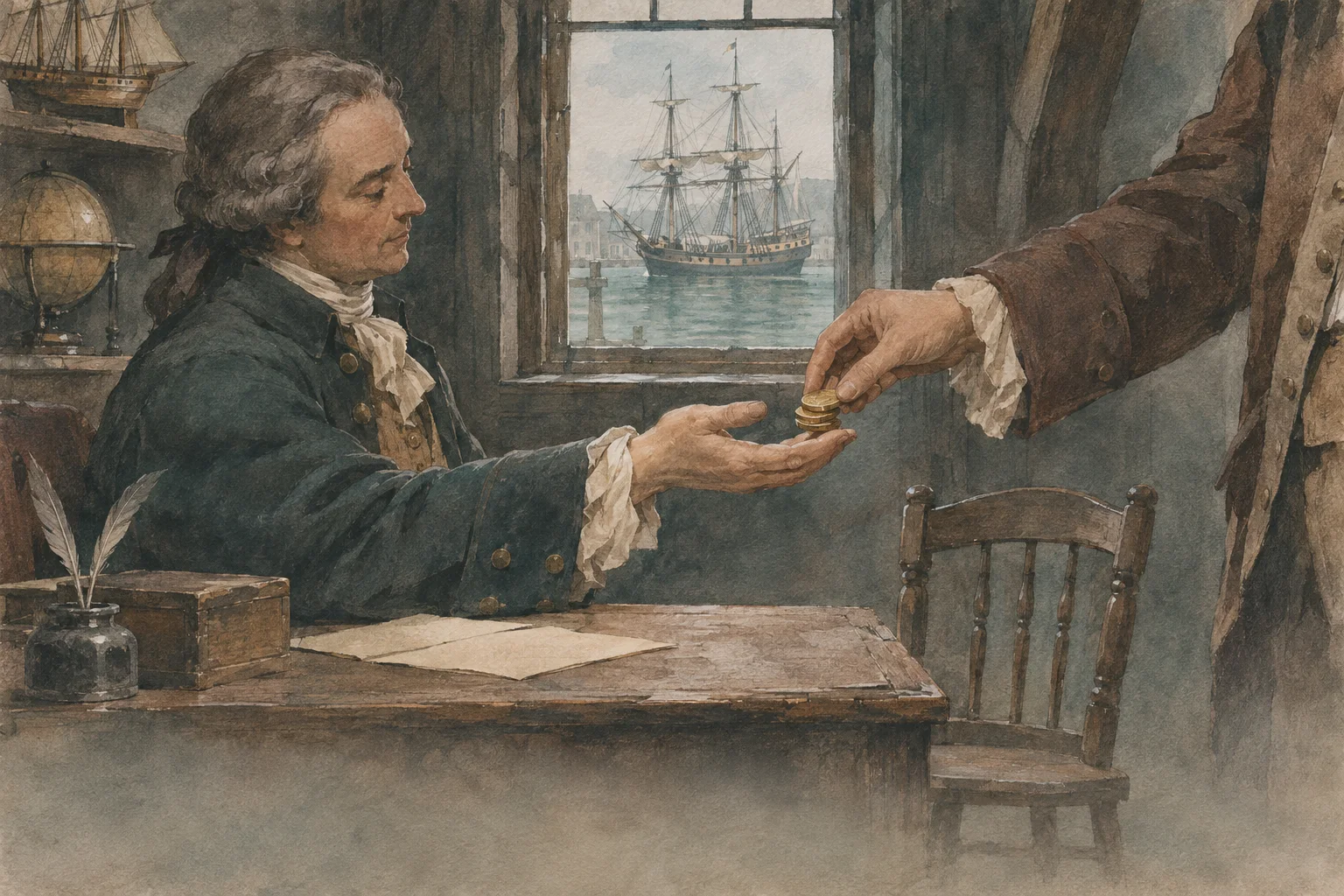
The interaction between steady interim inflows and deferred liabilities is a central theme in the analysis of financial commitments. When an underwriter expands marine insurance across peaceful seas or an investment venture books paper profits while asset redemptions are blocked, decision arrangements structure choices between immediate gains and future exposures. This chapter examines two synthetic historical cases from WSTiger—dated 1739 and 1974—analysing how steady cash flows interact with correlated hazards and illiquid asset freezes.
4.1Ten calm years and gathering war
Synthetic scene. In a setting dated 1739, a fictional marine insurance underwriter sits at a table where policy papers for shipping voyages are laid out. The underwriter looks over the policy terms after ten years of rare accidents along the route. Across the table, the underwriter's hands rest upon the documents as rumours of war between two countries circulate. The underwriter waits to determine whether to increase underwriting, share risk with other underwriters, or set an underwriting limit by route. The scenario establishes the initial conditions:
A fictional marine insurance underwriter greatly increases insurance on a shipping route where accidents have been rare for ten years, generating stable annual premium revenue.
For ten consecutive years, maritime commerce along the route operated with few accidents. In an insurance setting, an extended period of rare claims generates statistical confidence. Participants may interpret the steady inflow of premiums as stable income, taking past calm as evidence of continuing safety. In Taleb's (2007) terms, protracted calm creates an epistemological trap: participants mistake the lack of adverse events for structural resilience, discounting catastrophe until a systemic shift occurs.
The tranquil setting is altered when an external geopolitical contingency emerges:
Rumors of war begin circulating between two countries.
Under ordinary conditions, maritime insurance operates on the assumption of independent events: an accident suffered by one vessel does not indicate that another vessel will suffer damage elsewhere. War, however, is a common-mode contingency. If naval hostilities begin, multiple insured ships may face capture or disruption simultaneously. The underwriter's central question isolates the strategic dilemma:
Should underwriting be increased further, risk shared with other underwriters, or an underwriting limit set by route?
Faced with this choice, the three options present distinct trade-offs: increasing underwriting captures ongoing premium income while accepting concentrated exposure; sharing risk with other underwriters disperses potential claims at the cost of ceding premium; and setting route limits caps the underwriter's aggregate liability while forfeiting premium on voyages outside the limit. WSTiger's example judgment presents this reading of the dilemma:
This example distinguishes revenue earned during a period of rare accidents from the risk that a single event triggers claims on many contracts at once.
When a common event such as war occurs, the total claim amount is compared with capital.
The invalidation condition sets out the formal boundary for reconsidering this policy:
Re-judgment is carried out once the possibility of war is resolved or the contracts are confirmed to be spread across different risks.
This invalidation condition identifies the qualitative condition—the resolution of war rumours or confirmation of risk dispersion—without specifying an observable numerical threshold, leaving policy revision to qualitative assessment.
4.2Paper profits and illiquid claims
Synthetic scene. In a setting dated 1974, participants in a synthetic joint venture operating entity gather around a table where operating ledgers are spread open. The participants look at accounts showing a profit on the books, while notes alongside indicate that redemptions of some assets are blocked. Their hands turn the ledger pages, noting that investor payment commitments come before asset recovery. The operating group waits to decide whether reported profit should be distributed, available cash should serve as the basis, or payment schedules should be negotiated. The scenario describes the operating environment:
The synthetic joint venture operating entity showed a profit on the books, but redemptions of some assets were blocked.
In financial accounting, firms may recognise revenues on an accrual basis when contractual entitlements arise, even if cash has not yet been received. While this standard reflects formal earnings under normal operating conditions, it creates operational friction when liquidity is constrained. If asset redemptions are blocked, an entity may record positive valuation profits while lacking available cash to satisfy immediate claims:
Investor payment commitments come before asset recovery.
This gap of timing between payment commitments and asset recovery creates an immediate administrative conflict. Investor payment obligations are due, yet available liquid funds are constrained. The central question articulates the options:
Should the reported profit be distributed, should available cash serve as the basis, or should payment schedules be negotiated?
The three options present distinct approaches to managing the constraint. Distributing reported profits honours immediate expectations but risks liquid shortfalls if blocked assets remain unrecovered; basing distributions on available cash preserves solvency while reducing immediate payments to investors; and negotiating payment schedules aligns disbursement obligations with asset recovery while imposing the burden of waiting on investors whose receipts are deferred. WSTiger's example judgment distinguishes accounting figures from cash liquidity:
This example distinguishes unrealized profit from payment capacity.
Asset recovery that has not been confirmed does not automatically fund the scheduled payments.
The invalidation criterion establishes when this posture should be revised:
If the timing of asset recovery is delayed or the priority of payment obligations changes, it is re-judged.
As in the 1739 setting, the invalidation criterion names qualitative contingencies—delayed recovery timing or shifting payment priorities—without establishing a numerical threshold.
4.3How the records treat waiting and exposure
When these two synthetic settings are analysed side by side, they illustrate how risk arrangements structure choices between immediate cash flow or reported profit and deferred liabilities.
In Case C001, the underwriter collects premiums during calm intervals, while the exposure to common-mode losses becomes salient when rumours of war circulate. In Case C004, the entity records profit on the books, while liquid payouts depend on whether blocked asset redemptions can be recovered.
In this study's reading, both settings can be examined alongside economic theories of tail risk and instability. Raghuram G. Rajan (2005) emphasizes how incentive structures encourage taking risks that yield steady interim returns, while Hyman P. Minsky (1986) posits that stability breeds instability as financial commitments become more fragile over time. In these synthetic cases, past calm or book profits precede proposals to expand commitments or navigate liquidity delays.
Importantly, neither record specifies who bears the cost of waiting while decisions are deferred or reassessed. In the ledger's quantitative distributions across all 53 cases, the bearer of waiting costs is settled in only 24 cases (and read as implied or unknown in all of them), while remaining unsettled in 29 cases. The records focus on the procedural choices of the operating entity, leaving unstated which specific parties absorb the losses if common-mode shocks occur or if assets cannot be redeemed.
4.4The synthetic records
To examine how WSTiger's analytical architecture structures these choices, the formal parameters of the two records are summarized below:
| Field | Case C001 (Marine Insurance on a Calm Route) | Case C004 (Trapped Cash and Paper Profit) |
|---|---|---|
| Setting Year | 1739 (synthetic past) | 1974 (synthetic past) |
| Core Vulnerability | Marine underwriting expanded over ten calm years; rumours of war circulate | Accounting profit booked while asset redemptions are blocked; commitments precede recovery |
| Key Distinction | Revenue earned during rare accidents versus single-event correlation claims | Unrealised book profit versus immediate operational payment capacity |
| Primary Trade-off | Expand underwriting versus share risk or set route limits | Distribute reported gains versus preserve cash solvency and negotiate schedules |
| Invalidation Condition | Possibility of war resolved or contracts spread across different risks | Timing of asset recovery delayed or priority of payment obligations altered |
| Condition Form | Qualitative geopolitical contingency (unobservable threshold) | Qualitative administrative contingency (unobservable threshold) |
4.5What the case adds
Mackay's historical narrative portrays speculative collapses as convulsions of collective delusion, where a populace is overtaken by sudden frenzy until panic restores sobriety. That narrative framing conceals the quiet administrative mechanisms that make tail-risk collection appear rational during the calm. In speculative promotions, promoters collect cash subscriptions immediately while obligations to pay dividends or redeem capital are deferred to an unexamined future.
Cases C001 and C004 isolate this exact mechanism in the concise prose of administrative decision records.
In Case C001, ten calm years create the precedent of steady premium revenue. The underwriter collects premiums voyage by voyage, while the catastrophic exposure—a naval conflict that captures all vessels on the route in a single stroke—remains dormant. When rumours of war circulate, the underwriter debates whether to expand underwriting, share the risk, or impose route limits. The invalidation condition specifies that the policy will be reassessed if the possibility of war is resolved or if contracts are verified to be dispersed across different hazards. That condition is a qualitative geopolitical contingency: it establishes no numerical benchmark or date. It allows the underwriter to continue harvesting premiums while war remains merely a rumour, keeping current earnings intact while aggregate capital remains vulnerable to correlation shock.
In Case C004, the joint venture books accounting profits on an accrual basis while asset redemptions are frozen. Investor payment commitments fall due before cash can be recovered. The record structures management's dilemma around three operational choices: distributing paper gains, basing payouts strictly on available cash, or negotiating delayed payment schedules. In doing so, the record converts a severe liquidity shortfall into an internal scheduling problem. Management decides how to stagger disbursements, while the investors whose capital is deferred absorb the uncompensated burden of waiting.
These cases contribute three insights to the debate between agency theory and sociological danger.
First, they demonstrate how administrative records formalise asymmetric choices within the firm. In both settings, the text structures the dilemma around internal accounting balances—comparing claim accumulation against capital in 1739, and distinguishing paper accruals from cash payment capacity in 1974—focusing on the procedural mechanics of the operating entity.
Second, they illustrate how invalidation conditions operate in administrative practice. It might be argued that setting a condition for revisiting policy demonstrates prudent governance, proving that the decision-maker actively identifies operational boundaries. But as Power (2004) and Clarke (1999) observe, when governance relies on qualitative criteria, those conditions make policy reviewable without creating an observable, binding constraint. By specifying unobservable conditions—such as awaiting the resolution of war rumours or changes in payment priority—the records leave the policy in force through ongoing internal discretion rather than establishing a threshold that forces liquidation.
Third, both records preserve an absolute silence regarding the external bearer of delay. In the parent study's decision ledger, independent coders left the bearer unsettled across more than half the catalogue (29 of 53 cases), while pre-registered tests for waiting costs on others (H1) remained unclear and decider-bearer distance (H4) found no empirical support. Cases C001 and C004 exemplify the root of that finding: the administrative format defines procedural options for the decider while leaving the parties who absorb the eventual delay outside the formal text of the record.