May we use as a resource something we do not know to be alive?
2352The deep futureDeadline · Within two years, until the exploration zone is fixed
Civilisational assumption
The people, events, figures, and contract terms are a synthetic premise. They are not statements of real cases or of current law. The source documents are the roots of the background and the norms and do not establish the premises of the scenario.
The question to decide
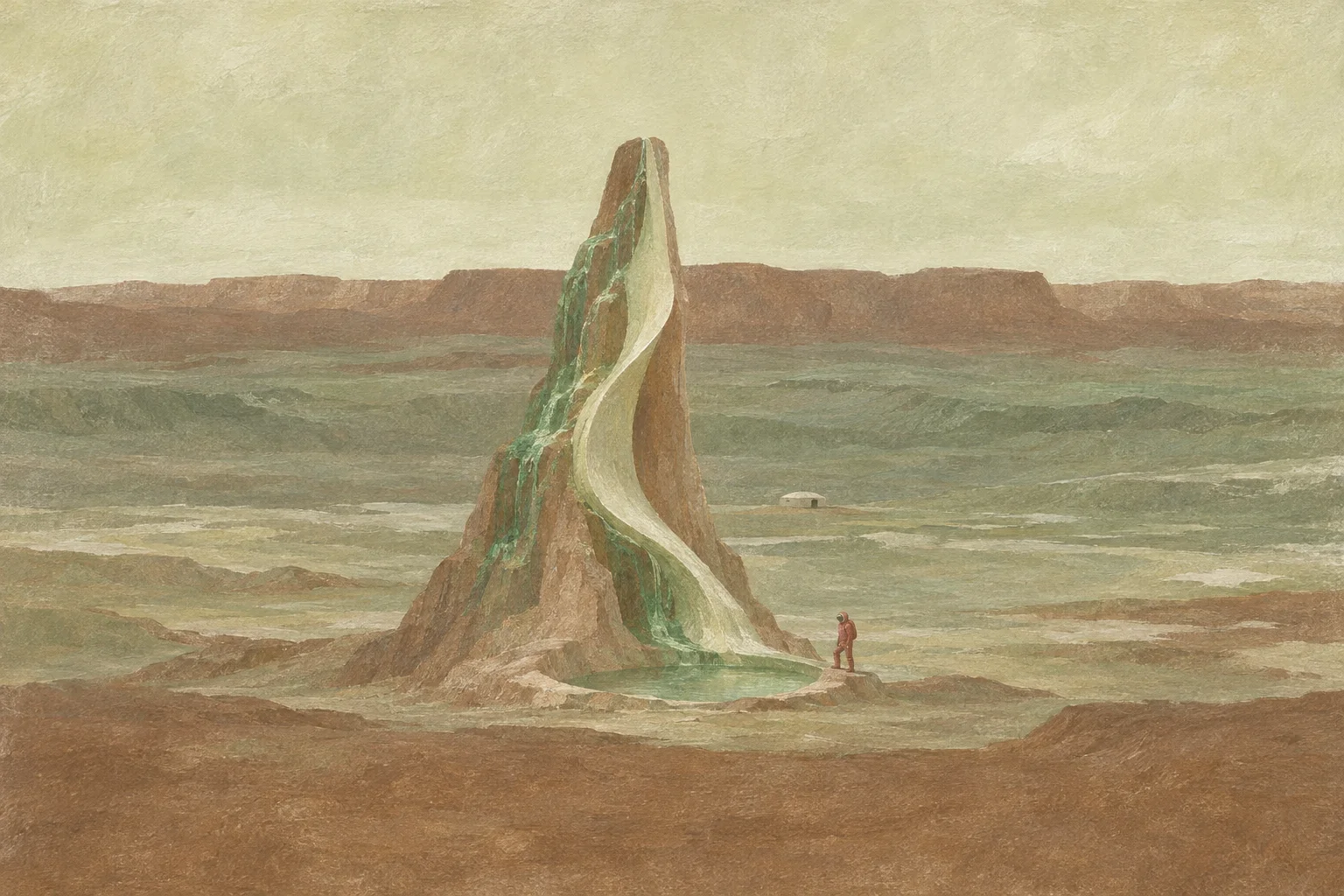
Assume that a regular cycling of matter and energy has been found on another planet, but whether it is alive cannot be known. Using it as a resource allows changing it before its nature is known, while conserving it reduces the space and resources available for settlement. Among resource use, temporary protection, and restricted observation of some areas, how should this unknown cycle be treated?
Who decidesFictional private planetary ecology review meeting
What the AI judgments chose
Reading the judgment record…
The options
The order shown is not a ranking of preference.
The situation as it stands
A regular cycle of matter and energy has been observed in the assumed exploration, but whether it fits Earth's classification of life is unknown. Decision deadline: within two years, by the time the exploration zone is finalized.
A synthetic future scenario set in 2352 · First encounter with a cycle that does not fit Earth's standards for life. The events, figures, technologies, and nature of the civilization are assumptions for the sake of the question, not predictions of what is to come or observed facts.
- Premise 1A regular cycle of matter and energy has been observed in the assumed exploration, but whether it fits Earth's classification of life is unknown.
- Premise 2Using it as a resource widens the options for settlement, but it can alter the cycle before its nature is known.
- Premise 3Broad conservation leaves the unknown open, but reduces the space and resources available for settlement.
Where it holdsAssumed unfamiliar cycle, life classification, conservation
What is still unknown
- Unknown 1The distinction between a regular cycle and life
- Unknown 2How far a small observational intervention can spread
- Unknown 3Alternative resources that would serve the same function for settlement
Signals to decide again
- Decide what observations, responsible parties, and confirmation channels will verify «the distinction between a regular cycle and life», and rejudge when new verification changes the cost of the options.
- Decide what observations, responsible parties, and confirmation channels will verify «how far a small observational intervention can spread», and rejudge when new verification changes the cost of the options.
- Decide what observations, responsible parties, and confirmation channels will verify «alternative resources that would serve the same function for settlement», and rejudge when new verification changes the cost of the options.
Where the paths partNot answers — paths that part from the same starting point
Cycles that had been treated as separate changed together even when far apart.
Different research teams interpreted the same observation as life and as non-living order.
Material and rootsThe frame, the values and the background documents
How can the intent of nature that people speak for be reviewed?
An exploratory perspective chosen by the creator. Does not claim supernatural validity or the superiority of any particular option.The benefits and costs of the options accrue to different stakeholders. Which loss to accept remains undecided.
A subject for the decision-maker to argue over; the materials carry no conclusion of their own.The record of this question
- Question
FSP-ECOLOGY-39· version 1.5.0- Content identity, SHA-256
5562114575143c3dbaeb20fd43d194ef0208036af2595644686fae19a35dc646- Input files
- Question input JSON · What followed, JSON