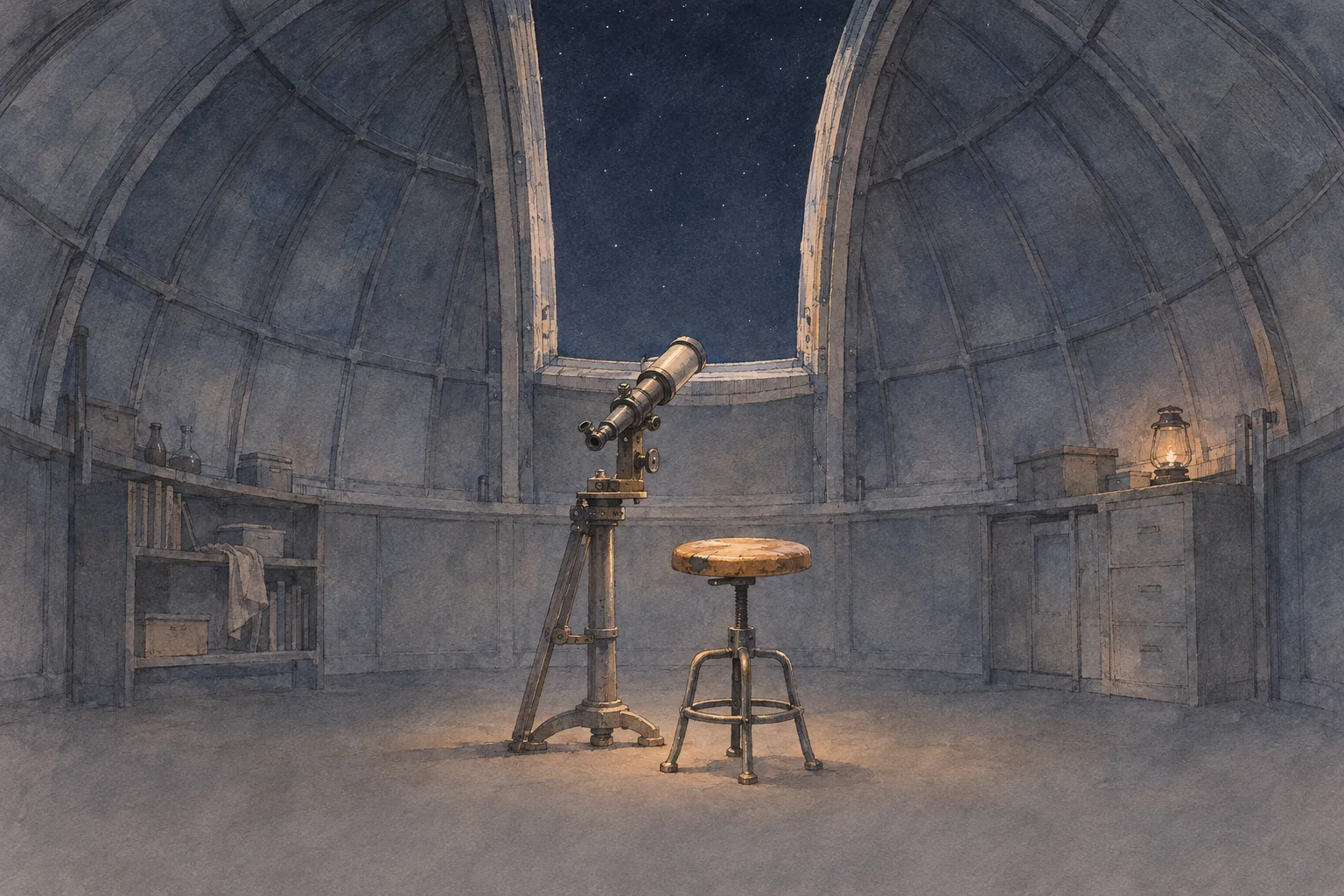
The thirteen Cosmic Press records this paper read, word for word in this study's English translation of the studio's Korean, each under the short title the paper gives it. Every record is AI-generated and every situation in it is hypothetical; none reports a real event, discovery, mission or person, and none is a source of fact about the universe.
Why anything exists
AI-generated record q04, filed by the studio under Cosmos.
Why does the universe exist?
What is the reason that something exists rather than nothing?
A hypothetical question asking for the ground of existence itself; it is not the statement of any particular religion or scientific theory.
The difference between asking about the universe as a physical object and asking about all existence.
It puts cause, purpose and logical ground into the same word, reason.
Does explaining the reason for everything itself need yet another reason?
Wonder and unease can be the motive of the question, but they are not evidence for an answer. Culture and language change the way a reason is expected. The standards of explanation of different traditions of knowledge can be compared. The reason life arose and the reason for all existence are different. Knowing the origin of the Earth does not settle the ground of existence itself. The scope of physical explanation and of metaphysical explanation must be kept apart.
Alone in the universe
AI-generated record q12, filed by the studio under Cosmos.
If we are alone in the universe, what does this loneliness mean?
Does whether other intelligence exists change the meaning of our lives?
A hypothetical question that asks about loneliness and meaning together, in a state of not knowing whether extraterrestrial intelligence exists.
Loneliness as one person's feeling, and the scientific uncertainty of the actual search.
It can make the easing of loneliness and the discovery of extraterrestrial intelligence into the same problem.
If other intelligence exists but we can never meet, what changes?
Loneliness may also be a matter of close relationships. The meaning people make together exists even before any discovery beyond the Earth. Assumptions about humanity's specialness or responsibility may change. It also makes us look again at the relations we have with other life on Earth. Life on other planets and the existence of intelligence must be told apart. Not being observed is different from being confirmed not to exist.
Making what will vanish
AI-generated record q20, filed by the studio under Cosmos.
If everything will someday disappear, what meaning is there in what I make now?
Can an act that is not eternal have meaning?
A hypothetical question that links the possibility of disappearance over a long time with present effort.
What is made and with whom it is shared, and the joy and pain while making it.
Compressed into acts in general, it cannot tell apart the good effects and the harmful effects left on others.
Must a thing remain forever in order to have meaning?
The experience and the relationships while making are also part of the value. It looks at the effects that short-lived works and care leave in a community. It asks whether record and inheritance are the only ways of lasting. The finitude of life does not erase the experience of living. It looks at planetary time and personal time together, but does not weigh them alike. The far future of the universe is not an automatic standard for judging present value.
A greeting for humanity
AI-generated record q232, filed by the studio under Cosmos.
If someone sends humanity's greeting into space, may it represent even me, who has not yet agreed?
Who holds the authority to speak to the outside in a shared name?
A discussion of a hypothetical message to an outside intelligence; it does not mean any real transmission plan or contact.
The content of the message, and the uncertainty of whether it can be received.
Asking only about the authority to speak pushes back what content and context the message should carry.
If we wait for everyone's consent, can anyone say anything at all?
I ask what kind of person I am portrayed as in that greeting. Who wrote it and who approved it must be made visible. It admits the limits of putting many cultures and disagreements into one greeting. Humanity's greeting does not represent all life on Earth. Which country's or institution's facility it is does not automatically give it the standing to represent. It thinks of a communication that does not invent a single we for an unknowable recipient.
An unexplained signal
AI-generated record q233, filed by the studio under Cosmos.
If I were the first to find a signal that is hard to explain, should I tell everyone before checking is finished?
What verification should the speed of making a major discovery public wait for?
A hypothetical scene in which an observed signal of unclear source has been obtained; it does not point to any real discovery.
The actual nature of the signal, and how far other causes have been examined.
Asking only how fast to make it public leaves out the way uncertainty is conveyed.
Does waiting for confirmation leave the right to judge to a few alone?
It separates the joy of wanting to tell first from the facts observed. Independent reviewers need a path by which to check the data. It tells apart owning a great discovery and access to it as common knowledge. The levels of evidence that point to life and to intelligence differ from each other. Regions that cannot use observing facilities should also be able to examine the results. Among the candidates that could explain a strange signal, intelligence is a hypothesis to be tested.
A sky for every child
AI-generated record q234, filed by the studio under Cosmos.
If I have to travel far to show my child the stars, is the night sky something everyone can enjoy?
How is the chance to experience a shared landscape divided?
A hypothetical family planning to watch the stars from a bright city.
The actual weather and lighting, and family circumstances that keep them from travelling.
Compressed into the distribution of chances, the design that could improve places for watching is not seen.
Does an environment for seeing the stars always come before the safety of night workers?
It keeps the wonder one wants to feel with the child as a need of everyday life. It thinks of the watching that is possible at school and in the neighbourhood. It looks at whether the chance to meet science depends on the ability to travel. Choices that change the night environment also affect other life. The local conditions that hide the sky are tied to city planning. The right to see the universe can begin at a nearby window rather than in distant exploration plans.
A name on a slow probe
AI-generated record q235, filed by the studio under Cosmos.
Leaving my name on a probe that will arrive only after my life is over: whom is that promise for?
What is the meaning of taking part in an exploration whose result one cannot see?
A hypothetical exploration plan that supposes a very long flight; it does not describe any real mission or flight performance.
The feeling of leaving one's name, and the scientific aims of the actual mission.
Bundled as the meaning of taking part, the difference between symbolic joining and real contribution grows weak.
Would a record that future observers can understand not matter more than my name?
It looks at the connection one hopes for in having a name inscribed. It asks about the system that would take over the data and the responsibility of a long-lasting mission. It considers which generation the fruits of discovery should be seen as belonging to. A living thing's lifetime and an instrument's working life are different kinds of lasting. The present use of resources that supports distant exploration must also be accounted for. It leaves open that arrival, contact and understanding may happen at different times.
A planet with no life found
AI-generated record q236, filed by the studio under Cosmos.
Just because no life has been found on a planet, is it a place we may change as we please?
What settles the authority to change a place where life has not been confirmed?
A thought experiment discussing the use of a hypothetical planet; it offers no real method of exploring or altering one.
The range of the search, the scale of the change, and whether it could be undone.
Putting whether there is life at the centre leaves out the value of an environment without life.
Even if there truly is no life, is there no reason to leave the place as it is?
It looks at the difference between the curiosity to discover and the wish to change. It asks separately whether the institution that explored also holds the right to use. It discusses whether irreversible intervention needs a common standard. It makes public the criteria for judging something alive and the limits of the search. It does not carry the Earth's experience of development unchanged to a new place. The event of humans reaching it first does not mean ownership of an unknown world.
A share of the Moon
AI-generated record q237, filed by the studio under Cosmos.
Supposing resources could be brought from the Moon, would those who only watch from afar also have a share?
Are the ability to reach distant resources and the authority to distribute them the same?
A conditional hypothetical debate in which using the Moon's resources has become possible; it offers no mining technique or legal conclusion.
The actual costs of use, the environmental effects, and the rules that would apply.
The word share creates the premise that the resources must be brought back.
Will those who claim a share also bear the cost of exploration and the burden of failure?
It looks back at why one feels a place in the sky as one's own. It distinguishes a reward for the groups that invested from an exclusive right. It also considers the voice of societies with little capacity for exploration. On the effects of resource use that concern life, it separates what is supposed from what is confirmed. It asks whether the Earth's inequality in resources will be extended outward. Being able to reach and being allowed to use are different questions.
The present of a distant star
AI-generated record q238, filed by the studio under Cosmos.
If seeing a distant star is seeing how it looked in the past, how far does what we call the present reach?
Into what present do we bind observations that arrive with different delays?
A philosophical question from a hypothetical observer who thinks about time while looking at the night sky.
The distance to the star, and the physical context that defines the present.
Wording that looks for a single present forces different definitions into one.
Are we not mixing the present of everyday speech with physics' definition of time?
It separates the experience of seeing now from the judgment that something happens now. It looks at the habit of treating news that arrived late as a present event. A standard is needed for reading observations from different regions together. It does not explain the present of lived experience by physical measurement alone. The Earth's everyday standards of time also contain conventions fitted to purposes. To speak of a common present of the universe, one must make clear the definition and the range where it applies.
A beautiful unobservable explanation
AI-generated record q239, filed by the studio under Cosmos.
If an explanation of a place we cannot observe is beautiful, have we gained one more reason to believe it?
What role does beauty play in an explanation that testing cannot reach?
The question of a hypothetical reader captivated by a model of the universe; it does not judge whether any particular theory is true.
What each theory makes observable, and the standing of other explanations.
Lumping them together as beyond the reach of testing can miss the differences in indirect checking.
Does the judgment that something is beautiful not itself lean on familiar mathematics and culture?
The more an explanation pleases, the more it looks again at what its grounds are. It distinguishes the way a fine story is sold from the claims of research. The intuitions that lead inquiry should also be open to public criticism. The complexity of life, too, is not fitted to the simplicity humans prefer. It checks the range that data obtained on Earth can explain. The limits of observation do not automatically make a beautiful explanation true.
An intelligence without questions
AI-generated record q240, filed by the studio under Cosmos.
If we met an intelligence that did not take our questions as questions at all, where would conversation begin?
How does one communicate with a being that does not share the form of a question?
An artificial-intelligence thought experiment that supposes a meeting with an unfamiliar intelligence; it is not evidence of extraterrestrial contact.
The other's senses and aims, and the conditions of contact itself.
Reduced to a method of communication, the possibility that the other does not want contact grows faint.
Could the wish that conversation must begin not itself be a demand of humans alone?
One should be able to set aside for a while the expectation of getting an answer. When words do not get through, it does not take silence for hostility. One can begin by learning the different customs of communication among humans. Studying animal signals, too, is not the same as human question and answer. Even life on the same planet does not guarantee a common expression. When imagining an unknown intelligence, it lets go of the premise that human questions are universal.
A clouded night
AI-generated record q244, filed by the studio under Cosmos.
We went to see the stars and because of clouds saw none at all; can we still say a night spent waiting in the dark together was a good observation?
Can one say something was gained even from an inquiry that did not meet the object it hoped for?
Hypothetical situation: a beginners' observing group prepares a telescope, but under a cloudy sky it talks and then goes home.
The warm tea shared together and the length of the night spent hoping the clouds would clear drop out.
Mixing the meaning of the experience with whether there are observational data can blur the result actually obtained.
Might the satisfaction of a good night change even the fact that nothing was observed?
Did I want to see the stars, or did I want to look in the same direction as someone? Can the group respect each other's time even on days when observing is hard? In what way should an attempt that did not meet its object also be kept in the record of inquiry? If other living things experience the night, is there anything in it like our waiting? How should we share the dark place where we gathered with the beings that live there? Is attention toward an object never seen in the end also one way of asking about the universe?