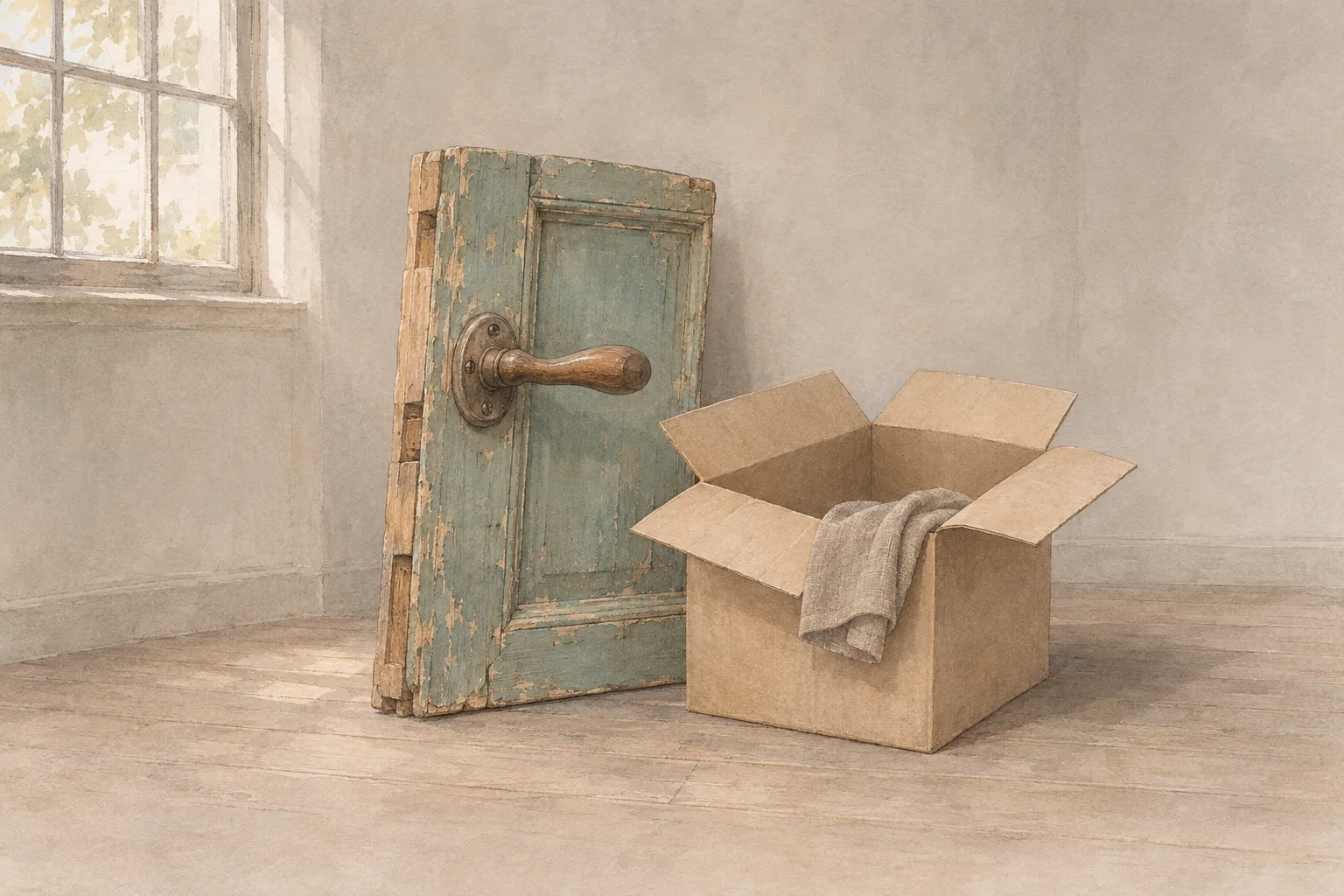
A question about memory always says, without meaning to, where the memory is. In the records read here, one imagined person asks how to remember a father who is missing from the family photographs; the memory is in the album, and the trouble is what the album shows. Another asks why the smell of an autumn wind brings back a conversation from years before; the memory is in the air, and the trouble is that it arrives uninvited. A third asks whether a pot that neighbours tended for decades can be saved from the scrap dealer; the memory is in the pot, and the trouble is that the building around it is about to come down. This paper argues that in a catalog of AI-generated questions, where the question keeps its memory decides which way the question's own doubt about itself will turn.
The question
The records belong to Cosmic Press, one of the RISCON family's studios, whose public catalog is made of generated questions set in imagined situations. An entry does not answer its question. It sets the question beside a compressed, more general form of it, says what the compression keeps and what it loses, names an assumption the question rests on, finds a defect in the compressed form, puts a counterquestion and carries the question across six scales, from a single person to the far future or the cosmos. The studio files each entry under one of its topics, and one of them is Memory.
The research question, then: when a Memory entry places the remembered past in something someone made, in an object or place that endures, or in a smell or a touch, which way does the entry's criticism of itself point? It belongs to a series of studies that ask of each record set how it frames a question and what it says is lost or defective in its own framing. The records are not testimony about remembering. They are framings, written to be read, and this paper reads them as such.
The answer in brief
The answer has three parts. Where a family or a village has made the record, the question is already suspicious of it, and the entry's criticism goes after the cure the question proposes, protecting what a more complete record would trample: a wish not to be photographed, a fact that can be checked, a private quarrel. Where the memory is a thing or a place that lasts, the record raises the thing into a store of memory, then charges its own question with nostalgia and names who would pay for the keeping. Where the memory is a sense, the critique deflates the moment and turns toward the person now near. Across all three, the notes that carry each question to larger scales give memory to other animals and send it into a future that either records everything or keeps nothing.
The contribution
The paper contributes three things. First, it gives a reading of how one AI-generated record set frames questions about memory: not as one picture but as three, sorted by what carries the memory. Second, it shows that the record set's suspicion of nostalgia is a suspicion on behalf of the present and of other people, not a suspicion about whether memory is accurate. The critique guards accuracy only where the memory is a made record, and there it guards a fact that a kind story might bury. Third, it offers a simple method for reading such catalogs: classify the carrier, then follow the direction of the record's own doubt, checking each reading with a plain count on the original Korean so that no translation decides it.
The debate
The works that this paper reads with divide, roughly, over whether memory belongs to the one who remembers or to the practices of a group, and they turn that question onto photographs, objects, buildings, nostalgia and forgetting.
The social view has a long lineage, and its own reviewers have found it hard to hold together. Jeffrey K. Olick and Joyce Robbins, Social Memory Studies: From 'Collective Memory' to the Historical Sociology of Mnemonic Practices (1998), describe the field as nonparadigmatic, transdisciplinary and centerless, and try to remedy that disorganization by building a tradition, a range of working definitions and a historical approach out of its diversity; the move their title names runs from 'collective memory' to a historical sociology of mnemonic practices. Susannah Radstone, Memory studies: For and against (2008), pushes from the other side. Debates about memory culture, Radstone notes, have hinged on its perceived over-personalization of the political, and the article argues that this split comes partly from over-generalizations produced by concepts that travel across disciplines; its conclusion is that the politics of memory culture and memory research might best be analysed within the disciplines and with the methods from which memory studies borrows. For a reader of the Cosmic Press records, the two together pose a test, which is this paper's own framing. A catalog that carries every question from one person to society and beyond can be read as a machine for travelling concepts. The question is which way it carries them.
On family memory and its media, three works give this paper its first lens. Robyn Fivush, The Development of Autobiographical Memory (2011), presents autobiographical memory as a system that integrates past experiences into an overarching life narrative, develops within social and cultural contexts, and, on the evidence the review presents, takes shape in the way mothers reminisce with their young children: elaborated and evaluative reminiscing goes with more detailed, coherent and evaluative autobiographical memories in the children. This paper reads that account as saying that a memory is told before it is owned. Marianne Hirsch, Family Frames: Photography, Narrative, and Postmemory (1997), as its publisher describes it, studies the conventions by which photographs construct family relationships, the idealized image a family responds to when it is photographed, and the gap between lived reality and that ideal; family photographs permit false impressions and misreadings and are still a powerful means of shaping personal and cultural memory. Annette Kuhn, Memory texts and memory work: Performances of memory in and with visual media (2010), looks at how performances of memory in and with films and photographs may embody, work through and even unpick the interconnections between the private, the public and the personal. This paper reads the three as placing memory between people and the family stories, photographs and films through which it is told, with Hirsch alone expecting the photograph to mislead as well as to keep.
On things and places, two works give the second lens. Sherry Turkle, Evocative Objects (2007), collects writings that reveal everyday objects as companions that anchor memory, sustain relationships and provoke ideas. Michael Guggenheim, Building memory: Architecture, networks and users (2009), asks why buildings are so disputed with regard to time and memory, shows how objects can stabilize memories, and argues that buildings cannot be isolated, because they are singular, stay in one place and are used by many people at once; the article calls them mutable immobiles, changed and converted while they still stand where they stood. This paper reads the first as handing memory to the object, and the second as noting that a building belongs to many users at once.
On nostalgia and forgetting, three works give the third lens. Svetlana Boym, The Future of Nostalgia (2001), asks why an age of globalization should be accompanied by a global epidemic of nostalgia, and whether people even know what they are nostalgic for; as the book's jacket puts it, it explores collective nostalgia, the personal stories of exiles and the souvenir collections of ordinary immigrants, and diagnoses an epidemic of longing and its antidotes. Paul Connerton, Seven types of forgetting (2008), questions the commonly held view that remembering is usually a virtue and forgetting necessarily a failing, and separates at least seven acts that the single verb covers, among them prescriptive forgetting, forgetting that is constitutive in the formation of a new identity, and forgetting as planned obsolescence. Viktor Mayer-Schönberger, Delete: The Virtue of Forgetting in the Digital Age (2009), as its publisher describes it, follows the role of forgetting and argues that the digital age's inability to forget has unforeseen and perhaps humiliating consequences in daily life.
The debate, then, is also about whether a memory should be kept more fully, whether keeping is a virtue, and who pays when it is kept or let go. The Cosmic Press records must raise such questions about themselves, because each must find a defect in its own framing. That makes them a useful object for the debate, with one caution. The works above study people, media, objects and societies. The records study nothing; they are generated framings. What they can show is which of the debate's positions an AI-generated catalog builds into its questions, and where it puts them. The next chapter sets out the records and the method, then reads the ten in three groups.