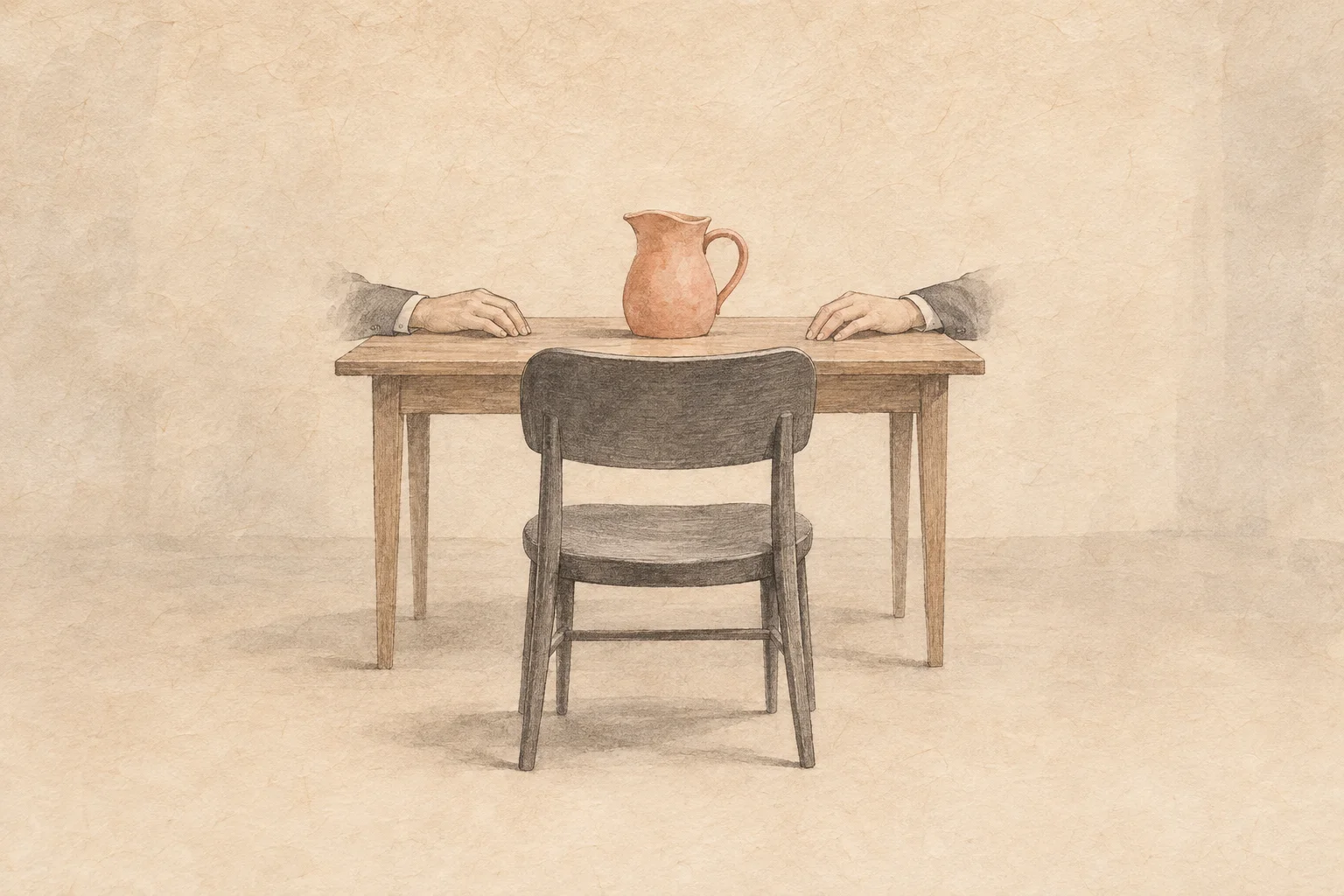
In 1947 Herbert Simon wrote on administrative authority; in 1993 Karl Weick wrote on organizational resilience; in 2016 the meeting recorded here took place. These pages set the three beside one another: Simon of 1947, Weick of 1993, the meeting of 2016.
5.1The architecture of formal office
Chrysostom's accession to the Roman empire reflects a foundational insight into institutional architecture: human organizations construct formal offices to establish collective coordination beyond the variability of personal character and moral virtue.
In Herbert A. Simon's sociological terms, a formal office establishes an institutionalized framework of authority. An office decouples the role from the individual who occupies it. The authority attached to the office does not depend upon personal affection or charismatic inspiration; it functions through codified rules, recognized jurisdictions, and institutional sanctions. Within this structural framework, subordinates operate within a clearly defined zone of acceptance, executing decisions because the command originates from a legitimate structural position.
Formal office also anchors Simon's hierarchy of means and ends. An executive office formulates the broad value premises that govern organizational policy, determining what objectives the institution will pursue. Lower-level tiers accept these value premises as fixed operational constraints, concentrating technical expertise on selecting the factual means necessary to execute them. By institutionalizing this division of labor, formal offices provide administrative stability, enabling predictable coordination across organizational units and time horizons.
5.2The fragility of unwritten gifts
In contrast to the rigidity of formal office, restraint grounded in communal gifts and unwritten habits represents an alternative organizational posture. When members share an internalized understanding of organizational goals and mutual trust, they do not depend solely on centralized commands, drawing on peer adaptation to navigate sudden operational friction.
However, just as Chrysostom observed that the spiritual gifts had long since ceased, this study notes that unwritten communal habits possess distinct vulnerabilities: 1. Vulnerability to Attrition: Unwritten habits and shared understandings depend upon continuous interaction and common history. When experienced personnel depart, informal consensus can dissolve, leaving newer members without explicit operational guidance. 2. Ambiguity of Legitimacy: In the absence of a codified mandate, informal initiatives can be contested. When a member steps forward to exercise initiative during an authority holder's absence, others may question whether the action constitutes a necessary operational bridge or an unauthorized overreach. 3. The Collapse of Sensemaking: When crises disrupt familiar routines, shared understandings can fail. As Weick documented in his reading of Norman Maclean's account of the Mann Gulch fire, the breakdown of shared sensemaking can cause role structures to disintegrate under pressure.
Communal habits operate effectively when operating conditions are understood and members remain aligned. When deep procedural ambiguity arises, the lack of formal office can leave groups struggling to validate emergency actions.
5.3Who sees the office and who bears the waiting
While formal office establishes clear jurisdictional boundaries, it introduces operational challenges when an authority holder is absent. Because formal authority is tied to the designated position, attendees may lack the mandate to finalize binding commitments. If an operational question arises while a key person in charge is absent, the group confronts an impasse between postponing action and proceeding without authorization.
This dynamic creates a divergence between decision authority and operational delay:
- The Absent Authority Holder: The individual who holds formal authority is absent from the immediate discussion. From the standpoint of formal governance, deferring action preserves jurisdictional integrity and avoids premature commitments.
- Personnel Stationed at the Stoppage: Those present at the operational stoppage—such as the meeting convener and the personnel assigned to execute outcomes—absorb the immediate friction of delay, balancing the risk of idle waiting against the hazard of unratified action.
This tension between authority and operational stoppage appears across the 186 cases of the catalogue. When two readers evaluate who bears the delay, the wider count confirms that the cost of waiting falls upon personnel nearest the stoppage in 174 records (supported in 99% of decided cases, with 1 against and 11 unclear; strict reading finds 39 supporting cases and 147 unclear). Similarly, the power to lift a procedural hold remains outside the hands of those who wait: lenient reading records 92 instances where removal authority resides with the holder or an outside party (supported in 97% of decided cases, with 3 against and 74 unclear; strict reading finds 9 supporting and 160 unclear). In addition, the protective boundary of a restraint remains obscured from those beneath it across 97 leniently read cases (supported in 95% of decided cases, with 5 against and 70 unclear; strict reading finds 47 supporting and 124 unclear).
5.4What the patristic debate adds to administrative theory
Reading Chrysostom alongside administrative theory illuminates why organizations navigate a persistent tension between formal rigidity and informal vulnerability.
Chrysostom preferred the Roman empire because external structural authority provides a visible deterrent against disorder that voluntary spiritual fervor could not perpetually sustain. Organizations rely on formal offices because codified rules and explicit jurisdictions prevent informal factionalism.
Yet formal structures carry reciprocal vulnerabilities. By concentrating authority in designated positions, organizations risk operational paralysis when an authority holder is absent. When participants rely entirely on formal office without cultivating shared communal sensemaking, they lack the internalized capacity to coordinate responsibly during an authority gap.
The synthetic record examined in the following chapter captures this exact dilemma: an absent person in charge leaves a meeting divided between the prudent argument to postpone decisions and the pragmatic demand to establish an initial framework.