Near the end of the twenty-first chapter of Leviathan, in a section headed "In What Cases Subjects Absolved Of Their Obedience To Their Soveraign", Hobbes writes a sentence that seems to unpick much of what the previous eight chapters built. The sovereign he has described cannot be accused, punished or deposed by subjects. Yet the subject's duty to obey has an end, and the end is set not by the sovereign's will but by the sovereign's capacity: obligation lasts "as long, and no longer, than the power lasteth, by which he is able to protect them." A few lines later the point is put in five words: "The end of Obedience is Protection".
This article asks a question that follows from those sentences. If obedience runs only as far as protection, what must a subject be able to see in order to judge whether protection still runs? A limit the subject cannot perceive is not, in practice, a limit the subject can use. And Hobbes is unusually attentive to perception. His account of the natural condition defines war by what is known rather than by what is done; his account of the commonwealth calls for a power that is "visible"; his account of release turns on what "a man seeth".
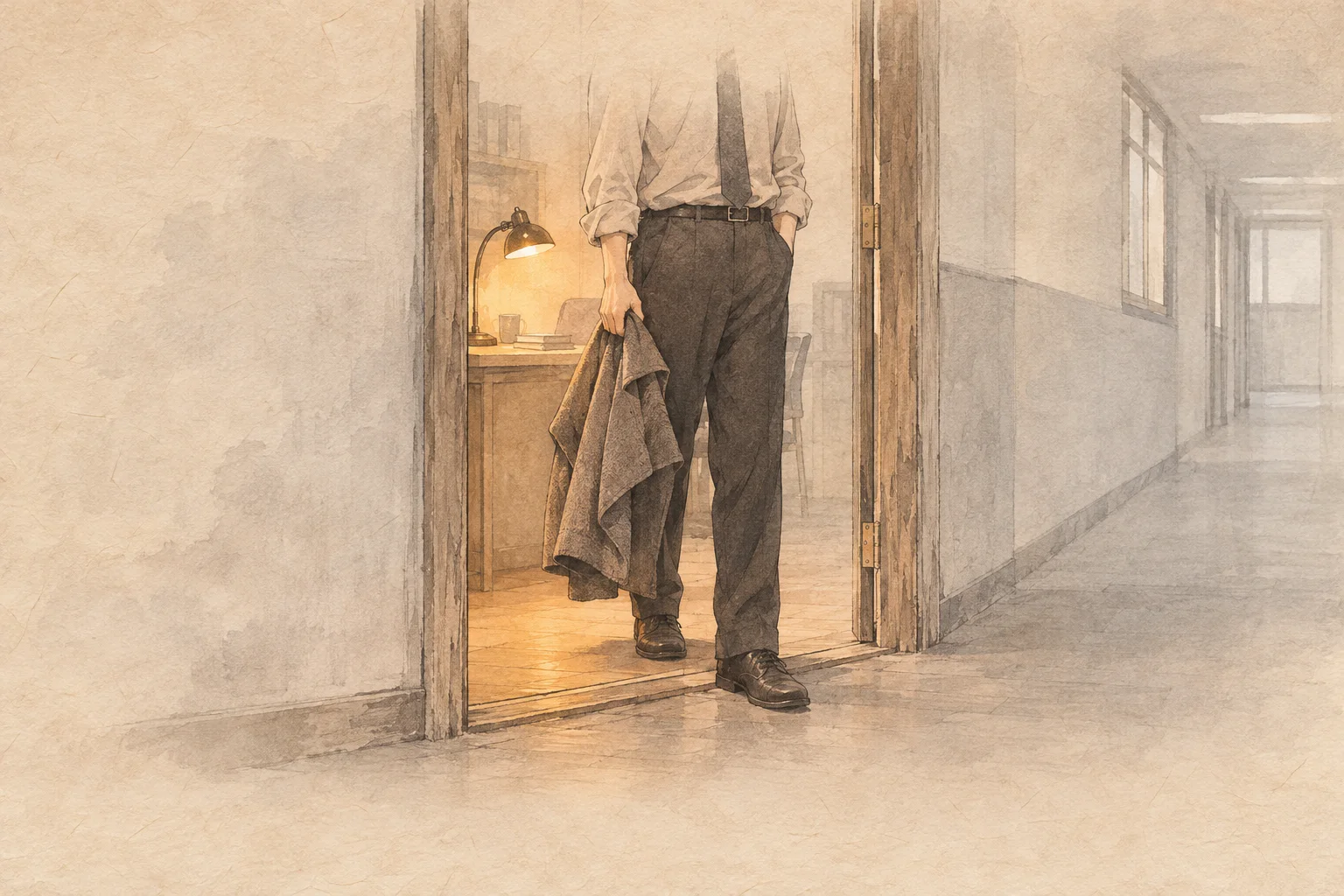
The question has a second half, set in a different kind of place. ARCHON, a studio in the RISCON family of sites, publishes small scenes drawn from working records, anonymised and summarised, each read through eight lenses. One of its scenes, which this article calls Hesitating to Leave, has a single sentence for its record: calls were forwarded after a manager's delay, and the employee who remained was not sure whether leaving was allowed. The scene is synthetic, a modern summary written for a platform and not an archival document. It is used here because it presents, in the smallest possible compass, a restraint whose end cannot be seen by the person it holds. No one ordered the employee to stay. The protection the post once required, someone to take the calls, had been redirected. And still the employee hesitated.
The debate this article joins concerns why people obey authority and when they may stop. Three positions can be laid side by side. On the first, obedience is owed to a power that protects and decides: Hobbes's sovereign, and, in the twentieth century, Carl Schmitt's sovereign who decides on the exception (Schmitt 1922). On the second, authority does not descend from a power at all but rests on the acceptance of those to whom an order is addressed, within a zone where orders pass unquestioned (Barnard 1938; Simon 1947). On the third, people comply chiefly because they see authorities as legitimate and their procedures as fair (Tyler 1990). Alongside all three stands an account of how members respond when an organisation fails them: by leaving or by speaking up, with loyalty holding exit back (Hirschman 1970).
Carl Schmitt served the Nazi regime from 1933, and critics read his theory of the exception in that light.
The contribution offered is a variable. Each of these positions has an answer to the question why people obey. Fewer, on the summaries this article relies on, say what a person must be able to see in order to stop. Hobbes, read closely, does say it, and he says it in a way that makes the subject's sight the hinge of release. The article proposes that the question whether the bearer can see the scope and the end of the restraint belongs beside the questions of protection, acceptance and fairness, and it tests the proposal against one synthetic scene in which the answer, on the record's terms, is no.
The placement of the secondary works in this debate, and their application to Hobbes and to the scene, are this article's own. What is attributed to an author below is limited to what the study's notes on that author state.
The article does not conclude that the employee should have left, or stayed, or that Hobbes's limit is the right rule for a workplace. It sets out what each reading gains and risks and who bears the cost, and it marks where a seventeenth-century theory of the commonwealth fits an office badly.
Sections 4 to 6 read the three chapters, with two short passages from chapters XVIII and XXIX that the source file prints beside them; Section 7 reads the scene.