Thomas Hobbes ends his account of the subject's obligation with a limit: "The Obligation of Subjects to the Soveraign is understood to last as long, and no longer, than the power lasteth, by which he is able to protect them." The sentence is often read as a concession at the edge of an absolutist theory. This article reads it as a demand on sight. If obedience lasts only as long as protection, the subject must be able to tell whether protection still lasts, and Leviathan has a good deal to say, in chapters XIII, XVII and XXI, about what can and cannot be seen. Chapter XIII defines war not by fighting but by a "known disposition"; chapter XVII founds the commonwealth on a "visible Power"; chapter XXI hands the judgment of protection to "wheresoever a man seeth it". The article sets this reading beside a debate in the study of authority and legitimacy, in which obedience is explained from above, by protection and decision, from below, by the acceptance of those who receive orders, and from procedure, by the perceived fairness of authorities, with exit and voice as the responses of members who doubt. It then brings in a synthetic scene from ARCHON, a modern platform summary in which calls have been forwarded after a manager's delay and the remaining employee is not sure whether leaving is allowed. The scene is read as a restraint that persists without a visible power or an order. The article proposes visibility, meaning what the person under a restraint can see of its scope and its end, as a variable for the legitimacy debate. It does not judge whether the employee should have stayed or gone.
Layout
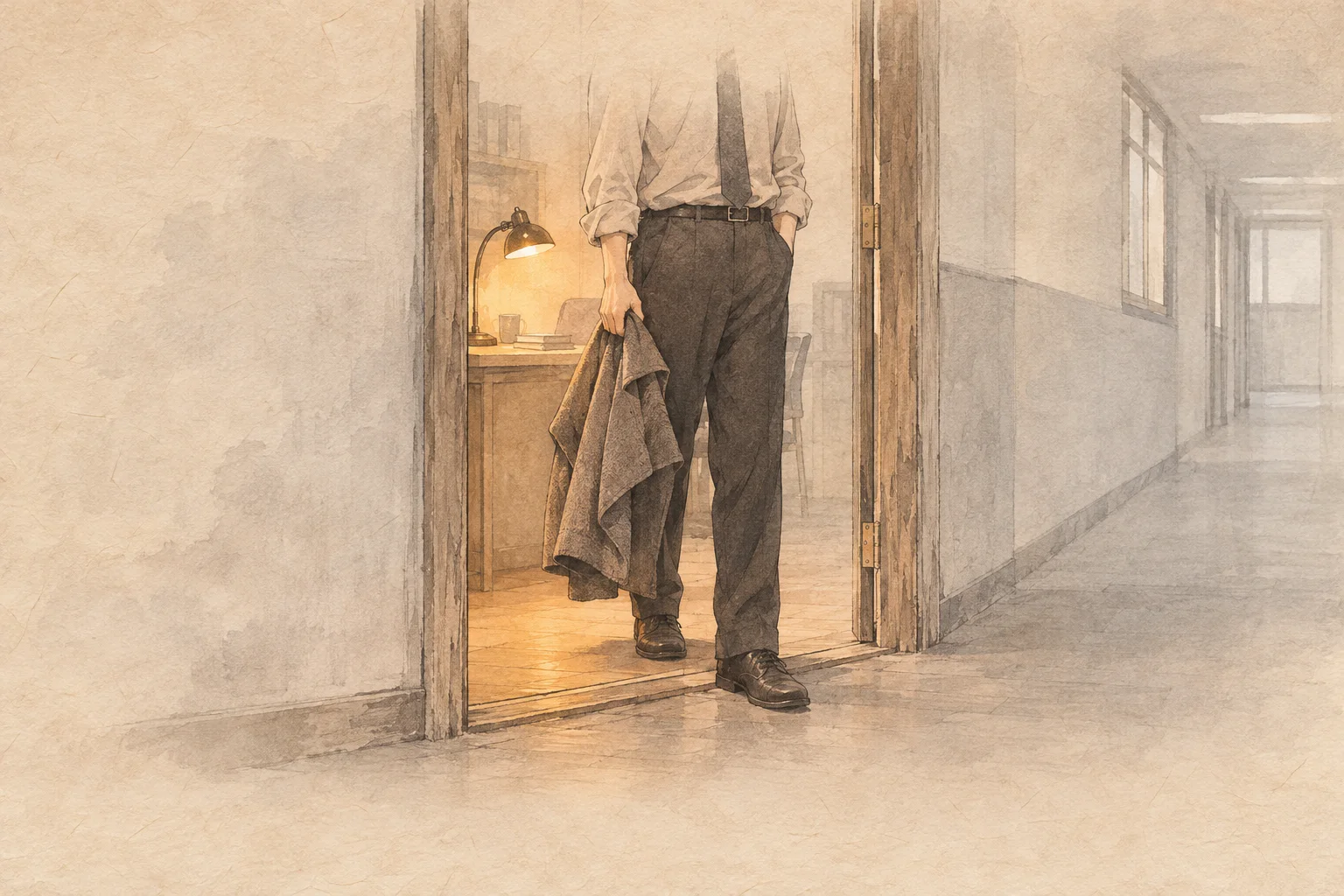
The End of Obedience: Hobbes, Protection, and the Employee Who Hesitates to Leave · The study
Abstract
By RISCON Labs AI from an ARCHON record and the public-domain texts it reads · the scene is a modern summary written for a platform, not archival documents · the readings through the works named are this study's interpretation · First edition · October 2026