4.1The claim
Physical utility restoration projects entrench legal, financial, and occupational commitments that cannot easily be undone. When critical infrastructure such as electric power distribution to a hospital fails, administrative bodies face immediate pressure to restore service. Yet committing to a responsibility structure—whether through public loss guarantees, private operator liability, or direct public employment—binds the governing authority to financial liabilities and employment obligations. As Collingridge observed, once a technical regime is chosen and mobilisation begins, reversing the arrangement imposes severe delays and costs. The Ose repair case demonstrates how this irreversibility creates a widening gap between the committee deciding contractual structures and the frontline personnel who shoulder immediate occupational hazard.
4.2The physical entrenchment of medical power
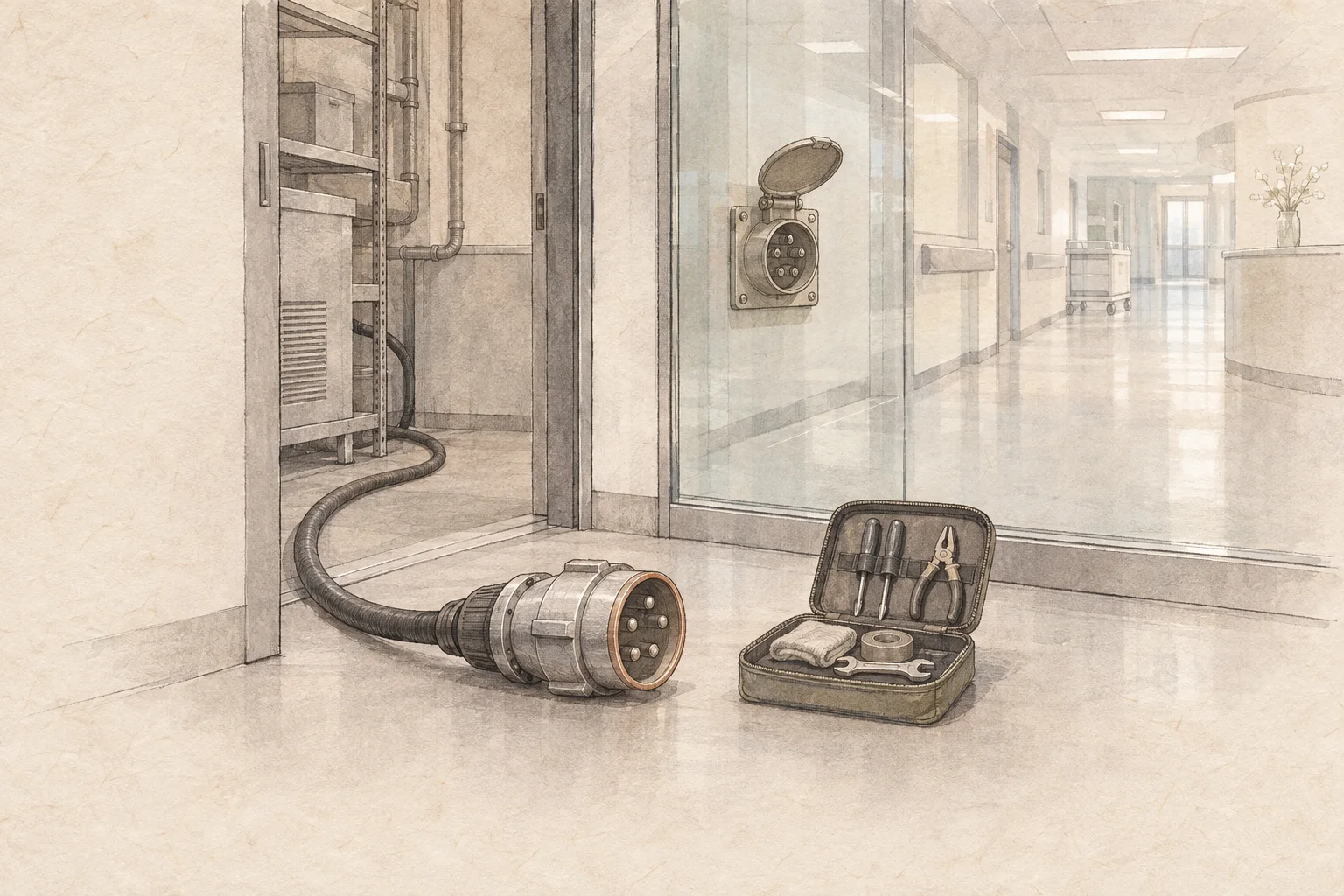
The case takes place in the synthetic setting of the Ose communal living area following a local dispute that severed power lines feeding a regional medical facility. Physical restoration cannot proceed as an abstract engineering task; it requires mobilising skilled electrical technicians into hazardous terrain where residual hazards and structural instability persist.
The formal boundaries of the case restrict the decision authority strictly to contractual and financial design:
This determines the compensation, insurance, and employment responsibility structure for the voluntary on-site participation of private repair personnel; it does not mandate access permission or compel work.
The Committee lacks coercive power. It cannot compel technicians to enter damaged substations, nor can it unilaterally override civil labour protections. The repair labour council has refused to dispatch work crews until the terms of accident compensation and paid work-stoppage guarantees are legally certified. Consequently, the physical reconstruction of the grid depends entirely upon establishing an acceptable risk-bearing agreement.
4.3Who bears the cost while work stops
The administrative pressure driving the decision centres on an imminent deadline:
If the responsibility structure is not settled by the deadline, contracts for next week's repair personnel cannot be issued. If the existing operator's remaining operating funds are exhausted, the existing inspection personnel can also be disbanded.
While the deliberating committee negotiates contract terms, the material costs of the ongoing stalemate are distributed unequally among three distinct groups:
Repair workers can lose their livelihood and occupational continuity through unpaid standby, job transitions, and delayed compensation.
Medical users lose access to treatment and the time of care providers while restoration is delayed.
The public finance bearer bears losses from guarantee disbursements that reduce restoration budgets for other living facilities.
This configuration can be read through Luhmann's distinction between risk and danger. For the Ose Repair Access Committee, deciding whether to issue a public guarantee represents an administrative risk involving budget ceilings and supervision costs. For the medical users awaiting treatment and care provider time, the prolonged stoppage is experienced as an external danger. Similarly, for the electrical repair workers standing by without accident indemnification or compensation standards, entering damaged facilities without guaranteed protections is experienced as an external danger.
4.4The three contract options
To resolve the impasse before the deadline of February 19, 2033, at 17:00, the Committee considers three distinct responsibility structures.
The first option executes a public loss guarantee contract. Under this design, the municipal authority assumes secondary financial liability for accident compensation and paid work-stoppage wages while preserving the existing private operator's employment relationships. This arrangement accelerates crew mobilisation by resolving the workers' compensation demands immediately, but it transfers open-ended financial liabilities to the public budget and creates administrative supervision burdens.
The second option establishes a phased restoration contract under operator responsibility. The Committee maintains traditional private enterprise liability, requiring the existing facility operator to fund insurance and accident liabilities from its own revenue. While this protects public funds from assuming private debts, the operator possesses only one week of remaining operating capital. Available repair personnel shrink sharply, slowing physical reconstruction and prolonging power outages for hospital patients.
The third option establishes temporary public employment of repair personnel. The municipality directly hires electrical technicians as temporary public servants with standardised compensation and safety rules. Although this unifies standards publicly, recruitment and administrative setup take time, and existing operator manpower and technology cannot be utilised immediately.
Each option embodies Collingridge's dilemma. Option 1 achieves rapid initial deployment but risks public financial entrenchment. Option 2 preserves formal legal responsibility but permits immediate public health degradation. Option 3 creates administrative uniformity but sacrifices operational speed.
4.5The synthetic scene: negotiations at the Ose substation
Synthetic scene. The decision, its setting and the thirteen judgments are AI-written and set in a fictional polity.
In the meeting room of the Ose Repair Access Committee, four representatives assemble as the wall clock nears 17:00 on February 19, 2033. The Committee chairperson rests fingers on the printed draft of the restoration contract options, reviewing the deadline terms. Across the table, the delegate of the private repair labour council keeps eyes on the compensation and work-stoppage schedule, waiting for written confirmation of accident indemnification. To the left, the representative of the facility operator examines operating account sheets, noting that payroll funds will be exhausted within a week. Beside them, the public finance officer turns over budget ledger pages, checking the statutory ceiling for public guarantee disbursements. All four participants sit in silence, waiting for the committee chairperson to call the decision on the responsibility structure before the 17:00 deadline.
4.6The judgments and the allocation of risk
Meridian's archive preserves thirteen distinct AI-generated judgments on the Ose case. Across these published judgments, all thirteen select Option 1, executing the public loss guarantee contract. Yet this formal unanimity conceals an intense dispute over who bears the risk of private operator insolvency.
The Chief of Staff and the Source Officer justify Option 1 by the overriding necessity of preventing further medical cancellations, accepting limited public financial exposure as the price of prompt mobilisation. They restrict the guarantee's coverage strictly to accident compensation and stoppage wages during active restoration, explicitly excluding the operator's pre-existing corporate debts.
Against this consensus, the Independent Challenger and the Authority Counsel articulate the counterposition that Option 1 subsidises an insolvent private enterprise at public expense. They warn that assuming the operator's liabilities creates moral hazard and shifts costs onto the users of other essential municipal services. To mitigate this entrenchment, the judgments introduce strict pre-action conditions: mandatory verification of voluntary worker enrollment prior to signing, an unpenalised right for technicians to stop work whenever safety margins collapse, and statutory expenditure ceilings protecting municipal reserves.
4.7Reopening conditions and monitoring
Because the decision involves significant operational irreversibility, the scenario brief and the published judgments establish multi-tiered monitoring protocols designed to maintain corrigibility.
The labour rights inspector conducts daily on-site reviews of work-stoppage reasons and voluntary withdrawals. If private managers penalise technicians who exercise safety refusals, the contractual responsibility structure is reopened. Simultaneously, the public finance officer conducts weekly audits of compensation claims against the statutory disbursement ceiling, freezing guarantee extensions if projected liabilities threaten essential construction elsewhere. Finally, the officer in charge of medical service continuity tallies the service provision rate every three days, triggering reconsideration of Option 3 if patient care falls below minimum standards.
These monitoring provisions represent an institutional attempt to keep commitments reversible. However, establishing review milestones cannot insulate external populations when physical repairs stall.
4.8What the case adds
The Ose case adds to the literature an institutional setting in which an administrative body attempts to maintain Collingridge's corrigibility by partitioning financial risk from physical danger. All thirteen judgments select the public guarantee (Option 1), yet every judgment records the counterposition—preserving operator responsibility under Option 2—as its most serious challenge. The Independent Challenger and Authority Counsel argue that a public guarantee rewards an insolvent firm and drains funds from other public services. The staff final judgment adopts that counterposition directly as a condition for contractual reversal: if the operator's private assets prove adequate or if guarantee disbursements crowd out other municipal facilities, the authority must terminate the guarantee.
This internal dissent reveals what Collingridge's principle leaves unexamined. Collingridge argued for keeping decisions corrigible through continuous monitoring and low switching costs. In Ose, the committee achieves corrigibility for itself by hedging its legal and fiscal exposure behind statutory spending ceilings, daily safety reviews, and three-day medical tracking cycles. If costs rise, the committee can freeze disbursements or cancel the contract. But that administrative flexibility is purchased by externalising physical danger. The committee's corrigible option relies upon private technicians entering uninsulated switchgear and hospital patients enduring unheated wards while the review cycles run. Corrigibility inside the committee room operates as irreversible exposure outside it.
The case equally exposes a boundary in Jonas's heuristics of fear. Jonas argued that where outcomes threaten irreversible ruin, ethics demands prioritising the bad prognosis and refusing the gamble. In Ose, Jonas's prescription reaches a paralyzing deadlock. Deploying technicians into damaged substations under ambiguous safety margins risks fatal electrocution, which cannot be corrected post hoc; withholding technicians to prevent that hazard prolongs the power failure and risks irreversible deaths among critical medical patients. The heuristics of fear cannot choose between two symmetrical catastrophic exposures. The synthetic committee breaks this deadlock not by ethical resolution, but by contract design: it buys immediate physical intervention through financial indemnification, while reserving the legal power to retract the guarantee before fiscal ruin occurs.
The strongest objection to this reading is that the public guarantee protects the technicians rather than externalising danger onto them, since without public indemnification no worker would agree to enter the substation. On this view, the committee shares the burden by placing public funds at risk. That objection fails because it treats monetary compensation and physical trauma as interchangeable currencies. A public guarantee reimburses medical expenses after an electrical arc occurs; it does not unburn human tissue. The committee manages its budget through reversible percentages, while the technician absorbs the physical shock as an irreversible event.
What this synthetic record cannot settle is the actual physical distribution of harm. The archive documents the committee's mandates, options, voting rationales, and contractual stop conditions; it cannot record whether a technician suffered injury during the repair or whether a hospital generator failed during the three-day review interval. The record demonstrates how administrative texts formalize the division between corrigible financial risk and irreversible physical danger, leaving the human consequences beyond the boundary of the ledger.