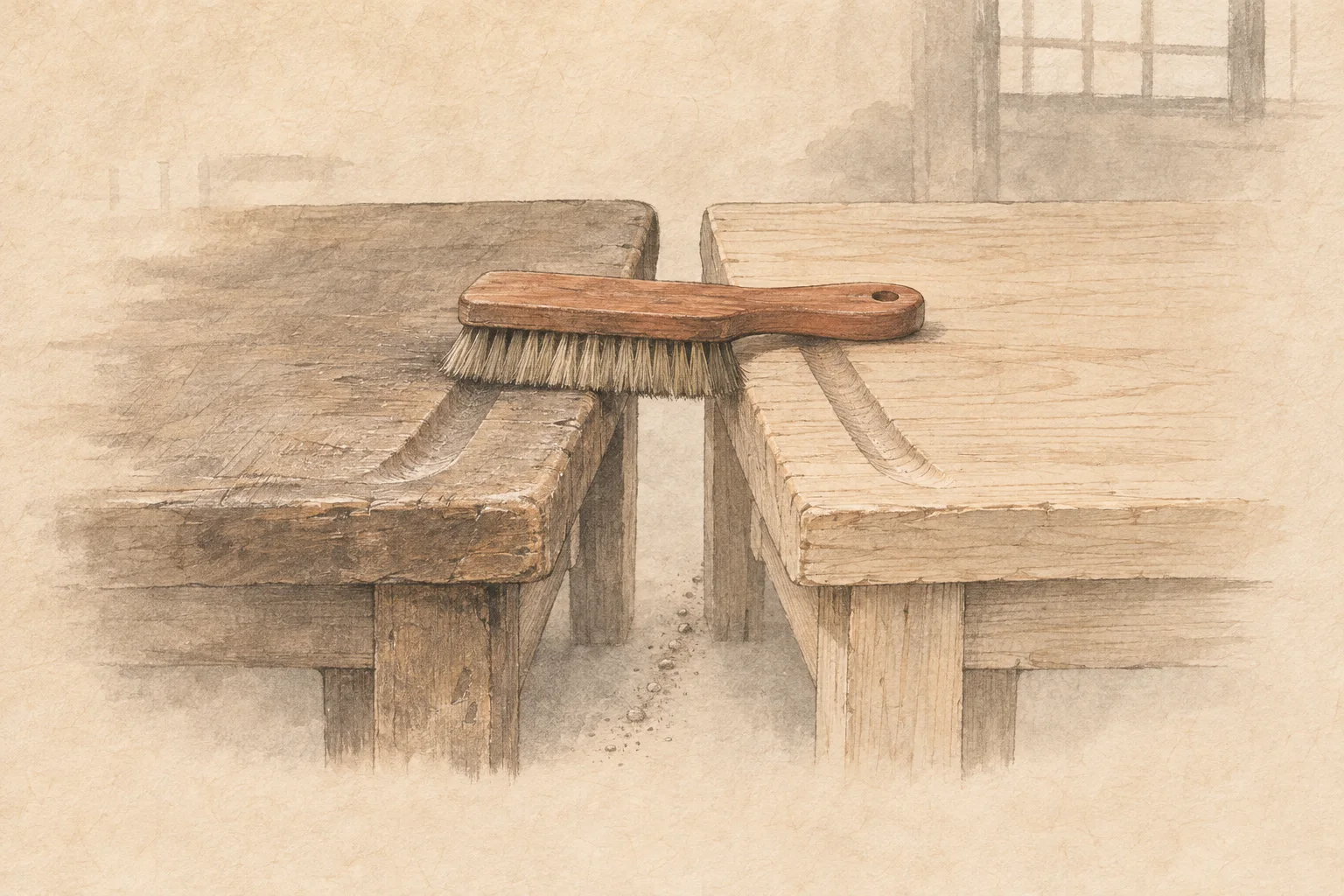
NADIR, a studio in the RISCON family, publishes question–judgment pairs about decline, filed under a research frame that runs from a decade of erosion through a collapse in 2026 to a turning point in 2027. Every pair is a hypothesis, the frame's ending is not an observed fact, and the studio calls its judgments and options a model's conditional proposals. This paper reads the sixteen pairs that the studio files under work, which it labels commitment and execution, in the transition year, and that set out options. All are unreviewed hypothetical decision exercises in two invented situations: a new organisation that starts by quickly copying the procedures of the previous one, and a small new team in which everyone has agreed to help without dividing who is in charge. No pair names a real person, organisation or event. The paper asks how the set frames the work of starting again.
Its answer has four parts. The exercises never speak of commitment; they ask where work lives. In the copied organisation they find procedures that outlast the problems they once solved. In the small team they find work that nobody owns drifting to the capable, the willing and the first to notice. Their recurring remedy is to give each continuing task a reason, a holder and a substitute, while the options set beside them speak of scope and charge rather than of inheritance. The paper's contribution is a reading, in a synthetic record set, of starting again as a problem of where work and its reasons are kept.