Question: When missing the last train means no other scheduled service that day, should the train leave on time, wait within a limit, or leave on time while late connecting passengers are carried separately?
Decision year: 2026
Deadline: Within 20 days, before the new last-train operating agreement
Who decides: Fictional Night Transit Connection Council
World: Realistic synthetic. The people, organizations, figures and events in this case are fictional constructs.
This page follows one decision through three steps. First comes the question as the record sets it. Then come the thirteen AI judgments made on that question, where they meet and where they part. Last come the observations that will later show which judgments held up. The check has not happened yet. Nothing on this page says which option is right. The council decides, and so does the reader.
1Prologue: The last two minutes
Synthetic scene: the people, places, times and lines of dialogue below are invented to show the record's premises. They are not observations.
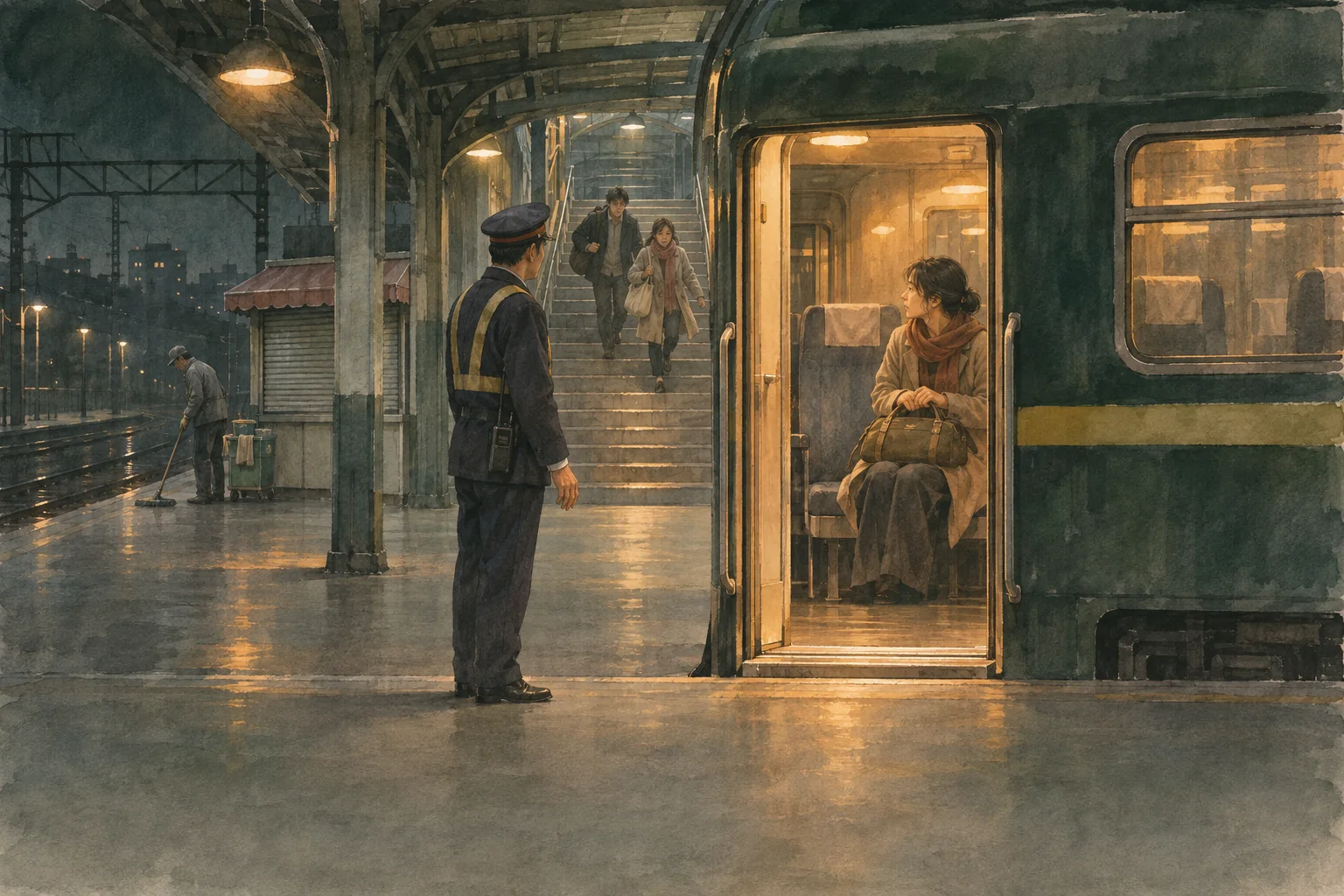
The station is where two lines meet. At this hour the platform lights are still on, but the kiosks behind the ticket barrier have pulled down their shutters. A cleaner pushes a cart along the far wall and does not look up. The last train of the night stands at the platform with its doors open. Its scheduled departure is two minutes away.
The station operations officer stands near the front of the train, under the arrival board. Most of the board has gone blank for the night. One line remains: the connecting service from the other line. Next to it, one word: delayed. There is no number of minutes beside the word. The officer has been watching it for a while, as if staring might make a number appear.
The cab window slides down. The driver leans out.
"Are we holding?"
"Not yet."
"I hand over at the terminal," the driver says. "The maintenance crew takes the train off me there. If I'm late, they start late. And whoever's after them starts late too."
The driver says it flatly. It is not a complaint. It is how the night is put together: one person's end of shift is the next person's start. The driver checks the time on the cab clock, then on a wristwatch, as though the two might disagree.
Two carriages back, a passenger sits with a bag on the seat beside them and a phone in one hand. They are not worried yet. They have a connection to make after the terminal, a different service from the far end of the line. They have made it before. It works as long as this train leaves when the timetable says it will. They look at the open doors, then at the clock above them, then back at the phone.
Somewhere short of the station, on the connecting service, a transferring passenger stands by the door with one hand on the rail. They know the timetable. They know this is the last train. If it goes without them, there is no later one, no slower one, nothing else on the board tonight. They count the remaining stops under their breath. Counting does not make the train go faster. Through the window the tunnel wall slides past at the same speed it always does.
On the platform, a second officer from the night desk comes down the stairs with a phone held to one ear.
"I've got someone on about a car," the night desk officer says. "For anyone who misses it."
The station operations officer turns. "Can it take a wheelchair?"
The night desk officer repeats the question into the phone. Waits. "They're checking."
"Which areas does it cover? People coming off that train won't all be going the same way."
"They're checking that as well."
"And if they say yes, who pays for it?"
The night desk officer does not repeat that one. They just shrug and keep the phone to their ear.
The station operations officer asks the questions that ought to have answers. "How many are on it? For this train, I mean."
"I don't know."
"How late does it usually run?"
"Nobody's written it down. Some nights it's on time. Some nights it isn't."
The driver leans out again. "If we wait, who says how long?"
Nobody answers. There is no figure on the board. There is no count of the people on the connecting service, and no count of the people aboard who have somewhere else to be after the terminal. There is no list of where a car can go. There is a phone call that has not finished.
Each person here knows one loss well. The driver knows the shift change at the terminal. The passenger aboard knows their own connection at the far end. The transferring passenger, still in the tunnel, knows there is nothing after this train. The maintenance crew at the terminal, who are not here, know only that a train should arrive at a certain time. The station operations officer is the only person who can see all of these at once, and has no rule that says which comes first.
The cleaner reaches the end of the wall and turns the cart around.
The clock above the doors moves on. The station operations officer looks at the board, at the open doors, at the driver's face in the cab window. The officer raises a hand.
The scene stops here. Whether the train left on time, waited, or left while a car was arranged for those who missed it is not part of the record. What the record does fix are the three conditions the scene was built on.
It is a synthetic operating condition that passengers who miss the connecting service have no other scheduled service on the same day.
Delaying the last train affects the terminal connections of passengers already aboard and the shift changes of operating and maintenance staff.
Separate transport is fast for a small number of passengers, but accessible vehicles and destinations by area must be verified.
2The question
2.1Who decides what, by when
The night in the prologue recurs. It is not a single crisis. It is a pattern that a rule will govern. The body that writes the rule is the Fictional Night Transit Connection Council. The record gives it one question to answer:
How long should the Fictional Night Transit Connection Council wait for late-arriving connecting services, within 20 days before the new last-train operating agreement? Decide whose last journey to preserve among on-time departure, waiting within a set limit, and separate transport for connecting passengers.
Two things in this wording matter. The first is the phrase how long. It does not ask whether to wait. It asks for a length, and zero is a length. Eight of the thirteen judgments set the train's wait at zero, and most of the others use zero as their fallback. The second is the phrase whose last journey. The question does not pretend every journey can be kept. It asks the council to choose.
The council's area of authority is set out in a short line:
Transfer waiting, terminal connections, operating labor hours
These are three things the council may decide about: how long a train waits for transfers, what happens to connections at the terminal, and how long the operating staff work. They are also three things that pull against each other. A longer wait helps transferring passengers but costs terminal connections and staff hours. A shorter wait does the opposite.
The deadline is fixed:
Within 20 days, before the new last-train operating agreement
And the record states why the decision cannot wait:
It is a synthetic operating condition that passengers who miss the connecting service have no other scheduled service on the same day. Decision deadline: within 20 days, before the new last-train operating agreement.
The reason given is the first premise, word for word. If a later train existed, a missed connection would mean a longer evening, not a lost one. Because no later train exists, on every night that the connecting service runs late, someone loses their last scheduled way home or someone else pays to prevent it. The new operating agreement will write that choice down. Once it is signed, the choice holds on every night it covers.
The record classifies the decision as one about who bears the loss of the last connection and the losses from delay. In plain terms: on the nights the connecting service is late, a loss happens. It cannot be avoided entirely. The council's job is to say who carries it.
2.2Where authority does not reach
Every judgment in the record draws a boundary around its own effect. They use different words, but they draw it in the same place. The decision covers last trains under the new agreement. It does not cover daytime services. It does not cover other lines. It does not become a general transfer policy. It makes no claim about real transit agencies or current law.
One judgment states the legal side of this boundary most plainly:
The effect of this decision is limited to transfer waiting, the last train's terminal connections, and the operating working hours of driving and maintenance staff handled by the fictional Night Transit Connection Council. It applies only to last trains and connecting services designated in advance after the new agreement takes effect, and it does not create obligations covering general train operations or a comprehensive duty to provide separate transport. Because the input does not prove real-world legal or contractual authority, no effect on actual institutions is claimed.
Two limits follow from this. The first is that even inside the case, the council's authority to bind its members is assumed, not shown. Several judgments therefore require the agreement to name, in writing, who has authority to order a train to wait and who orders it to depart. The question the driver asked in the prologue, who says how long, is not answered by the record. It is turned into a condition the agreement must meet.
The second limit is quieter. The mandate covers waiting, terminal connections and labor hours. It does not mention timetables. None of the three options changes when the connecting service runs, or how it is scheduled. The options all work at the moment of the missed connection: hold the train, or let it go and deal with the passengers left behind. Whether the council could act earlier, on the cause of the delay, is not in the record. This will matter in the second branch of chapter 4.
2.3The three options and what each costs
The record offers three options. Each comes with a one-line statement of its cost.
Keep on-time departure
Preserves the time of passengers aboard and of operations, but concentrates the loss from connecting-service delays on transferring passengers.
Under on-time departure, the train leaves when the timetable says. The driver hands over on time. The maintenance crew starts on time. The passenger aboard makes the connection after the terminal. The transferring passenger who is still in the tunnel loses the last journey. The whole loss lands on one group, and that group has no other scheduled option that night. The rule is easy to apply on the platform: nobody has to judge anything at the moment of departure.
Wait within a limit
Preserves some transfers, but creates losses for passengers caught by the time limit and for onward connections.
Under a waiting limit, the train holds for a set time and then goes. Within the limit, the loss is shared: passengers aboard arrive later, and some may miss their own onward connection; staff shifts slip. Beyond the limit, the transferring passenger loses the journey, as under on-time departure. A limit also creates an edge. Someone whose connecting service arrives just after the limit runs out loses the journey by a small margin, while someone just inside it keeps the journey. Where the edge falls decides who is on which side of it.
Transport connecting passengers separately
Maintains existing operations and provides an alternative, but cost, vehicle eligibility and responsibility must be newly secured.
Under separate transport, the train leaves on time and the passengers who miss it are carried another way. The last train, its crew and its passengers are unaffected. The cost moves to the body that arranges the transport: money, vehicles, dispatch work, and the question of who is responsible if the car does not come, cannot take a wheelchair, or does not go to the right area. The transferring passenger still bears something: a wait for the vehicle and a different kind of journey. And the option only exists if the vehicles exist. In the prologue, the phone call had not finished.
The three options are not as separate as their labels suggest. In the judgments that follow, on-time departure appears as the fallback for nearly every choice. Separate transport appears as a conditional supplement in judgments that chose a waiting limit. A waiting limit appears as the objection in judgments that chose separate transport. The options are the poles. Most of the judgments sit between them.
2.4What is still unknown
The record lists three things nobody yet knows.
Delay distribution and actual number of transferring passengers
Users whose connections break after the terminal
Access conditions for separate transport and feasibility of night operation
The first unknown is about the people left behind. How late does the connecting service run, how often, and how many of the people on it need the last train? If delays are usually short and passengers are many, a waiting limit saves many journeys at small cost. If delays are long and scattered, a limit saves few journeys and still costs something on every night it is used.
The second unknown is about the people already aboard. How many of them have a connection after the terminal that a wait would break? If they are few, waiting costs little. If they are many, waiting moves the problem from one platform to another, one stop further down the line.
The third unknown is about the car. Are there vehicles that can carry every passenger who might need one, including passengers who need access equipment? Can they run at night? Do they cover the areas people are going to? Who is responsible for them? Separate transport depends entirely on these answers.
The record does not leave the unknowns as a list. It attaches a rule to each:
Determine the observation, person in charge and verification window for “delay distribution and actual number of transferring passengers,” and re-judge if a new verification changes the costs of the options.
The other two reopening rules have the same shape. For the users whose connections break after the terminal, and for the access conditions and night feasibility of separate transport, the council must name what will be observed, who observes it and within what window. If the new verification changes what the options cost, the decision is made again.
There is one more line in the record that shapes everything after it. Among the materials attached to the case is a statement of value: the benefits and costs of the options go to different parties, and which loss to accept has not been decided. The record says this is for the decision-maker to argue. Whoever wrote the material offered no conclusion. The thirteen judgments in the next chapter each take a position on it. None of them claims the data settle it.
3The prediction
Thirteen AI judgments were made on this question. Each was written from a named perspective. Each states a choice, a confidence level, and the same set of fields: what it decides, what it rests on, what loss it accepts, what must be true before it acts, when it stops, what the strongest objection is, and what remains uncertain. This chapter sets them side by side.
3.1Where the thirteen agree
Before the split, the common ground. It is wider than the split suggests.
All thirteen judgments state that the three unknowns are unverified. None of them treats the delay distribution, the count of transferring passengers, the broken onward connections, or the feasibility of night transport as known. None of them sets its confidence at high. Nine say medium and four say low.
Nearly all of the thirteen use on-time departure as the state the system falls back to when their own conditions fail; the Solo Judgment says a halt does not switch automatically to any option. They differ on whether that fallback is temporary, provisional, or the subject of an immediate new decision. That difference is in section 3.7. But none of them, when its conditions fail, orders an improvised wait.
All thirteen refuse to promise separate transport before the vehicles, night operation, destinations and responsible party are verified. This holds for the judgments that chose separate transport as their main option, and for the ones that keep it only as a supplement.
All thirteen turn the unknowns into tasks with someone in charge of each and a window of time for the check. The council is told to name people and windows. None of the judgments names actual people, and none claims a check has already been done.
One judgment states the shared refusal in its plainest form. It chose on-time departure, but its condition applies to every reading of the case:
Before concluding the agreement, the council must specify the scheduled departure time, the person responsible for on-time departure and the passenger information procedure. It must also designate the persons in charge and verification windows for verifying the delay distribution and actual number of transferring passengers and broken connections after the terminal, and provide separate transport only where accessible vehicles, destinations by area and night-operation feasibility have been verified. Until this verification is complete, passengers must not be told that separate transport is guaranteed.
The last sentence matters most to the transferring passenger in the tunnel. Under every judgment in the record, nobody tells that passenger a car is coming unless a car can come.
3.2The split: 7 / 5 / 1
On the main option, the thirteen split three ways.
| Perspective | Choice | Confidence | Form of the choice |
|---|---|---|---|
| Review Coordination | O3 | MEDIUM | On-time departure, separate transport arranged in advance |
| Independent Challenge | O3 | LOW | On-time departure, separate transport only once verified |
| Operations Planning | O3 | MEDIUM | On-time departure, accessible eligible vehicles for confirmed passengers |
| Judgment Synthesis | O3 | MEDIUM | 0 additional minutes, separate transport |
| Improvement Design | O3 | MEDIUM | 0 minutes, separate transport only on days conditions are met |
| Multi-Perspective Final Judgment | O3 | MEDIUM | Conditional default, O1 applied temporarily when conditions fail |
| Solo Judgment | O3 | MEDIUM | 0 minutes, implemented only after conditions are confirmed |
| Evidence and Sources Review | O2 | MEDIUM | Fixed 5-minute limit as a provisional value |
| Decision-Maker's View | O2 | LOW | Fixed 5-minute cap, one wait only |
| Authority and Legal Review | O2 | LOW | Limit set as a number only after data are confirmed |
| Decision Quality Review | O2 | MEDIUM | Limit set only after data are confirmed, conditional default |
| Outcome Review | O2 | LOW | Limit set in minutes within confirmed safe range |
| Domain Analysis | O1 | MEDIUM | 0-minute wait, separate transport as supplement once verified |
Seven judgments chose separate transport. Five chose a waiting limit. One chose on-time departure.
This is not a vote, and the record does not treat it as one. The judgment written to bring the perspectives together chose separate transport, and framed its choice like this:
The fictional night transit connection council decides on O3, “transport connecting passengers separately,” as the conditional default option. The last train departs on time without additional waiting, and the trip of eligible passengers who missed the same day's last regular service because of a late connecting service is compensated with verified separate transport. On days when the execution conditions for separate transport are not met, providing it is not promised; O1 is applied temporarily, followed immediately by a new judgment.
In its stated basis, the same judgment says its choice is a normative decision about how losses are allocated, and not one based on a majority vote or on observed superiority. Decision Quality Review, which chose a waiting limit, adds a caution about its own decision: identical inputs do not prove that the decision came from independent runs or a fair experiment. Seven to five tells the reader where the judgments landed. It does not tell the reader that seven is more likely to be right than five.
A second point about the table. Confidence does not follow the majority. Three of the four low-confidence judgments are on the waiting-limit side. But one of the separate-transport judgments, Independent Challenge, is also low. And the single on-time judgment is medium. The judgments are not more certain because they agree.
3.3The O3 majority: on time, plus a car
The seven judgments that chose separate transport share one idea. They want to separate two losses that waiting ties together. If the train waits, the transferring passenger's gain is paid for by the passenger aboard and the crew. If the train leaves and a car is sent, the transferring passenger's journey is kept by other means, and the train's passengers and crew are unaffected.
The judgment that opens the record puts it this way:
The Fictional Night Transit Connection Council decides on O3 ‘Transport connecting passengers separately’ as the basic principle of the new last-train agreement. The last train departs on time, but eligible transferring passengers who miss the last scheduled service because of a late connecting service are provided with separate transport arranged in advance. This is a loss-allocation decision that protects the time of passengers aboard and of operating staff while not giving up the last journey of transferring passengers.
The phrase arranged in advance carries much of the weight. In the prologue, the car was being arranged during the two minutes before departure, by phone, with nobody able to say whether it could take a wheelchair. The separate-transport judgments do not accept that version. They want the vehicles, the areas, the hours and the responsible party fixed before the agreement is signed.
They also say what they are willing to pay for this:
The burdens of vehicle procurement costs, dispatch and communication work, destination verification and allocation of responsibility required for O3 are accepted. The loss that transferring passengers waiting for a separate vehicle may face additional waiting and procedures is also accepted. However, the risk of promising the service without having secured eligible vehicles and night operation is not accepted.
The last sentence draws a line. These judgments accept cost, work and some inconvenience for transferring passengers. They do not accept an empty promise. If the car cannot be guaranteed, they would rather not offer it.
Operations Planning accepts a similar set of losses, and spells out what the transferring passenger still bears:
This accepts the cost required for separate transport, the burden of securing vehicles, and the administrative burden of accessibility verification and allocation of responsibility. It also accepts the loss that connecting passengers waiting for a vehicle to arrive are left with a later arrival than the regular last train and uncertainty about how they will travel.
One judgment on this side is careful not to describe separate transport as a solution. It describes it as a move:
The council decides to accept the additional cost required for separate transport and the operational burden of vehicle access and destination confirmation. It also states explicitly that this burden does not eliminate the losses of connecting passengers but is a choice to move them from regular train delay to a separate transport system.
This is an important admission. It would be easy to summarise the majority position as keeping everyone's journey. The record does not say that. It says the loss is moved, from a shared delay on the train to a separate system the operating body pays for and runs. Whether that system works is a separate question.
The least certain of the seven names what could make the move expensive:
The delay distribution, the actual number of transferring passengers, the number of people harmed by connections cut after the terminus, and the accessibility and night-operation feasibility of separate transport are all unverified. Therefore the judgment that O3 actually produces a smaller total loss is not proven, and the current decision is a conditional design intended to separate losses. In particular, the possibility that the cost and implementation difficulty of O3 grow if transfer demand is high or destinations are widely dispersed remains an unproven hypothesis.
The third premise said separate transport is fast for a small number of passengers. Independent Challenge spells out the other half of that sentence. If the number is not small, or if people are going to many different areas, the car becomes several cars, and the plan grows. Nobody knows yet which way the numbers fall.
What the majority rests on, then, is a value choice and a design. The value choice is that the train's passengers and crew should not carry the cost of another service's lateness. The design is that a separate system can carry it instead. What the majority accepts losing is money, staff work, and a slower, less certain journey for the people the car picks up. What it refuses is a promise it cannot keep.
3.4The O2 minority: a limit, in two forms
The five judgments that chose a waiting limit share a different idea. They do not want any single group to carry the whole loss. A limit shares the loss: some delay for the train, some lost journeys beyond the limit. The car is kept as a possible supplement, not the main answer.
Within this group there are two forms. Two judgments set a number now. Three refuse to set a number until the data arrive.
A fixed limit of 5 minutes. The first judgment of this kind is open about what the number is and is not:
The Fictional Night Transit Connection Council decides on O2 ‘Wait within a limit.’ The last train waits up to 5 minutes from its scheduled departure time for a late connecting service to preserve transferring passengers' last scheduled journey, and beyond 5 minutes it departs, prioritizing the terminal connections of passengers already aboard and the shift changes of operating and maintenance staff. The 5 minutes is not an observed optimum but a provisional policy value to be placed in the new agreement, to be adjusted or rejected within 20 days according to the verification results at the milestones below.
The 5 minutes comes from the judgment, not from the record's data. The record contains no delay figures. The judgment says so, and treats the number as a starting value to test.
The second fixed-limit judgment, written from the decision-maker's chair, adds a rule that the train waits only once and only for a designated connecting service. It is direct about who pays:
The council accepts that last-train passengers and driving and maintenance staff may bear a delay of up to 5 minutes and the limited inconvenience that follows from it. At the same time, it also accepts the more concentrated loss that passengers whose connecting service arrives more than 5 minutes late may lose the same day's regular service. This is not a choice that eliminates any group's loss but a decision that fixes in advance the maximum extent to which loss is shifted.
The phrase “fixes in advance the maximum extent” is the core of this position. A limit is a ceiling on how much the train's passengers and crew can be asked to give. Above the ceiling, the transferring passenger is on their own. The judgment does not hide that.
It also returns to the driver's question from the prologue. Before implementation, it says, the agreement must name the connecting services covered, the single source for the official estimated arrival time, how the minutes are timed, and the person with authority to order departure. If information is missing or conflicting on the night, the train leaves on time. In that version, the station operations officer under the blank board would have had a rule.
A limit set only after the data. The other three waiting-limit judgments decline to name a number. They choose the structure of a limit and leave its size to verification. One of them makes this a legal condition:
The fictional Night Transit Connection Council decides to adopt O2, “Wait within a limit,” in the new last-train operating agreement. The waiting limit is fixed as a number in the agreement after the delay distribution, the actual number of transferring passengers, and losses to connections after the terminus are confirmed, and if that limit cannot be set, O2 is not implemented. For transferring passengers who arrive after the limit is reached, the last train is not delayed further and separate transport is not automatically guaranteed.
Another ties the limit to the onward connections and shifts it must not break:
The fictional night transit connection council decides to adopt O2, “wait within a limit.” The waiting limit is not set as an arbitrary fixed value; it is fixed in minutes within a range that does not further break the driving and maintenance shifts and the onward connections beyond the terminus confirmed before the agreement. If a safe limit cannot be calculated or the allowable waiting time is 0 minutes, the train departs on time, and O3 is applied as a supplement only where eligibility has been confirmed.
Notice the third sentence. If the safe limit turns out to be zero, this judgment amounts to on-time departure. Once the data arrive, a waiting-limit judgment can end up in the same place as the single on-time judgment. The difference is in what each assumes before the data arrive.
The third judgment of this form is the most explicit about what it does not know:
The current delay distribution, the actual number of transferring passengers, the riders whose onward connections would be cut, and the access conditions and night-operation feasibility of separate transport are all unverified. Therefore, the appropriate waiting time cannot be fixed as a number, nor can it be asserted that O2 has a larger net effect than the other options. Sameness of input also does not prove that this decision went through independent runs or a fair experiment.
What the minority rests on, then, is also a value choice. No group should carry the whole loss unconditionally. The train's passengers and crew can be asked for a bounded amount; transferring passengers can be protected up to that bound. What the minority accepts losing is some delay for everyone aboard, some onward connections, and the journeys of passengers just past the limit. What it is unsure of, in its own words, is the number.
3.5The single O1 judgment
One judgment chose on-time departure. It is not the most confident judgment in the record, but it is not the least confident either. It sets its confidence at medium, the same as most of the majority.
The Fictional Night Transit Connection Council decides that under the new last-train agreement the last train will depart on time without waiting for late connecting services. The waiting limit after the scheduled departure time is therefore 0 minutes, and separate transport is kept as a supplementary measure only where eligibility and night-operation feasibility have been verified. This decision gives priority to preventing last-train delays from spreading to the onward connections of passengers aboard and the shift changes of operating and maintenance staff.
In practice, this sits close to the separate-transport judgments. Both set the train's wait at zero. Both mention separate transport. The difference lies in which part each treats as the commitment. The majority commits to the car, on conditions. Domain Analysis commits to the zero and treats the car as something to add if it can be verified.
It is plain about the cost:
For the sake of on-time departure, the loss that passengers on late connecting services may be unable to complete their last journey by a scheduled service that same day is accepted. Because this loss is concentrated on transferring passengers, the burden is not considered resolved until the conditions for separate transport are verified. In exchange, the risk of delay propagating to the connections after the terminal of passengers aboard and to operating and maintenance shift changes is limited.
The middle sentence is easy to miss. Domain Analysis does not say the transferring passenger's loss is acceptable and settled. It says the burden is not resolved. The judgment chooses on-time departure while stating that the people it leaves behind are still owed an answer.
What this judgment rests on is the risk of a spreading delay. A late train means a late handover, a late maintenance start, a broken connection further down the line. The judgment chooses to stop that chain at the first link. What it accepts losing is the transferring passenger's last journey, until something better is verified.
3.6Each side's strongest objection
Every judgment names the strongest objection to its own choice. Reading these side by side shows that the three positions are arguing about the same few unknowns.
The separate-transport majority faces the waiting limit:
The strongest objection is the argument that O2, waiting within a short limit, could preserve the journeys of more transferring passengers while avoiding the cost of separate transport. In particular, if it is verified that the actual number of transferring passengers is large, delays are short, and the impact on connections after the terminal and staff shift changes is small, there would be reason to switch to O2. However, those conditions are currently unverified, so for now O3, which does not shift delay onto the entire last train, is adopted.
The waiting-limit minority faces on-time departure:
The strongest objection is the argument that departing on time under O1 is what predictably protects the onward connections of passengers aboard and the operating and maintenance shift changes. This argument is valid because of the ripple effects of last-train delays, but O1 attributes the entire loss to transferring passengers who have no other scheduled service on the same day. Therefore a limited 5 minutes is chosen for now, but if verification of U1 and U2 shows that waiting saves almost no transfers or that the losses to onward connections and shift changes are unbearable, the decision switches to O1. Until U3 is verified, O3 is kept only as a conditional supplementary measure, not as an independent alternative.
The single on-time judgment faces both:
The strongest objection is the argument that, since there is no other scheduled service on the same day, the train should wait briefly under O2 or directly preserve transferring passengers' last journeys under O3. In particular, if transferring passengers are few and separate transport is feasible, insisting on on-time departure alone could excessively concentrate the loss on vulnerable transferring passengers. However, because the actual scale of transfers, a safe waiting limit and the night feasibility of separate transport have not been verified, these are not adopted as the basic agreement now, and the decision is reopened once that information is verified.
And one separate-transport judgment states exactly what would make it change its mind:
The strongest objection is the argument that waiting within a short limit, as in O2, could preserve some transfers without the cost of separate vehicles. However, because the delay distribution, the actual number of transferring passengers, and onward-connection breaks beyond the terminus are currently unverified, there are insufficient grounds to set a reasonable waiting limit, so it is not adopted. If observation shows repeatable short delays and limited downstream effects, so that the cost of O2 becomes smaller than that of O3, the 0-minute principle is rejected and the decision is made again in favor of waiting within a limit.
Put together, these objections describe a small map. If delays are short, clustered and predictable, many people are on the connecting service, and few onward connections break, the waiting limit gains ground. If transferring passengers are few and the car can be verified, separate transport gains ground. If no wait is safe and the car cannot be verified, on-time departure is what remains. The positions do not disagree about this map. They disagree about what to do before anyone knows where on it the case sits.
3.7Fallbacks differ
Nearly all of the thirteen fall back to on-time departure when their conditions fail. They do not agree on what that fallback means, and one refuses an automatic fallback altogether.
The doubtful separate-transport judgment refuses to let the fallback settle in:
If, within the confirmation window, any one of the following cannot be confirmed — accessible eligible vehicles, the feasibility of night operation, a destination confirmation procedure, or the party responsible for costs and liability — execution of O3 is halted and it is rejected from that agreement proposal. If, even during operation, an unconfirmed destination or an ineligible vehicle arises, that separate transport is not dispatched and the last bus runs on schedule. In this case the transfer loss again falls concentrated on passengers, so the meeting must not treat O1 as a permanent alternative and must make a new decision immediately.
The sentence speaks of the last bus. The rest of the record speaks of a train. The quotation is left as written.
The Solo Judgment goes further and refuses any automatic switch:
Implementation of O3 is halted if any of the following holds: eligible vehicles cannot be secured, night operation is impossible, the actual number of transferring passengers cannot be accommodated, or the destinations, cost, or responsible party cannot be settled. If new data confirm that limited waiting greatly reduces transferring passengers' losses without harming onboard passengers' onward connections or staff shift changes, the 0-minute waiting principle is also rejected and O2 is reconsidered. A halt does not switch automatically to O1 or O2. Instead, the decision is remade by comparing the newly confirmed costs.
The judgment written to bring the perspectives together takes a middle course. On-time departure is applied while the decision is remade:
If any one of eligible vehicles, night dispatch, the destination confirmation procedure, or the responsible party is not settled before the agreement, O3 does not take effect and that option is rejected. O3 is also suspended if dispatch failures repeat during operations, or if there are confirmed signs that the separate transport encroaches on last-train operation or on driver and maintenance shift changes. In that case, no unverified transport or ad hoc waiting is put in place. O1 is applied provisionally, and the decision, including O2, is reopened using the confirmation data for U1–U3.
Review Coordination uses the same structure and adds one restriction:
If accessible eligible vehicles or night dispatch are not secured, or if passenger handover, destination fulfillment or the responsible party cannot be verified, the separate transport concerned is halted and the decision is reopened. O3 is also halted if separate transport operations are found to encroach on the operating and maintenance shift changes of the regular last train. When halted, no ad hoc waiting is ordered, and O1 and O2 are compared again using verified data.
No ad hoc waiting. In this version, the station operations officer under the blank board would not be allowed to improvise a wait. The rule would either hold or the train would go.
The difference among these fallbacks matters because a fallback can quietly become the policy. If separate transport is never verified, and on-time departure is applied each time as a temporary measure, the result looks exactly like the single on-time judgment, without anyone having chosen it. Several judgments see this risk and write rules against it. The reader can decide whether rules on paper are enough.
3.8Timeline from the decision to the deadline
The judgments set milestones within the 20 days. They do not all use the same dates, and some count back from the deadline rather than forward from the decision. Placed on one line, counted forward from the decision, they look like this. Every step below is something the judgments plan, not something that has happened.
Within 5 days after the decisionleads, records and verification windows are named for U1–U3
Seven judgments put this step here: Evidence and Sources Review, Judgment Synthesis, Decision-Maker's View, Outcome Review, Improvement Design, Multi-Perspective Final Judgment and Solo Judgment. Two others set data deadlines at this point instead of naming leads and windows. Authority and Legal Review expects the operations data officer to have compiled the delay distribution and the count of transferring passengers for the most recent period, and the connection impact officer to have submitted a list of riders whose connections after the terminal would be cut. Operations Planning expects the delay distribution and transfer count, and the broken connections, to be confirmed by this day. These are the two most demanding schedules in the record.
6 days after the decisionthe verification window for delays and transfer counts is set
Review Coordination counts back from the deadline. At 14 days before it, the person in charge of operating data sets the verification window for the delay distribution and actual number of transferring passengers.
Within 10 days after the decisiondelay, transfer and onward-connection data are recorded
Decision-Maker's View, Outcome Review, Improvement Design, Multi-Perspective Final Judgment and Solo Judgment expect the first data on delays, transfers and broken onward connections here. Improvement Design adds a first checklist of whether separate transport is feasible. Evidence and Sources Review uses this point to compare who loses what under its 5-minute limit. Operations Planning has the vehicle and contracting officer check accessible vehicles and the range of destinations by this point. Domain Analysis, which allows more time at the start, finishes naming its leads, data scope and windows within these first 10 days.
12 days after the decisioncandidate limits and losses are compared
Authority and Legal Review compares, for each candidate waiting limit, who bears which loss and how the working hours of operating staff are affected. Judgment Synthesis reviews the data on delays, transferring passengers and cut connections.
13 days after the decisionbroken connections after the terminal are verified
Review Coordination, at 7 days before the deadline, verifies the users whose connections break after the terminal and the range of destinations.
15 days after the decisionseparate transport is reviewed and all options are set in one table
Domain Analysis compares delays, transfers, onward connections and the feasibility of separate transport in a single table. Evidence and Sources Review verifies the access and night-operation conditions of separate transport and decides whether to include it as a supplement. Decision-Maker's View reviews separate transport on its own. Outcome Review compares O1, O2 and O3 again. Improvement Design reviews whether the observed values change the cost and feasibility of separate transport. Multi-Perspective Final Judgment and Solo Judgment review accessibility, night operation, destinations and responsibility. Operations Planning tests night dispatch and the allocation of responsibility through a trial procedure.
17 days after the decisionvehicle access, night operation and responsibility are confirmed
Judgment Synthesis confirms vehicle access, night-operation feasibility and the assignment of responsibility. Review Coordination, at 3 days before the deadline, has the person in charge of separate transport check access, night operation and responsibility, and the council re-judges whether to keep separate transport.
18 days after the decisionthe draft agreement is recorded and O3 is re-judged
Authority and Legal Review records a draft agreement covering authority, responsibility, passenger announcements and stop procedures, and records whether it is approved. Operations Planning judges the cost of separate transport again using the three results. Multi-Perspective Final Judgment decides again whether to keep, modify or reject separate transport.
20 days after the decisionthe agreement is finalised, adjusted or reopened
Nine judgments name this day. Four give no day-20 milestone. Review Coordination's last step is 3 days before the deadline. Decision-Maker's View judges again just before the conclusion. Independent Challenge and Decision Quality Review place their checks before the agreement is finalised, without a day number. What they do on that day differs. Evidence and Sources Review keeps, adjusts or rejects its 5-minute limit. Domain Analysis keeps on-time departure or reopens the other options. Outcome Review finalises a waiting limit only if the minutes and stop signals are written down. Operations Planning and Multi-Perspective Final Judgment finalise only if the conditions are met. Authority and Legal Review reopens all three options if the confirmed values change their costs.
After the first 10 operating daysthe same items are reopened
Decision-Maker's View reopens the decision on the same items after the first 10 operating days under the new agreement. Decision Quality Review checks actual delays, transfers, broken connections and the feasibility of separate transport again in the first agreed review window after the agreement takes effect.
Two things stand out on this line. The first is how much has to happen in 20 days: three sets of data gathered, a vehicle arrangement tested at night, a responsible party agreed, a number chosen or rejected, a draft written. Several judgments assume data that may not exist yet. The second is that the deadline is not the end. Two judgments build a review into the first weeks of operation, because the first real nights under the rule are the first real observations anyone will have.
4The branches
The record attaches two events to the case. They are not a forecast and not a sequence. Each one starts from the same initial state, the state described in chapters 2 and 3, and each one is a separate possibility. The record states that the two event cards do not follow one another automatically, do not imply an observation schedule, and do not imply a correct answer. Read them as two different worlds the council might find itself in.
4.1Branch B1: few passengers, unverified equipment
Transferring passengers are few, but for some of them the access equipment required for a separate vehicle has not been verified.
At first this looks like good news for separate transport. The third premise said a car is fast for a small number of passengers. In this branch the number is small. But the second half of the sentence cuts the other way. For some of those few passengers, nobody has verified that the vehicle can carry them with the access equipment they need. This is the question from the prologue — can it take a wheelchair? — and in this branch it is still unanswered.
The separate-transport judgments wrote their stop conditions for exactly this. Independent Challenge, quoted in section 3.7, halts separate transport and drops it from the proposed agreement if eligible accessible vehicles cannot be confirmed within the window. Improvement Design draws the same line in more operational terms:
If any one of vehicle eligibility, night operation, the responsible party, or accessibility is not confirmed, or if a passenger's destination cannot be confirmed, dispatch of that separate transport stops. Also, if it emerges that separate transport structurally delays driving and maintenance shifts or the last train's operation, operation of O3 stops, on-time departure is maintained, and the agreement is decided again.
Operations Planning ties the stop to the 20-day window and forbids using vehicles that have not been checked:
If any one of eligible vehicles, night dispatch, or the responsible party is not confirmed within 20 days, implementation of O3 is halted and unverified vehicles are not deployed. Even after implementation, if actual dispatch failures recur or separate transport encroaches on driving and maintenance staff shift changes or on last-train operations, that operation is stopped immediately and the decision is reopened, including O1 and O2.
So in this branch, the majority option stops for at least some passengers, possibly the ones who most need an alternative. Improvement Design's stop is per dispatch: a car that cannot take a particular passenger is not sent for that passenger. That passenger is left with on-time departure. The others might still get a car. The judgment accepted this outcome in advance: it named, among its accepted losses, the residual loss on days when the conditions are not met, and said that loss is recorded rather than hidden.
But the small number of passengers also bears on the other positions. The single on-time judgment named this case in its counterposition, quoted in section 3.6: if transferring passengers are few and separate transport is feasible, insisting on on-time departure alone could excessively concentrate the loss on vulnerable transferring passengers. In B1, the first half of that condition holds. The second half does not, at least not for everyone. Domain Analysis's own stop condition says it would consider running separate transport in parallel only once accessibility and night operation are verified. In this branch, that verification is exactly what is missing.
For the waiting-limit judgments, a small number of passengers is a weakness. A wait delays everyone aboard for the sake of the people on the connecting service. If those people are few, the trade looks worse. One judgment wrote this down as a stop condition:
If waiting is confirmed to exceed any one of the agreed working-hour, maintenance, or operating limits, or to breach the approved standard for protecting terminal connections, waiting for that last train is stopped and the agreed departure procedure is followed. If the numeric limit or the person responsible for giving orders cannot be finalized before signing, O2 itself is rejected and O1 is deliberated again. If new confirmation shows that actual transfer demand does not justify the benefit of limited waiting, or that losses are excessively concentrated on a particular group, the agreement is suspended and the decision is made again.
The last sentence covers both halves of B1. Small demand may not justify a wait. And if the passengers who lose out are the ones whose access needs have not been verified, losses are concentrated on a particular group. Either signal suspends the agreement.
Decision Quality Review, which kept separate transport only as a supplement, would drop the supplement in this branch:
If the required unverified items cannot be verified before the agreement, or if the waiting limit exceeds the range agreed to be allowed for onward connections or labor shifts, the entry into force of O2 is halted and on-time departure becomes the temporary default. If the accessible vehicles, destinations by area, night-operation feasibility, or responsible party for separate transport are not confirmed, the O3 supplementary measure is rejected. If later verification data change the attribution of losses, the temporary default is not maintained either, and the decision is reopened.
So in B1, every position comes under pressure from one of its own conditions. The separate-transport judgments stop the car for the passengers it cannot be shown to carry. The waiting-limit judgments face a demand that may be too small to justify a wait. The on-time judgment's own objection becomes sharper, because the concentrated loss now falls on people whose access is the open question.
The tension the branch exposes is plain. The tool best suited to a small number of passengers is the tool that has not been verified for some of them. The record does not resolve this. It shows that a verified car is not a detail to be sorted out later. In this branch it decides whether the majority option exists at all for the people it was meant to help.
4.2Branch B2: a recurring timetable mismatch
The main cause of delay turned out to be a recurring mismatch in connection timetables.
This is a different world. Here the late arrivals are not random bad nights. They come from the way the timetables of the two services fit together, and they repeat. The record names only the main cause. It gives no frequency or size of the delays, so the first unknown is still open.
Several judgments wrote conditions that respond to repetition.
Decision-Maker's View, which set a fixed 5-minute cap, has a rule for repeated demand above the cap:
If even one case is confirmed in which the 5-minute wait actually cuts an onward connection beyond the terminus or makes a driving or maintenance staff shift impossible to carry out, the waiting rule for that connecting service is suspended immediately and switched to on-time departure until it is judged again. The train also does not wait on days when the official estimated arrival time or the person with authority to order departure cannot be confirmed. Conversely, if transfer demand that repeatedly exceeds the waiting cap is confirmed, a new decision including O1 or O3 is opened, rather than an arbitrary extension.
The last sentence matters in B2. If the mismatch puts the connecting service past the cap night after night, the judgment does not stretch the cap. It opens a new decision. And the first sentence matters too: a wait that recurs night after night raises the chance that one of those waits breaks an onward connection or a shift. One confirmed case suspends the rule for that service.
The single on-time judgment has a rule for passengers who repeatedly lose their journey:
If verified data show that passengers on late connections repeatedly lose their last journey, and at the same time there are signals that a short wait does not damage the onward connections of passengers aboard or staff shift changes, application of the 0-minute principle to the next agreement is halted and O2 is re-examined. If the accessibility and night operation of separate transport are verified so that on-time operation and transferring passengers' last journeys can be preserved together, application of O1 alone is halted and running O3 in parallel or switching to it is deliberated. Conversely, if signals are verified that waiting actually breaks onward connections or shift changes, review of O2 is rejected.
In B2, the first part of that condition is likely to be met: a recurring mismatch means the same people lose their journey again and again. Whether the second part holds, that a short wait does no damage, depends on the second unknown, which B2 does not answer.
The separate-transport judgments named this world in their counterpositions. Delays clustered in a short range were one of the three things that would make them switch to a waiting limit:
The strongest opposing view is that the limited waiting in O2 could directly preserve the final trip for more transferring passengers, without the cost and responsibility problems of a separate vehicle. The decision is remade as O2 and O3 is rejected if three things are confirmed: delays repeatedly cluster in a short range, the actual number of transferring passengers is large, and such waiting keeps connections beyond the terminal and driver and maintenance shift changes within acceptable limits. Conversely, if no waiting limit is safe and O3's implementation conditions are also not met, O1 is considered as the new default option.
The strongest objection is the argument that O2, “Wait within a limit,” directly preserves some final trips without the eligibility and responsibility issues of separate vehicles. If later observation confirms that delays cluster in a short range, that the actual number of transferring passengers is large, and that the effect on connections after the terminus and on staff shift changes is small, O3 must be rejected and the decision remade in favor of O2. Conversely, setting an arbitrary waiting limit without those signals allocates losses without basis to transferring passengers at the edge of the limit and to users of later connections.
B2 supplies the first of the three conditions, or something close to it. A recurring mismatch is the kind of cause that produces clustered delays. It does not supply the other two. The record does not say how many passengers are on the connecting service in this branch, or what a wait does after the terminal. So B2 moves the case toward the part of the map where a waiting limit gains, without placing it there.
Evidence and Sources Review adds a condition that B2 may test from the other side. If recurring missing records leave the council unable to judge whether any limit works, the agreement is reopened:
In individual runs, waiting stops and the train departs if the connecting service's expected arrival exceeds 5 minutes, or if waiting is found likely to breach the protection criteria for connections after the terminal or operating and maintenance shift changes. For the policy as a whole, O2 is rejected if it is verified that no limit greater than 0 minutes can substantially preserve transfers while protecting onward connections and shift changes. If a state in which this judgment cannot be made due to missing records recurs, the new agreement is also reopened to review O1 or an O3 whose conditions have been verified.
There is a larger question in B2 that the judgments do not reach. If the cause is a mismatch in timetables, the most direct response might be to change the timetables. None of the three options does that. The council's mandate, as the record states it, covers transfer waiting, terminal connections and operating labor hours. It does not mention timetables. Whether the council can ask for a timetable change, require one, or only respond to its effects is not in the record. That is a question about authority, not a fact. A reader in B2 might reasonably ask whether all three options treat a symptom, and whether the decision that matters most belongs to someone else.
5The check
The present state of this case is: Before the deadline; awaiting the check.
The observations that will test the judgments can be fixed now, before anyone knows the results. Fixing them now matters. Once the results arrive, it becomes easy to choose, after the fact, the observations that flatter the outcome. The table below sets out what to observe, who checks it and when, which judgments an observation would bear out, and what it would reopen. It gives no scores and no right answer. An observation that bears out a judgment does not prove the judgment's value choice was right. It shows only that the conditions the judgment depended on turned out as it expected.
| What to observe | Who checks it, and when | If it is observed, which judgments it bears out | What it reopens |
|---|---|---|---|
| Delay distribution and actual number of transferring passengers | Operations data officer; within 5 to 12 days after the decision | If delays are short and clustered and passengers are many: the five waiting-limit judgments. If passengers are few: the conditions several separate-transport judgments relied on | The separate-transport judgments' own counterpositions, which switch to a waiting limit if delays cluster, passengers are many and downstream harm is small |
| Riders whose connections break after the terminal | Connection impact officer or station operations officer; within 10 to 13 days after the decision | If harm is large: Domain Analysis and the separate-transport judgments, which rest on not passing delay onto passengers aboard. If harm is small: the waiting-limit judgments | The size of any waiting limit; if no limit above zero protects onward connections, the waiting-limit option itself, under the Evidence and Sources Review and Outcome Review conditions |
| Accessible vehicles, night dispatch, destinations by area and the responsible party | Vehicle and contracting officer or separate transport lead; within 15 to 17 days after the decision | If confirmed: the seven separate-transport judgments, and the supplement kept by Domain Analysis and the waiting-limit judgments | If not confirmed: separate transport is rejected from the agreement under the separate-transport judgments' stop conditions, and on-time departure is compared with a waiting limit |
| Whether a numeric limit and a holder of departure-order authority can be fixed before signing | The council; within 18 to 20 days after the decision | If fixed: the waiting-limit judgments that set the limit after data, and Decision-Maker's View on the departure-order holder | If not fixed: the Authority and Legal Review stop condition and the Outcome Review conditions before acting apply; the waiting-limit option is not implemented, and on-time departure is deliberated again (Authority and Legal Review) or applied to the run (Outcome Review) |
| A wait that breaks an onward connection after the terminal, or makes a shift change impossible | Persons named in the agreement; in the first 10 operating days after it takes effect | One confirmed case triggers the Decision-Maker's View stop condition and bears out the risk named in Domain Analysis | On-time departure for that connecting service until it is judged again |
| Recurring dispatch failures, or separate transport encroaching on shift changes or last-train operation | Persons named in the agreement; after it takes effect | Triggers the stop conditions of Multi-Perspective Final Judgment, Operations Planning and Review Coordination | On-time departure applied provisionally; the comparison with a waiting limit is reopened using verified data |
| Recurring missing records that prevent judging whether a limit works | The council; throughout operation | Triggers the Evidence and Sources Review stop condition | The whole agreement, to review on-time departure or separate transport with verified conditions |
A few notes on reading the table.
The first three rows are the three unknowns. They are checked before the deadline, and the judgments' schedules put them in roughly this order: data on delays and passengers first, then onward connections, then the car. If the order slips, the later checks have less time, and the vehicle check, which the majority depends on most, comes last.
The fourth row is about the council itself, not the passengers. A waiting limit needs a number and a person who gives the order. If neither can be settled, two of the waiting-limit judgments do not take effect at all.
The last three rows can only be observed after the agreement is in force. They will not exist on day 20. They are the first real evidence about how the rule behaves on actual nights, and two judgments, Decision-Maker's View and Decision Quality Review, explicitly schedule a review for them.
No row in the table measures whose loss matters more. That question is not one an observation can answer. The table shows which conditions held. The weighing remains with the council.
6The questions that remain
The record ends with three questions. They are not about this case alone. They are handed back here so that a reader can carry them to a decision closer to home.
Whose space does saving time use?
In this case, the time saved by on-time departure belongs to the passengers aboard and the crew. It is paid for in the space of the transferring passenger: a platform at night with no train. The time saved by a waiting limit belongs to the transferring passenger and is paid for by everyone aboard. Think of a similar rule where you live or work. The last shuttle from a hospital to a residential area. The last ferry of the evening. A clinic that closes its doors at a fixed hour, whatever is in the waiting room. A school bus that leaves at the bell. When the rule saves time for one group, whose space, whose evening, whose route home does it use? Is that group in the room when the rule is written?
Does rising demand narrow or widen access gaps?
In this case, separate transport works well for a few passengers and becomes harder as their number and their destinations grow. And for some passengers, as branch B1 showed, it may not work at all until access equipment is verified. A waiting limit, by contrast, costs the same delay whether one person or many are waiting. Think of a service near you that handles exceptions by hand: a callback list, a special arrangement, a person who stays late. When more people need the exception, does it stretch to cover them, or does it reach the easiest cases first and leave the rest? Who are the rest?
How far does a disruption in one part of the network spread?
In this case, a late connecting service on one line becomes a held train, a late handover, a late maintenance start and a missed connection at the far end of another line. Each link is small. The chain is long. Think of a schedule you depend on or set. Where does a delay that starts with you end up? Who downstream absorbs it without ever knowing where it came from? Would you know if your choice broke someone else's connection, and who would tell you?
The record also attaches an interpretive frame, under the title Rituals of roads and thresholds. It asks which movements need permission, and who guards that gate. On the platform in the prologue, the gate was the open door of the last train, and the person guarding it had no rule. The record is careful about what this frame is:
An exploratory perspective chosen by the creator. It does not claim supernatural truth or the superiority of any particular option.
It is offered as a way of looking, not as evidence. None of the thirteen judgments uses it as a basis of fact. A reader may find it useful to ask, of their own rule: where is the threshold, who stands at it, and on whose authority do they open or close it?
7Sources and notices
Background documents. The record cites two background documents. Neither proves the events, figures or feasibility of this case.
- UN-Habitat · World Cities Report (2024). It deals with urban climate response, infrastructure and inequality together. It is not data observing damage to the fictional city or the scale of migration. https://unhabitat.org/world-cities-report-2024-cities-and-climate-action (checked 2026-09-07)
- OECD · Strategic Foresight Toolkit (2025). It is a method for examining policy by surfacing assumptions and building alternative futures. It does not guarantee the probability of this case or its technological realization. https://www.oecd.org/en/publications/foresight-toolkit-for-resilient-public-policy_bcdd9304-en.html (checked 2026-09-07)
The record also includes a statement of value, that the benefits and costs of the options go to different parties and which loss to accept is undecided, and the interpretive frame described in chapter 6. Both are offered for the decision-maker to argue. Neither is evidence.
Synthetic setting. Every person, institution, event and figure in this case is a synthetic setting. The Fictional Night Transit Connection Council, its mandate, its deadline, the premises, the options, the unknowns and the two event branches are constructs. They are not statements about actual cases or current law. The scene in chapter 1 is invented to show the premises and adds no facts to the record.
Authorship. The thirteen judgments quoted on this page are AI-generated. This page is an AI's expansion of the record. Every block quote is copied from the record as written. All other text, including the scene, the summaries, the timeline and the check table, was written by an AI and is not part of the record. The record used here is an English translation of a Korean original, which is the authoritative version.
Date. The judgments were written on 2026-09-08.
Input hash. 85cb540ba0af4308765b10f4d56cd70d2d21283909cb087fc035a0dde08b43b4