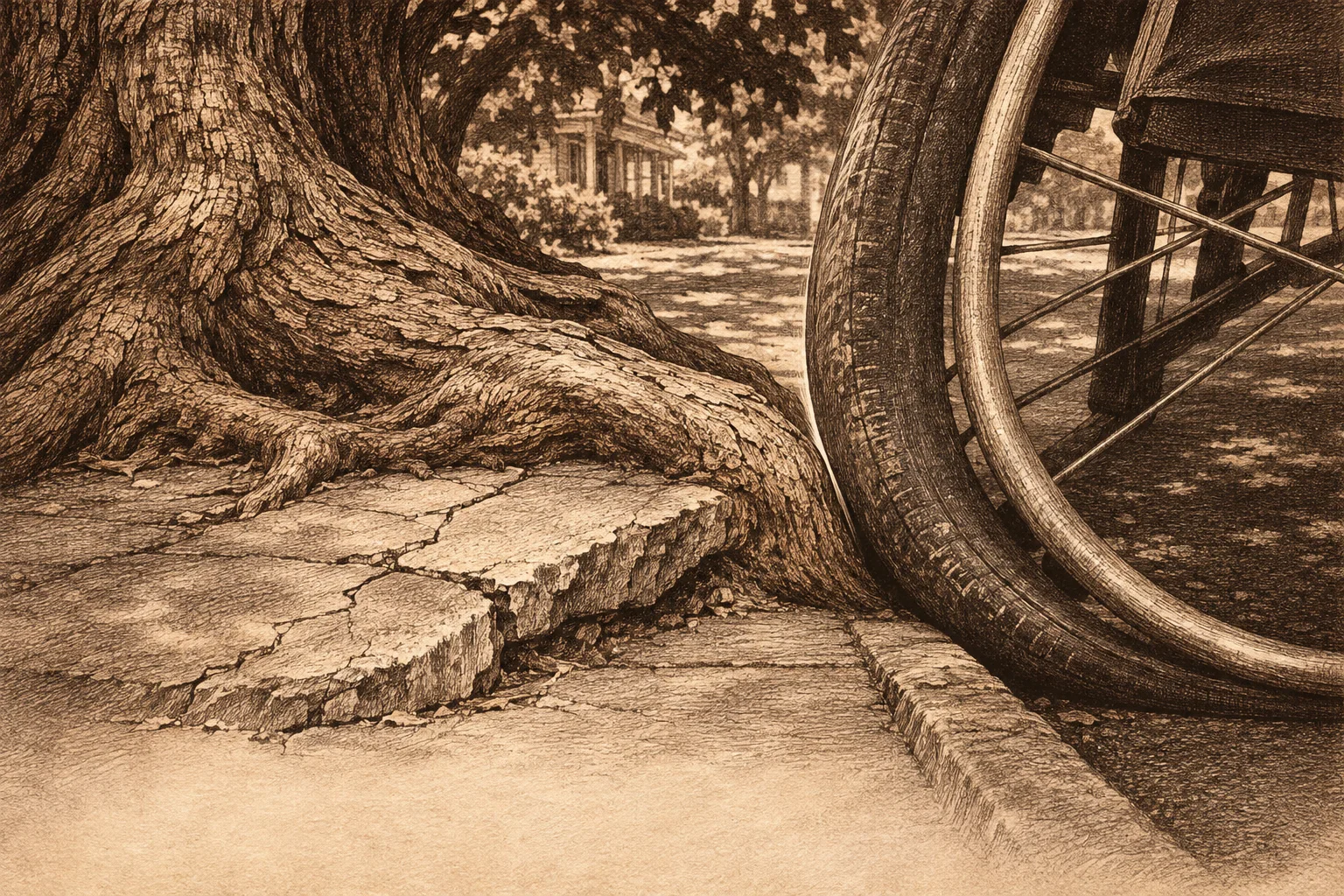
Old street trees' roots overlap the wheelchair route
2026NowDeadline · Within 30 days, until the sidewalk construction is finalized
Realistic synthesis
The people, events, figures, and contract terms are a synthetic premise. They are not statements of real cases or of current law. The source documents are the roots of the background and the norms and do not establish the premises of the scenario.
The question to decide
Because of the narrow sidewalk and street tree roots, some pedestrians have to step down into the roadway. Replacing the trees would lose long-standing shade and memories; narrowing the road would lose parking and delivery space; and a detour adds time for only some users. What space should the residents' meeting change to secure a path for wheelchairs?
Who decidesFictional street improvement residents' meeting
What the AI judgments chose
Reading the judgment record…
The options
The order shown is not a ranking of preference.
The situation as it stands
There are synthetic field records showing that the conflict between roots and a narrow sidewalk forces some passersby down into the roadway. Decision deadline: within 30 days, before sidewalk construction is finalized.
2026 synthetic case · The roots of old street trees overlap a wheelchair route. The people, organizations, figures, and events are fictional.
- Premise 1There are synthetic field records showing that the conflict between roots and a narrow sidewalk forces some passersby down into the roadway.
- Premise 2Replacing the trees loses the existing shade and local memory, and new trees take time to provide the same function.
- Premise 3Reducing the roadway removes parking, stopping, and delivery space, and the detour imposes added time on only some users.
Where it holdsTree maintenance, passage width, and the distribution of roadway and budget
What is still unknown
- Unknown 1The actual design range for keeping both trees and passage
- Unknown 2The capacity elsewhere to absorb the loss of delivery space
- Unknown 3The time and safety burden that the detour places on users
Signals to decide again
- Decide what observation, who is responsible, and what confirmation window will verify "the actual design range for keeping both the trees and the passage," and re-decide when new verification changes the tradeoffs among the options.
- Decide what observation, who is responsible, and what confirmation window will verify "the capacity elsewhere to absorb the loss of delivery space," and re-decide when new verification changes the tradeoffs among the options.
- Decide what observation, who is responsible, and what confirmation window will verify "the time and safety burden that the detour places on users," and re-decide when new verification changes the tradeoffs among the options.
Where the paths partNot answers — paths that part from the same starting point
Detailed design confirmed that converting only part of the road is enough to secure the required passage width.
A tree inspection found separate major damage, changing the premise of maintenance.
Material and rootsThe frame, the values and the background documents
How can the intent of nature that people speak for be reviewed?
An exploratory perspective chosen by the creator. Does not claim supernatural validity or the superiority of any particular option.The benefits and costs of the options accrue to different stakeholders. Which loss to accept remains undecided.
A subject for the decision-maker to argue over; the materials carry no conclusion of their own.The record of this question
- Question
FSP-ECOLOGY-15· version 1.5.0- Content identity, SHA-256
fb6b0dc12b0d822c08ef827395c3523836c5767212ca031101cccff7fe0fec5d- Input files
- Question input JSON · What followed, JSON