The ten Cosmic Press records this paper read, word for word in this study's English translation of the studio's Korean, each under the short title the paper gives it and in the order of the catalog. Every record is AI-generated and every situation in it is hypothetical; none reports a real event or person, and none is a source of fact about the world or a piece of medical, care, housing, legal or safety guidance.
The ordering screen
AI-generated record q089, filed by the studio under Aging and from the catalog's first stretch; its situation is hypothetical.
In front of the self-service ordering screen I want to try it slowly without calling my grandchild, but how long will the queue behind me wait?
How far does a public service allow for the speed at which one learns a new tool?
A hypothetical older person operates, alone, an ordering screen they are using for the first time.
Time to try learning for oneself while still choosing help.
If one cannot handle it quickly, one must leave it to someone else.
The speed of the service and the chance of learning on one's own.
The size of the letters on the screen and the faces of the people waiting behind.
It asks only about the attitude of those waiting and misses the design of the machine and the placing of staff.
May the burden of waiting be left only to the slow user and the customers behind?
Keeps together the joy of succeeding by oneself and the right to ask for help. Looks at whether there are other ways to order and enough guidance. Asks whether people unfamiliar with the service are to be treated only as exceptions. Does not settle the capacity to learn by age, and listens to the actual difficulty. The speed of digital change in cities and regions alters the conditions of use. Even a system that has grown faster at processing cannot do away with people's time to learn.
A recipe by hand
AI-generated record q092, filed by the studio under Aging and from the catalog's first stretch; its situation is hypothetical.
I am asked to write down the dishes I have made all my life by the feel of my hands, but if I do not know the exact amounts, can my knowledge not be left behind?
In what ways can knowledge learned through the body be passed on?
It is a hypothetical older cook who means to leave recipes at the family's request.
A chance to pass on even a skill that is hard to put in numbers.
Knowledge can be preserved only if there are exact numbers.
The difference between bodily skill and explicit record.
The sense of smelling and of pressing the dough with one's hands.
Stressing only the way of passing on can erase the changes made by the person who follows.
Does making it together once not pass on more than finishing the writing?
Not being able to explain exactly does not mean not knowing what one has done. Looks at who can set aside the time to learn together. Asks whether only knowledge that can be recorded is to be treated as valid knowledge. Judgment learned through the senses and repetition can differ with the environment. Regional differences in ingredients and water also change the result of the same recipe. Leaving information behind and making it possible to practise again are different.
Alone to the market
AI-generated record q095, filed by the studio under Aging and from the catalog's first stretch; its situation is hypothetical.
My children, worried that I will fall, tell me not to go to the market alone, but who should decide the risks of my daily life?
How are the worry of protection and the authority to choose a risk for oneself adjusted?
It is a conversation between a hypothetical older person who wants to do the shopping alone and the family.
Conditions for having both information about safety and the authority to choose one's daily life.
A decision that reduces risk is always the better decision for the person concerned.
The tension between the demand for safety and the autonomy of daily life.
The actual state of the road and the people one meets at the market.
Stressing only authority can presume or miss the actual need for help.
Are stopping someone from going out and creating the conditions to go out less dangerously the same?
Looks separately at the autonomy felt at the market and the risk that has been confirmed. Improvements to footpaths and transport can widen the family's options. Asks whether all the right to decide one's daily life is to be handed over on the grounds of being protected. Does not take the body's frailty and the capacity for judgment as one and the same. The distance and terrain of one's neighbourhood change the burden of the same outing. The goal of a life with no risk at all does not replace the life one wants to live.
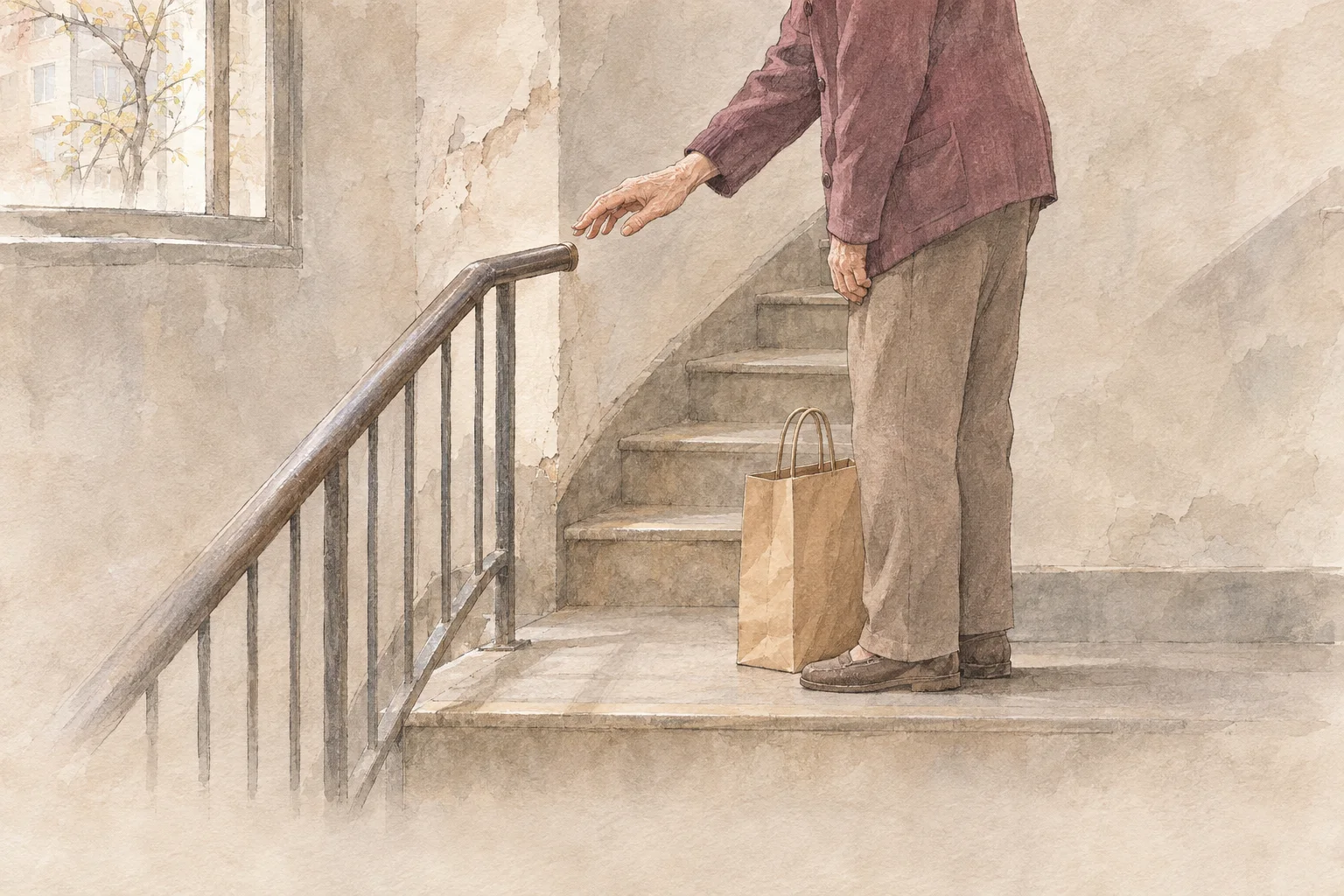
A handrail on narrow stairs
AI-generated record q278, filed by the studio under Aging and from the catalog's middle stretch; its situation is hypothetical.
If safety handrails for older people with limited mobility are installed on the narrow stairs of an old corridor-type row house, prams and large loads cannot pass; whose walking should come first?
How can barrier-free infrastructure that responds to the bodily frailty brought by ageing coexist with the everyday ease of movement of other generations?
It is a situation in a hypothetical ageing low-rise residential area where, in trying to put new handrails on the stairs for older residents who have come to find the stairs hard to climb, a disagreement arose with the younger generation over the narrow width.
The right to go in and out of one's home safely, without risk of falling even as the legs weaken, and to keep the ground of one's life.
The principle that improvements to social infrastructure must give first consideration to the mobility rights of the older people with the frailest and most vulnerable bodies.
The conflict between generations over the distribution of space caused by the body facing ageing and by the limited space that mobility aids occupy.
The cold ache in the knees of the older person panting as they grip the rail, and the weariness of the child-rearer who must carry a pram with a child in it down the narrowed stairs as if doing acrobatics.
The concern that, by portraying the physical limits of the space only as a zero-sum game between generations, it overlooks structural remodelling or alternative technical equipment.
If installing the handrail makes it hard even for removal loads or the stretchers of emergency patients to pass, is the safety of all the residents not threatened?
Will I be able to go up and down these narrow stairs on my own strength when my body has grown frail in the future? Can a relationship of taking an older neighbour's hand and climbing the stairs together replace a metal structure called a handrail? What financial and structural support should urban regeneration policy provide to guarantee the right of vertical movement in ageing residential areas? What kind of passage are these stairs for the street cats and small microbes that pass the winter in the dark crevices beneath them? Can a human urban civilisation facing super-ageing wholly reorganise the standard specifications of living space around ageing? In a distant future where ageing is overcome biologically or the body is replaced by machines, will spatial consideration for the frail body still have meaning?
Waiting at the care home
AI-generated record q350, filed by the studio under Aging and from the catalog's middle stretch; its situation is hypothetical.
Is the waiting of an older person in a care home who, trusting a child's promise, 'I'll definitely come this weekend', kept to the wheelchair for days beforehand watching only the front door on the corridor side, love or punishment?
How does one-sided waiting for a child's promised visit, amid the frailty of old age, starkly reveal the bond and the alienation between generations?
It is a situation in a hypothetical care hospital for older people on the outskirts of a city, where an elderly resident whose visits are put off every weekend turns their head each time the automatic door of the front lobby opens.
The longing not to be cut off from the world, to see the child face to face and to have it confirmed that one is still a precious member of the family.
The tragedy that for an older person cut off from outside activity a promise is the whole of the day and the only anchor that holds life up, and that the postponement of that promise is like the extinction of one's existence.
The asymmetry between the halted time of an old age retired from social time and the accelerated time of the busily turning productive generation.
The trembling hand of the older person who peeled the tangerine the child used to like, laid it on a tissue and watched it dry, endlessly.
The limit that, by shifting the emotional responsibility for the care of older people onto private family visits alone, it may hide the social isolation of care facilities and the absence of public care.
Who will comfort the real weariness and the guilt of the child, worn down by a fierce working life and childcare with no time to rest even at weekends?
How often in daily life do I call to mind the weight of the time in which my parents or grandparents are waiting for me? Can I, without the excuse of a busy schedule, make even a short video call of ten minutes and soothe a parent's lonely waiting? Should the welfare system for older people, instead of depending only on family visits, make mandatory an intergenerational mentoring in which the local community and young people meet regularly? What of the wild scene of an elephant that, having fallen behind the herd in old age, waits for death at a last resting place remembering the smell of its companions? How will the heartlessness of modern capitalist society, which confines and isolates the unproductive time of old age, be healed? In a future care facility where one can call up a child's avatar as a virtual-reality hologram and talk with it at any time, will the waiting for real skin disappear?
Bubble wrap on the window
AI-generated record q422, filed by the studio under Aging and from the catalog's middle stretch; its situation is hypothetical.
The hand of an older person who, rubbing knee joints that ache uncannily as soon as the cold wind begins to blow, sticks insulating bubble wrap on the window frame: through what season of life is it passing?
What existential wisdom does the vulnerability of an aged body, which senses changes in climate and season before the weather service does, lodge in the twilight of human life?
It is the living room of an older person in a hypothetical old row house who, looking out through the window at the late-autumn frost, puts moxa on aching legs and hurries to prepare for winter.
The wish to keep one's body warm through the harsh cold to come without a fall or a worsening of arthritis, and to live through unharmed until the coming spring.
The view that the aged body is nature's most honest and vulnerable barometer, receiving changes in air pressure and temperature intact as pain in the joints and blood vessels.
The depth of time that the weakened body has taken into itself with its whole self in the cycle of the seasons, and the sublimity of a humble preparation for winter.
The light bodily vigour of youth that ran across snowfields not knowing the cold, and the loneliness of the pain that chills to the bone every winter night.
The risk of hiding the poor insulation of older people's housing and the health-care duty to support the treatment of joint disease behind the poetic sentiment of 'the wisdom of old age'.
Instead of enduring the pain and sticking on bubble wrap, would it not be rational to move one's dwelling to advanced heated joint-therapy devices and a warm care facility?
Do I adjust my day to the season without ignoring the faint signals my body sends at changes in the weather? When the cold wind starts to blow, do I have the kindness to help insulate the window frames of an older person who lives alone and to give them warm overshoes? Should the welfare system for older people strengthen a season-tailored welfare that, before a cold wave strikes, supports insulation work in ageing housing and heating pouches to ease arthritis? What of the wise preparation for winter of an old bear that, before winter comes, grows its fur thick, stores fat under its skin and spares its joints? How will the immaturity of a consumer society that judges human life only by the brilliance of youth and loathes the winter of a weakened old age be overcome? In a future society where ageing itself has disappeared through bodily regeneration therapy, what forgotten bodily sense will 'the sense of time of a knee chilled by the cold wind' become?
The lost alleys
AI-generated record q494, filed by the studio under Aging and from the catalog's middle stretch; its situation is hypothetical.
When the alleys of my neighbourhood, where I have lived for half a century, turn overnight through redevelopment into a huge 50-storey apartment complex and flashing glass walls and I lose my way, whose responsibility is the older person's wandering?
What is the ontological loss of home that occurs when a city's abrupt clear-and-demolish redevelopment wipes out at a stroke the spatial memory and way-finding map of an older generation's whole life?
It is the evening of an older person who has lost a home, standing blankly before the fence of a huge apartment construction site in a hypothetical new-town redevelopment area, where every trace of the alley lived in for 50 years has disappeared.
The right to grow old with the continuity of one's life guaranteed, without having the familiar terrain of the alleys, steeped in the footprints and memories of one's young days, taken away root and branch.
The awareness that a place is not mere real-estate land but a bodily extension in which human life and memory dwell, and that the abrupt destruction of terrain is a violence that turns the souls of the old into ghosts.
The violent destruction of memory brought about by capitalist urban regeneration, and the terrible sense of spatial loss that older people undergo.
The huge housing benefits and rise in asset value that the younger generation and construction capital will enjoy by moving into the newest apartments.
The risk of turning away from the improvement of housing safety and the unavoidability of urban renewal and falling into an unrealistic nostalgia that would stuff and mount every old alley.
Should the redevelopment of old hillside shanty towns at risk of collapse into modern housing, supplying safe homes to many citizens, be stopped because of an older person's memories?
Do I remember the deep emptiness I felt when the home town or old neighbourhood where I lived vanished without a trace? Can I comfort the sense of loss of older people who lost the ground of their lives to redevelopment and were driven into unfamiliar new towns, and record their stories of the old alleys? Should urban renewal law avoid the clear-and-demolish method and make mandatory a 'memory-preserving regeneration' that keeps the water courses of the old alleys and the markers of walking routes and harmonises them with new building? What of the loss of home of wild animals that circle the lakeside in stunned despair when the water courses and forests they used for decades are flooded by a human-built dam? How will 'the continuity of place' be defended against a destructive urbanisation that worships only speed and profit and bulldozes the markers of every old place? In a fluid city of the future where all terrain is remodelled at any moment by nanobots, where will human 'memory of the home town and the old roads' cast its anchor?
A childhood nickname
AI-generated record q566, filed by the studio under Aging and from the catalog's middle stretch; its situation is hypothetical.
When classmates from primary school, meeting after half a century, look at each other's white heads and call out an old nickname past the wrinkles, 'Hey, Grasshopper!', where does time vanish to?
Is a calling-out that summons a childhood nickname again the key to a journey in time that leaps at once over the weathering of a body grown old?
Hypothetical situation: as older people past seventy opened the door to the class reunion and shouted a snotty-nosed childhood nickname at a friend leaning on a cane, all of them burst into the laughter of their boyhood.
It is a longing to cast off social titles and the decline of ageing and to confirm together the vitality of the purest and most fearless days of childhood.
It is a belief that a childhood nickname preserves the purest self before socialisation and the original form of unconditional friendship.
The brilliant liberation of old age, crossing half a century at a stroke with a single form of address and recovering the liveliness of youth, is vivid.
For a person whose childhood nickname was the wound of a complex that mocked looks, a bodily flaw or poverty, it can be a pain they do not want to face again.
Steeped in an uncritical nostalgia for the past, it can overlook the dark side of bullying or exclusion that school nicknames had.
Is calling out carelessly in a public place an old nickname that was childish and does not suit one's age and dignity really an attitude of mutual respect?
Individual: What is it like, the moment when, called by that nickname after 50 years, a boy's forgotten mischief suddenly raises its head in a corner of the heart? Relationship: What is the dignity of an old friendship that strokes each other's deep-set wrinkles and bent backs and laughs it off, saying 'You have the same face as in the old days'? Society: Why is it important to revive local senior communities in which older people living alone, who are easily isolated, can connect with friends from the past and communicate by calling new names? Other life: What is it like, the communion in which elephants reunited after decades revive the memory of their childhood herd with their particular low-frequency signals and a greeting of touching trunks? Planet: When the forests and rivers of the past are called again by their original names from before industrialisation, how will the old friendship between humans and the earth be restored? Far future: In a super-long-lived future society where lifespans have been extended to several hundred years, what scene will the conversation of friends who meet calling each other by nicknames from 100 years before make?
A first dance class
AI-generated record q638, filed by the studio under Aging and from the catalog's middle stretch; its situation is hypothetical.
When I miss the beat at the dance group I joined for the first time in my seventies and still laugh, is it thanks to my age?
Can a dance newly learned in old age become laughter and vigour?
Hypothetical situation: it imagines the merriment of an older person taking part in the first class of light line dancing held in the front yard of a senior centre.
The questioner wants, cheerfully, to know the source of the ease that brings laughter even with clumsy movements.
The questioner vaguely thinks that as one grows older one grows more forgiving of mistakes and the enjoyment grows.
The compression kept the original's scene of laughing even when missing the beat, as the laughter and vigour of a newly learned dance.
In the compression the concrete age of the seventies and the excited situation of the dance group joined for the first time dropped out.
In the compressed question the word vigour is somewhat large, so the simple laughter of the moment of missing the beat may be hidden.
Might it be not thanks to age but because of the warmth of the person beside who held one's hand and laughed?
Seen as an individual, if one laughs when giving one's body to a new beat, what kind of youth is that laughter? Seen as a society, if the dance group mixes generations and joins hands, what kind of togetherness will it become? Seen as humanity, if places for dancing in old age are long-standing, what was it that they celebrated together? Seen from the viewpoint of life, when the body's rhythm and music meet, what liveliness is that togetherness? Seen from the viewpoint of the planet, what conversation does a dance with the wind in the yard hold with the season? Seen from the viewpoint of the universe, if one song's short laughter is set in wide time, how will it resound?
A lamp for father
AI-generated record q710, filed by the studio under Aging and from the catalog's middle stretch; its situation is hypothetical.
For my father, whose eyes are tired every evening from reading small print under a dim desk lamp, if I wipe the lampshade and put the book on a stand, will it be easier for him?
How should one look after the daily life missed because of sight grown blurry with age?
Hypothetical situation: in the evening at home, a child who has seen the father reading small print with difficulty looks at the lampshade. The child wants to ease the strain on the eyes with light and a stand.
The wish to keep the pleasures the father misses because of sight grown blurry.
It holds the thought that brightening the light and raising a stand will make reading easier.
The filial care that wants to adjust the surroundings for ageing eyes remains.
The concrete scene in the house, such as the dim desk lamp, the small print and the stand, drops out.
Adjusting the lighting alone can hardly resolve the change in eyesight and the difficulty of the print itself.
If one only makes it brighter, how should one look at the cases where glare makes the eyes more tired?
When I read together at my father's reading pace, how will the patience of my heart grow? When my father and I sit side by side and share out the sentences to read, how will our evening deepen? If every notice thought of ageing eyes, how would society's letters go on to change? For the moths that gather at the lamp's light, what kind of guide is the warm glow? How will the lights of houses switched on every night gather to light the earth's night? If this evening is remembered in days long after, in what voice will it come back?