1.1Data and method
GAEKJU's public library held 496 questions when this study fetched it, each record read one by one through the studio's public interface on 2026-10-06. The library sorts them into three kinds, 40 record readings, 51 outside cases and 405 synthetic scenes, and into seven kinds of talk. Each question asks one of three things of its kind of talk: whether it is the same across domains, whether it costs performance, or whether it has changed across eras. GAEKJU's English names for two of the kinds are "Looking up" and "Holding out", and the library holds 57 and 58 synthetic scenes of them.
The selection follows one rule: every synthetic scene of the kinds of talk "Looking up" and "Holding out" whose evidence holds no digit. The evidence is the part of a scene that says what is particular to its setting and what the scene leaves unanswered; a digit there marks a count, a rate or a year brought in beside the reasoning. The rule keeps the scenes whose evidence stands on words alone. A script applied it to the whole library. It leaves 11 scenes, five of the first kind and six of the second, and sets 104 aside. Four ask the performance question, four the era question and three the domain question.
Every scene is synthetic, and every one opens its evidence with the label "Synthetic:". Seven are set in the 2020s, one moves from the 1990s to the 2020s, one from the 2000s to the 2020s, and two are supposed for 2030. The study reads each scene as a written frame for a decision, not as a report of what happens in a trade.
The scenes share one form. Each has a setting, a scene of three sentences, two lines of talk, one term, the evidence, three readings of one sentence each, a lean towards one reading, a judgment ending with the basis date 2026-09-25, a counter-condition and a proposal. These slots are guaranteed by GAEKJU's format, so the fact that every scene has three readings, a counter-condition and a proposal is not a finding. What the slots say is. Across the eleven there are 22 lines of talk and 33 readings.
The records are Korean. This study made the English translation sentence by sentence, labelled in each scene's translated record with the hash of the Korean record; every block quote below is that translation, word for word. Roles are put neutrally, and no gendered pronoun is added where the Korean has none. GAEKJU's word for its scenes' proposals is kept in the source lines as "Asi".
The counts in this chapter come from a script that reads only the fetched records. It tests the Korean for marks the argument needs, with the words of each test listed beside the counts: the reading in each scene that sides with the schedule, the form or the one above; the reading that sides with the one who spoke; the reading the scene leans to; judgments that read the words as something other than refusal or complaint; the naming of a deadline, a time for the answer or the length of a wait; the naming of an authority; and proposals that divide time or refuse to leave the wait with one person. Measured against the whole library, no field of the eleven scenes repeats GAEKJU's own five-word runs to the series threshold of 30%; the highest, the judgments, stand at 3%. The sentences can be read as each scene's own.
1.2Three readings, and the one leaned to
Every scene puts a hostile or a dismissive reading on the table, and none of them leans to it. The plainest case is the synthetic scene of the next visit, set at a desk where repair jobs are assigned. A technician says the next booking cannot be taken now, because the parts from the earlier repair need checking again. The scene's first reading is short:
These are the words of a technician trying to avoid work.
This is the label that Milliken, Morrison and Hewlin (2003) found people fear when they decide whether to speak: being viewed negatively. The scene writes it down as one of the three ways to read what was said. Its second reading turns the refusal into information about a record, and its third adds a cost that neither of the first two counts:
The new customer's waiting also has to be counted as a separate cost.
The scene leans to the third. Its judgment does not clear the technician; it says the words are hard to read only one way, and then moves the question from the person to the sheet:
The technician's words are hard to read only as turning away the next customer. If the booking sheet could not hold the time to recheck for the earlier customer, the two customers' times have to be rearranged together.
The pattern holds across the set. Twelve readings in the eleven scenes side with the schedule, the form or the one above, at least one in every scene, and the lean falls on none of them. Ten scenes also hold a reading that sides with the one who spoke up or held out. The lean falls on that reading once. In the other ten scenes it falls on a third reading, one that names a check, a time, an authority or another cost.
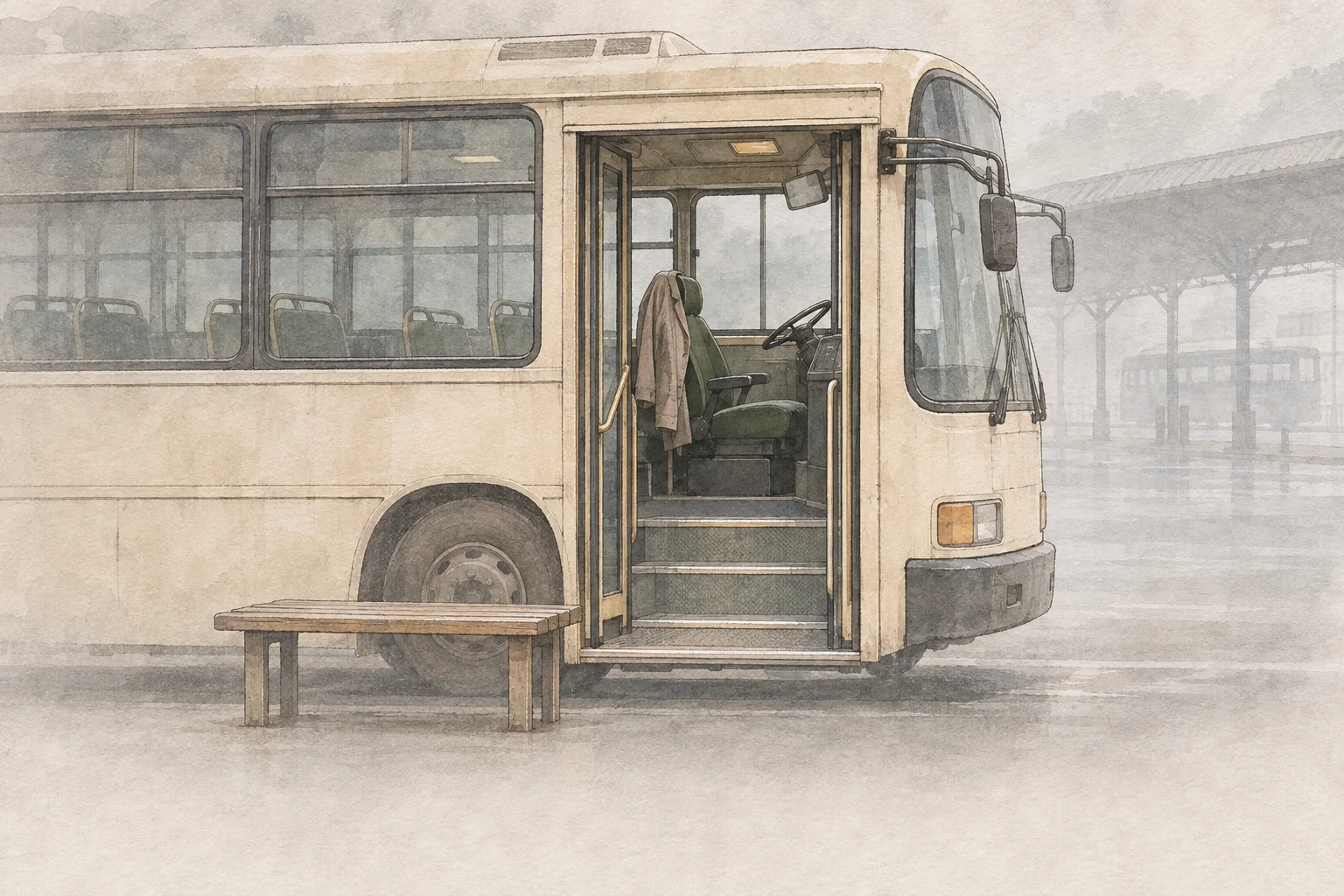
The synthetic scene of the bus held back shows the three side by side. A driver hears a sound unlike the usual one on a bus about to depart:
This bus can't go out now. It sounds different from usual.
The readings run from the service to the passengers to the sound itself:
Refusing to depart disrupts the service.
Without looking at the cause of the sound, neither cost can be concluded.
The scene leans to the last. It treats the driver's words neither as a disruption nor as a safety measure, but as the start of a check whose result the scene does not give. The judgment says what kind of words they were:
The driver's words are a question asking for a check rather than a declaration of putting down the work. Only by looking at the cause of the sound can the value of delay and of safety be compared.
Six of the eleven judgments read the words in this way, as something other than refusal, avoidance or complaint, and seven of the eleven use the word question. Faraj and Xiao (2006) note that dialogic coordination practices, which include epistemic contestation and protocol breaking, are highly contested because of epistemic differences, reputation stakes and the possible apportioning of blame. This study reads the scenes' first readings as that contest written out: the blame is on the page, assigned to the speaker, and the scene then declines to lean to it. The scenes do not settle the contest. They move it to a check that has not yet been made.
The one exception is instructive. In the synthetic scene of the experiment left out, supposed for 2030, an automatic judgment has made a results table from clear results only, and a lab head asks where the next question came from. Here the scene leans to the reading that sides with the one who spoke:
The experiment without an answer is also grounds that made the next question.
Even so, the judgment narrows what the lean allows. It does not ask for every experiment to come back into the table:
Rather than listing every experiment without an answer, one should look at the cases linked to follow-up questions.
The scene that leans to the speaker thus limits the speaker's claim in the next breath, and the scenes that lean elsewhere limit both sides. The set has, in this sense, no reading that wins outright. Hirschman (1970) sees loyalty as what retards exit and permits voice to play its proper role. The scenes give voice a part of a particular size: enough to stop a plan for a check, not enough to replace the plan.
1.3The time no record held
The scenes hear "not yet" and "wait" as a question about a time that some record left out. The clearest statement is in the synthetic scene of the next visit, where the evidence names the gap without reference to anyone's character:
In home repair, travel time and the time for checking again do not show well in the booking slots.
The synthetic scene of the missing inspection, supposed for 2030, puts the same gap in a plan made by an automatic judgment. The plan has the shortest schedule; a supervising deputy stops it:
Wait. The inspection time for this floor is missing.
One of its readings answers for the plan, holding that the shortest schedule is the best choice, and the scene does not lean to it. The judgment names what the word "wait" was doing, and hands the next step to the people whose work will move:
The deputy's 'wait' is not a refusal of speed; it questions the time missing from the plan. Which work to move once the inspection is put in has to be compared together with the builders.
Orlikowski and Yates (2002) propose that people produce and reproduce temporal structures through everyday action, and that these structures in turn shape practice. This study reads the booking sheet, the plan and the results table in these scenes as such structures: made by people or by a judgment people set going, and shaping what the next person can do. The speaker's "not yet" is, on this reading, the moment the structure is shown to be short. The scenes do not say the structure was wrong. Their counter-conditions say what would show it was right after all: in the scene of the missing inspection, that the inspection time was already in the schedule; in the scene of the next visit, that no recheck was needed and the same refusal repeats.
The synthetic scene of the trees not ready sets the two kinds of time against each other in its evidence:
At an arboretum, the time trees take to recover and the date of an event flow differently.
Its judgment takes the foreman's words as a question that sets one time against the other, and leaves the outcome open:
The foreman's words do not turn visitors away; they are a question that sets the time the trees take to recover against the date people set. Which sections can open needs a separate check.
The "Looking up" scenes find the same gap from the other side. There the missing time is the time of the answer. In the synthetic scene of the promised review, a coordinating teacher takes the teachers' requests up and gives them a promise to review:
While the schedule stays blank, the teachers cannot remake their materials, and the coordinating teacher waits for the answers from above and from below at once.
The scene holds the promise in the coordinating teacher's own words, and the judgment finds in it not avoidance but a decision that does not yet exist:
In the coordinating teacher's words there is less an intent to avoid responsibility than the trace of a decision not yet made. Not being able to tell when the waiting ends tilts the teachers' preparation time.
Five of the eleven scenes name a deadline, a time for the answer, or the length or end of a wait. In the synthetic scene of the unanswered readings, a shift lead at a power plant sends up accurate readings and no answer comes before the shift changes. One reading takes the silence as consent:
No answer means agreement with the present state.
Van Dyne, Ang and Botero (2003) propose that silence is more ambiguous than voice and that observers misread its motives more often. Their propositions concern employees' silence, and this scene's silence is above, so the work fits only in part; this study reads the scene as setting the same ambiguity one step up the line. The scene's judgment declines to read the silence at all, and turns to what can be checked:
Even when an accurate report goes up, if the answer is late the burden of deciding stays below. Rather than reading silence as approval, it is safer to check the deadline for an answer and the interim authority.
Two of the eleven scenes name an authority to decide or to adjust: this one, and the scene of the stuck episode, where a refusal becomes a negotiation only when someone may change the order of episodes. Klein, Ziegert, Knight and Xiao (2006) describe senior leaders who hand the active leadership role down and take it back. The shift lead's line, asking who makes the interim call, is this study's picture of the moment before such a handing down, when nobody yet knows whether it has happened.
The synthetic scene of the fax margin, which moves from the 1990s to the 2020s, places the missing time in a form. A branch manager writes questions in the margin of a faxed report; later, similar matters are entered into set fields on a screen:
Entering the numbers became faster, but the field for attaching a question is narrow.
The scene does not conclude that questions were lost. Its judgment asks for a record that would show it:
When the form changes, the place where a question can be written changes. Rather than concluding that the questions decreased, this scene makes one check which questions head office answered.
1.4Who holds the wait
The scenes treat the wait itself as a cost and divide it. Eight of the eleven proposals divide, allot or separate time or work, and five refuse to leave the wait, or the work of explaining it, with one person, one side or one group. The proposal of the promised review names the person who would otherwise carry it:
Give the teachers the expected time of approval together with the range they can prepare in the meantime. Do not push the delay of the decision above onto the explaining labour of the coordinating teacher alone.
The scene of the bus held back allots the same kind of labour to the person on the other side of the refusal:
Reflect the time for the maintenance check in dispatching and open the option of a replacement vehicle along with it. Allot time for explaining a delay of the first bus to the dispatcher as well.
In these proposals the cost of a "not yet" is not only the delay. It is also the talk that the delay requires: telling the teachers, telling the dispatcher, telling the policyholder. The synthetic scene of the photo's time makes the person waiting part of the judgment. A loss adjuster objects that the time on one photograph does not match, and the judgment weighs the objection against the one who waits for it:
Even if the adjuster's objection is right, the time of the person waiting is a cost. The moment the photo to check and the time of the answer are set, the gain of the question and the cost of the delay can be handled together.
None of the works read here gives that person a place. The voice research frames its question between the one who speaks and the one above; the scenes add the next crew, the teachers, the visitors, the policyholder and the next customer, and in this scene put that person's time inside the judgment. This is this study's reading, and it is the figure this study offers to the debate.
The hearer's part in the scenes is small but steady. In five of the eleven, the second line of talk answers the speaker with "together": the dispatcher will look at a replacement bus as well as the check; the construction lead will look at the work that moves back; the production lead will work out the order of episodes together. Edmondson (2003) found that the most effective leaders lowered concerns about power and status so that people would speak up. This study reads the scenes' second lines as a smaller version of the same move, written into one line of talk: the one who hears the "not yet" takes up its question and widens it.
Perlow (1999) found that a reward system based on individual heroics kept a group's time famine going. This study reads the scenes' proposals as running the other way. In the synthetic scene of the stuck episode, a creator refuses to deliver an episode as it is, and the proposal does not pull the creator's remaining time forward all at once:
Pick the option of dividing the finished scenes and the remaining work between episodes. Do not pull the creator's remaining time forward all at once; fit it to the editing schedule as well.
The two scenes supposed for 2030 add a turn. In both, an automatic judgment made the plan or table that a person questions, and four of the eleven proposals hand a task to the automatic judgment. The same kind of judgment that left the inspection time out is asked to pick the order again and to spread the added time:
The automatic judgment picks again an order of work that includes the inspection time. It divides the waiting and starting times so that the added time does not pile onto one partner firm only.
The scene does not say whether the second pick will hold what the first did not. It leaves the "wait" as the step that sent the plan back, and the proposal as a plan to be checked in its turn. Read with Faraj and Xiao (2006), the scenes place dialogic contestation at the point where a plan made by a judgment meets a person who knows a missing time; read with Orlikowski and Yates (2002), they let that person remake a temporal structure without making it disappear. Both readings are this study's.