7.1Mackay as evidence of telling
Limited to evidence of how episodes were told, the South Sea chapter bears the limit well. It shows, in one connected narrative, the forms judgment takes after an outcome: the warner made prophet, the crowd made mad, the directors given reasons, the judges moved by the loss. Creeping determinism appears as a sorting of people into those who knew and those who did not; outcome bias as punishment before guilt and a retroactive statute; after-the-fact explanation (Taleb 2007) as the whole chapter.
The chapter also shows what the psychological works, as their notes describe them, do not. A narrative chooses which documents to keep. Mackay keeps the warnings and drops the replies; keeps a letter written during the fall and has none from before the rise; keeps Gibbon's dissent and his own verdict side by side. The judgment of a decision, in a narrative, depends on which records of the time survive and which the teller chooses to quote. The committee's account of torn and falsified books adds that the records of the time can themselves be rewritten after the outcome. Those are features of judgment after the fact that the first position's remedy, judging from what was known at the time, has to meet and often cannot.
Set beside Mackay, Kindleberger's sequence looks like a more careful form of the same narrative act, each stage named by where it leads. Applied to a situation still in progress, such a sequence carries the risk the thread names in reverse: the reason is fitted to an outcome that has not yet occurred, and the fit is taken as evidence that it will.
7.2What the records add and what they cannot
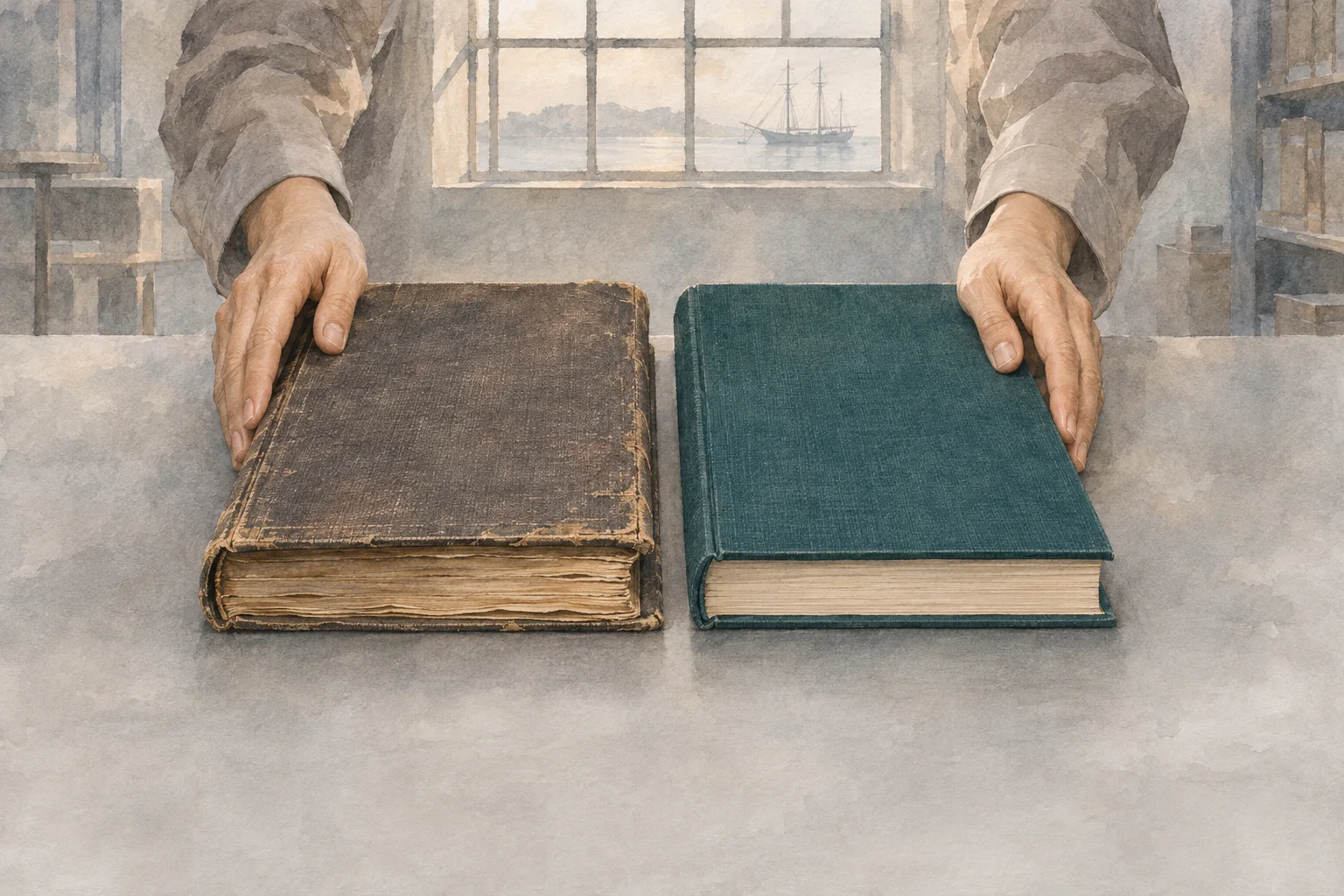
The two records add what Mackay's chapter cannot: a decision written before its outcome. In the voyage record the log exists; in the post-mortem record it barely does. The pair is one setting in two times, and the contrast between them is the contrast between the Broderick letters and the books a director kept before taking office. Each names the separation Mackay's chapter mostly fails to make.
What the records cannot do is show how the separation would work. They are synthetic scenes without outcomes. Nothing in them shows a reviewer reading the log, a reconstruction carried out, or a mandate changing how traders write. And they say nothing about who would read the log or the reconstruction; as the methods section noted, no record in the study names who decides. For a question about how a decision should be judged, the identity of the judge is not a small omission. Mackay's chapter is full of judges, the House, the country, the committee, the historian, and the difference between their verdicts is largely a difference between who they were and what they had to lose.
7.3Who bears the judgment
The post-mortem record's first option would hold the trader accountable on the strength of a review that the record's own example judgment calls a product of "the clarity that follows a result". The cost of that option, if the review is wrong, falls on the trader, who is at the point where the work stopped and who did not write the review. In Luhmann's terms, as his note gives them, the loss is a risk to those who decide the trader's fate and a danger to the trader. The same structure appears in Gibbon's account, where a "lawless majority" judged and the directors bore the fines. Read this way, the judgment of a decision after the fact is itself a decision, made under uncertainty, whose cost falls on someone other than its maker. The records do not draw that conclusion, and the article offers it only as a reading.
7.4Alternative readings
Three readings run against the one given here. The first is that Mackay's verdicts are simply correct: the committee's reports he quotes find corruption, and a narrative that calls the directors dishonest is reporting. The article does not dispute those findings and has no evidence to. Its claim is narrower: the chapter's verdicts are often stated before their evidence, and some, the directors' imagined confidence and the warners' prophetic spirit, rest on nothing but the outcome.
The second is that revisit conditions in a form written for study are not meant to be observable. The article accepts that, and notes only that these two use the words the records themselves treat as suspect.
The third is that a mandate for prior records would produce better records than Power's and Clarke's arguments suggest, once traders saw records read fairly. Neither the records nor Mackay's chapter offers evidence either way.