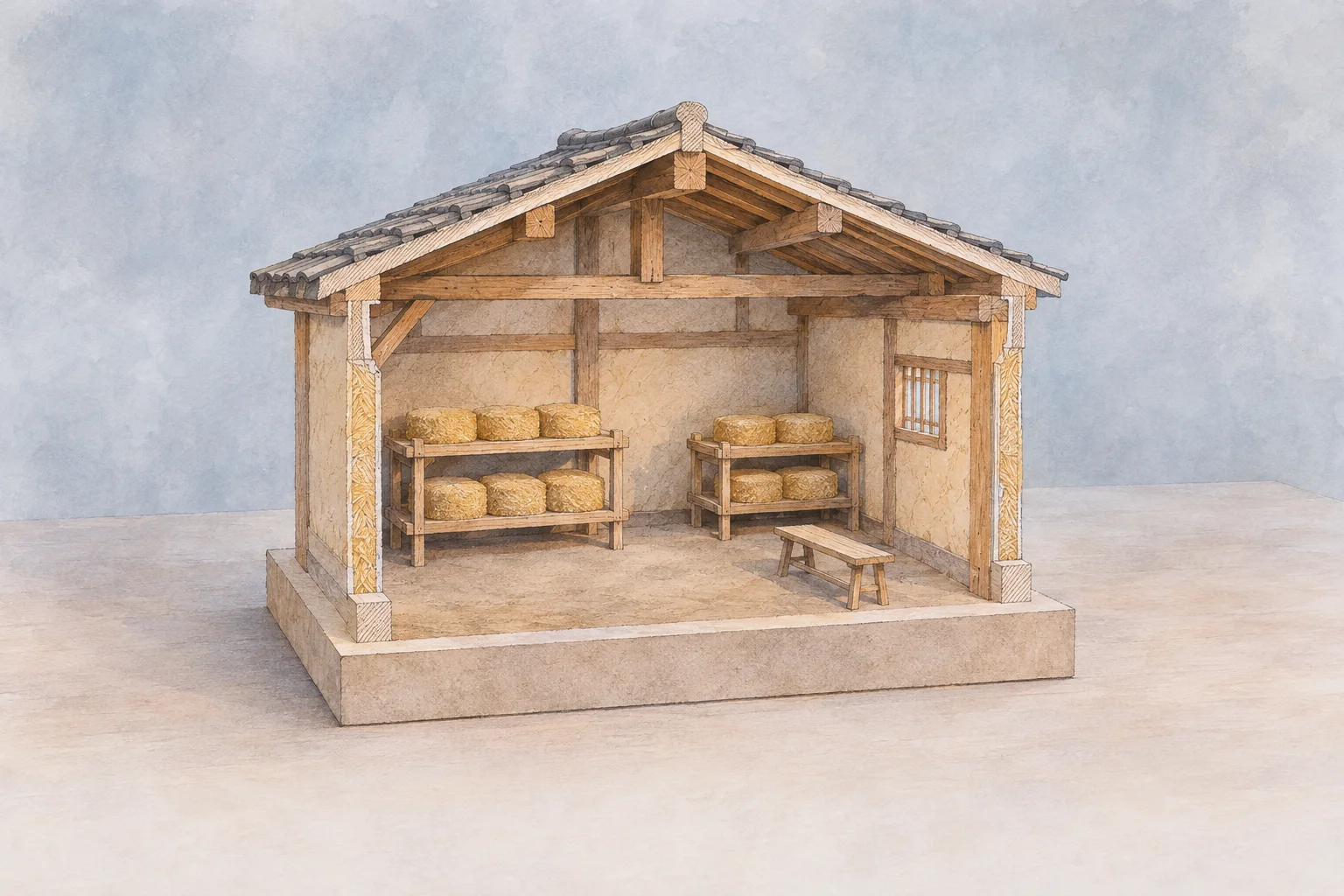
This study is an expansion by AI of question records published by GAEKJU, a studio in the RISCON family. The records are Korean: every sentence in a block quote is a record's own, in the English translation made sentence by sentence for this study from the Korean original, which each translated record names by its hash. The rest is AI writing. The eleven records are what GAEKJU calls synthetic scenes: in GAEKJU's words, written for comparison and not testimony from those trades. This study draws no fact about any trade from them. No sentence about a source record is quoted here, and GAEKJU's record readings and outside cases are not read. No person is identified or rated. The readings through the works named are this study's interpretation.
| Case | Studio | Record |
|---|---|---|
| The blasting shelter | GAEKJU | https://gaekju.risconlabs.com/kr/library#gk-idle-dom-syn-10 |
| The inspection bench | GAEKJU | https://gaekju.risconlabs.com/kr/library#gk-idle-dom-syn-11 |
| The set-up site | GAEKJU | https://gaekju.risconlabs.com/kr/library#gk-idle-dom-syn-12 |
| The nuruk room | GAEKJU | https://gaekju.risconlabs.com/kr/library#gk-idle-dom-syn-15 |
| The drivers' canteen | GAEKJU | https://gaekju.risconlabs.com/kr/library#gk-idle-dom-syn-19 |
| The strawberry photo | GAEKJU | https://gaekju.risconlabs.com/kr/library#gk-idle-dom-syn-5 |
| The calving night | GAEKJU | https://gaekju.risconlabs.com/kr/library#gk-idle-dom-syn-7 |
| The biosecure canteen | GAEKJU | https://gaekju.risconlabs.com/kr/library#gk-idle-dom-syn-8 |
| The coal-face lunch | GAEKJU | https://gaekju.risconlabs.com/kr/library#gk-idle-dom-syn-9 |
| The control room of 2030 | GAEKJU | https://gaekju.risconlabs.com/kr/library#gk-idle-era-syn-6 |
| The dough room | GAEKJU | https://gaekju.risconlabs.com/kr/library#gk-idle-perf-syn-5 |
The records were read on 2026-10-06. This book was written on 2026-10-07.
Bibliography
- John D. Norton, Are Thought Experiments Just What You Thought? (1996).
- Tamar Szabó Gendler, Galileo and the Indispensability of Scientific Thought Experiment (1998).
- Tamar Szabó Gendler, Thought Experiments (2006).
- Jonathan Dancy, The Role of Imaginary Cases in Ethics (1985).
- Janet Finch, The Vignette Technique in Survey Research (1987).
- Rhidian Hughes and Meg Huby, The Application of Vignettes in Social and Nursing Research (2002).
- Christiane Atzmüller and Peter M. Steiner, Experimental Vignette Studies in Survey Research (2010).
- Herman Aguinis and Kyle J. Bradley, Best Practice Recommendations for Designing and Implementing Experimental Vignette Methodology Studies (2014).
- Nicholas Jenkins, Michael Bloor, Jan Fischer, Lee Berney and Joanne Neale, Putting It in Context: The Use of Vignettes in Qualitative Interviewing (2010).