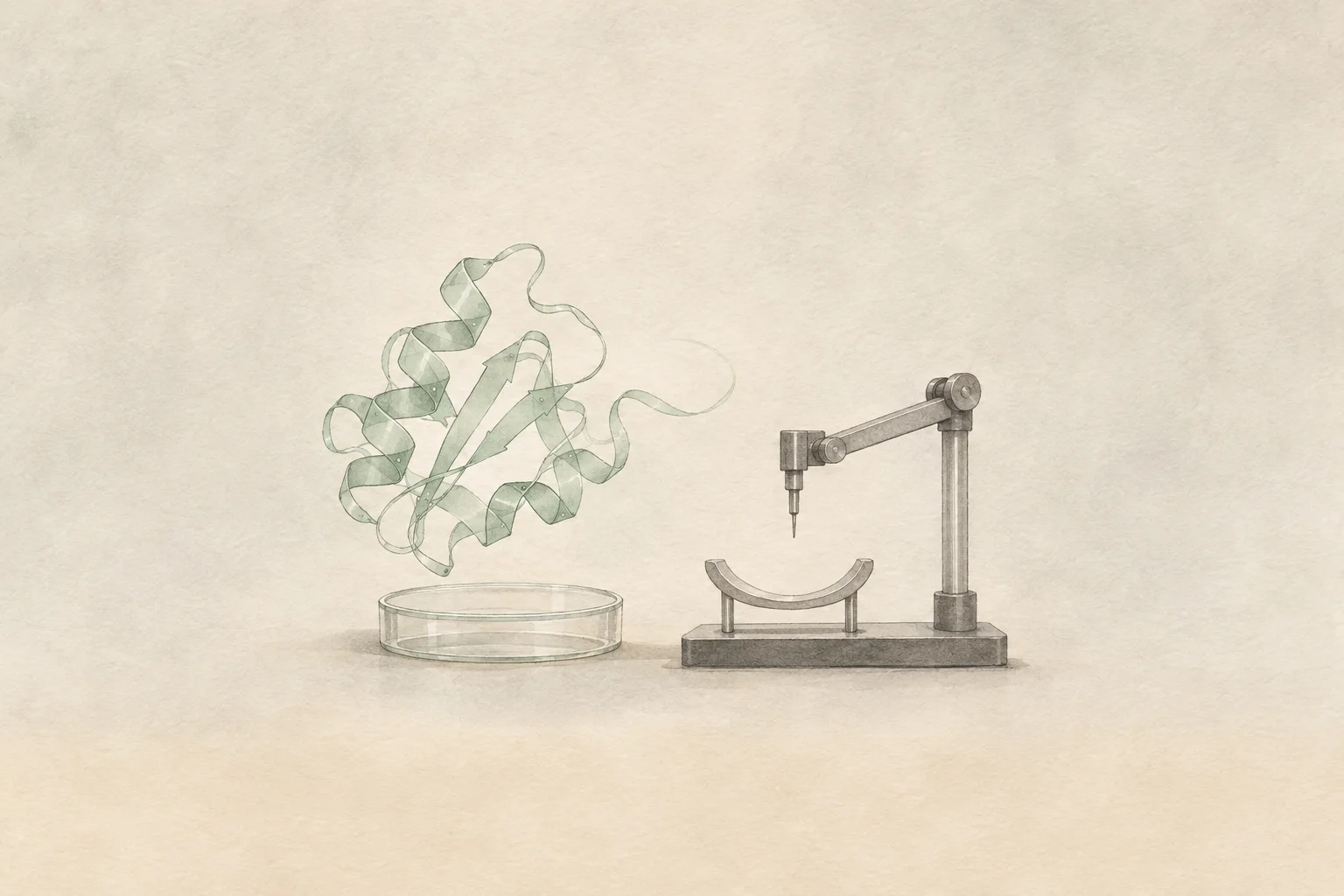
A protein's shape can now be predicted from its sequence alone, and a public database holds predictions for over 214 million protein sequences. Whether such a prediction may stand in for a structure determined by experiment is not a question of computing alone. Someone has to decide, for some purpose, at some time. This paper asks, in Meridian's form, when a predicted structure may stand in for an experimental one, who decides, by when, and what would make the decider revisit the decision. It answers from eight articles published under the Creative Commons Attribution licence and from nothing else: the AlphaFold papers of 2021 and 2024, the two papers of the AlphaFold Protein Structure Database, and four independent assessments. It does not use IATHEON's records, and it gives no medical, clinical or investment advice.
The texts never grant the substitution in general, and none of them names a journal or a funder as the judge. The developers supply confidence measures and a blind test. The database's stewards supply confidence bands and guidance, and leave the interpretation to the user. The independent assessments make the answer depend on the residue, the purpose and the shape the protein takes at the moment that matters. The dates in the texts fix the evidence, not the decision: training cut-offs, test windows and versions. The conditions for looking again are new experimental data, a change of purpose, a partner or a state the prediction left out, and a new version of the predictor or the database. The paper's contribution is to set these answers side by side and to show where each text leaves the choice open.