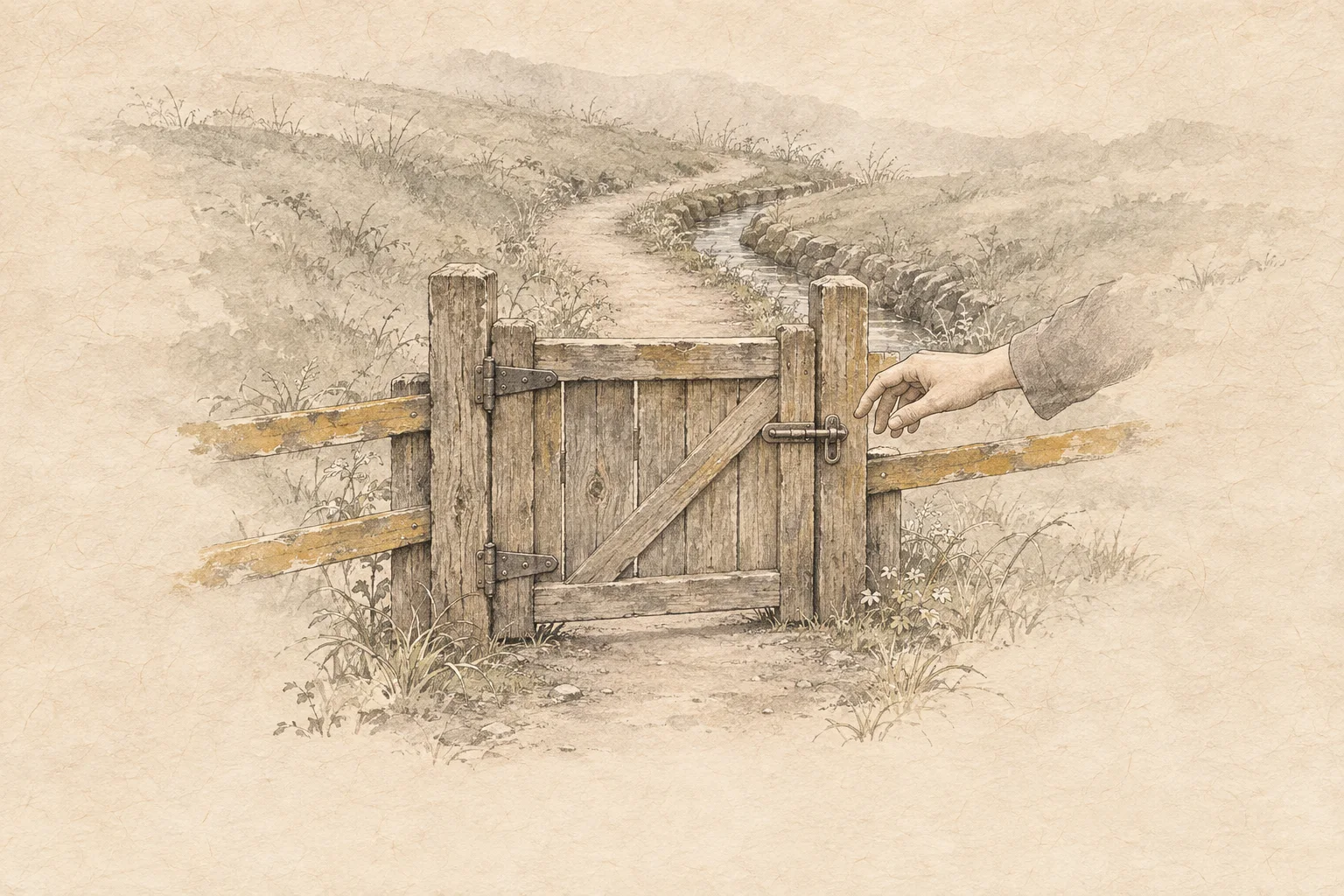
This study is an expansion by AI of 2 records published by ARCHON, a studio in the RISCON family, and of the public-domain source texts listed below. Every sentence in a block quote is word for word either a record's own or a passage of a source text saved with this study, and its source line names which; the rest is AI writing. The scene began in a working record that ARCHON summarised and anonymised; the raw record is not public. It is a synthetic scene, a modern summary written for a platform, not an archival document, and it cannot show what any particular organisation did. All but the first of its lenses suppose what could follow and do not report what happened, and ARCHON's judgments are its own readings, dated and revisable. The readings through the works named are this study's interpretation. Nothing in this study is advice on management, staffing, procedures or any other decision.
| Scene | Studio | Record |
|---|---|---|
| Purchase-Page Image | ARCHON | https://archon.risconlabs.com/kr/library?pair=arq-6675425b3c94f3b0-boundary |
| Unscheduled Goods Return | ARCHON | https://archon.risconlabs.com/kr/library?pair=arq-7dbb6cbc9400df7b-boundary |
The source texts this study read are saved with it, and the passages it quotes from them stand in them word for word:
| Text | File | Address |
|---|---|---|
| G. K. Chesterton, The Thing (1929), the opening of the essay "The Drift from Domesticity" | sources/chesterton-the-thing-fence.md | https://archive.org/details/thingwhyiamcatho00ches_0 |
| Niccolò Machiavelli, The Prince, chapters VIII, XV and XVII to XIX, translated by W. K. Marriott (1908) | sources/machiavelli-prince-8-15-19.md | https://www.gutenberg.org/ebooks/1232 |
ARCHON's judgments are dated 2026-09-20. The texts were fetched on 2026-10-05. This study was written on 2026-10-07.
Bibliography
- The Bible, King James Version (1611): 2 Thessalonians, chapter 2.
- Carl Schmitt, Political Theology (1922); The Nomos of the Earth in the International Law of the Jus Publicum Europaeum (1950); Political Theology II (1970).
- G. K. Chesterton, The Thing (1929), the parable of the fence.
- Niccolò Machiavelli, The Prince (1532), translated by W. K. Marriott (1908).
- ARCHON, the public question library (archon.risconlabs.com), for the ten scenes.
- Robert K. Merton, "Bureaucratic Structure and Personality," Social Forces 18 (1940).
- Herbert Kaufman, Red Tape: Its Origins, Uses, and Abuses (1977).
- Paul S. Adler and Bryan Borys, "Two Types of Bureaucracy: Enabling and Coercive," Administrative Science Quarterly 41 (1996).
- Giorgio Agamben, State of Exception (2005; Stato di eccezione, 2003).
- Barry Bozeman, Bureaucracy and Red Tape (2000).
- Paul Pierson, Politics in Time: History, Institutions, and Social Analysis (2004).
- Sofia Ranchordás, Constitutional Sunsets and Experimental Legislation: A Comparative Perspective (2014).
- Christopher Hood, The Blame Game: Spin, Bureaucracy, and Self-Preservation in Government (2011).
- Alexander L. George and Andrew Bennett, Case Studies and Theory Development in the Social Sciences (2005).
Back to the series · What Withholdeth: Restraint in Ordinary Organisations