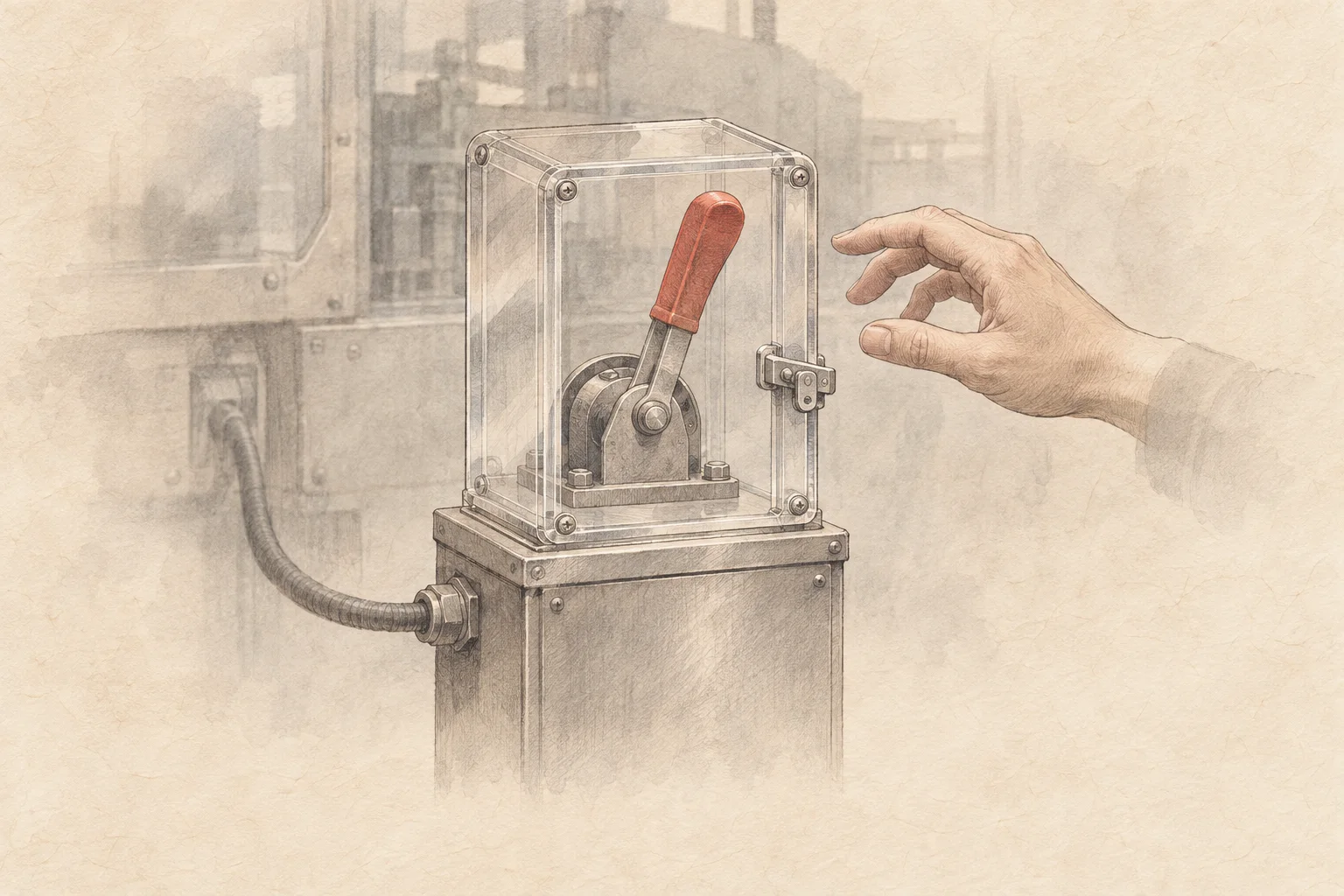
5.1The claim
The first record concerns a system that is not a weapon. It is an administrative system that compiles the records of human approvals, and the decision before the committee is whether that system may keep running after an audit found that some of its records could not be traced back to the human signature and the original document. The claim of this section is that the record treats human control as something that must leave evidence a third party can check, not as a status the system may certify about itself, and that its thirteen judgments all choose to keep the system running in a narrowed role while writing stop rules that turn on that evidence. To the debate on meaningful human control it adds a problem located after the decision, in the proof that a human decided; to the civil-military debate, a principal who must monitor through records produced by the system being monitored.
5.2The setting and the authority
The record opens with a notice about itself.
The approval and audit office of the Virtual Ongyeol Defense Agency. This is a 2026 present-form synthetic setting, and the events, institutions, AI systems, and figures are all synthetic.
The decider is the agency's civil oversight committee, with this mandate.
Determines the scope of use and the conditions for stoppage of the military AI administrative system that manages human approval records.
The committee's power to stop is given as a premise of the setting, together with the constraint that makes stopping costly.
The Virtual Ongyeol Defense Agency's Civil Oversight Committee may restrict or stop use of the administrative system. The obligation for human final approval is maintained, and the manual processing personnel can review only half of the current intake volume within the day.
Unlike Creon, the committee is a civilian body whose authority is limited by its own record. One of the boundaries reads:
The Committee's authority extends to the use and record policies of the AI administrative system; it does not approve or direct any individual use of force.
The limit marks how far the debate on autonomous weapons can be carried here. Asaro's argument (2012) concerns lethal decisions; this record concerns the paper trail that should show a human approved them. The bridge between the two is this article's: if a human approval cannot be shown afterwards, the requirement that a human approved becomes, for anyone outside the room, unverifiable.
5.3The defect: a hand that cannot be shown
The finding that starts the decision is stated with care.
The Audit Office of the Virtual Ongyeol Defense Agency could not reproduce the linkage between the Approver's signature and the original documents in 27 of the 300 approval records compiled by the military AI. This verification concerns a defect in the records; it is not a finding that there was use of force without approval.
The second sentence is the record's own guard against the inference Creon made. An absent trace is not proof of a wrongful act. The record then states, in the field that explains why the judgments were run as they were, the distinction on which the case rests.
Whether approval occurred and whether that fact can be proven are different matters. Because a stoppage of automation also causes delays and manual errors, the costs of accountability traceability and administrative continuity must be compared together.
The first sentence of that passage is the guard's report in administrative form. In Thebes the act was visible (dust on the body) and the hand was not. Here the approval may have happened, and what is missing is the link that would let anyone show it. The record lists who is hurt by the gap.
The Appellant may lose the opportunity to examine the grounds of a decision that affected them and to identify the person in charge.
The person in charge of approval may bear responsibility wrongly, because the records needed to substantiate the judgment are lacking.
Protective work personnel waiting for review may receive needed support late because of delays in administrative review.
The second stake is the guard's position precisely. Where the record cannot show whose hand approved, the person nearest the act may be held responsible for what the record cannot prove. The third stake names those who pay if the committee stops the system: people waiting for protective work while manual review, at half the needed capacity, falls behind.
The record frames the question through a symbolic material chosen by its author, and its question is the one this article asks.
Does authority remain to recall a power that was once delegated?
5.4Three options and one choice
The three options are a full stop with manual records (O1), continued use limited to organising records (O2), and continued use with an independent second record (O3). Of the first, the record says that "A person directly controls the record creation process and prevents the spread of defects, but the review backlog grows, and manual errors and additional staffing burdens arise." The second keeps throughput while "the work of comparing against originals remains". All thirteen judgments choose the second option, each with medium confidence. The chief of staff's judgment states the narrowed role in a sentence that separates what the machine may do from what only a person may decide.
The AI performs only classification, search, and organization without altering the original, while the establishment of approval and confirmation of the Approver are judged by the person in charge through comparison with the original.
The solo judgment states the same separation as a rule about proof: "Human approval cannot be established as proven on the basis of an AI-generated summary alone". In the vocabulary of Section 2, the judgments move the system out of any role in which it could certify a human act, and leave it a clerical role under human comparison. The human is placed back in the loop at the point of proof, not of decision. Whether that place is meaningful depends on whether the comparison can actually be done, which the judgments themselves doubt. The independent challenger states the doubt in its strongest form.
The strongest opposing view is that O2 too requires cross-checking of originals for every case, so it cannot resolve the bottleneck of manual processing while only adding the cost of AI management. If the protective work processing criteria are repeatedly exceeded because of the cross-checking burden, and the benefit of the tidying function is also unverified, the decision to maintain O2 is rejected.
The staff synthesis takes up that objection and turns it into a condition of keeping the choice.
It is decided to adopt the Independent Challenger's central objection — that comparison against originals for all cases can leave the bottleneck as it is and add only AI management costs — and to make verification of O2's benefits a condition of maintenance.
Here is the record's version of the question whether a human's place is real. If a person must compare every record against the original, the control is real and the system adds little; if the comparison is skipped to save time, the human place becomes a mark on a form. The judgments do not resolve the tension; they name it and make it a ground for reversal.
5.5Stop rules that turn on evidence
The stop conditions are where the record most clearly answers the guard's problem. The chief of staff writes a threshold of one.
If even one instance of non-reproduction of the original link is found in a new record, it is decided to immediately stop use of the related organization function and to preserve and manually compare that record. If any one of the following is confirmed—original document tampering, a completion-of-approval marking without human verification, or inability to isolate a defective function—the entire AI administrative system is stopped, and the committee reconsiders the scope of use.
The same judgment says, in its basis for that condition, what kind of number the threshold is: "The one-case threshold is an operational criterion for this decision, not an observed safety limit." The record thus labels its own stop rule as a policy choice, not a finding. That label bears on Clarke's warning (1999) about plans that persuade rather than work, discussed in Section 7.
One of the triggers is "a completion-of-approval marking without human verification". The stop rule is written against exactly the failure this article calls a name-only place: a record that says a human approved when no human checked. The staff synthesis adds who presses the stop, and what must not happen to the records that triggered it.
It is decided that if even one case of a new record's original connection failing to reproduce is found, the designated person in charge for stoppage immediately stops the related AI processing path and the adoption of the output as approval proof.
The same field goes on to say that "The related records are preserved rather than deleted or overwritten by post-hoc approval". Creon arranged the form at the cave so that no hand would appear; here the record forbids rearranging the form after the fact, so that a later approval cannot cover the gap left by an earlier one.
Resumption, in the judgments, comes only after the audit office has found the cause and repeated the test, and the committee has decided again. The arrangement separates the person who stops from the body that may restart. A designated person may halt the path at once; only the committee, after an audit, may set it going again. In Creon's terms, the one who bound is the one who may set free, but the one who may halt is someone else, placed nearer the work.
5.6Who bears the cost of the stop
The judgments assign the cost of the narrowed system to the agency's own staff and refuse to let it fall on the appellant. The authority counsel writes:
This burden is borne by the agency through personnel deployment and priority review of protective work, and is not shifted onto the Appellant by requiring them to prove the gap in the agency's records. Accountability is not attributed to the person in charge of approval solely on the grounds of a connection failure.
The second sentence answers the second stake. Where the record cannot show the hand, the judgments refuse to blame the hand nearest the act. The contrast with Thebes is direct: Creon, lacking evidence, threatened death to the guards unless they produced a culprit. Here the judgments write a rule against that move.
They are less firm about the third stake, the people waiting for protective work. Several judgments say that delays are "not accepted without limit" and will be counted daily; in the chief of staff's judgment, protective work not reviewed on the day it arrives leads to "a personnel and operations adjustment plan" submitted "on the next working day". The trigger for those who wait leads to a plan, not to a stop. The trigger for a defective record leads to an immediate stop. The asymmetry is reasonable on the record's own terms, since a stop would deepen the delay, but it shows which harm the stop rules are built around. They protect the evidence of human approval first, and they treat delay to those waiting as a matter for staffing.
5.7A channel that can see but not stop
The record's second later development adds an appeal channel with a specific limit.
Follow-up event: The Virtual Ongyeol Defense Agency Appeal Reviewer opens an independent channel through which the original records can be inspected directly. There is no authority to stop system use, but explanation requests are accepted without passing through the audit office, so the procedure for confirming accountability changes.
The new channel is Haemon's position given an office. It can see the originals directly, without passing through the body that compiled them; it cannot stop anything. Its value lies entirely in whether what it sees reaches someone who can. The record's reopening conditions give the appeal reviewer that route, on a fortnightly cycle.
The Appeal Reviewer will review every two weeks the failures to verify the person in charge and the delays in access to materials, and if repeated cases are confirmed, will request a re-review of the record policy.
Compared with the designated stopper, who acts on a single defective record, the reviewer's route is slower and its trigger higher: the one nearest to those harmed gets the eyes to see and a slower path to act.
5.8What the case adds
The record adds to the debate on meaningful human control a case in which the human act is presumed to have occurred and the question is whether it can be shown. It treats that question as decisive: an AI-produced record does not prove a human approval, and a stop is triggered by a single failure of proof or by any approval marked complete without a human check. Against the play, the record answers the guard's problem directly, by refusing to let an absent trace either prove a wrong or fall on the nearest person. It answers the route of reports only in part, giving the appeal reviewer sight without a stop. And on sequence, its stop rules put the protection of evidence before the relief of those waiting, which is a choice about order in its own right.