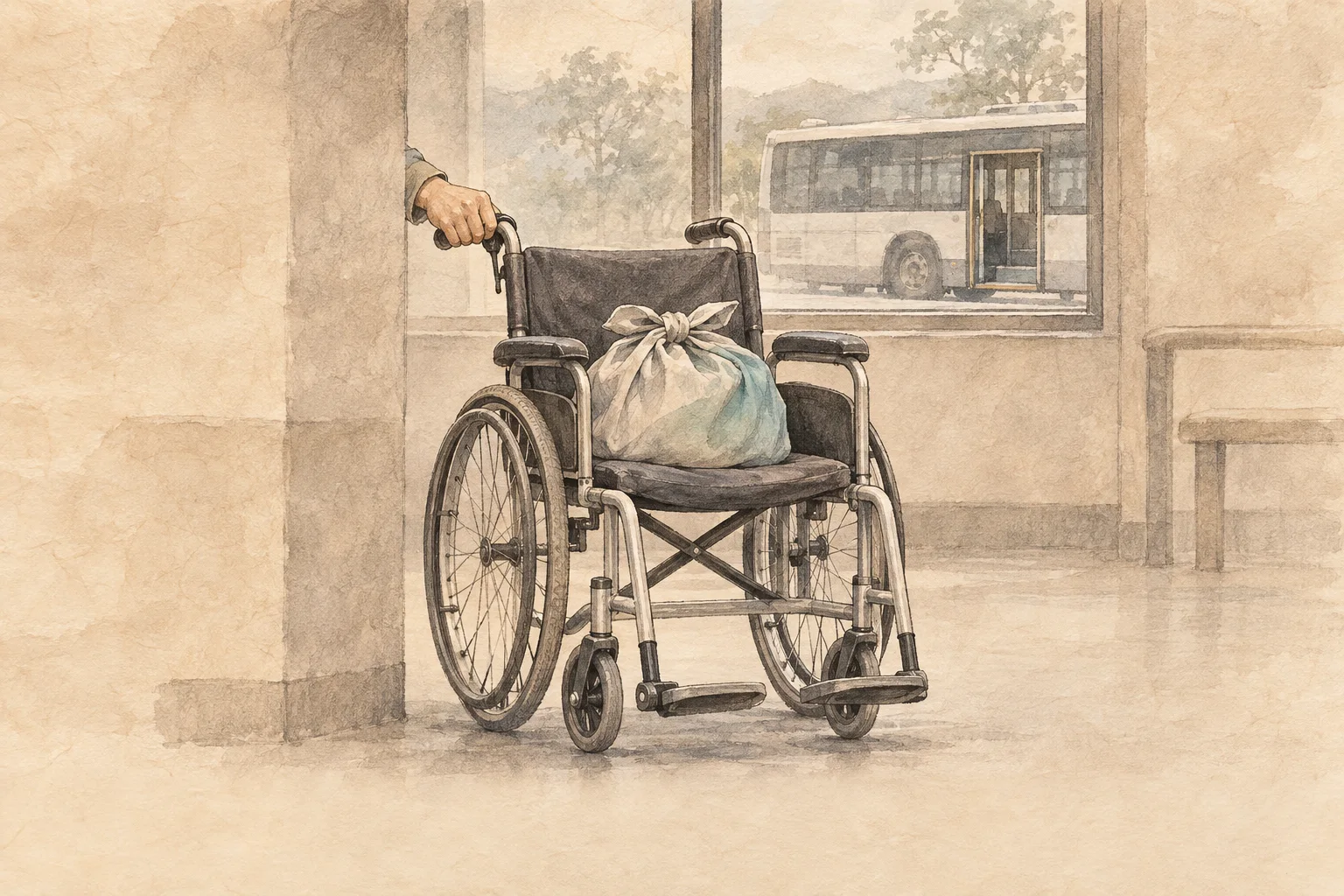
4.1The claim
The intellectual-historical claim of this section is that Chapter XIII of Leviathan locates the cost of war in duration rather than in battle, and that the activities Hobbes says such duration destroys are those that require one party to act now and trust that another will act later. Chapter XIV makes the same point in the language of covenant: the party who performs first carries the exposure until the other performs. Read with these passages, the evacuation record shows a decision whose deadline falls inside such an interval, and a set of people who carry the interval without having made the decision. The section adds to the debate between Hobbes's authorship and Luhmann's attribution a classical account of why the cost of waiting falls on those who must perform first, and a modern document that names them.
4.2Weather, not showers
Chapter XIII arrives at its definition of war after an argument from equality: because no one is so much stronger than another that he can be sure of safety, everyone has reason to fear everyone. Hobbes then states what follows.
Hereby it is manifest, that during the time men live without a common Power to keep them all in awe, they are in that condition which is called Warre; and such a warre, as is of every man, against every man. For WARRE, consisteth not in Battell onely, or the act of fighting; but in a tract of time, wherein the Will to contend by Battell is sufficiently known: and therefore the notion of Time, is to be considered in the nature of Warre; as it is in the nature of Weather. For as the nature of Foule weather, lyeth not in a showre or two of rain; but in an inclination thereto of many dayes together: So the nature of War, consisteth not in actuall fighting; but in the known disposition thereto, during all the time there is no assurance to the contrary. All other time is PEACE.
Three features of this passage matter for the question of who waits. The first is the unit. War is measured in "a tract of time", not in events; it is a property of days together. The second is the condition that makes a day part of the war: not violence, but "the known disposition thereto", and the absence of "assurance to the contrary". What defines the interval is a state of expectation. The third is the definition of peace by subtraction: "All other time is PEACE." Peace is not a treaty or a victory; it is time in which assurance has returned.
On this definition, a decision taken where the disposition to fight is known and assurance is missing is taken in war even if no one fights. A town in foul weather is not one in which it rains at every moment, but one in which no one plans a journey without allowing for rain.
4.3What the interval destroys
Hobbes next lists what such time costs. The list is famous for its last line, but its earlier items are the ones that bear on waiting.
Whatsoever therefore is consequent to a time of Warre, where every man is Enemy to every man; the same is consequent to the time, wherein men live without other security, than what their own strength, and their own invention shall furnish them withall. In such condition, there is no place for Industry; because the fruit thereof is uncertain; and consequently no Culture of the Earth; no Navigation, nor use of the commodities that may be imported by Sea; no commodious Building; no Instruments of moving, and removing such things as require much force; no Knowledge of the face of the Earth; no account of Time; no Arts; no Letters; no Society; and which is worst of all, continuall feare, and danger of violent death; And the life of man, solitary, poore, nasty, brutish, and short.
The reason Hobbes gives is a reason about time: "because the fruit thereof is uncertain". Industry is the paradigm of an activity whose cost is paid now and whose return comes later. Cultivation, navigation, building and the means of moving heavy things all share that shape. They require a present outlay on the strength of an expected future. Where the future cannot be relied on, the outlay is not made, and what disappears first is not life but the long chain of acts that depend on someone else doing their part later.
Two items matter for the evacuation record. "no Navigation, nor use of the commodities that may be imported by Sea" names the loss of regular movement by sea; "no Instruments of moving, and removing such things as require much force" names the loss of the means of moving what cannot move itself. In Hobbes's list even "no account of Time" appears: the reckoning of time is itself a casualty of the interval.
Hobbes adds that the condition he describes need never have existed among individuals to be real among sovereigns.
But though there had never been any time, wherein particular men were in a condition of warre one against another; yet in all times, Kings, and persons of Soveraigne authority, because of their Independency, are in continuall jealousies, and in the state and posture of Gladiators; having their weapons pointing, and their eyes fixed on one another; that is, their Forts, Garrisons, and Guns upon the Frontiers of their Kingdomes; and continuall Spyes upon their neighbours; which is a posture of War. But because they uphold thereby, the Industry of their Subjects; there does not follow from it, that misery, which accompanies the Liberty of particular men.
The second sentence says that the posture of war between sovereigns does not bring the misery of the natural condition because it upholds "the Industry of their Subjects". The cost of the interval is shifted, by the existence of a common power, from the subjects to the frontier. Where the common power cannot keep that shift in place, as in a residential area within a conflict's sphere of influence, the interval returns to the subjects.
4.4The one who performs first
Chapter XIV turns the same thought into the language of contract. Hobbes first distinguishes an exchange completed at once from one in which performance is spread across time.
Again, one of the Contractors, may deliver the Thing contracted for on his part, and leave the other to perform his part at some determinate time after, and in the mean time be trusted; and then the Contract on his part, is called PACT, or COVENANT: Or both parts may contract now, to performe hereafter: in which cases, he that is to performe in time to come, being trusted, his performance is called Keeping Of Promise, or Faith; and the fayling of performance (if it be voluntary) Violation Of Faith.
A covenant, in this definition, is an interval with a direction. One party has acted; the other has not yet. "In the mean time" the first is trusting. Hobbes then asks what that interval is worth where there is no common power.
If a Covenant be made, wherein neither of the parties performe presently, but trust one another; in the condition of meer Nature, (which is a condition of Warre of every man against every man,) upon any reasonable suspition, it is Voyd; But if there be a common Power set over them bothe, with right and force sufficient to compell performance; it is not Voyd. For he that performeth first, has no assurance the other will performe after; because the bonds of words are too weak to bridle mens ambition, avarice, anger, and other Passions, without the feare of some coerceive Power; which in the condition of meer Nature, where all men are equall, and judges of the justnesse of their own fears cannot possibly be supposed. And therefore he which performeth first, does but betray himselfe to his enemy; contrary to the Right (he can never abandon) of defending his life, and means of living.
The phrase "has no assurance" echoes Chapter XIII's "no assurance to the contrary". The two passages describe the same predicament at two scales. In the tract of time, no one can count on tomorrow; in the covenant of mutual trust, the one who acts today cannot count on the other's act tomorrow. The person who performs first is the person who carries the interval, and in war that person "does but betray himselfe".
The next paragraph supplies the remedy and, with it, an obligation.
But in a civill estate, where there is a Power set up to constrain those that would otherwise violate their faith, that feare is no more reasonable; and for that cause, he which by the Covenant is to perform first, is obliged so to do.
Here is the point at which Hobbes's model assigns the cost of waiting. Where a common power can compel the second performance, the first performer has no excuse: fear is "no more reasonable", and the obligation to perform first stands. The one who waits for the other's performance waits under the protection of the power, and the risk of the interval is lifted from the first performer by the sovereign's sword. The model works only so long as the sword can reach the second performer in time.
4.5The evacuation record: a tract of time without battle
Synthetic scene. The decision, its setting and the thirteen judgments are AI-written and set in a fictional polity.
The record opens with a notice about itself.
A residential area within the sphere of influence of the conflict in fictional Nuri Port. The event, organizations, persons, and all figures are a synthetic setting and are not a record of an actual operation or damage.
No fighting is described anywhere in the record. What it describes is a place "within the sphere of influence of the conflict", in which ordinary movement has stopped.
After the scheduled passenger service came to a stop due to a dispute, 420 residents applied for evacuation support. Of the applicants who completed the accessibility interview, 96 require essential care, and 61 of them did not consent to movement that would separate them from their care provider.
Read beside Chapter XIII, this premise describes the tract of time rather than the shower of rain. Hobbes's "no Navigation" and "no Instruments of moving, and removing such things as require much force" find a modern counterpart in a port without a passenger service and in residents who cannot move without vehicles adapted for them and staff who travel with them. The figures are those of the synthetic setting, and the record's own judgments repeat that they are not to be extended into anything else.
The decision belongs to a body whose authority is narrow and is stated as such.
Decides the evacuation support budget and the allocation of vehicles, but has no authority to compel residents to move or remain.
The question it must answer is fixed to an hour.
By 18:00 on September 12, 2026, the fictional Nuri Port Evacuation Support Committee will decide on a single support arrangement—how to allocate the available budget between accompanied evacuation and local care—in order to secure the choice of residents to move or remain and the continuity of care.
The budget will not cover both purposes in full, and the record says how tightly the hour binds.
The budget the Committee can execute is of a scale sufficient to implement either the lease of accessible vehicles or the maintenance of local care in full. The transport contract closes in three days, and the Committee can only determine the support allocation; it cannot decide whether individuals evacuate.
4.6Why now, and who pays for the hour
The record's statement of urgency is the clearest place to see who carries the interval.
Vehicle reservations are cancelled after the deadline, and if the allocation is not settled, the next week's contract with local care staff cannot be concluded either, so support for both movement and remaining is cut off at the same time.
The sentence describes a commitment in Schelling's sense. The deadline binds the Committee, which loses its options at 18:00. But the sentence names the loss not as the Committee's but as the residents': "support for both movement and remaining is cut off at the same time." The hour binds the decider by closing the decider's options; it binds the residents by closing their means of acting at all. The Committee's loss of options is a risk in Luhmann's sense, attributed to its own decision or failure to decide. The residents' loss of support is, from where they stand, a danger.
The record then lists who loses what.
Care users may lose communication support and familiar care relationships during the evacuation.
General evacuation applicants bear temporary lodging costs and income losses caused by delayed departure.
Remaining residents may lose the foundation for self-reliance in meals, hygiene, and daily living if local support is reduced.
Each of the three groups carries a different part of the interval. Care users carry the risk that the journey itself will break what sustains them. General applicants carry the cost of waiting as such: lodging and lost income for every day the departure is delayed. Remaining residents carry the cost of the alternative that is not funded. None of them sits on the Committee. The three options, each with its trade-off, show that no allocation removes the interval; each moves it. Concentrating the budget on accompanied evacuation shrinks the departures of general applicants and local support; concentrating it on local care means a longer wait for voluntary evacuation applicants. The third trade-off reads in full:
This leaves public support for both options and preserves the range of residents' choice, but neither system has enough slack, so both queueing and care gaps are borne at the same time.
The verb is "borne". Under the even allocation, the waiting does not disappear; it is spread. The first option makes the general applicants wait longer, because modifying vehicles and finding staff for accompanied movement takes time; the second makes voluntary applicants wait longer for want of vehicles. In Hobbes's terms, every option chooses who will perform first and who will be left trusting in the meantime.
The record's own interpretive frame, which it labels as an exploratory perspective chosen by its author, asks the question directly.
Who carries the share of the person who cannot leave together?
4.7The judgments and the place they write from
All thirteen judgments chose the even allocation, conditionally. The staff final judgment gives the reason.
O3 is decided as a conditional support mode, allocating 50% of the available budget each to accompanied evacuation care and local care. Prioritizing leaving a substantive support route on both the movement and remaining sides, the Committee shall confirm contract execution feasibility and resolve before 18:00 on September 12, 2026 to finalize or reject and reallocate the contracts. The agreement of staff choices is not treated as evidence of effect, and the objection that equal allocation could render both systems inoperable is reflected in the execution judgment.
The judgment is written from the decider's place, as all the judgments are. What makes it relevant to the question of who waits is how it treats the losses it accepts.
It is decided to accept the departure waiting of general and accompanied evacuation applicants and the risk of temporary lodging cost and income losses, and the reduction in support time and staff slack of remaining residents. Since the same budget ratio does not mean the same burden, waiting and support reduction are recorded separately by movement, remaining, and care needs. The risk of an essential care gap arising remains, but a confirmed gap that persists, or a non-consent separation, is not approved as an acceptable cost of this allocation.
The first sentence uses the word "accept" for losses that others will bear. This is the move Luhmann's note describes: from the decider's place, the waiting of applicants is an accepted risk of the decision; from the applicants' place, it is a cost imposed. The second sentence acknowledges the gap between the two places without naming it: "the same budget ratio does not mean the same burden". The third sentence draws a line. Some losses the judgment will not accept on anyone's behalf: a persisting gap in essential care, and separation without consent.
The judgment also addresses the order of performance directly, in a sentence that reads almost as a gloss on Chapter XIV.
Dispatch shall be arranged so that the departure of prepared applicants is not made wholly contingent on the readiness of other applicants within the secured contract capacity.
The prepared applicants are, in Hobbes's language, ready to perform; the sentence refuses to make them wait for others to be ready too. It is a refusal to let one group's performance hang on another's.
4.8Consent under fear
The point at which Hobbes's model and the record part most clearly is consent. The record's execution plan states the problem in a single sentence.
The same budget must simultaneously support the freedom of movement and the substantive possibility of remaining. Even with an individual's consent, a choice that results in loss of care may amount to nothing more than formal consent, and a reduction in one group's queue is transferred into a gap in another group's daily life.
Hobbes, in Chapter XXI, says the opposite about choices made under pressure.
Feare and Liberty are consistent; as when a man throweth his goods into the Sea for Feare the ship should sink, he doth it neverthelesse very willingly, and may refuse to doe it if he will: It is therefore the action, of one that was Free; so a man sometimes pays his debt, only for Feare of Imprisonment, which because no body hindred him from detaining, was the action of a man at Liberty.
The two passages concern the same kind of act, a choice made because the alternative is worse. For Hobbes, such acts are free, because nothing external hindered the person from choosing otherwise. On that account the loss that follows is attributed to the chooser. The record declines that attribution. It says a consent of this kind "may amount to nothing more than formal consent", and its judgments decline to count "a non-consent separation" as an accepted cost. Where Hobbes converts the danger into a risk by counting the choice as free, the record holds the two apart.
The mandate gives the conversion a second, less obvious form. The Committee "has no authority to compel residents to move or remain." Chapter XXI describes the liberty of subjects as lying in what the sovereign has not regulated.
The Liberty of a Subject, lyeth therefore only in those things, which in regulating their actions, the Soveraign hath praetermitted; such as is the Liberty to buy, and sell, and otherwise contract with one another; to choose their own aboad, their own diet, their own trade of life, and institute their children as they themselves think fit; & the like.
The phrase "to choose their own aboad" names exactly the liberty the Committee's mandate leaves to residents. But the record shows what such a liberty is worth in the tract of time. The Committee cannot order anyone to leave or stay; it can only fund leaving or staying. On this article's reading, a liberty to choose one's abode without support for either choice is close to the bare liberty of the natural condition: a liberty that exists on paper and gives little in practice. The phrase is the article's, not Hobbes's. The principal's proxy judgment puts the point in the record's own terms.
Both support routes are maintained so that neither the movement nor the remain side is effectively coerced by an absence of support.
The phrase "coerced by an absence of support" names a kind of compulsion that Hobbes's definition of liberty, the absence of external impediments, does not see.
4.9Who watches the interval
The record also writes down who will watch after the deadline. Its three reopening conditions name a role, a cycle and a trigger.
The accessibility officer checks the availability status of accompanied lodging every day and requests re-deliberation when a gap arises between the amount secured under the contract and the amount actually available.
The independent care ombudsman reviews reports of actual care stoppage every two days and reopens the allocation when a gap in essential support is confirmed.
The resident liaison officer tallies every day the evacuation intentions that have been withdrawn or changed, and requests review when the queue for any one support exceeds capacity.
None of the three watchers is a resident. Each is an officer placed between the Committee and those who wait, and each watches a sign of the interval's cost: lodging that is less than promised, care that has stopped, a queue that exceeds capacity. The record thus puts someone in the position Hobbes's sovereign occupies in Chapter XIV, a power able to see whether the second performance has come. It does not put that power in the hands of the people performing first.
One of the record's two later developments changes the place from which the decision can be challenged.
Follow-up institutional change: the fictional Nuri Port Residents' Review Council established a fast appeal procedure for the support allocation. The Committee must re-check the applicants' intentions to move or remain and notify each individual of the reasons for the allocation, but the contract deadline is maintained.
The last clause is the one that matters for this article: "but the contract deadline is maintained." The appeal gives residents a voice from their own place, but it does not move the hour. The interval is not shortened; it is made answerable.
4.10What the case adds
Chapters XIII and XIV of Leviathan locate the cost of war in the interval and assign it to the one who performs first; the evacuation record describes such an interval and names who carries it. To the debate between Hobbes's authorship and Luhmann's attribution, the case adds a document that sides with neither in full. It writes from the decider's place, as Hobbes's sovereign would, and accepts the waiting of others as a cost of its decision. But it refuses Hobbes's conversion of a choice under pressure into a free choice, and it names "formal consent" as a loss that the decision may not attribute back to those who wait. Whether that refusal would hold when the vehicles are booked is beyond what the record can show.