1.1The question
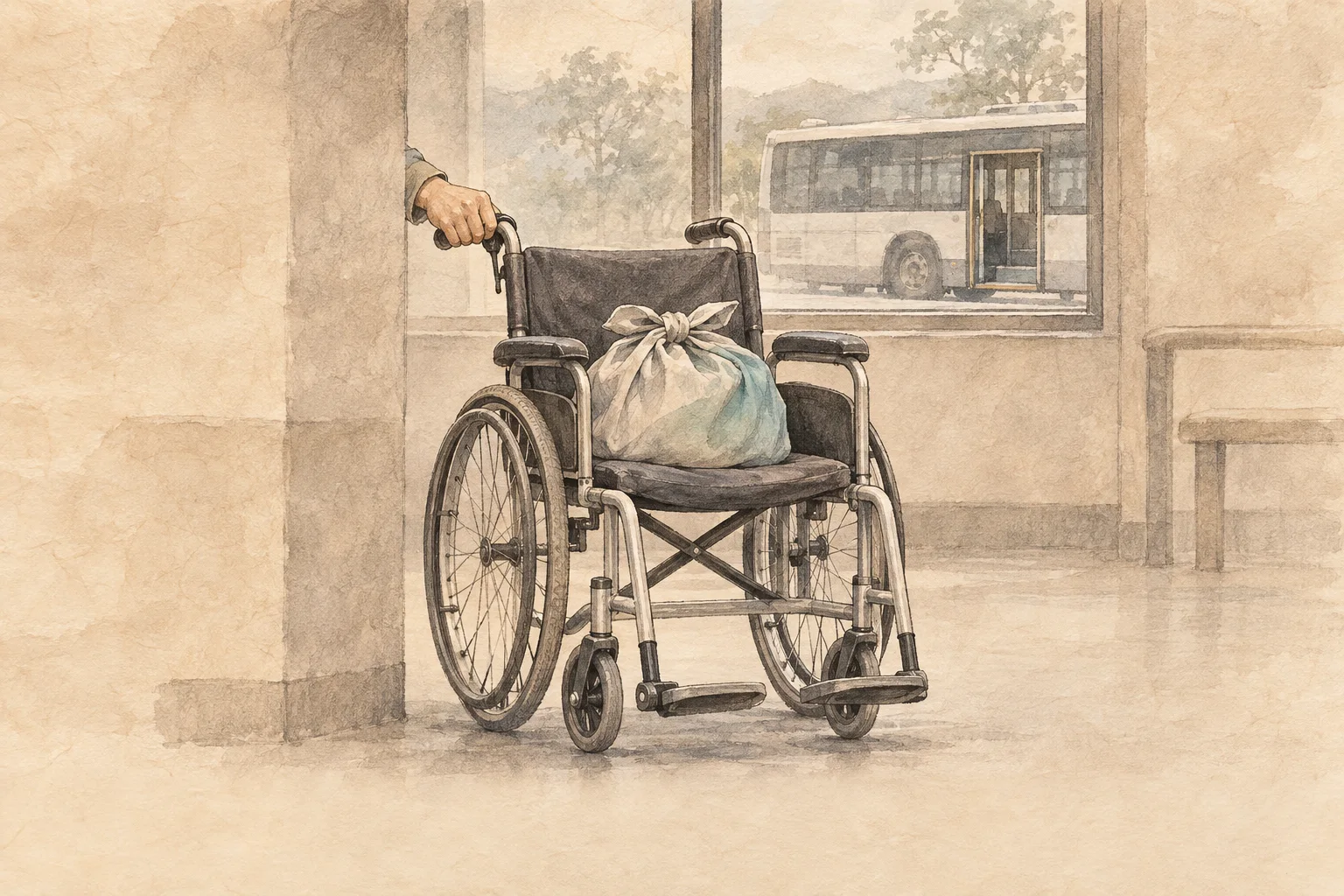
Most accounts of decision under pressure ask who decides and whether the decision was right. Fewer ask who carries the interval. Between the moment a question becomes urgent and the moment it is answered, someone is already paying: a family waiting for a vehicle, a patient waiting for a filter to be replaced in a clinic, a worker whose rest depends on a schedule that has not yet been fixed. The deadline that a decision record writes down is the edge of that interval, not its whole.
This article asks: does the cost of a deadline fall on the one who decides, or on the one who stands still while the decision is pending? It puts the question to one old text and two new documents. The old text is Hobbes's Leviathan, whose Chapter XIII holds that war is a matter of time rather than of battle. The new documents are two decision records from Meridian's defence collection. In the first, a committee in a fictional port must divide an evacuation budget between accompanied departure and local care by a fixed hour in 2026; in the second, a committee in a fictional industrial zone must divide a reduced production line between civilian hospitals and military service facilities by a fixed hour in 2031.
1.2The contribution
The contribution is narrow and comes in two parts. The first is a reading. Leviathan is usually remembered for the misery of the natural condition and for the absolute sovereign. Read for time, it says something more specific: that the cost of war is borne in duration, by activities that need trust across time; that a covenant in which one party performs first leaves that party exposed until the other performs; and that the sovereign's covenant makes each subject the author of what the sovereign does, so that losses which fall on subjects are, in Hobbes's terms, their own. Chapter XXI then lists the liberties that authorship cannot transfer. Read together, these passages give a classical model of how a loss that falls on one person can be attributed to another person's choice.
The second part brings that model to Luhmann's distinction. Luhmann's Risk: A Sociological Theory (1993) separates risk, a possible loss attributed to one's own decision, from danger, a possible loss attributed to something outside one's control, and holds that the same loss is a risk to the one who decides and a danger to those affected who did not decide. Applying that distinction to records of decisions in wartime settings, and setting Hobbes's authorship beside it, is this article's own step. The records are useful here because they write down, before any outcome, who decides, who waits and what the deciders refuse to let the waiting cost.
1.3The debate joined
Two positions are set against each other: authorship, as Hobbes builds it, in which the subject owns the sovereign's acts and a choice made under fear is still free; and Luhmann's attribution, in which the same loss looks different from the place of the one who decided and from the place of the one who did not. Michael Walzer's Just and Unjust Wars (1977), Aaron Friedberg's In the Shadow of the Garrison State (2000) and Thomas Schelling's The Strategy of Conflict (1960) serve as points of reference, on emergency, on what a decider can command, and on the deadline as a commitment. Section 2 sets them out.
The placement of these works in one debate, and their application to Hobbes and to the records, are this article's own. Each work is described only as far as its reading note in the parent study goes. The article does not decide between the sides, and it draws no conclusion about real wars, states or committees.