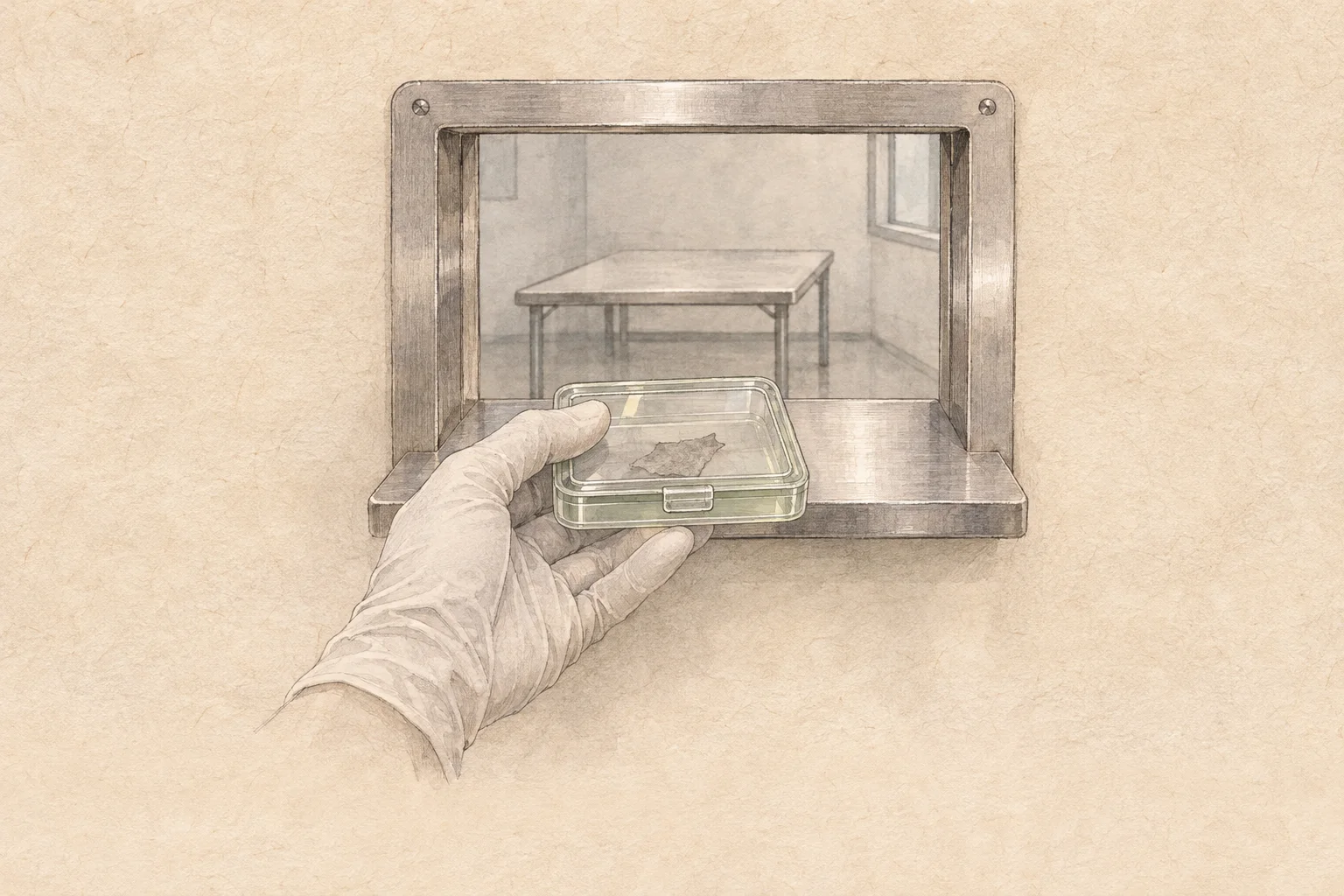
The fourteen records frame evidence as a passage, not an inference. They ask by what route material reaches the court that will decide, what carries it, what kind of thing it is and who must move it; they do not ask what it proves, and they leave the forming of a view to the court. This conclusion returns to the two debates, states the contributions, and sets out limits and further research.
Discussion
The debate over what proof is concerns the step from evidence to conclusion. Twining, Rethinking Evidence (2006), puts that step at the centre of the subject and the rules around it. Pennington and Hastie, Explaining the Evidence (1992), find that people judging once at the end of a case follow a story rather than Bayesian updating, Bennett and Feldman, Reconstructing Reality in the Courtroom (1981), suggest that the criminal trial is organized around storytelling, and Allen and Pardo, The Problematic Value of Mathematical Models of Evidence (2007), argue that formal mathematical models explain the value of items of evidence less than their builders assume. The records take no part in this dispute, and their silence is complete in a way that can be counted: no question asks how much something proves, no condition for looking again turns on weight or credibility, and no record names the dispute between the parties that the evidence would be about. A story model needs a story; these records give the materials of a hearing without the story they would serve.
This study does not read the silence as a failing: the records are synthetic practice materials published as general information, not legal advice, and a record that told its reader what evidence proved would be doing something else. The silence has a shape all the same. Where the records come closest to the inside of proof, they hand it over. The record on a party's own words names "material from which the court forms its view" and stops there. The record on the court acting on its own names "the state of the judicial mind" as material to examine and does not describe it. Damaška, Free Proof and Its Detractors (1995), takes up the idea that the law should not assign probative weight to items of information. This study reads the records as written inside that idea, from the side of the person who brings the material: what the reader is given is everything up to the weighing.
The debate over evidence as an institution concerns the setting. Damaška, Evidence Law Adrift (1997), names the divided tribunal, the concentrated trial and the parties' prominent role, and sets them against unified tribunals, episodic proceedings and parties with fewer responsibilities. Langbein, The German Advantage in Civil Procedure (1985), locates the shortcomings of lawyer-dominated civil procedure in leaving the gathering of facts to partisans. Damaška, Epistemology and Legal Regulation of Proof (2003), holds that good fact-finding arrangements depend on the type of proceedings and the decision-makers. The records belong to this conversation, but not as a description of a system. Their pairs of readings divide along its lines: a record of an investigation set against what a court that did not directly observe may lose; the record of a witness's earlier examination against a party's request to hear the witness again; the judge's lead in small claims against the parties' applications as its backbone; the court's view that materials are unnecessary against the protection of the sole materials for an asserted fact. The comparative literature draws such lines between systems. The records draw them inside single questions and leave each one open.
Friedman, Anchors and Flotsam (1998), suggests that the author of Evidence Law Adrift, schooled in Continental Europe, may take the rhetoric of Anglo-American evidence law somewhat too seriously. The caution fits a study of records like these, which are not a system's rhetoric but synthetic exercises, and whose divisions may be the studio's teaching device rather than features of any court. Jackson and Summers, The Internationalisation of Criminal Evidence (2012), observe that a cosmopolitan law of evidence has been developing in criminal cases across the common law and civil law traditions. The records, which name no tradition and pair readings pointing both ways, are not about criminal cases, and this study draws no support for that observation from them.
Contributions
The study makes three contributions. First, it brings a kind of document that the works used here do not take up, public question records for people without a lawyer, into the debate over proof, and shows that in this genre the inferential centre of the subject is left out and the institutional frame is the whole of what is taught. Second, it shows that the records' treatment of evidence is organized around the record that carries material between episodes: investigation outside the court, preservation before an action, examination abroad, a preparatory hearing that closes. That is the episodic setting the institutional literature describes, seen from the side of the person who must move material through it. Third, it shows that the records stage, as open questions inside single records, the divisions the comparative literature draws between whole systems: presence and record, judge and parties, the court's view of need and a party's protection. The records do not resolve them, and this study does not either.
Limits
The limits are those of the material. The records are synthetic practice materials published as general information, not legal advice, under an editorial reference date that is neither a case date nor a confirmation of current law. They report no real case, and nothing in this study is a claim about what any court does. The fourteen were chosen by one lexical rule in one section; the 16 Courtroom questions on witnesses, experts and inspection that do not use the word evidence, the 9 Documents questions that do, and the criminal-trial series would each test whether the frame holds beyond it. The counts describe wording, not practice. The readings through the works are this study's own, and several works speak of juries, criminal trials or national systems that the records do not concern. Nothing here suggests what evidence a reader should offer or how.
Further research
Three lines follow. The first is to read the left-out questions on witnesses, experts and inspection, and the criminal-trial series, to see whether the absence of weight holds where the subject is testimony and expertise, where credibility might be expected to enter. The second is to set these records beside written help for people without a lawyer that does take up the inside of proof, such as guides that ask a reader to tell what happened, and to see how the two frames divide the work between the reader and the court. The third is to ask readers. Whether a person preparing for a hearing reads these records as preparation for proof, or as the whole of it, only readers can show. The contribution of this study stands at the start of those lines: these records teach evidence as the passage of material to a court that will weigh it, and leave the weighing, in their own words, to the court that forms its view.