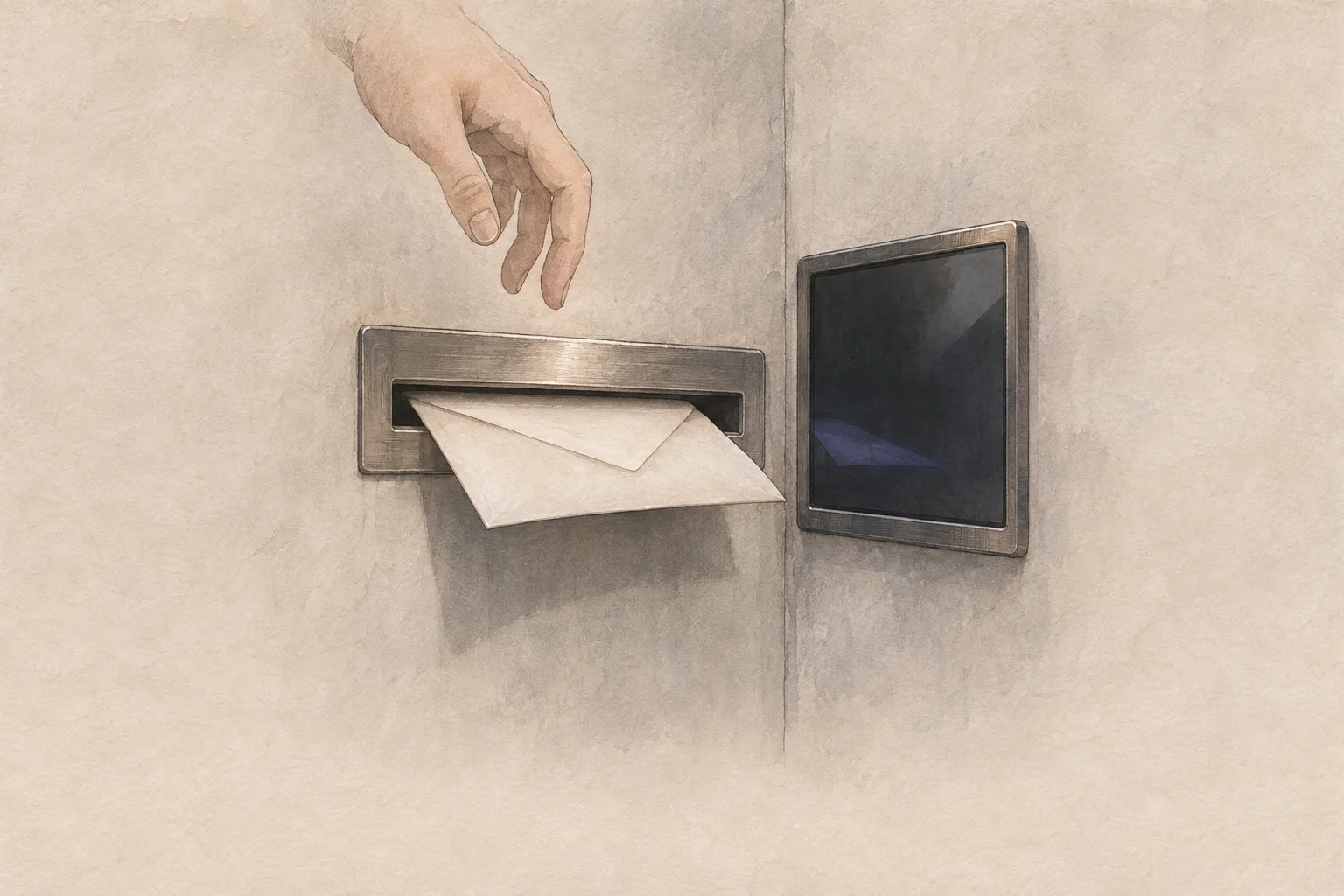
A court case is carried by papers that have to travel. A claim is meant to reach the other side; a pleading is meant to reach the court; a decision is meant to reach the people it concerns. The person who goes to court without a lawyer meets this travel, on paper and on screen, with no lawyer beside them to say whether a paper has arrived. This study asks how a public set of records written for such a person frames that movement. When a court paper moves, from one side of a case to the other or from paper to screen, what do the records treat as showing that it arrived, whose arrival do they count, and what do they name as a reason to look at the matter again?
The answer offered here is that the records make arrival a matter of record. They never ask whether the person a paper was meant for read it, understood it or learned of it. They ask what another paper shows: the service record, the notice the serving body gave the court, the report of a place for receiving service, the publication in a gazette, the screen on which a filing was registered. Where the person who actually received, read or filed a paper differs from the person the record names, the records set the two side by side and ask which one counts, and they leave the answer open. Inside electronic filing they keep paper in view, through printouts, paper filings and originals, and they ask whether two forms of a document are the same document. When they name a reason to look again, it is a new or changed record, almost never anything a person did and never anything a person knew. That is the contribution: written help of this kind, prepared in advance for a person without a lawyer, teaches its reader to see a court paper the way a file sees it, and so takes a side, without saying so, in a debate about what documents do that has mostly been conducted about officials, judges and system designers.
The records
The records come from PRO SE, a studio of the RISCON family that publishes a library of questions for self-represented litigants. Every question in the library is marked synthetic, the library is offered as general information and not legal advice, and its date is an editorial reference date, not a case date or a confirmation of current law. None of the records reports a real case, and this study draws no fact about any law, court or person from them. What can be studied is the frame: how a question about a court paper's movement is put to a reader who has no lawyer. Each record has the same shape. It asks a question, says what material is examined, gives two readings that point different ways, puts a question where a judgment would stand, and names a condition under which the matter would be looked at again. PRO SE does not make the decision, and neither does this study.
The debate
Two arguments meet in the records read here. One concerns what documents do in law and administration. The other concerns what changes when courts move from paper to screens.
The first argument sets two views of the document against each other. On the ordinary view, a document records an act that happened elsewhere: a paper says that service was made, and the service is the thing. Matthew S. Hull, Documents and Bureaucracy (2012), surveys the anthropological and social research on bureaucratic documents and holds that the fundamental insight of this literature, which this study sets against that view, is that documents are not simply instruments of bureaucratic organizations but are constitutive of bureaucratic rules, knowledge, practices, subjectivities, objects, outcomes and even the organizations themselves. Hull's study of the planned city of Islamabad, Government of Paper (2012), begins from the observation that in the electronic age documents appear to have escaped their paper confinement while people are still surrounded by flows of paper with large consequences; it treats files, maps, petitions and visiting cards as the enduring material infrastructure of more ephemeral classifications, laws and institutions, and it explains how writing practices designed to isolate government from society became a means of taking part in it. Cornelia Vismann, Files: Law and Media Technology (2008), takes as its motto the old maxim that what is not on file is not in the world. It argues that subject, state and law are effects of record-keeping and filing practices, that files do not simply serve legal systems but mediate and process them, and that the stacks, files and registers of earlier administration reappear in computer architecture. Bruno Latour, The Making of Law: An Ethnography of the Conseil d'Etat (2010), reconstructs from the daily practice of a French supreme court how legal reasoning is woven, and Ben Kafka, The Demon of Writing (2012), offers a critical history and theory of paperwork as one of the most ubiquitous and least understood forms of media. This study reads these works as placing the question of what happened inside the paper that says so, not behind it.
The second argument concerns the courts' move online. Richard Susskind, Online Courts and the Future of Justice (2019), proposes online courts as an answer to civil justice that takes too long, costs too much and is unintelligible to ordinary people. Evidence and arguments are submitted through online platforms, judges deliver decisions through them, and "extended courts" give users tools to understand the law and their options; a chapter on online guidance holds that self-represented users will need such tools, and a chapter on "economy-class justice" takes up the worry that online courts would give people of limited means an inferior service. Ethan Katsh and Orna Rabinovich-Einy, Digital Justice (2017), hold that on-demand justice should be a natural part of an on-demand society. Against the confidence of this side stand two warnings. Catrina Denvir and Amanda Darshini Selvarajah, Safeguarding Access to Justice in the Age of the Online Court (2021), analyse survey data and case decisions to show the importance of channel plurality and digital support, identify the groups most at risk of digital exclusion, and examine the expectations the judiciary sets about internet access, capability and the design of online systems. Mireille Hildebrandt, Law as Information in the Era of Data-Driven Agency (2016), asks lawyers to reconsider the grammar of modern positive law in the face of a data-driven society and holds that collaboration with the designers of these systems is needed to sustain, among other things, the contestability of legal effect.
The two arguments touch at one point. Hull's survey argues for the value of studying paper documentation for the study of electronic forms, and Vismann's history ends in computer architecture. Neither side, as read here, asks what a written aid prepared in advance for a person without a lawyer should say counts as a paper having arrived. The works on documents, as their notes describe them, look at bureaucrats and judges and the files they make and read; the works on online courts look at the design of systems and the people they include or exclude. A written aid can do neither. It cannot sit beside its reader at the counter or the screen. It can only say what will be looked at when the question of arrival comes up, and how it says so shows which view of the document it holds.
The argument and its plan
The study reads fifteen records closely, quoting what it reads. Chapter 1 gives the data and the method, then reads the records in two groups. The first concerns service, and the chapter argues that these records make arrival a matter of another paper and set the person who received a paper beside the person the record names. The second concerns electronic filing, and the chapter argues that these records keep paper and the original inside the electronic file and ask whether two forms of a document are the same. An appendix gives every record read, word for word. The conclusion returns to the two arguments, states what the records add and what they cannot show, and names further work.