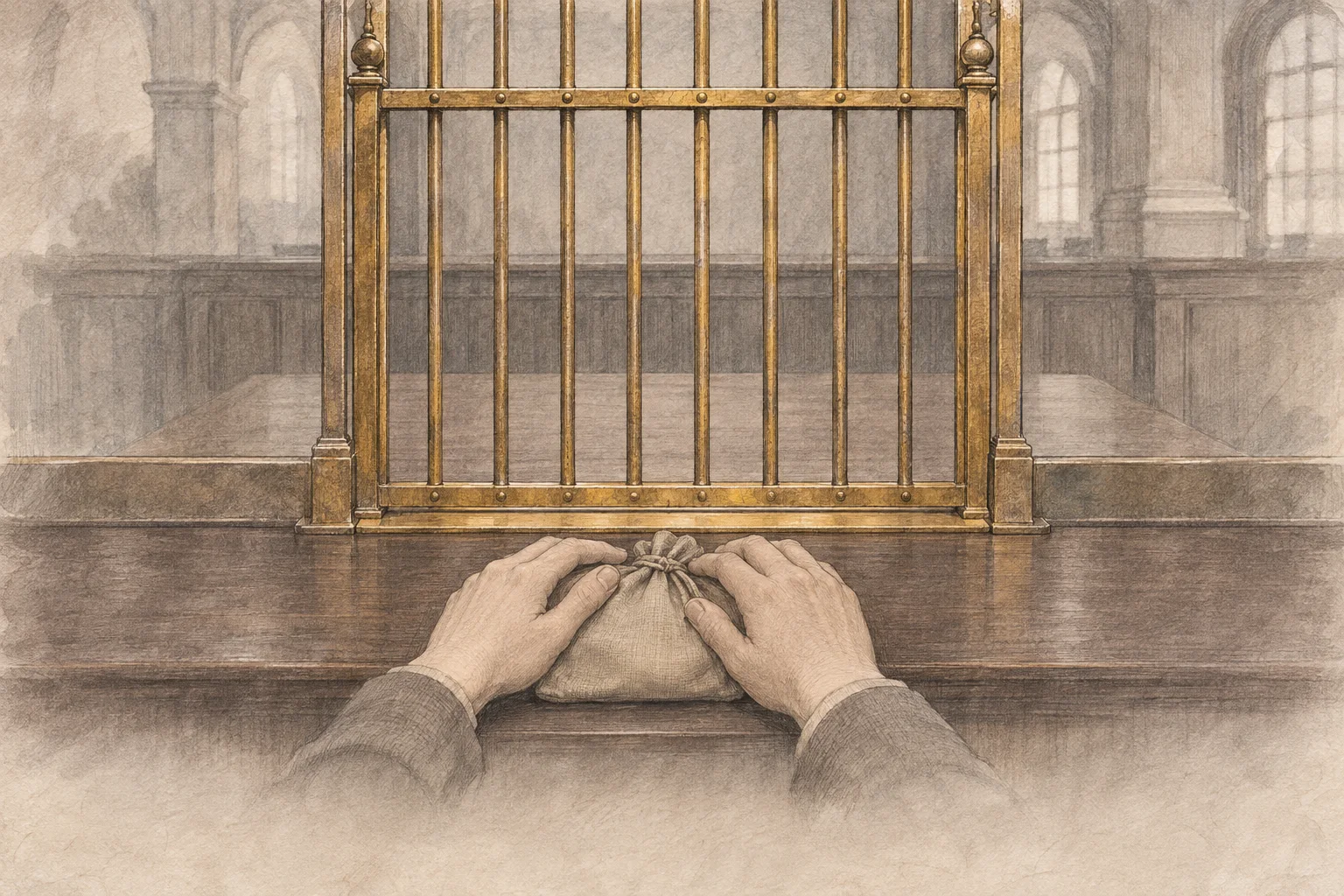
The historical claim of this section is that in October 1907 no public authority ordered the Knickerbocker Trust Company closed, and no document at hand gave its suspension, or the restriction of payments that followed across New York, any term. The suspension was the result of a refusal by a private association that had no duty to examine the company, and the boundary that decided the refusal was membership. This bears on the debate over runs and insolvency, and on the debate over restriction, in one particular way: it shows that in 1907 the question whether the company was illiquid or insolvent was not answered wrongly; it was not asked.
4.1Sprague's account of the refusal
Sprague begins his account of the week of the crisis by noting that in the week before, while the clearing house was putting its own affairs in order, there had been nothing in the nature of a crisis. The crisis came the following week, set off by the difficulties of one trust company. The Knickerbocker was, in his account, the third largest trust company in New York. Distrust attached to it because of its president's connection with certain other enterprises, and the distrust showed itself in a run of unfavourable clearing balances, the daily settlements in which an institution owes more to the others than they owe to it.
On Monday, 21 October, Sprague writes, the National Bank of Commerce announced that it would stop clearing for the Knickerbocker on the next day. This is the first closure in the story, and its kind deserves a close look. The Knickerbocker was not a member of the clearing house. It cleared through a member bank, and the member bank withdrew that service, giving notice only the day before. An unofficial committee of a few trust companies and banks was not, on Sprague's account, given the chance to examine the company's affairs until the last moment, so that definite action would have been difficult if not impossible. Nothing was done except a reassuring statement by the directors announcing that the president had resigned. On the Tuesday, after a run of three hours, the company was forced to suspend.
Sprague then states what he does not know. Whether the company could have been assisted is not clear, he writes; but that assistance, if it had been possible, would have been to the advantage both of the banks and of the other trust companies is in his view certain. The company's size made help difficult. Yet its assets could not have been in a hopeless state, because the company resumed business in the following March under a plan of reorganization agreed by its depositors and shareholders. The same plan, he adds, showed that the assets were even then far from liquid. In the absence of any association among the trust companies, and of any sense of responsibility among the clearing-house banks, the suspension was in his judgment unavoidable.
The next paragraph of the chapter turns from the trust company to the clearing house. Had the Knickerbocker been a bank and a member of the clearing house, Sprague thinks it highly probable that it would have been assisted, following the precedent of 1884. Apparently no proposal to assist it was considered, and he finds that readily explained. Relations between the banks and the trust companies had been strained for years. The banks complained that they competed unfairly with institutions not required to hold a large cash reserve. In 1903 the clearing house had adopted a rule requiring every trust company that cleared through a member to accumulate a reserve, smaller than a bank's but larger than most trust companies held. Rather than submit, nearly all the trust companies gave up their clearing privileges. The most important exception, Sprague notes with some surprise, was the Knickerbocker itself, which on that account would seem to have deserved particular consideration from the clearing house. He adds, as a second argument, that help might have been given from purely selfish motives, since a group of banking institutions is like a row of bricks, the fall of one endangering the rest. And yet, all things considered, he judges that the clearing house's failure to act was the most natural course, unfortunate in its consequences but hardly blameworthy.
Three features of this account matter for the question of who was shut out. The first is that the boundary was drawn twice. The clearing house had drawn a boundary in 1903 by its reserve rule, and the Knickerbocker had stayed inside the part of it that the rule governed, holding the reserve required of a trust company that cleared through a member. The boundary that mattered on 21 and 22 October was a different one: membership of the association, which the Knickerbocker, as a trust company, did not have. The company had met the clearing house's terms for clearing and was still outside the circle of help.
The second feature is that the closures in the story were acts of private parties with no stated term. A member bank ended a clearing arrangement, announcing on the Monday that it would stop on the Tuesday. The trust company's own directors could do nothing but announce a resignation. The suspension itself was a fact forced on the company by the run, not an order anyone gave. Its end, when it came, was a reorganization agreed by depositors and shareholders in the following March, which is to say that the people who bore the suspension were also the people who ended it. Sprague names them in that one clause; he does not say what they lost.
The third is that Sprague's own diagnosis of the company is split. Its assets were not hopeless, because it later resumed; its assets were far from liquid, because the plan of reorganization showed it. This is the distinction the debate over runs turns on, and Sprague, writing afterwards, cannot say on which side of it the company stood on 22 October. What he can say is that no one at the time was in a position to find out.
4.2The spread and the restriction
From the Knickerbocker, Sprague follows the panic to the Trust Company of America, the second largest trust company, on which a run began on Wednesday, 23 October, set off chiefly by the disclosure that its affairs had been discussed at a conference on the Tuesday. That company and the Lincoln Trust Company, on which a run began on the Thursday, were assisted, partly because their assets appeared to be in better condition than the Knickerbocker's, but more because, in Sprague's judgment, it had become clear that the foundation of the whole credit structure was in danger. The help was slow and its meaning unclear. A committee of trust company presidents, formed on 23 October, received applications, made examinations and reported to meetings of all the trust company presidents; money was provided from day to day, with bonds contributed by various trust companies passed to national banks, which used them as security for additional government deposits. Confidence was not restored, Sprague writes, until 6 November, when it was announced that a majority of the shares of the two companies had been placed under the control of a committee of trust company presidents and that the necessary financial arrangements had been made for both to carry on their business.
Here the examination that the Knickerbocker never received was carried out, but only after the run had begun and by an ad hoc committee. Sprague's lesson from the episode is blunt. Unless measures can be taken at the outset that are almost certain to restore confidence in threatened institutions, it is far better to leave them to their own devices, either liquidation or reorganization. The money given to the two trust companies, he concludes, saved them from failure but served no wider purpose; had it been used to meet the demands of banks throughout the country, alarm might have been delayed and general suspension avoided.
During the three days of heavy runs, Sprague writes, the whole city was threatened with a general panic. Small institutions on the edges of the city suspended. Depositors began to withdraw from savings banks, and the savings banks were obliged to exercise their right to require sixty days' notice. This is the only closure in Sprague's account of the week that came with a stated term, and the term belonged to someone unexpected. It was not set by any authority in the crisis. It was a right written into the savings banks' terms with their own depositors, and invoking it shut the depositors out for a known period. The other relief of those days, the money pools formed by J. P. Morgan on the Thursday and the Friday to prevent a collapse on the stock exchange, Sprague describes as piecemeal relief without any certainty of its continuance. In no crisis since the Civil War, he writes, had matters been allowed to drift for so many days of acute panic.
The clearing house itself, Sprague argues, should at least have authorized the immediate issue of clearing-house loan certificates. Experience in earlier crises, he writes, showed that their early issue calmed the public, because it let the banks grant accommodation to borrowers more freely and partly prevented particular institutions from being weakened by unfavourable clearing balances. He calls the failure to issue them at least as early as the Tuesday the most serious error of the crisis. He then reports, through a statement by the president of the clearing house, why it was delayed: the committee knew that issuing certificates would at once bring about a restriction of cash payments throughout the country; hoping the panic would subside, it postponed the issue from day to day, honouring drafts against a falling reserve, until it concluded that it would be folly to hesitate longer.
That statement is the closest thing in the excerpt to a document of decision, and it records a decision taken by postponement. The committee did not decide on a date or on a condition; it waited, and when it acted, the act it had foreseen followed. Sprague's own summary of the result is severe. Almost as soon as withdrawals began, and before the New York banks had lost much of their reserve, cash payments were restricted once more, and for the first time the restriction came immediately upon the issue of the loan certificates. In the last section of the excerpt he calls the restriction in New York a discreditable step, taken when the New York banks were much stronger than on earlier occasions and when the prospects of securing additional funds were far better, and he says it brought on more or less complete suspension throughout the country.
Nothing in the excerpt gives the restriction a term. It was not an order with a date; it was a practice of the banks that began when the certificates were issued and would end when the banks resumed full payment. Sprague's explanation of why depositors behaved as they did bears on terms that were never written. There is, he writes, a well-grounded belief among the people that cash will be hard to get in times of economic disturbance, because banks had suspended in some measure several times in the previous century, the last time in 1893. Some depositors withdraw from fear; others withdraw prudently, to be certain of having money for their affairs; still others hope to profit from selling currency at a premium. Former suspensions had made a tradition, and only the successful endurance of a crisis by the banks could break it. On Sprague's reading, 1907 was an unusually favourable chance to break it, and the chance was lost.
4.3The modern record
Skeptron's record of the episode, written in 2026 from a Federal Reserve History essay attributed to Moen and Tallman, compresses this week into two sentences:
The clearing house, which had held back resources in support of member institutions, refused the request of the non-member Knickerbocker. After being unable to confirm the payment capacity of the books within a short period, financial support also fell through, and business was suspended on the 22nd.
The record and Sprague's text differ on two points, and both should be stated. The record says that the clearing house refused a request. Sprague's excerpt does not describe a request to the clearing house or a refusal by it; it says that apparently no proposal to assist the company was considered, and the closing act it names is the National Bank of Commerce's announcement that it would stop clearing for the company. The record also says that the clearing house had held back resources to support its members, a statement the excerpt does not make in those words; what the excerpt says the clearing house held back was the issue of loan certificates. The record's source is a modern essay, and the two accounts may rest on evidence this article does not hold. The differences are given here as they stand.
On one point the record and Sprague agree closely, and the record states it more sharply than the 1910 text. The company's books could not be examined in time. Sprague puts this as a matter of opportunity: the committee was not given the chance to examine the company's affairs until the last moment. The record turns it into a question about what may be inferred:
May the fact that there was insufficient time for review be turned into a confirmed finding of asset impairment?
Its answer separates the categories that the debate over runs needs kept apart:
Separate the verification status of liquidity and payment capacity, and the eligibility for support.
That sentence names three things: whether the company had cash, whether it could ultimately pay, and whether it was the kind of institution entitled to help. Sprague's account supplies the third and leaves the first two open. The Knickerbocker was ineligible because it was not a member; whether it was illiquid or insolvent, Sprague says, is not clear. The record's warning against turning lack of time into a finding of bad assets is the modern summary's version of the same caution.
What the record leaves out is as instructive as what it keeps. It does not mention the reserve rule of 1903 or the fact that the Knickerbocker had complied with it, which is the detail that led Sprague to think the company deserved particular consideration. It does not mention the reorganization of the following March, so the suspension in the record has no end. It names no one who bore the cost of the suspension: not depositors, not shareholders, not the other trust companies. And it does not reach the restriction of cash payments at all. For a reader of the record alone, the Panic of 1907 is a refusal and a stoppage on one Tuesday.
4.4What the case adds
Read together, Sprague and the record show a closure whose boundary was institutional and whose term was nowhere written. To the debate between those who read panics as runs that strike sound institutions and those who look to weak banks and badly built institutions, the case adds a third observation: in 1907 the people placed to tell illiquid from insolvent were neither required nor given time to do so, and the line that decided the outcome was membership. In their reassessment of the crisis, Moen and Tallman (1992) emphasize that the systemic contraction centered on the non-clearing trust sector, where the structural exclusion from mutual emergency reserves turned deposit runs into catastrophic suspensions. To the debate over restriction, it adds that the restriction Friedman and Schwartz credit with preventing a wave of failures and Sprague condemns as discreditable was, in the account at hand, decided by postponement and given no term. Neither reading of the restriction can be tested from the documents. What can be read from them is consistent with the narrower observation that no authority in New York that week wrote down how long any closure would last.