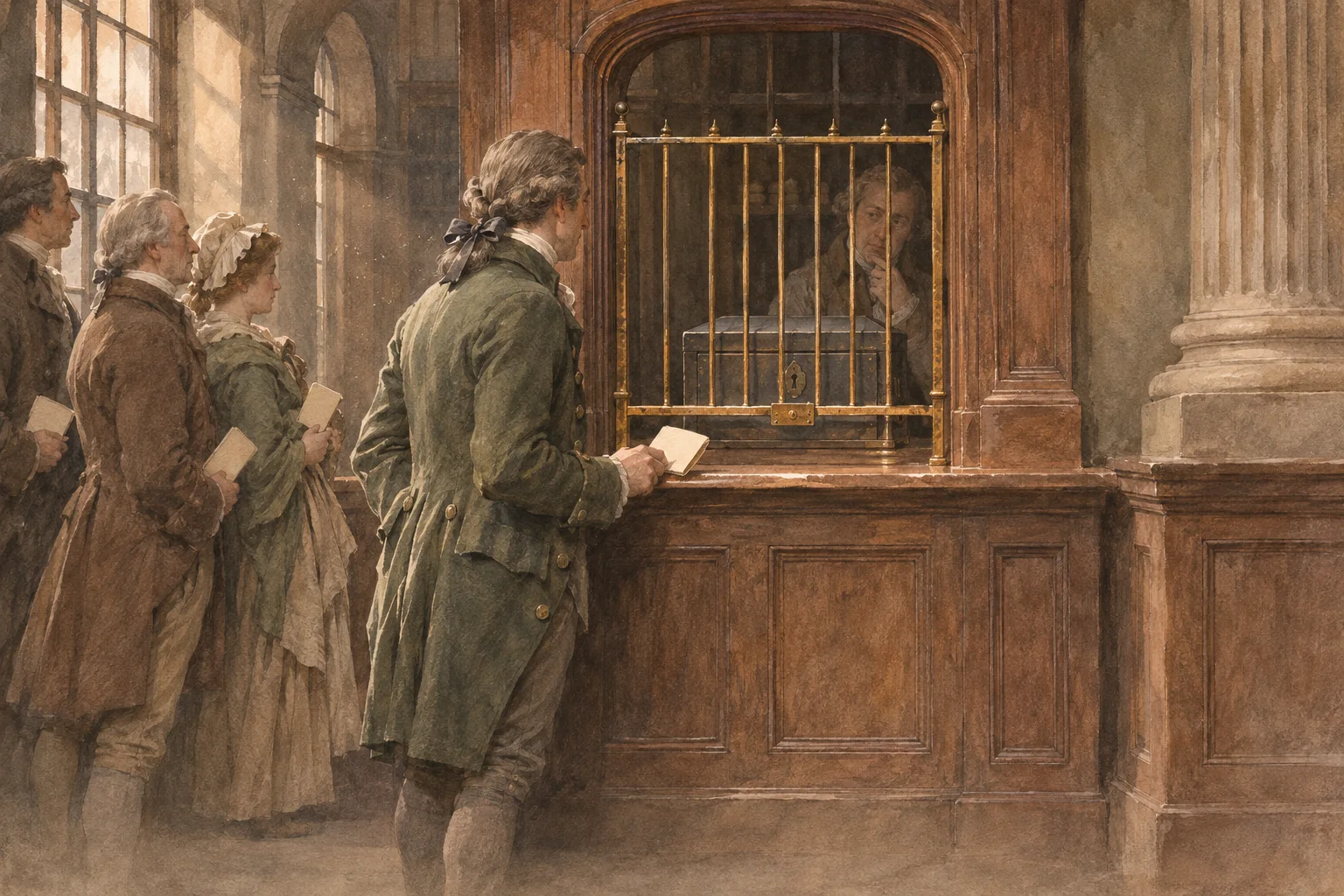
On the morning of Monday, 27 February 1797, the directors of the Bank of England posted a handbill upon the gates of Threadneedle Street in London, informing the public that by order of the Privy Council, they had ceased paying their promissory notes in gold coin. This extraordinary announcement marked the beginning of the Bank Restriction Period, an epochal twenty-four-year experiment in inconvertible paper money that reshaped the British economy during the struggle against Revolutionary and Napoleonic France. What originated as a provisional emergency decree issued to arrest an acute liquidity drain on a single weekend became an institutional regime that spanned nearly a quarter of a century.
This chapter argues that the Bank Restriction of 1797 provides direct historical evidence for the proposition that temporary crisis measures systematically outlast their declared horizons. By analyzing the Minute of Council of 26 February 1797, Henry Thornton's seminal 1802 treatise on paper credit, and the parliamentary Bullion Report of 1810, this chapter demonstrates that the absence of binding, self-executing terminal criteria enabled successive wartime administrations to postpone resumption repeatedly. While unconstrained paper credit shielded the British banking system from catastrophic liquidity collapse and facilitated wartime public borrowing, it simultaneously generated currency depreciation, inflation, and severe distributional burdens for holders of fixed incomes and unindexed wages.
4.1The Minute of Council and the suspension of specie payments
The immediate catalyst for the emergency intervention of February 1797 was a severe banking panic compounded by military alarm. Throughout 1796, the Bank of England had experienced a steady drain of gold coin and bullion from its vaults, driven by heavy government remittances to Continental allies, foreign grain purchases following harvest shortfalls, and extensive advances to William Pitt's treasury to fund the war with France. In February 1797, the crisis reached acute proportions when four French naval vessels landed a small force of troops near Fishguard on the coast of Wales. Although the invasion was rapidly repulsed, rumors of French landings triggered intense panic across the country.
Depositors and noteholders rushed to country banks in Newcastle and other provincial centers to convert paper notes into gold guineas. As country banks exhausted their local cash reserves, they dispatched urgent demands to their London correspondent bankers, who in turn made unprecedented runs upon the central cash reserve of the Bank of England. By Saturday, 25 February 1797, the Bank's stock of gold bullion and coin had plummeted to approximately one million pounds, against notes in circulation and demand liabilities exceeding ten million pounds. The directors of the Bank informed Prime Minister Pitt that unless the government intervened immediately, the institution would be entirely drained of cash by Monday afternoon.
Meeting in extraordinary session on Sunday, 26 February 1797, the King's Privy Council issued an emergency Minute of Council signed by Clerk of the Council W. Fawkener. The Minute set out the official justification for state intervention into the private affairs of the corporation, recording that unusual demands for specie had been made on the metropolis in consequence of exaggerated alarms in different parts of the country. Confronting an imminent shortage of cash for public services, the Council gave its unanimous opinion that "the directors of the Bank of England should forbear issuing any cash in payment, until the sense of parliament can be taken on that subject" and suitable regulations established.
In The Bank of England: A History, John Clapham (1944) traced the institutional development of the Bank through this crisis, covering the restriction of cash payments from 1797. In legal terms, the Minute of Council represented an emergency executive intervention without direct statutory authority. Because the Bank of England was legally chartered as a private joint-stock corporation whose banknotes were binding legal contracts payable in gold coin on demand, the executive order effectively required the corporation to breach its common-law contractual duties. To regularize this unprecedented situation, Parliament acted rapidly. On 3 March 1797, Parliament passed an indemnity act to protect the Bank directors from legal suits, followed on 3 May 1797 by the Bank Restriction Act.
The initial Bank Restriction Act was enacted as an explicitly provisional measure with a precise calendar deadline: it was to remain in force only until 24 June 1797, a period of less than two months. The legislature envisioned that the temporary breathing space would allow the public alarm to subside, confidence to return, and the Bank's gold reserves to be replenished. Yet when June 1797 arrived, the war with France continued unabated, domestic confidence remained delicate, and Parliament extended the restriction to one month after the commencement of the next parliamentary session. In November 1797, Parliament renewed the act again, extending it until six months after the conclusion of a definitive treaty of peace.
Skeptron's standardized case record captures the concrete institutional facts of this transformation, emphasizing the separation between temporary rhetoric and historical duration:
The obligation to exchange banknotes for gold of equal value was temporarily suspended. The official chronology presents the Restriction Period as 1797–1821, and also explains the issuance of low-value notes and counterfeiting.
As Skeptron's record notes, the suspension of cash payments immediately confronted the monetary system with a severe physical shortage of small change. Prior to 1797, the Bank of England had not been permitted to issue notes under five pounds, and ordinary retail transactions had relied almost entirely on gold guineas, silver coin, and copper tokens. With gold withdrawn from circulation into hoards, the government authorized the Bank to issue one-pound and two-pound notes. While these low-value notes sustained everyday commerce, they were crudely engraved and rapidly sparked a massive wave of counterfeiting, which resulted in hundreds of capital prosecutions and public outcries over the social costs of paper money.
4.2Thornton's analysis of paper credit and wartime renewal
Contemporary banking doctrine found its most sophisticated exposition through the writings of Henry Thornton, whose 1802 enquiry investigated the delicate equilibrium between metallic bullion and circulating paper. Writing as both a practicing banker and a parliamentary policymaker, Thornton explained how a credit system operating with inconvertible paper could function stably, while dissecting the errors committed by the Bank of England in the months leading up to the 1797 crisis.
Thornton's central insight concerned the systemic role of the central cash reserve. He observed that in a developed commercial society, smaller private banks and provincial institutions relied upon the cash reserves of the Bank of England. Thornton treated the Bank of England as the holder of the nation's central cash reserve, which had to support the broader credit structure of the country—a function that Walter Bagehot later termed the ultimate cash reserve. Because the Bank was the servant of the public interest rather than an ordinary commercial establishment, it could not be judged by the same rules that governed individual merchants.
Reviewing the panics of 1793 and 1797, Thornton advanced a revolutionary critique of orthodox banking practice. He argued that if the Bank of England had committed any fault in those crisis seasons, it was not that it had enlarged its note issues too much, but rather that it had restricted its notes too severely. When an internal panic broke out, depositors and country banks demanded cash out of fear and general hoarding. Thornton suggested that by suppressing too many notes before the suspension, the Bank may have aggravated rather than lessened the demand upon itself for guineas, failing to cure the evil by diminishing its notes. In this study's reading, this contraction intensified the distress of the commercial community.
Thornton vigorously defended the parliamentary intervention that suspended cash payments against critics who claimed that the state had violated private property and the sanctity of debt contracts. A banknote was indeed an express contract to pay metallic coin. But Thornton asked what would occur if every noteholder insisted upon immediate physical execution of that contract simultaneously. In an acute alarm, the demand for gold was practically infinite, while the physical supply of gold was inherently finite: all the gold in the world could not satisfy such claims if every creditor pressed them at once. Because creditors were themselves debtors in an interconnected commercial web, a rigid insistence on immediate cash payment would trigger universal insolvency.
Parliament's interposition, Thornton argued, gave effect to the universal interest of the nation. It relaxed the literal interpretation of debt contracts, permitting "money" to mean "money's worth"—a transferable claim on real goods and general purchasing power—rather than the specific physical pieces of metal. By suspending cash payments while a reserve of gold still remained in the Bank's vaults, Parliament prevented the complete dispersal of the national treasure, provided the necessary coin for paying common laborers, and preserved the ongoing credit of banknotes. Once the panic subsided and the Bank extended its note circulation to customary levels, credit revived, gold flowed back into the country, and foreign exchange rates improved.
Yet when Thornton turned in Chapter V of his treatise to the renewal of the suspension act, his analysis revealed the institutional dilemma of the escape clause. Thornton addressed why repealing the law in the later period of the war was inexpedient, observing that gold had been drawn abroad by unfavorable exchanges and alarms of invasion continued, while country banks would face heavy calls in preparing for cash opening. In this study's reading of the debates around 1802, Thornton maintained that the renewal of the restriction stood entirely upon the particular circumstances of the times, and not upon any principle that implied permanence or long continuance. Yet in practice, as the war resumed and expanded, those particular circumstances were invoked year after year, postponing resumption indefinitely.
4.3The Bullion Report of 1810 and the struggle for resumption
The second decade of the Restriction Period witnessed the emergence of the Bullion Controversy, which pitted sound-money bullionists against defenders of the Bank's inconvertible paper. The analytical evolution of these disputes, as examined by Frank Whitson Fetter (1965), shows how ideological divisions hardened around the Bank's operational autonomy. When the parliamentary committee opened its investigation in 1810, witnesses and market returns established that trading in standard gold bullion had reached £4. 10s. per ounce, standing roughly 15 1/2 percent above the statutory Mint benchmark, while Continental exchange quotations in Hamburg, Amsterdam, and Paris fell between 16 and 20 percent below par.
Alarmed by the sustained premium commanded by bullion and the worsening terms of foreign trade, the House of Commons created an investigative committee in early 1810 to examine the circulating medium. The Committee's Report, presented on 8 June 1810, stands as one of the most influential state papers in economic history. As the Report recorded, most commercial witnesses ascribed the high price of gold entirely to an alleged scarcity arising from unusual demand upon the Continent, chiefly for the use of the French armies and intensified by alarm and hoarding. In contemporary debates, defenders of the Bank maintained that notes issued in the discount of solid short-term commercial bills could not become excessive.
The Bullion Report decisively rejected these explanations. It concluded that the extraordinary rise in the market price of gold and the collapse of Continental exchange rates were direct manifestations of an excess in the domestic paper currency. Because Bank of England paper was inconvertible into gold, the normal self-correcting specie-flow mechanism was severed. When paper money became excessive, it could not be redeemed in coin or exported to foreign markets; it simply depreciated in value relative to gold and foreign currencies.
The Committee examined the existing statutory provisions governing the termination of the restriction. Under the statutes then in force, "the Bank would be compelled to pay in cash at the end of six months after the ratification of a definitive Treaty of Peace", an open-ended formula that Horner and his colleagues judged deeply defective. Tying resumption to an indefinite political and military event provided no operational guidance to the Bank directors and offered no credible timeline to the commercial community. If peace were concluded unexpectedly, requiring the Bank to pay in cash within six months would be impossible without causing severe credit contraction and widespread mercantile ruin. Conversely, if the war dragged on for years, the indefinite postponement of resumption encouraged further currency depreciation and destroyed public confidence in the monetary standard.
The Bullion Committee therefore recommended a bold, definitive statutory solution, urging an explicit statutory deadline: "Your Committee are therefore of opinion, that even if Peace should intervene, two years should be given to the Bank for resuming its payments ; but that even if the War should be prolonged, Cash payments should be resumed by the end of that period." The Committee urged Parliament to repeal the existing open-ended law and enact a fixed, compulsory two-year horizon for resumption, leaving the gradual mode of contracting paper issues to the discretion of the Bank directors.
Yet the political power of wartime finance triumphed over economic theory. When the Bullion Report was debated in Parliament in May 1811, the House of Commons decisively rejected Horner's resolutions by an overwhelming majority, adopting instead counter-resolutions proposed by Nicholas Vansittart declaring that Bank of England notes were equivalent to legal coin in public estimation. It was not until the definitive military defeat of Napoleon at Waterloo in 1815, followed by years of bitter economic deflation, that Parliament finally addressed resumption. In 1819, Parliament enacted the Resumption Act (Peel's Act, 59 Geo. III c. 49), establishing a staged schedule of bullion payments that concluded with the full restoration of cash payments in gold coin on 1 May 1821.
4.4What this case adds: the 1797 record and Hypothesis F2
For the debate over the gold standard as a rule with an escape clause, the record of 1797 adds four distinct legal formulations of the suspension's end rather than a single continuous episode. Bordo and Kydland's (1995) model requires that private agents maintain the expectation of an eventual return to parity; the documentary record discloses how the written basis of that expectation was repeatedly rewritten by sovereign authorities.
The suspension began on Sunday, 26 February 1797, with an executive Minute of Council that contained no escape clause, no terminal date, and no reserve threshold. The Privy Council gave only a procedural instruction: the Bank of England was directed to forbear issuing cash until the sense of Parliament could be taken on that subject and proper measures adopted to maintain the means of circulation. When Parliament convened and passed the Bank Restriction Act on 3 May 1797 (37 Geo. III c. 45), it codified this procedural pause as a strict calendar term of fifty-two days, expiring on 24 June 1797.
Within weeks, Parliament abandoned the calendar deadline. Subsequent continuation statutes replaced the fifty-two-day horizon with an undatable geopolitical condition, extending the restriction first to November 1797 and then until six months after the ratification of a definitive treaty of peace. In his 1802 treatise, Henry Thornton defended these renewals as necessary adaptations to the extraordinary circumstances of the French war, arguing that an immediate return to cash payments would force a destructive contraction of mercantile credit, while maintaining that the restriction was justified by emergency necessity rather than any principle implying permanent inconvertibility.
By 1810, the House of Commons Bullion Committee recognized that tying the legal end of the suspension to an uncertain political event had destroyed the disciplinary bound on paper issue. The Committee argued that an exit condition defined by peace was inherently indefinite, removing the Bank's incentive to prepare for resumption and producing the gold premia and exchange depreciation observed in market quotations. The Committee therefore urged Parliament to restore an observable calendar term, recommending a compulsory two-year horizon for cash resumption, whether the war continued or not. When the House of Commons rejected the Committee's resolutions in May 1811, it deferred resumption for another decade, until Peel's Act in 1819 (59 Geo. III c. 49) established a graduated bullion schedule that culminated in cash resumption on 1 May 1821.
For retrospective analysis, the central source hazard is that modern reference works and platform summaries attach an end year (1821) to the 1797 suspension as if the twenty-four-year duration had been contemplated from the start. That retrospective end date is an anachronistic supply of what the actors never wrote. In 1797, neither the Privy Council nor Parliament enacted a twenty-four-year regime; they enacted an immediate fifty-two-day pause. For Hypothesis F2, the case illustrates how an emergency act framed as a provisional expedient outlasts its initial term once the legal instrument removes an observable calendar date.