Across the history of monetary institutions, the promise of a sovereign authority or a central bank to exchange its circulating paper notes for gold at an immutable parity has stood as the definitive anchor of monetary credibility. In classical economic theory, gold convertibility served as an institutional constraint against the overissue of currency, tying the volume of domestic paper credit to the physical availability of precious metal reserves. Yet whenever severe systemic shocks occurred—whether provoked by the fiscal exigencies of war, sudden domestic banking panics, or destabilizing speculative runs on foreign exchange—governments repeatedly intervened to suspend their legal obligations of cash payment. In announcing these extraordinary interventions, authorities almost invariably framed the cessation of specie payments as a temporary expedient: a brief pause designed to protect national reserves from depletion until order was restored and normal convertibility could be safely resumed.
The central inquiry of this investigation concerns the marked divergence between the declared provisional nature of such monetary suspensions and their ultimate historical outcomes. When an authority acts in an acute financial crisis to halt the redemption of paper currency into precious metal, does the underlying legal decree or public proclamation specify an observable condition, calendar date, or objective threshold on which the emergency measure will terminate? Who bears the economic burden of currency depreciation and purchasing power loss during the interim period of suspension? And what institutional forces cause measures that were explicitly presented as short-term pauses to endure for decades or to dissolve the established monetary regime altogether?
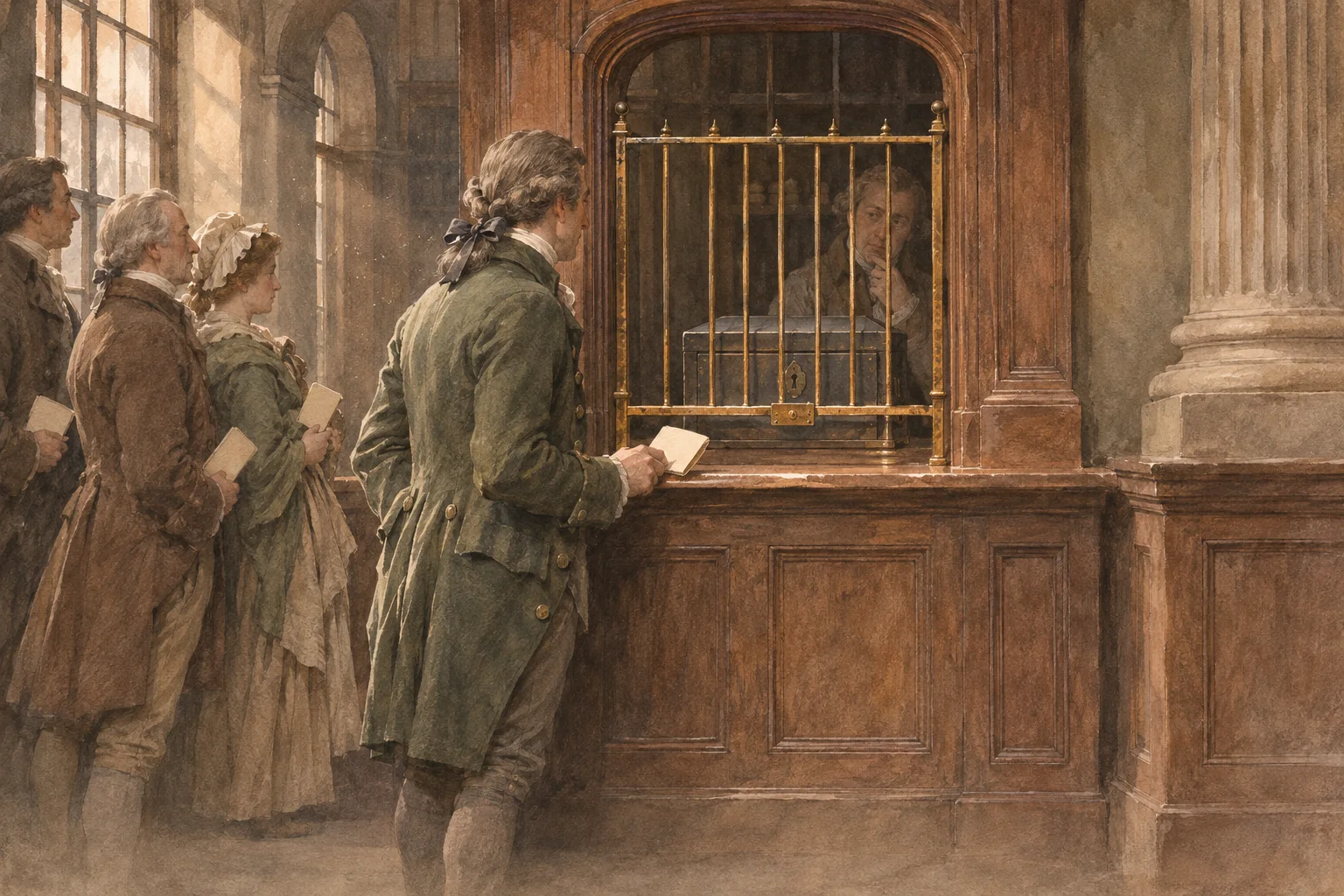
To evaluate these questions, the historical analysis focuses upon two landmark monetary crises: the British suspension of cash payments in 1797 and the closing of the American gold window in 1971. In both instances, supreme executive authorities acted abruptly on a Sunday to arrest acute reserve pressures. On Sunday, 26 February 1797, King George III's Privy Council issued an emergency Minute of Council directing the directors of the Bank of England to cease issuing cash in payment. The Privy Council explained this intervention as an urgent response to heavy metropolitan cash withdrawals sparked by provincial panics, which threatened to leave the public service without necessary coin. What began as an interim administrative instruction pending parliamentary consultation became the Bank Restriction Act of 1797, inaugurating an inconvertible paper money regime that lasted twenty-four years until cash payments were formally resumed under Peel's Act in 1821.
In August 1971, amidst mounting balance-of-payments deficits and intense speculative pressure against the dollar, the American presidency made an equally momentous intervention. On the evening of 15 August 1971, the White House announced the New Economic Policy. Speaking to the nation, President Richard Nixon instructed Treasury Secretary John Connally to halt dollar convertibility into gold or foreign reserve assets on an interim basis, reserving administrative discretion to permit exchanges only when judged advantageous to monetary stability and American interests. Accompanied by domestic wage-price controls and a ten percent border tax, the action was presented as a provisional defensive measure against currency speculators. Yet unlike the British experience of 1797, the 1971 suspension was never followed by a resumption of gold payments. Instead, it dismantled the par value system established at Bretton Woods in 1944, inaugurating the contemporary global era of floating fiat currencies.
This investigation contends that the tendency of emergency gold suspensions to become prolonged or permanent is not an accidental historical anomaly, but the systemic result of institutional asymmetry in the design of crisis powers. When authorities suspend convertibility without defining precise, self-executing terminal criteria, the suspension immediately insulates the monetary authority from the disciplinary constraints of reserve loss. By freeing the state and the banking system from the immediate necessity of redemption, the emergency measure creates entrenched domestic constituencies that benefit from expanded credit and nominal price flexibility. Meanwhile, the unorganized holders of currency, fixed-income creditors, and wage earners bear the dispersed costs of inflation and exchange rate depreciation. Because returning to parity requires painful economic contraction, falling prices, and fiscal retrenchment, the political costs of lifting a suspension consistently exceed the political costs of renewing or perpetuating it.
This argument speaks directly to a central controversy in monetary economics and macroeconomic history: the debate over commitment rules versus discretionary policy. In modern macroeconomic scholarship, Michael D. Bordo and Finn E. Kydland (1995) characterized the classical gold standard as an institutional commitment mechanism possessing an institutional escape hatch: sovereign states could interrupt metallic redemption during extraordinary shocks like major hostilities or system-wide panics without impairing enduring monetary credibility, contingent upon the public anticipating restoration at the legal parity once normalcy returned. This inquiry tests that escape-clause interpretation against the documentary reality of the decisions themselves. Drawing upon the theoretical insights of Finn E. Kydland and Edward C. Prescott (1977) on time inconsistency, Robert Higgs (1987) on the crisis ratchet effect in government authority, and legal theorists Oren Gross and Fionnuala Ní Aoláin (2006) on how legal systems accommodate emergency powers and the derogation of legal rules in states of emergency, the chapters that follow demonstrate that emergency suspensions systematically alter the baseline of governance, making a return to the prior legal order exceptionally difficult.
Methodologically, the analysis grounds its historical evaluations in the public-record questions and standardized cases developed by Skeptron, a research studio within the RISCON platform. Skeptron compiles detailed decision records of historical crises, evaluating public actions across uniform structural axes: the identity and authority of the decider, the stated grounds and missing information at the time of decision, the specified operational horizon and waiting burdens, the reversibility of the measure, and the conditions required for subsequent revision. By examining Case C001 (The Bank Restriction of 1797) and Case C002 (The Closing of the Gold Window in 1971) within the broader framework of Skeptron's decision ledger of 84 emergency cases, this volume subjects registered hypothesis F2 to systematic qualitative and textual evaluation. Hypothesis F2 posits that in most cases where an authority presents an emergency act as temporary and the record reports its eventual outcome, the measure lasted longer than first stated or became permanent.
The primary evidence examined in the text comprises the surviving legal decrees, parliamentary investigations, contemporary banking treatises, and executive addresses that enacted and justified the suspensions. For the 1797 episode, the analysis reads the original Minute of Council of 26 February 1797, the pioneering treatise on paper credit published in 1802 by Henry Thornton, and the famous 1810 Report of the Select Committee of the House of Commons on the High Price of Gold Bullion. For the 1971 episode, the documentary record centers on the presidential address of 15 August 1971, contextualized by the institutional scholarship of Joanne Gowa (1983) and Harold James (1996), alongside Allan H. Meltzer's (2009) account of the strains on the dollar under the gold exchange standard up to 1969.
The volume proceeds across five subsequent chapters. Chapter 2 reviews the theoretical and historical literature on monetary commitment rules, escape clauses, time inconsistency, and emergency powers. Chapter 3 sets out the archival sources, methodology, Skeptron case structure, and registered hypotheses F1 through F5 from the decision ledger. Chapter 4 provides a granular documentary examination of the Bank Restriction of 1797, tracing how an emergency Sunday order evolved through Thornton's defense of paper credit and the 1810 Bullion Report into a twenty-four-year hiatus. Chapter 5 analyzes the Nixon Shock of August 1971, dissecting the political economy of the Camp David decisions and the rhetoric of temporary stabilization that permanently dissolved the Bretton Woods order. Chapter 6 conducts a structured comparative discussion of the two cases, analyzing why temporary framings lacked exit dates, who bore the interim costs, and how the historical evidence confirms hypothesis F2. The Conclusion summarizes the findings, articulates the institutional limits of the inquiry, and suggests directions for future research into emergency monetary governance.