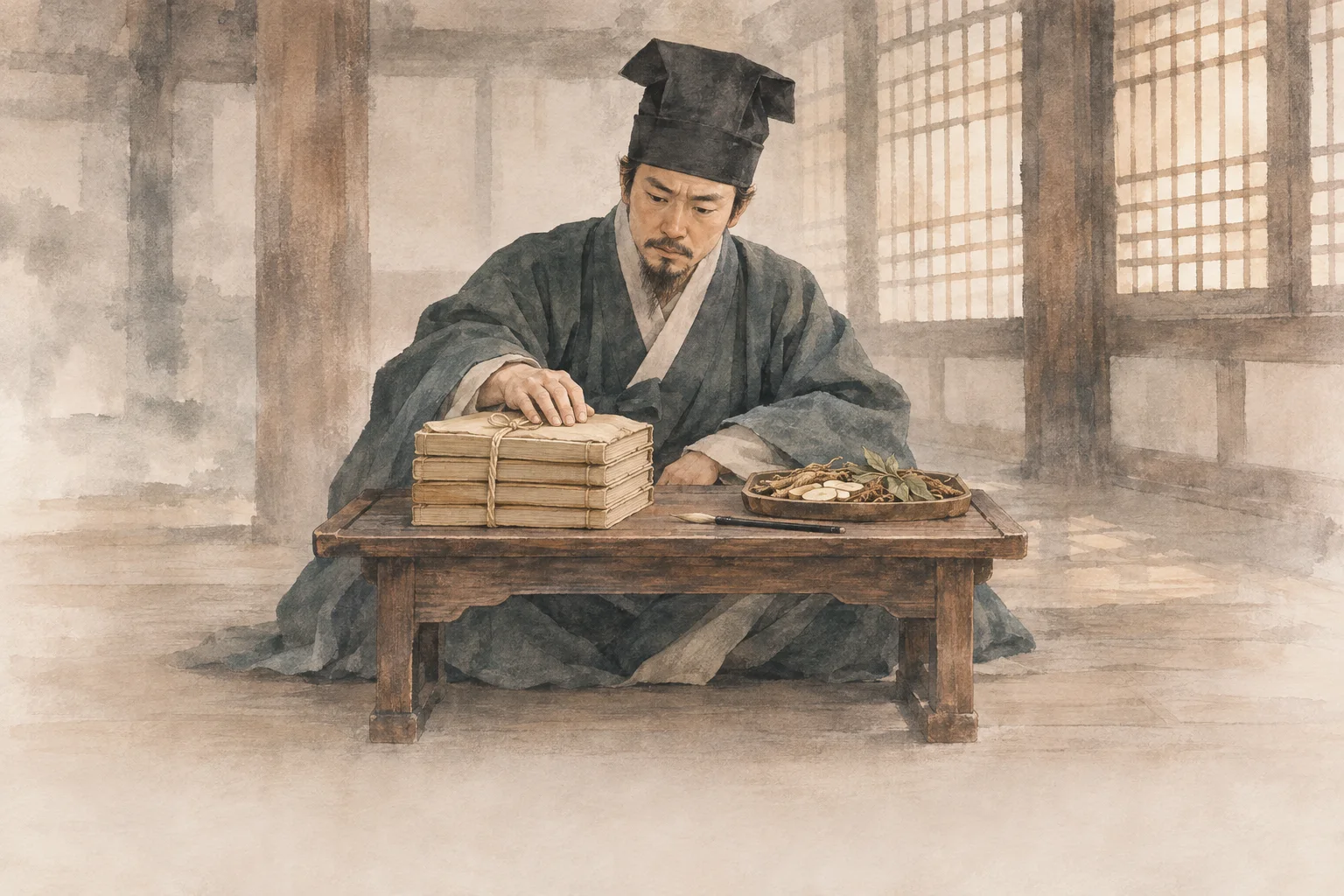
The historical claim of this section is that the Joseon court commanded a physician's knowledge by ordering a selection from many books into one, a classification by kind, a standard dose, and the writing down of local names and local practices for local medicines, and that the preface records the command, its interruption by war and death, its completion and an order to print and distribute, all before the printing itself. For Scott's argument, the command simplifies books and records local knowledge rather than overriding it; for Suh's history, the editorial principles show the naming of an eastern medicine as an explicit editorial choice. The text cannot show what the book did once printed.
5.1The preface's complaint: many books, an obscured art
Yi Jeong-gu's preface opens not with the king but with the history of medical writing. Its first paragraph ends with a complaint: "上自倉、越,下逮劉、張、朱、李,百家繼起,論說紛然,剽竊緒余,爭立門戶,書益多而術益晦,其與《靈樞》本旨不相徑庭者鮮矣。" In this article's own English: from the ancient physicians down to the later masters, a hundred schools arose one after another, their arguments in confusion; they plundered one another's leavings and contended to found their own schools; the more books there were, the more obscure the art became, and few did not stray far from the original meaning of the Lingshu, one of the medical classics.
The paragraph continues with the harm: "世之庸醫,不解窮理,或倍經訓而好自用,或泥故常而不知變,眩于裁擇,失其關鍵,求以活人而殺人者多矣。" In this article's English: the mediocre physicians of the world do not understand how to pursue principles to the end; some turn their backs on the teachings of the classics and like to follow their own judgment, others cling to old habit and do not know how to adapt; dazzled by the choices, they lose the key, and many who seek to save people kill them instead.
The problem the preface sets is not a shortage of knowledge. It is an excess of books and a failure of selection. The remedy, accordingly, will be a single book that selects. The preface states as known that the books are many and confused and that physicians who cannot choose among them do harm. It does not count the harm.
5.2The first command
The second paragraph brings in the king, in the formal terms of the preface: "我宣宗大王,以理身之法,推濟眾之仁,留心醫學,軫念民瘼。" This article translates: the great king Seonjong, extending the method of ordering the body to the benevolence of relieving the multitude, set his mind on medicine and grieved over the sufferings of the people. The transcription names the king 宣宗, Seonjong; the reading note on the Dongui Bogam names him Seonjo, and this article uses the note's name elsewhere (Heo Jun 1613). The preface then dates the command by the sexagenary cycle, "嘗于丙申年間", in the byeongsin year, and quotes it:
"近見中朝方書,皆是抄集庸瑣,不足觀爾。宜裒聚諸方,輯成一書。且人之疾病,皆生于不善調攝,修養為先,藥石次之。諸方浩繁,務擇其要。窮村僻巷無醫藥,而夭折者多,我國鄉藥多產,而人不能知爾。宜分類並書鄉名,使民易知。"
In this article's rendering: Lately the books of prescriptions from the central court [China's court] have come before the throne; all are copied compilations, commonplace and trivial, not worth reading. You should gather the prescriptions together and compile them into one book. Moreover, people's illnesses all arise from failing to take care of themselves; cultivation comes first, medicines and needles after. The prescriptions are vast and numerous; strive to select what is essential. In poor villages and remote lanes there are no physicians or medicines, and many die before their time. This country produces many local medicines, but people cannot recognise them. You should classify them and write their local names beside them, so that the people may know them easily.
The command moves from a verdict on the books from China, through an order to gather and select, a priority of cultivation over medicines, and a named harm, the early deaths in villages without physicians, to a method: classify the local medicines and write their local names, "使民易知".
The command names its beneficiaries, and they are not physicians. They are "民", the people, and specifically people in places without physicians. A book of selected prescriptions, classified, with local names written beside them, is meant to reach a reader who has no physician to ask. In that sense the command makes medicine legible: not to the state, but to its subjects.
The preface then records the first execution of the command: Heo Jun withdrew and, with a scholar-physician and royal physicians whom the preface names, "設局撰集,略成肯綮", set up a bureau and began the compilation, roughly establishing its essentials. The command created an office.
5.3War, death and exile
The next paragraph records interruption: "值丁酉之亂,諸醫星散,事遂寢。" Rendered here by this article: then came the disturbance of the jeongyu year; the physicians scattered like stars, and the work was laid aside. The reading note on the Dongui Bogam places the royal command after the Japanese invasions (Heo Jun 1613). The preface says only that a disturbance came, that the physicians dispersed, and that the work stopped.
The command was then renewed in a different form: "厥後,先王又教許浚獨為撰成,仍出內藏方書五百卷以資考據,撰未半而龍馭賓天。" This article's English: afterwards the former king again ordered Heo Jun to complete the compilation alone, and brought out five hundred volumes of books of prescriptions from the palace library to support his research; before the compilation was half done, the king died.
The bureau has become one physician, supplied from the palace library.
The completion comes under the next king, in the preface's words "至聖上即位之三年庚戌,浚始卒業而投進,目之曰《東醫寶鑒》,書凡二十五卷。" In this article's English: in the gyeongsul year, the third year after the present sage king came to the throne, Heo Jun at last completed the work and presented it, entitling it Dongui Bogam; the book has twenty-five volumes in all. The platform record dates the compilation to 1610.
The new king's response is quoted at length. He praises Heo Jun as one who "曾在先朝,特承撰集醫方之命,積年覃思,至于竄謫流離之中,不廢其功,今乃編帙以進。" This article translates: under the former reign received the special command to compile a book of prescriptions, and pondered it deeply for years; even in banishment and wandering he did not abandon the work, and now he has compiled the volumes and presented them. The phrase "竄謫流離" places part of the work in exile. The preface does not say why Heo Jun was banished, and this article does not either.
The king then speaks of the delay itself: "仍念先王命撰之書,告成于寡昧嗣服之後,予不勝悲感。" In this article's rendering: to think that the book the former king commanded has been completed only after his ignorant and unworthy successor took the throne brings grief past bearing.
The command thus outlived its giver. The preface marks the time between command and completion by a war, a dispersal, a renewal, a death and an exile, and dates only the first command, the war and the presentation, by cyclical years.
5.4The second command: reward, print, distribute
The new king's instruction ends with three orders: "其賜浚太僕馬一匹,以酬其勞。速令內醫院設廳鋟梓,廣布中外。" Rendered here by this article: let Heo Jun be given a horse from the royal stables, to reward his labour. Let the Office of Royal Physicians promptly set up a hall for the printing, and let the book be spread widely, within the capital and beyond. And the preface adds: "且命提調臣廷龜撰序文弁之卷首。" — and he commanded his servant Jeong-gu, the superintendent, to write a preface to stand at the head of the volumes.
The orders move from the compiler to the book. The compiler is rewarded with a horse. The book is to be printed by the royal medical office and distributed "中外", within and beyond. The preface itself is ordered at the same time. It is written, therefore, after the command to print and before the printing it anticipates.
The words for printing, "鋟梓", speak literally of carving catalpa wood, a figure for printing. The preface does not say whether the book would be printed from carved blocks or from movable type. The platform record says the first edition was printed with wooden movable type in 1613; the preface, written before the printing, cannot confirm or contradict that.
The record's Scenario gives the dates and the edition:
A 25-volume first edition compiled by Heo Jun in 1610 and printed with wooden movable type by the Naeuiwon in 1613.
The target is the complete sets held by the National Library of Korea and Jangseogak.
And its answer to the first question separates two dates:
The publication notation of the material currently cited is the 1613 first edition.
The record and the preface agree on the twenty-five volumes and on the royal medical office as printer. The preface gives the order to print and its date of writing; the record gives the year printing was done. The three moments, completion, the order to print with the preface, and the printed edition, fall in different years. The record's 1610 and 1613 mark two of them; the preface's own reign date marks the third.
5.5Yi Jeong-gu's four conditions
After the narrative, Yi turns to argument. He begins with the ruler's duty: "臣竊念太和一散,六氣不調,癃殘札瘥,迭為民災,則為之醫藥以濟其天死,是實帝王仁政之先務。" This article's English: Your servant humbly reflects that once the great harmony is dispersed and the six qi are out of balance, infirmity, deformity, pestilence and disease come one after another as calamities upon the people; to provide medicine against them and rescue the people from untimely death is truly the first duty of a ruler's benevolent government.
The transcription prints "天死", which would mean death by heaven; in context the sense expected is premature death, written with the character 夭 that the king's command uses in "夭折". This article's English follows the sense of premature death and notes that the transcription prints the other character.
He then states four conditions for medical knowledge to do good: "然術非書則不載,書非擇則不精,采不搏則理不明,傳不廣則惠不布。" In this article's English: but an art not set down in a book is not carried; a book not selected is not refined; a gathering that is not broad leaves the principles unclear; and a transmission that is not wide does not spread the benefit. The third clause prints "搏", to strike, where "博", broad, is the reading the sense requires; this article's English follows "博" and notes that the transcription prints the other.
The four conditions are a theory of how a command about knowledge works. Knowledge must be written; the writing must be selected; the selection must rest on a broad gathering; and the result must be widely transmitted. The first three describe what Heo Jun did, gathering from many books, including the five hundred volumes from the palace, and selecting. The fourth describes what the second king ordered: print and distribute. In this article's reading, Yi's sentence ties the command to compile and the command to print into a single act of government, completed only when the book reaches its readers.
The use of the book follows: "蓋不必遠稽古籍,近搜旁門,惟當按類尋方,層見疊出,對證投劑,如符左契。" This article translates: one need not search far among the ancient books or near among side schools; one has only to look for the prescription by its category, and they appear layer upon layer; one matches the remedy to the signs as one matches the two halves of a tally.
This describes a reading practice, not a medical claim, and is read here only as such. The book is to be used by category, and the image of the tally, two halves of a split token that must fit, describes a classification so complete that each case finds its match: a convention of equivalence in Desrosières's sense, cases sorted into kinds so that each kind can be acted upon (Desrosières 1998).
The preface closes with the date, the full official titles of its author, and the words "奉教謹序", in this article's English, respectfully written by royal command. The preface is itself a commanded text.
5.6The editorial principles: arrangement and mirror
The editorial principles speak in a servant's voice, opening "臣謹按", your servant respectfully notes, and explain how the book is built.
The first principle concerns arrangement. It sets out a view of the body, internal organs and external parts, with essence, qi and spirit as their masters, and compares the Daoist emphasis on cultivation with the physicians' remedies: "道家以淸靜修養爲本,醫門以藥餌針灸爲治,是道得其精,醫得其粗也。" In this article's rendering: the Daoists take purity, stillness and cultivation as the root; the school of medicine treats with medicines and acupuncture; thus the Way grasps the refined, and medicine the coarse. The principle echoes the first king's order that cultivation should come first and medicines second.
The plan of the book follows: "今此書先以內景精氣神藏府爲內篇,次取外境頭面手足筋脉骨肉爲外篇,又採五運六氣四象三法,內傷外感諸病之證,列爲雜篇,末著湯液針灸以盡其變。" Rendered here by this article: now this book first takes the internal landscape, essence, qi, spirit and the organs, as the inner part; next the external, head, face, hands, feet, sinews, vessels, bones and flesh, as the outer part; then it gathers the five phases and six qi, the four images and three methods, and the signs of diseases of internal injury and external affliction, as the miscellaneous part; and lastly it sets out decoctions and acupuncture to cover all their variations. The reading note describes the same arrangement: internal conditions, external conditions, miscellaneous disorders, medicinal substances and acupuncture (Heo Jun 1613).
The purpose is stated next, in an image: "使病人開卷目擊,則虛實輕重、吉凶死生之兆,明若水鏡,庶無妄治夭折之患矣。" This article's English: so that a sick person, opening the book and seeing with his own eyes, may find the signs of depletion and repletion, light and heavy, good and ill fortune, life and death, as clear as in a mirror of water; and so, it is hoped, there will be no more harm from reckless treatment and early death.
Like the king's command, the principle names the reader as "病人", the sick person, not only the physician. And it names the harm the book is meant to prevent: reckless treatment and early death. Whether the book prevented them, the text cannot say.
5.7The single dose
The second principle sets a standard measure. It begins with a complaint about the old prescriptions: "古人藥方所入之材,兩數太多,卒難備用。局方一劑之數尤多,貧寒之家,何以辦此?" In this article's English: the ingredients in the ancients' prescriptions are given in amounts too large, hard to prepare in a hurry; the official formulary's single dose is larger still; how could a poor household manage it?
It then rejects a lower standard used in two other works, which fixed every dose at five units of weight ("皆以五錢爲率"), as "甚爲鹵莽", very crude, because in a prescription of twenty or thirty ingredients each would be present only in a tiny amount, too small to be effective. It adopts the practice of two recent works, which made one packet of seven or eight units, or up to one larger unit, "藥味全而多寡適中,合於今人之氣禀", in this article's English: with all ingredients present and the quantities in due proportion, suited to the constitutions of people today. The principle ends: "故今者悉從此法,皆折作一貼,庶使劑用之便易云。" This article translates: so now the book follows this method throughout and converts every prescription into a single packet, hoping to make the use of the doses convenient and easy.
Here is a standard measure in the plainest sense, the kind Scott names among the tools of legibility. Every prescription in the book is converted to one unit, the single packet. The reasons given are three: the poor cannot prepare large doses; a dose too small in each ingredient is useless; and the measure should suit "今人", people now. The standard simplifies. It also justifies itself by a local and present condition, the means of poor households and the constitutions of living people, rather than by imposing a measure from outside. This article does not judge whether the conversion was sound as medicine; it notes only that the principle names its reasons and the people it has in mind.
5.8Local medicines, local names
The third principle returns to the first king's order about local medicines. It begins with the study of drugs: "古人云,欲學醫,先讀本草,以知藥性,但本草浩繁,諸家議論不一,而今人不識之材居其半," In this article's rendering: the ancients said that to learn medicine one must first read the herbals to know the natures of drugs; but the herbals are vast, the authorities disagree, and half the materials are ones people today do not recognise. The answer is again selection: take only what is now in use, and cite only a few authorities.
Then the decisive instruction: "且書唐藥鄕藥,鄕藥則書鄕名與産地,及採取時月隂陽乾正之法,可易備用,而無遠求難得之𡚁矣。" Rendered here by this article: and the book writes both Chinese medicines and local medicines; for the local medicines it writes the local name and the place of production, and the month of gathering and the method of drying in shade or sun, so that they can be easily prepared and used, without the fault of seeking from afar what is hard to obtain.
This sentence carries out the first king's order to "分類並書鄉名". It goes beyond it. The book records, for each local medicine, not only its local name but where it grows, when to gather it and how to dry it. As this article applies Scott's term, that is local, practical knowledge, mētis, and the state's book does not override it: it writes it down beside the name a villager would use.
Scott's argument, as its note gives it, is that high-modernist schemes override local knowledge and fail. The Dongui Bogam is not a high-modernist scheme, and the fit is poor on that side. On the other side, simplification, the fit is closer: one book, one classification, one dose unit. But the simplification is of books and doses, not of the local knowledge of medicines, which the text enlarges into the written record. In this article's reading, the command makes the local legible to the people, through the state's book, rather than making the people legible to the state.
5.9Naming an eastern medicine
The last principle explains the title. It cites a remark of Wang Jiezhai that Dongyuan was a northern physician whose method a follower made known in Jiang and Zhe, and Danxi a southern physician whose learning another follower made heard in Shaanxi: "則醫有南北之名尙矣。" This article's English: so medicine has long had the names of north and south. Then: "我國僻在東方,醫藥之道,不絶如線,則我國之醫,亦可謂之東醫也。" In this article's English: this country lies apart in the east; the way of medicine and drugs has continued here like an unbroken thread; so the medicine of this country may also be called eastern medicine.
The second half of the title follows: "鑑者,明照萬物,莫逃其形," This article translates: a mirror illuminates the ten thousand things, and none escapes its form. The principle notes that earlier works used the same word in their titles, and ends: "今是書披卷一覽,吉凶輕重,皎如明鏡,故遂以東醫寶鑑名之者,慕古人之遺意云。" In this article's rendering: now with this book, open the volume and look once, and good and ill fortune, light and heavy, are as bright as in a clear mirror; so it is named Dongui Bogam, the Precious Mirror of Eastern Medicine, in admiration of the meaning the ancients left.
Suh's history, by its note, places the Dongui Bogam's naming of an eastern medicine and its use of local resources within the longer history of how Korean medicine was named as local (Suh 2017). The editorial principles show the naming as a reasoned choice. The compiler takes a category the Chinese tradition already used, medicine named by region, and places the country's medicine within it as a third region, the east. The argument is by analogy with north and south, and its ground is continuity: the way of medicine has continued here unbroken.
The mirror completes the theme of legibility. Nothing escapes its form, and it is offered to whoever opens the book, the sick and those who treat them, not to an official looking at subjects.
5.10The record beside the text
The platform record keeps to edition, dates and holdings, and says what it will not do. Its answer to the third question reads:
This matter verifies the reproducibility of the edition, compilation, printing, and preservation.
It does not generate a medical judgment applying the prescriptions of a classical work to an individual.
The second question asks a narrow question of the record's source, the application form for UNESCO's register:
How does the application form distinguish the year of compilation and printing from the composition of the volumes?
Of the command, its reasons, its interruptions and its method the record says nothing. Its subject is the book as an object, compiled, printed, counted in volumes and held, which is what a registration form would concern.
The ledger's readings follow the record. It finds a public act of compilation or gift; it cannot settle whether the act came before its cause or effect was established, since its two codings differed; it finds a named gap in time, between the compilation and the printing; it finds a count given as settled, the twenty-five volumes; it finds that the record does not name who bore the cost while the act waited; and it finds that the record names a later observation that would change how the act should be read. The only sentence in the record that names such an observation is its fifth answer, about when an original text was published and when a correction reached derived materials, and the record lists that sentence among its recurring frame sentences; this article does not treat it as a finding about the Dongui Bogam.
On one cell the source text says more than the record. The first king's command names who bore the cost while medicine was out of reach: people in poor villages and remote lanes, without physicians, many of whom died before their time. The editorial principles name poor households who could not prepare large prescriptions. The record names neither. The gap between command and completion, too, is fuller in the preface than in the record: the record's gap is between 1610 and 1613, while the preface's runs from the byeongsin command through a war, a renewal, a death and an exile to the gyeongsul presentation.
5.11What this case adds
For Scott's argument, the Dongui Bogam shows a state command that simplifies, into one book, one classification and one dose, and that writes down local knowledge rather than overriding it. It is not a high-modernist scheme, and its stated aim is to make medicine known to subjects, not subjects visible to the state. The partial fit is itself the finding: simplification and the recording of local knowledge appear in the same command.
For Suh's history, the editorial principles show the naming of an eastern medicine as an argument by analogy and the writing of local names as an instruction from the first king. The text cannot show how the name was taken up, or how the book was used once printed. Those questions lie beyond this preface, in the longer history of how Korean medicine came to be named as local, which Suh traces.