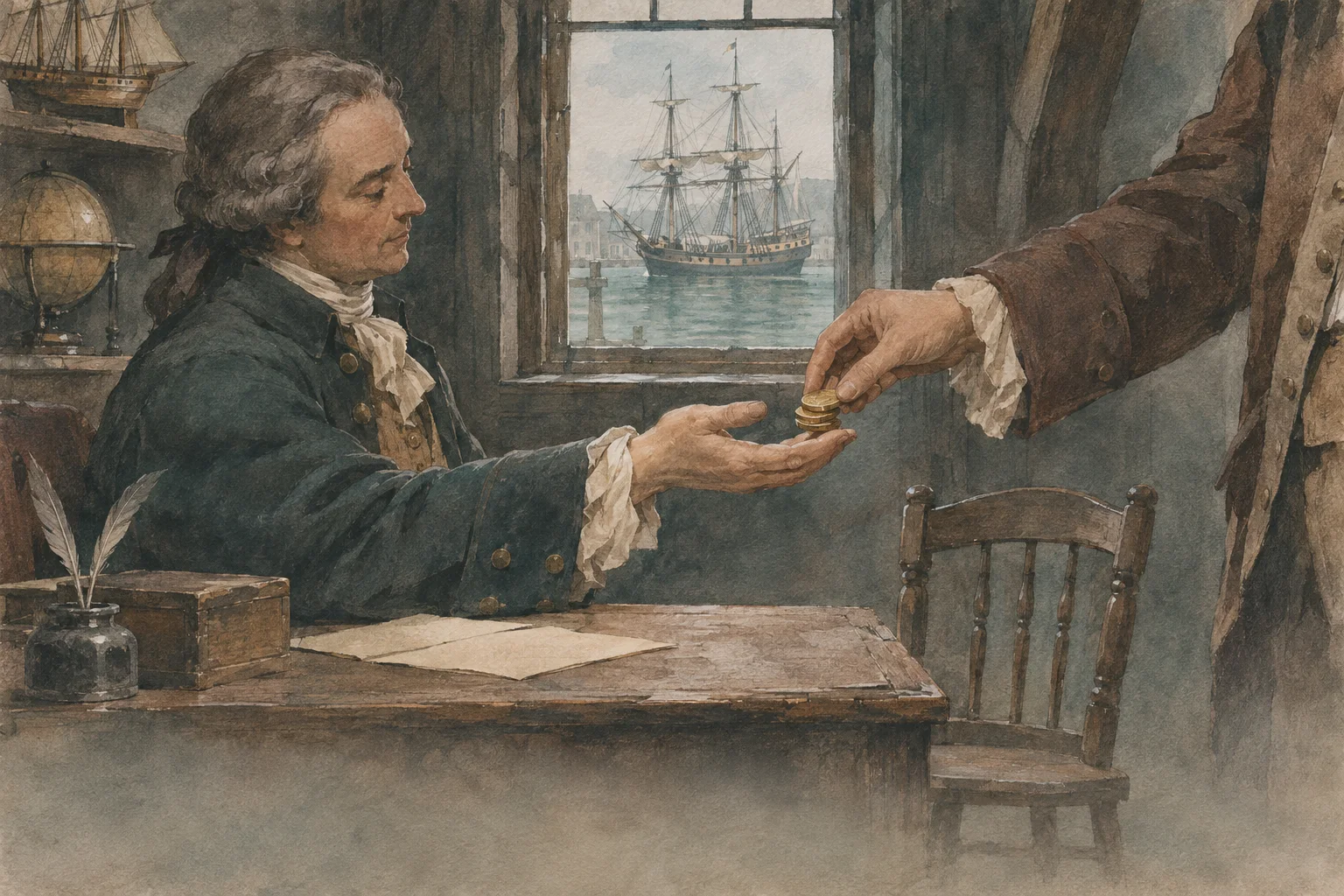
To examine how institutional records articulate the relationship between immediate premium extraction and deferred tail risk, this study combines narrative historical analysis with the quantitative evaluation of structured decision records. This chapter details the textual provenance of Mackay's 1841 account, outlines the architecture of WSTiger's synthetic decision settings, and presents the analytical structure and quantitative distributions of the pre-registered decision ledger.
This study is an expansion by AI of four synthetic decision records published by WSTiger, read beside Charles Mackay's 1841 narrative. The readings through the works named are this study's interpretation. The records are synthetic settings published for study, reporting no real firm or market transaction. In accordance with the study's rules, people decide: this study recommends no option, and draws no conclusion on which option should be chosen. Instead, it examines what each option gains and risks, who bears the burden and when, and what the record states would make the judgment change.
3.1Mackay and the history of schemes
Mackay's chapters on the Mississippi scheme and the South Sea Bubble provide period evidence of how promotional ventures were framed. When examining Mackay's narrative, this study observes strict methodological boundaries. While historical scholarship has challenged the scale and specific anecdotes of the tulip episode, the text serves here strictly as a historical record of narrative presentation rather than a source of quantitative data. In this study's reading, Mackay shows how promoters presented visions of gain to participants, framing speculative ventures during early modern manias.
3.2WSTiger synthetic decision records
The core empirical materials analysed in this study comprise four synthetic decision records published by WSTiger, a research studio within the RISCON family:
1. `wstiger:wst:risk-ko-selling-tails-past` (Marine Insurance Accumulated on a Calm Shipping Route): Placing a fictional marine insurance underwriter in a setting dated 1739, this record examines an underwriter who has greatly increased insurance on a shipping route where accidents have been rare for ten years. Rumours of war begin circulating between two countries that could affect shipping routes. 2. `wstiger:wst:risk-ko-selling-tails-present` (Weekly Option Premium Income): Set in a contemporary synthetic setting dated 2026, this record evaluates an options desk selling BTC out-of-the-money put options every week, earning steady premiums without a loss over the course of a year. The investment committee proposes increasing the position size because returns are stable. 3. `wstiger:wst:risk-ko-asymmetric-pay-future` (A vault where the performance token is received and the losses are borne by the depositor): Positioned in a hypothetical future setting dated 2034, this record investigates an on-chain operating vault that pays the person in charge governance tokens as a performance reward each time a profit is made, while all losses are borne by the depositor. The persons in charge submit proposals, one after another, to raise leverage. 4. `wstiger:wst:risk-ko-1` (Trapped Cash and Paper Profit): Located in a synthetic setting dated 1974, this record examines a synthetic joint venture operating entity that showed a profit on the books, but redemptions of some assets were blocked. Investor payment commitments come before asset recovery.
Each record contains a scenario, a central decision question, three strategic options, an example judgment reflecting WSTiger's institutional reading, and an invalidation criterion specifying when the judgment should be reconsidered; three of the four records also include a thematic thread.
To preserve strict evidentiary integrity, block quotations (> ) in this study are reserved exclusively for the verbatim sentences of WSTiger's synthetic records, followed immediately by their attribution in the format > — <case short title>, <field>. The synthetic nature of every record is explicitly acknowledged whenever a case is introduced.
3.3The decision ledger and registered hypotheses
To place these four specific cases within a broader empirical context, the study draws upon the pre-registered decision ledger, computed across a corpus of 53 synthetic decision cases in risk governance. The ledger's cells were coded independently by two models from different model families, with unsettled cells treated as unclear in the final metrics.
The 53 cases in the ledger span three temporal domains: 35 present settings, 9 past settings, and 9 future settings. All 53 cases are classified as synthetic. What the records themselves say across the corpus is summarized in the ledger as follows:
- Decider in record (A1): 0 cases.
- Missing items listed (A2): 0 cases; items listed in all: 0.
- Deadline in record (A3): 0 cases.
- Conditions for revisiting the judgment (A5): 53 of 53 cases (100%), all in the invalidation field; 5 of 53 (9%) state the condition with an observable number, threshold, or time (what the code can see; an event or a role it does not count). In 2 of 53 cases, the condition's wording is 30% or more the studio's frame.
What the two coders read across the 53 cases shows the following distributions:
- Decider: Coders agreed in 33 of 53 cases (62%), reading team-or-organisation (implied) in 23 cases, individual (implied) in 8 cases, team-or-organisation (stated) in 1 case, individual (stated) in 1 case, and leaving 20 cases unsettled.
- Bearer: Coders agreed in 24 of 53 cases (45%), reading the-decider (implied) in 12 cases, unknown in 7 cases, those-nearest-the-stoppage (implied) in 4 cases, third-parties-or-the-vulnerable (implied) in 1 case, and leaving 29 cases unsettled.
- Horizon: Coders agreed in 30 of 53 cases (57%), reading unknown in 18 cases, days-to-months (implied) in 11 cases, years (implied) in 1 case, and leaving 23 cases unsettled.
- Reversal constraint: Coders agreed in 11 of 53 cases (21%), reading easy (implied) in 9 cases, costly (implied) in 1 case, unknown in 1 case, and leaving 42 cases unsettled.
- Reversal action: Coders agreed in 13 of 53 cases (25%), reading costly (implied) in 6 cases, unknown in 5 cases, easy (implied) in 1 case, impossible (implied) in 1 case, and leaving 40 cases unsettled.
- Place: Coders agreed in 33 of 53 cases (62%), reading human-decides (implied) in 25 cases, human-approves (implied) in 3 cases, unknown in 3 cases, ai-or-rule-decides (implied) in 2 cases, and leaving 20 cases unsettled.
- Human role specified: Coders agreed in 42 of 53 cases (79%), reading no (implied) in 38 cases, no (stated) in 1 case, yes (implied) in 1 case, yes (stated) in 1 case, not-applicable (implied) in 1 case, and leaving 11 cases unsettled.
- Reason recorded: Coders agreed in 49 of 53 cases (92%), reading yes (stated) in 40 cases, yes (implied) in 5 cases, no (implied) in 2 cases, not-applicable (implied) in 2 cases, and leaving 4 cases unsettled.
Across the 53 cases, the records present a total of 159 strategic options. The two independent coders agreed that 44 of these 159 options reduce immediate losses. What those options give up, as both coders read it: resilience 18; long-term-stability 17; ethical-coherence 13; evolvability 7.
The ledger reports seven pre-registered hypotheses directly (H1 to H5, H7, and H8), while H6 (the longer the horizon, the less is decided now and the more conditions are set for revisiting) is read across the books in Volume 0:
- Hypothesis H1 (Waiting Costs on Others): The cost of waiting falls not on whoever decides but on those nearest the point where things stop. Under strict evaluation, H1 is unclear (supports 0, against 0, unclear 53, not applicable 0); under lenient evaluation, H1 is unclear (supports 5, against 12, unclear 36, not applicable 0; share 29%).
- Hypothesis H2 (Unobservable Reversal Conditions): Few decisions write down in advance what would reverse them, and those that do write it in words no one could observe. Under strict evaluation, H2 is supported (supports 48, against 5, unclear 0, not applicable 0; share 91%); under lenient evaluation, H2 is supported (supports 48, against 5, unclear 0, not applicable 0; share 91%).
- Hypothesis H3 (Missing Material): Where judgments diverge, material is missing. Under strict evaluation, H3 is not-applicable (not applicable 53); under lenient evaluation, H3 is not-applicable (not applicable 53).
- Hypothesis H4 (Reversibility and Distance): The harder a decision is to undo, the further apart are those who decide and those who bear the cost. Under strict evaluation, H4 is not-applicable (not applicable 53); under lenient evaluation, H4 is against (supports 1, against 3, unclear 3, not applicable 46; share 25%).
- Hypothesis H5 (Restriction Outlives Reason): A restriction outlives the memory of its reason. Under strict evaluation, H5 is against (supports 0, against 40, unclear 13, not applicable 0; share 0%); under lenient evaluation, H5 is against (supports 2, against 45, unclear 4, not applicable 2; share 4%).
- Hypothesis H7 (Automation Hollows Human Role): The more a decision is left to AI or an automatic rule, the more the human's place (approval, exception, review) is empty or a name only. Under strict evaluation, H7 is not-applicable (not applicable 53); under lenient evaluation, H7 is supported (supports 5, against 0, unclear 0, not applicable 48; share 100%).
- Hypothesis H8 (Loss Cutting Sacrifices Resilience): The options that cut the immediate loss most often give up evolvability and resilience among the four higher goals. Under strict evaluation, H8 is supported (supports 24, against 13, unclear 0, not applicable 16; share 65%); under lenient evaluation, H8 is supported (supports 24, against 13, unclear 0, not applicable 16; share 65%).
The four focal cases form part of this 53-case synthetic corpus, and the distributions provide context for how WSTiger's records document decision actors, revisit conditions, and waiting burdens.