One side wants the connection cut, the other wants it kept
2098The far futureDeadline · 14 days until the shared organ maintenance contract renews
Civilisational assumption
All people, institutions, events, figures, and future technologies in every issue are a synthetic premise. Background documents are sources for topic discovery and are not evidence of future facts or probabilities.
The question to decide
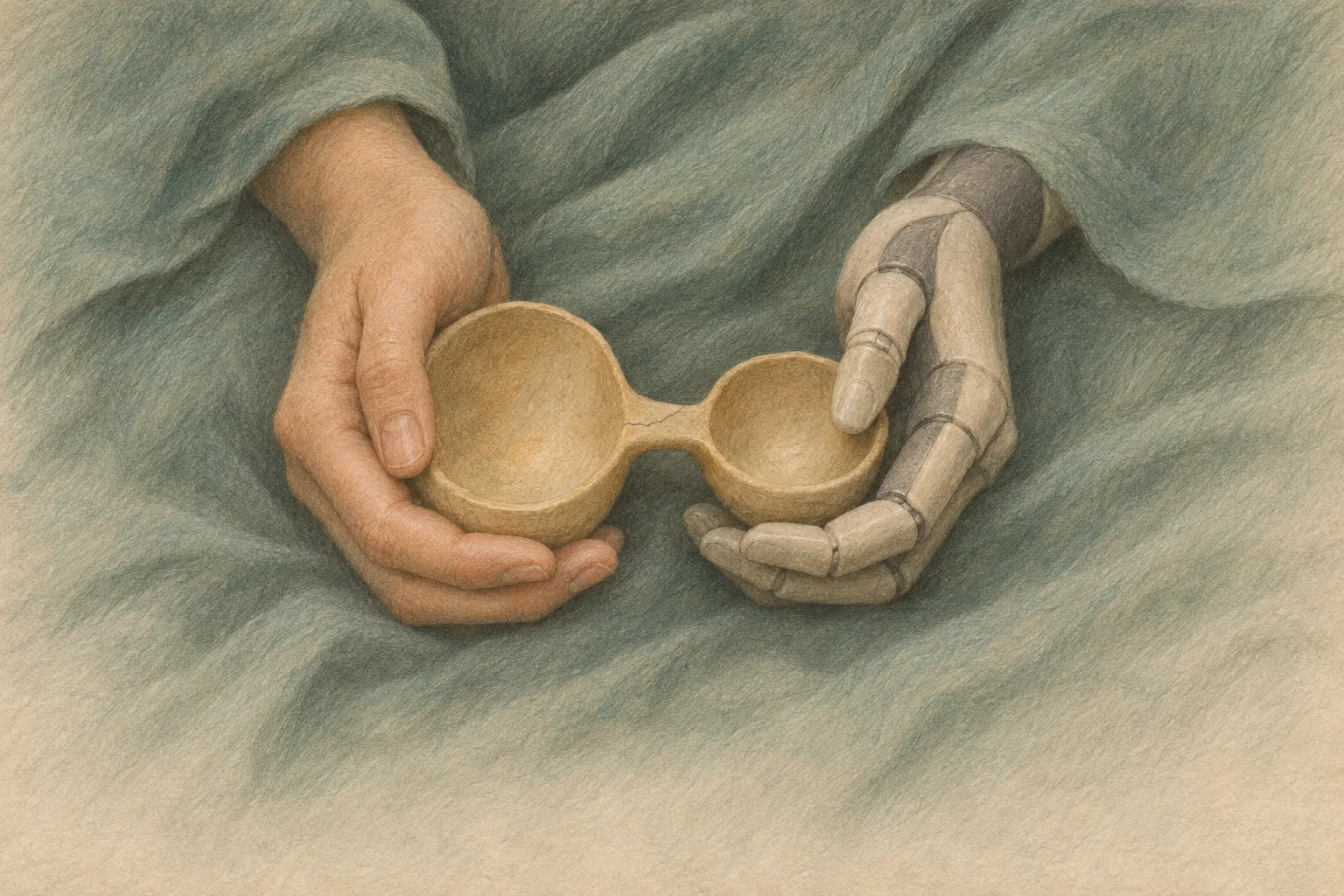
Assume a biological body and a machine body starting from the same memory have come to different judgments. The biological body repeatedly demands disconnection; the machine body repeatedly demands maintenance. Immediate separation would prevent preserving part of the shared memory on both sides at once, and separate maintenance resources are short. Does the joint review board keep the connection, separate them, or extend the connection only while checking the conflict of will further?
Who decidesPersonal, Agent, and Life Support Joint Review Board
What the AI judgments chose
Reading the judgment record…
The options
The order shown is not a ranking of preference.
The situation as it stands
Renewing the contract is not a simple extension; it fixes the stakeholder's connection for one more year.
Fictional blended-existence autonomous district · Shared life-support network
- Premise 1Assumes a synthetic technology in which a biological body and a machine body that began from a single memory come to make independent judgments.
- Premise 2The biological body demands the connection be terminated due to disconnection, and the machine body demands it be kept in order to preserve continuity, and both requests have been repeatedly confirmed.
- Premise 3If separated immediately, part of the shared memory cannot be preserved on both sides at once, and resources for separate maintenance are also insufficient.
Where it holdsDecides the stakeholder's consent to connection and the allocation of facility resources. Does not presume that divergent wills are one and the same.
What can be lost
- Unwanted integration can extinguish one side's autonomous life.
- Shared memories lost through separation may not be recoverable even after later reconciliation.
What is still unknown
- Unknown 1Whether the difference in will is autonomous change or an interface defect
- Unknown 2Whether the stakeholder understands and consents to memory loss after separation
Signals to decide again
- When separation testing independently confirms the comprehension and consistency of each request.
- When interface defects or the possibility of separate maintenance are confirmed by actual observation.
Where the paths partNot answers — paths that part from the same starting point
Even in a short test with the connection cut, the two conflicting requests are each maintained.
The independent maintenance facility actually secures the resources to house both existences together.
Material and rootsThe frame, the values and the background documents
After parts are replaced or split off, what standard still makes something count as the same?
An exploratory perspective chosen by the creator. Does not claim supernatural validity or the superiority of any particular option.The benefits and costs of the options accrue to different stakeholders. Which loss to accept remains undecided.
A subject for the decision-maker to argue over; the materials carry no conclusion of their own.Original quotation: Ethical synchronization of the judgment–memory–action loop Reprocessing: Reframed so that synchronization is not treated as a self-evident goal, and instead the refusal of connection and the loss of memory between different modes of existence are examined.
The root of the problem-finding. The original's future events and formulations are not treated as verified facts.The record of this question
- Question
FSP-IDENTITY-07· version 1.2.0- Content identity, SHA-256
b66ac2476564d264e0d8df3009fae721863b6e1697e49edde02c654a60faf590- Input files
- Question input JSON · What followed, JSON