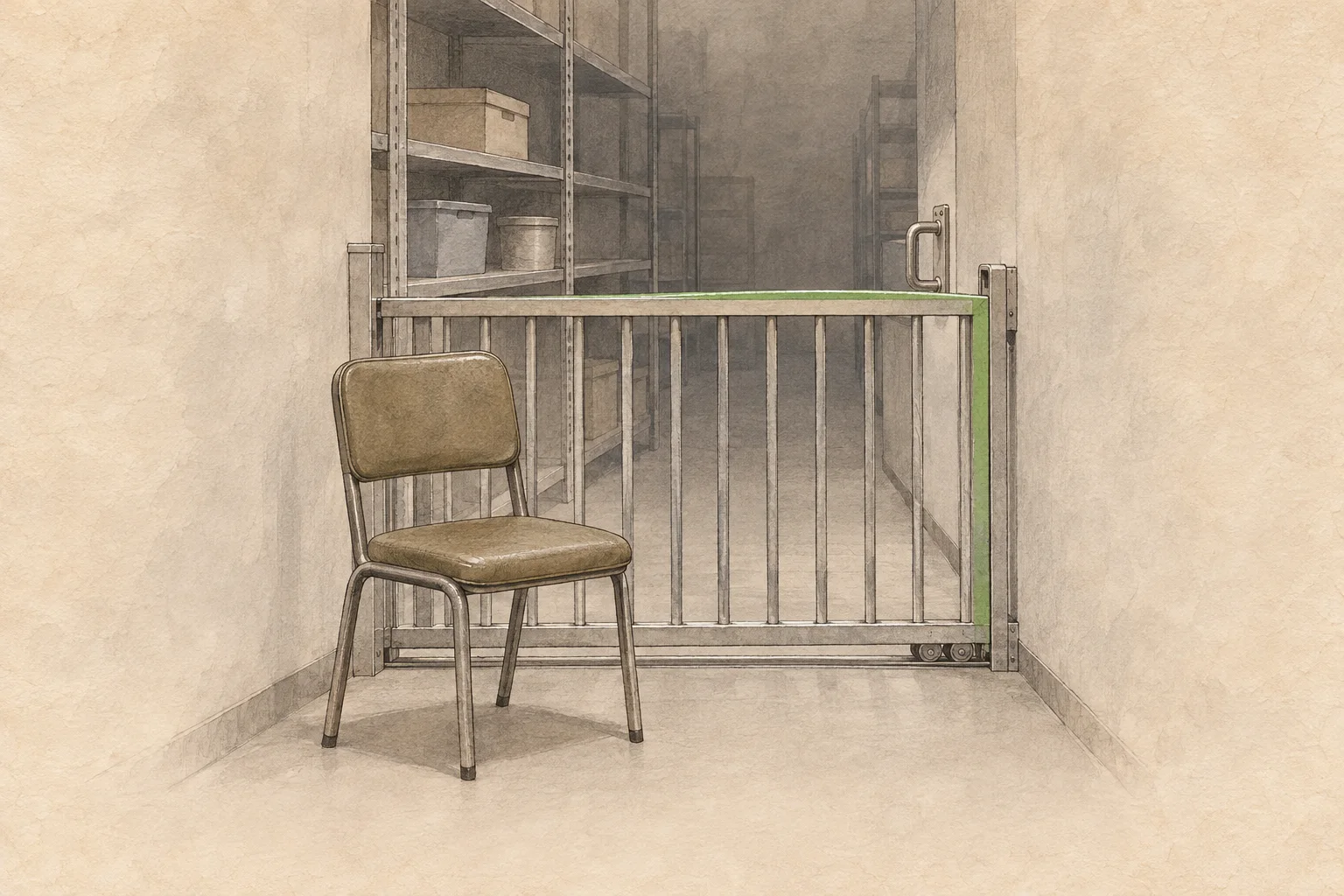
6.1A Lock No One Remembers
Synthetic scene: roles only — an approval-feature changer, a closing-materials user, and a program that still blocks.
The first scene of this chapter is a feature in a working program: a block on approvals of journal entries made after a period has closed. The record is one sentence, and it is read here whole.
The original reason for the feature that blocks post-period journal approvals could not be remembered accurately, so the behavior was checked again.
Three roles stand in this scene, and the third of them acts without being asked. The approval-feature changer is the role that decides about the behaviour of the control: whether to release it, test it, or keep it. The closing-materials user is the role that must work under the block. The record does not say that the block refused any approval in this scene; it reports only that the reason could not be remembered accurately and that the behaviour was checked again. The program itself is the third party, because it continues to enforce a decision whose original reason could not be remembered accurately. The record says only that the original reason could not be remembered accurately, and that the behaviour was checked again. It does not say that the lock was released, that it was kept, or what the check found. This chapter will not add any of those.
Two writers from Part I are within reach here, and each names one half of the difficulty. G. K. Chesterton's parable of the fence in The Thing (1929) asks the reader not to pull down a barrier until the reason for building it is known: the reason may be one the would-be remover has never considered. The parable assumes that a reason exists somewhere, or can be found by inquiry. Here the assumption is strained, because the reason cannot be remembered accurately. The fence is still standing, and the question of why is unanswered. Herbert A. Simon's Administrative Behavior (1947) supplies the other half. Simon describes how decisions taken in an organisation come to serve as premises for later work, and how the organisation sets the premises of later work; that a programme is a decision kept in a form that keeps operating after the person who took it has gone is this chapter's own reading of the stored-programme idea, which is placed with March and Simon in 1958 rather than with Simon's 1947 book. A program that still blocks is not, on this reading, a hostile thing. It is a decision that has outlived the memory of its author and continues to constrain work in an organisation that has moved on.
The question the scene leaves open is the one Chesterton's reader and Simon's official both face: what do you do with a restraint whose basis is unknown? Removing it on the grounds of inconvenience is one act; keeping it on the grounds of age is another. This chapter will not recommend either. It will show what ARCHON's records say about the question, and what the tradition adds to it, and where the tradition adds nothing.
6.2The Eight Lenses on the Lock
ARCHON reads this scene through eight lenses. The first reads the scene on the evidence it has; the other seven are hypothetical. All are dated 20 September 2026 and marked revisable.
One element runs through all eight lenses, and every judgment carries the same revision condition:
The Transaction Boundary the Lock Was Meant to Protect
If it is confirmed that the control no longer applies, it is not maintained out of inertia.
In ARCHON's records the judgments of lenses 2 to 8 follow one template across all ten scenes, with only the roles and the missing element changed: a general claim applied to the scene's roles, a separation of what was verifiable at the time from what arose later, and a warning about what must not be decided first. The repetition is a property of the cards, not evidence about the scenes. What follows quotes one example of each template judgment beside this scene's own question, with the roles the template assigns in this scene's names.
Start from the Records. The question:
When no one remembers why a journal-entry lock was created, where does the basis for releasing that control come from?
The structural reading:
An Old Program Exercises Prohibitory Authority in Place of an Organization That Has Forgotten
In this scene the roles are an approval-feature changer who must decide about the control and a closing-materials user who works under it; the lens engages the record as it stands and claims no remembered reason:
A rule that has dropped out of human memory still exercises authority inside a program.
The Threshold of Information. The question:
The transaction boundary the lock was meant to protect, which is invisible to the closing-materials user—who must disclose it first?
Information is not shared merely because the conclusion was sent quickly.
The approval-feature changer must disclose; the closing-materials user receives only the conclusion.
Authority to Stop. The question:
In the reason for the journal-entry lock that memory alone retains, who should hold the authority to say "wait"?
Under these conditions, it is worth first reviewing a structure that gives the closing-materials user a temporary hold right limited to specific signs, and that requires the approval-feature changer to leave a basis for release.
The discoverer and the holder of the stop authority are two different roles here, so the warning travels while the work continues.
The Cost of Rolling Back. The question:
If the person who decided to "verify the purpose of the existing control and change it" and the person who does the clean-up are different, what must be recorded together?
Time spent by the closing-materials user is not a category to be treated as a matter of individual diligence.
Waiting and rework fall on the closing-materials user, and the unnamed boundary is what a cost record would have to compare.
The Condition of Once Only. The question:
The reason for the journal-entry lock that memory alone retains — may the confirmation procedure be skipped once on the grounds of urgency?
If an exception is allowed, the approval-feature changer must specify the validity period, the work of the closing-materials users affected, and the conditions under which it stops again.
The exception would rest with the role holding the lock's decision, and its terms would have to fix the unnamed boundary.
Outcome and Luck. The question:
If the reason for the journal-entry lock that memory alone retains ended in a good outcome, can it be said that the choice was correct?
First separate whether the choice was made knowing the transaction boundary the lock was meant to protect, or whether the problem happened not to appear by chance despite the boundary not being known.
An outcome cannot certify the judgment while the boundary the lock was meant to protect is known to no one in the scene.
What to Leave for the Next Person. The question:
After the approval-feature changer has been replaced, can the basis of judgment for the reason for the journal-entry lock that memory alone retains be restored?
The next person in charge may see the mark of completion and mistakenly believe that the transaction boundary the lock was meant to protect has also been verified.
The handover this card supposes — a result and a completion mark, the reasons withheld — is the condition the record already reports about the original reason.
Evidence That Reverses the Judgment. The question:
When should the interpretation "an old program exercises prohibitory authority in place of an organization that has forgotten" be withdrawn?
Conversely, if a record is confirmed that a warning about the transaction boundary the lock was meant to protect was delivered but ignored, weight can be given to the exercise of authority rather than to insufficient information.
The reading is a hypothesis; this record alone establishes neither a person's intention nor a warning that was delivered.
Across the eight lenses the unnamed boundary does the same work: what must be disclosed, what a hold must limit itself against, what a cost table must compare, what an exception must not bypass, what a good outcome cannot certify, what a handover must record. It is never seen; the record says nothing about what the lock was protecting.
6.3The Image That May Not Be Changed at Will
Synthetic scene: roles only — an image change approver and a purchase-page production owner.
The second scene is a contradiction that the record presents before any reading is offered. It is read here whole:
An explanation appeared stating that images must not be changed at will, followed by a request to replace the purchase-page main image with a newly produced image.
Two things happen in the order the record gives them. First, an explanation appears: images must not be changed at will. This is a standing prohibition, and the record does not say who issued it, what it was protecting, or how long it has stood. Second, a request appears: replace the purchase-page main image with a newly produced image. This is not a request to change a picture at will. It is a request for a specific replacement, made by someone who presumably knows the first explanation. The record does not say whether the request lifts the prohibition, whether the approver has already given the answer, or whether the two statements belong to the same conversation at all. Those are not facts to be supplied. They are the gap the chapter will read through.
The order of the two statements matters. If a prohibition stands and then a request to do exactly the prohibited thing arrives, three readings are possible on the record alone. The request may be an ordinary instance of work that the prohibition already allows but never explained. The request may be an exception, granted or to be granted, that the prohibition's author intends. The request may be an instruction to do the thing the prohibition forbids, in which case the prohibition is being overridden from above rather than broken from below. Which of these holds changes everything about who has authority and who carries the cost of getting it wrong. The record cannot decide it, and this chapter will not.
Niccolò Machiavelli's The Prince (1532) is the tradition's sharpest tool for this shape, and it is worth naming precisely what it adds. Machiavelli argues that a prince must avoid being despised and hated, and that a ruler's reputation for keeping or breaking faith is a thing of consequence; whether that reputation shapes how far orders are obeyed is this chapter's extension of the concern, not Machiavelli's stated argument. He is not concerned with rules for their own sake; chapter XVIII of The Prince (Marriott) says only that a wise lord cannot and ought not to keep faith when such observance may be turned against him and the reasons that caused him to pledge it exist no longer, and what a ruler loses when commitments made in advance are expected to be set aside is this chapter's extension of that concern. The claim that a prohibition which people expect to be lifted on request invites the conduct it forbids is this chapter's extension of that concern, not Machiavelli's own argument. Applied to a page image, the point is modest but exact: a prohibition that people expect to be lifted on request is no longer a prohibition, and the person who lifts it on request becomes the one who has to judge each case without the support of a rule that holds. The answer this chapter would draw from that concern — that an exception must be handled visibly and with an account — is not given to the record; it is the question the record's contradiction puts to the organisation.
Simon's Administrative Behavior (1947) is also in reach here, and this chapter will return to it in 6.5: the prohibition on changing images stands as a premise for later work, exactly as the journal-entry lock does, and this chapter reads it as a stored decision on its own account rather than as Simon's. The difference is not in the form of the rule but in whether a person can be asked about it.
6.4The Eight Lenses on the Image
ARCHON reads the second scene through the same eight lenses in the same order. The first, "Starting from the record," is the studio's reading as it stands; the other seven are hypothetical suppositions about what could follow, and none reports what happened. The judgments are dated 20 September 2026 and marked as revisable. Every lens carries one missing element:
scope of the change prohibition and the approval status of this request
This is the same kind of gap as the lock's and not the same gap: the lock's boundary was lost from memory, while this scope may be known to the image change approver and simply not passed on. The scene's revision condition:
reduce unnecessary re-approval when repeat replacement is already delegated work
Each of the seven hypothetical judgments restates this condition after a condition of its own; that is a property of the cards, not a finding about the scene. The roles throughout are the image change approver and the purchase-page production owner; what differs is which of them can see, stop, or answer.
Starting from the record.
What approval must a request to change a purchase-page image under a prohibition on arbitrary changes include?
who can change the sales screen is at stake even in requests that revise presentation
This lens alone engages the record's order of events — the explanation that images must not be changed at will, followed by the request to replace the main image — and sets the key the others inherit: the request may or may not lift the prohibition, so the question is authority over the sales screen, not file access. Its judgment puts the choice with the side that established the criteria, the reverse of the lock scene, whose criteria are out of memory.
Information threshold.
The scope of the change prohibition and the approval status of this request, which the purchase-page production owner cannot see — who must disclose it first?
The approver knows the basis, the production owner receives only the conclusion: the missing scope becomes a disclosure question between two roles rather than a gap in the record alone.
Authority to stop.
In the purchase-page main image that cannot be changed at will, who should hold the authority to say “wait”?
On this lens's own condition the production owner cannot stop without the approver's approval, so the pause authority sits with the side that established the criteria, which must record the grounds for release.
Cost of rollback.
When the person who decided “specify the replacement target and approval scope” and the person who cleans up afterward differ, what must be recorded together?
Its judgment distinguishes whether the scope could have been verified at the time from circumstances that arose after the decision; here the approver decides and the production owner cleans up.
The once-only condition.
Purchase-page main image that cannot be changed at will — may the verification step be skipped once because it is urgent?
An urgent request would arrive at the approver, who would have to specify the validity period, the affected production owner's work, and the condition for stopping again.
Outcome and luck.
If the purchase-page main image that cannot be changed at will ended in a good result, can it be said that the choice was right?
A good result would not certify the choice unless the scope and approval status were known when it was made.
What to leave for the next person.
After the image change approver changes, can the basis for judgment on the purchase-page main image that cannot be changed at will be revived?
The roles are replaceable: the approver may change, and the completion mark left behind may be read as verification of a scope never verified.
Evidence that overturns the judgment.
When should the interpretation “who can change the sales screen is at stake even in requests that revise presentation” be withdrawn?
Its judgment points to a record showing that a warning about the missing scope was delivered and ignored, shifting the weight from information to authority.
The eight lenses return to one tension: a prohibition stands, a request asks to do the thing it forbids, and at every point where someone must act the missing element is named as unavailable. It blocks telling which of two things is happening: a legitimate act of presentation that the prohibition already permits but never explained, or a change that only becomes unauthorised when it fails. The handover card tests this chapter's own question about a stored decision, not Simon's account: whether the stored decision carries the reason or only the outcome.
6.5Two Prohibitions Through the Tradition
Two bodies of reading meet here: the works already used in this chapter — a parable, a book on administration, a figure of withholding, a prince — and the study of rules set out in sections 4.6 and 4.7, which asks what a rule becomes once it is stored. Each is said to fit badly where it does not.
Chesterton's fence in The Thing (1929) is the rule that one does not remove a barrier until one knows why it was put up. Applied to the journal-entry lock, it gains its full force where the record is thinnest: the reason is unknown, so the lock may be guarding a control the organisation has forgotten, and removing it because it is inconvenient would remove the protection before anyone has understood what it was. Its risk is that a fence rule can sanctify a barrier held by nothing but inertia. Chesterton's rule assumes an answerable question, and in the lock scene nobody can say why the lock was built, so the parable offers no way to distinguish a forgotten control from a dead one.
Section 4.6's Merton supplies what the parable cannot: a name for the lock's danger, that a rule may be kept not because a reason exists somewhere but because keeping rules is the work. Where Merton fits badly is decisive here: the notes describe the displacement of goals as officials coming to treat rules as ends in themselves and keeping to them after they have stopped serving their purpose; the claim that such keeping needs people who consciously hold the rule in hand, so that a gap in memory would count against the description, is this chapter's reading, while this record reports a gap in memory, not a habit of mind.
Kaufman's Red Tape: Its Origins, Uses, and Abuses (1977) asks a question neither Chesterton nor Merton asks: whose protection is dropped when a rule is cut. Cutting a rule means deciding whose protection goes, and that fits both scenes, because in each the removal would fall on someone other than the person who removes it. It fits badly in one respect the records make unavoidable: Kaufman writes of protections people demanded, and neither record reports anyone demanding anything. The lock's protection has no recorded claimant, and the image prohibition's scope is named as missing rather than as sought.
Simon's Administrative Behavior (1947) is the more exact tool for the lock. Simon describes how a decision taken at one level becomes a premise of the decisions below it; that a program carries a decision forward in a form that keeps operating after the person who made it has gone is this chapter's reading of the stored-programme idea, placed with March and Simon in 1958 rather than with the 1947 book. A program that still blocks is a decision stored and still running. The studio's judgment puts the point differently:
A rule that has dropped out of human memory still exercises authority inside a program.
The 1947 notes add that no one knows all the alternatives or foresees all the consequences — one reason a decision gets stored at all, and one reason its protected memory is lost. The gain is that the mystery is removed from the lock: it is not an adversary but an ordinary product of an ordinary process. The risk is that it makes the lock look blameless, as if a program that outlives its reason were a natural event rather than a condition an organisation chose to accept.
Feldman and Pentland's "Reconceptualizing Organizational Routines as a Source of Flexibility and Change" (2003) divides a routine into its ostensive aspect, the idea of it, and its performative aspect, what people actually do, with change arising from the gap between them. The division reads both scenes at once: in the lock the ostensive aspect — the reason — is lost while the performance continues unchanged; in the image scene the ostensive aspect is stated aloud, "images must not be changed at will", while the performance is a request to do what it forbids, so the gap is visible in the record's own order of events. Both scenes then stop looking like failures of memory or of obedience and start looking like the ordinary condition of any routine. Where it fits badly is in what it expects: Feldman and Pentland describe change arising from the gap, and neither record reports a change — only an explanation, a request and a check.
Section 4.6 also noted that formal structures adopted because they are taken for granted as legitimate can be decoupled from the work actually done; that fits the image scene better than the lock, where a program block cannot be decoupled from practice because it is the practice. Adler and Borys's "Two Types of Bureaucracy: Enabling and Coercive" (1996) asks a design question — whether a rule shows the reason it is for and can be repaired by the person inside it — since the notes state that the difference between enabling and coercive rules lies in how the rules are designed. Both scenes sit on the coercive side, and both fit the design reading badly — the lock hides its reason by accident rather than by design, and in that scene there is no designer whose choice can be examined.
The katechon is the third lens from the tradition, and the one that must be handled with the most care. Chapter 2 traced how Carl Schmitt read the withholding power in The Nomos of the Earth in the International Law of the Jus Publicum Europaeum (1950); this chapter needs only the consequence — Schmitt reads the empire's continuity as resting on its ability to restrain the coming of the Antichrist and the end of the present age; that such an order justifies itself by the delay it produces is this study's reading. Carl Schmitt served the Nazi regime from 1933, and critics read his theory of the exception in that light. The danger is directly relevant: if an order is justified by what it postpones, a forgotten lock can be credited with preventing a disaster that nobody can describe, because the disaster is by definition not yet here. Applied to this lock, the lens would flatter it: a rule that holds back harm, so it must be kept, and the fact that nobody can name what it holds back becomes evidence of how deep the harm goes. The cost on the other side is the closing-materials user's waiting, the uncertainty of anyone acting inside a control whose boundary is invisible, and the possibility that a past institution is being enforced on present work with no present author to answer for it.
There is a version of the reading that does not flatter. The letter's clause, quoted in section 1.1, names a holding with an end rather than a permanence; read as the delaying of every coming rather than the prevention of a particular one — a reading extended from Cacciari's and this study's own — the withholding power describes a lock that delays both error and correction. A journal entry approved outside the period may damage a closing boundary; a lock that blocks post-period approvals also delays the legitimate work that has outgrown the period. The delay is real in both directions, and the tradition does not say which it favours.
Machiavelli supplies the counterweight. In The Prince (1532) he is concerned with the reputation a ruler builds by keeping or breaking faith: chapter XVIII says that a wise lord cannot and ought not to keep faith when such observance may be turned against him and the reasons that caused him to pledge it exist no longer, and chapter XIX warns against those things which will make a lord hated or contemptible. What is lost when commitments made in advance are expected to be set aside is this chapter's extension, applied here to prohibitions, where the parallel is a rule everyone expects to be overridden. Both scenes are open to the reading. A program whose reason nobody can state can become a prohibition staff learn to work around, because it has no author to appeal to and no visible purpose to respect. A prohibition on changing images that meets a standing request can become, on the record's own order of events, a rule lifted whenever someone asks well. The image scene's own judgment points the same way from the other side:
The side that established the criteria must decide which changes it takes on and which changes it reviews again, so that authority and responsibility move together.
Machiavelli does not say which of these happened in either scene, and the record does not say it either. What he adds is the question both leave unanswered: what happens to the authority of a prohibition when people stop believing it will hold? The record shows only that a question was asked and a request was made.
The tradition gives three tools and one warning: Chesterton's discipline and its limit when the reason cannot be found; Simon's account of how a prohibition outlives its author in an ordinary and non-mysterious way; the extension of Machiavelli's concern to what a prohibition loses when it becomes expected to yield; and the katechon, a delay that runs in both directions and cannot by itself say what should be kept. The study of rules converts the question from what a prohibition means to what it has become — a stored rule, a residue of protection, a routine whose idea is missing or ignored, a structure kept beside practice, a rule that hides or shows why it exists.
What that scholarship cannot add is set by the records themselves. The records are anonymised summaries: they report that a reason could not be remembered accurately and that a behaviour was checked again, and that an explanation appeared and a request followed. They do not report who demanded the protection, who designed the rule, what the work beside it looks like, or what was decided afterwards. Most of the lenses through which this chapter has read them are marked hypothetical. Each of the works above describes a mechanism that could produce these scenes, and none can say which was at work here. The scholarship supplies the range of possibilities and the cost attached to each; it cannot supply the facts that would select among them, and no selection is made in this chapter.
6.6What the Two Scenes Share and Where They Split
The two scenes share a structure. In each, a prohibition stands whose boundary the person who must act inside it may not be able to see — for the journal-entry lock this follows from the scene's own record, for the purchase-page image it is only the condition the studio's hypothetical information-threshold lens assumes. In each, a second party is affected: a closing-materials user, named as the role that must work under the block, and a purchase-page production owner, the role the lenses place inside the prohibition. In each, the record stops at the question: no decision, no release, no refusal is reported. What it offers is a situation in which someone must act, or wait, without the basis for acting being available to them.
The split turns on the author. The journal-entry lock cannot state its author's reason: the record says only that the original reason could not be remembered accurately. The prohibition is a decision stored and still running in code, and the studio's structural reading puts the program where the holder stands:
An Old Program Exercises Prohibitory Authority in Place of an Organization That Has Forgotten
The image prohibition is read here as having someone who can be asked: the lenses suppose an image change approver who knows the basis for the judgment, could record grounds for release, and could say whether this request lifts the prohibition, changes only the main image, or applies to other screens:
who can change the sales screen is at stake even in requests that revise presentation
On the studio's reading, authority and responsibility can move together in the image scene because there is someone to move them. In the lock scene there is not; the program holds the authority that memory no longer supplies an author for.
Against the ledger's cells, the two scenes read as follows. The fields were coded again on 5 October 2026 without the studio's frame, which the first coding had taken for a restraint; the counts below are the second coding's. A cell is settled when the two codings agree, unsettled when they do not.
| Cell | Journal-Entry Lock (2016) | Purchase-Page Image (2017) |
|---|---|---|
| Restraint in the scene's own record | yes | yes |
| Where the restraint comes from | system-setting-or-code | standing-rule-or-principle |
| Does the scene's own record say why it exists | unsettled | not-said |
| A condition for lifting it named | named | named |
| With whom applying that condition rests | unsettled | the-holder-or-a-third-party |
| Can those who wait see what it protects and how far | no | not-said |
| Cell | Coders agree | The leading values in the library | Typical? |
|---|---|---|---|
| Restraint | 166 of 186 (89%) | yes (stated) 106; yes (implied) 46; unsettled 20 | both typical |
| Source | 120 of 186 (65%) | unsettled 66; gap-in-a-flow (implied) 32; decision-to-stop (stated) 14 | both atypical |
| Reason in scene | 132 of 186 (71%) | not-said 88; unsettled 54; stated (stated) 27 | image typical; lock in a large minority |
| Removal condition | 157 of 186 (84%) | named (stated) 139; unsettled 29; not-applicable 13 | both typical |
| Removal by bearer | 115 of 186 (62%) | the-holder-or-a-third-party (implied) 80; unsettled 71; not-applicable 17 | image typical; lock in a large minority |
| Boundary seen by bearer | 117 of 186 (63%) | not-said 72; unsettled 69; no (implied) 24 | image typical; lock in a minority |
Each of those judgements follows from the values, not from any computation of them. Both scenes show a restraint in the scene's own record, and restraint is the most settled of the study's own cells: the coders agree in 166 of 186 cases, and yes (stated) 106 with yes (implied) 46 run far ahead of any other value. Both scenes are atypical on source. System-setting-or-code appears as (implied) 9 and (stated) 5, and standing-rule-or-principle as (implied) 7 and (stated) 4, while the column's largest stated value is decision-to-stop (stated) 14 and its largest value of all is unsettled 66. On reason in scene the image is typical and the lock is not: not-said leads at 88, whereas the lock is coded unsettled, a value shared by 54 cases, and said-to-be-unknown now appears in the library only as (implied) 1, on none of the ten scenes this study reads closely. On removal by bearer the image is typical, the-holder-or-a-third-party leading at 80, while the lock is coded unsettled, shared by 71 cases, with not-said in 14. Among the ten scenes this study reads closely, five are coded not-said on reason in scene and four unsettled, while eight carry the-holder-or-a-third-party on removal by bearer. On the boundary the two scenes part company: the lock is coded no, which appears as (implied) 24 and (stated) 2, and the image is coded not-said, the leading value at 72. On this cell the image takes the library's commonest value, though not a majority of it: 72 of 186.
The ledger's cell for who bears the cost of waiting is bearer, on which the codings agree in 175 of 186 cases (94%), the dominant value being those-nearest-the-stoppage (implied) 134 with those-nearest-the-stoppage (stated) 39. The ledger's hypothesis that the cost of waiting falls on those nearest the point where things stop rather than on whoever decides is marked unclear strictly, on supports 39, against 0, unclear 147, and supports leniently, on supports 174, against 1, unclear 11. The ledger records 0 cases in which the decider appears in the record at all, so the table below marks its cost cells hypothetical: in both scenes the decider appears only in the roles the lenses assign, not in what the record says.
| Journal-Entry Lock (2016) | Purchase-Page Image (2017) | |
|---|---|---|
| What the prohibition is | A program block on post-period journal approvals | An explanation that images must not be changed at will |
| Roles the lenses assign | An approval-feature changer, a closing-materials user | An image change approver, a purchase-page production owner |
| Who waits (hypothetical) | The closing-materials user, while the approval-feature changer decides and looks for the reason | The purchase-page production owner, while the image change approver sets the target and approval scope |
| Who works again (hypothetical) | The closing-materials user, through handover, waiting and rework if the control is changed or rolled back | The purchase-page production owner, through rework if a replacement is reverted or a second approval is required |
| Who the readings say can answer | The approval-feature changer decides, but the reason is out of memory | The image change approver, on the lenses' assumption that this person knows the basis for the judgment |
| What would change the reading | Confirmation that the control no longer applies, or that a warning was delivered and ignored | Confirmation of the prohibition's scope and the approval status of this request |
The table is not a comparison of blame, and it is not a ranking. It shows that in both scenes the person who waits is named in the record as a role, and that rework enters through the studio's hypothetical cost lens, whose stated condition places additional explanation and rework with that role. The lens refuses to treat that waiting and rework as individual diligence: on its condition the follow-on work falls on that role rather than on the decision-maker — a split its own reconsideration warns against over-reading, since the decision-maker still bears the search for the reason and the specification of exception terms, and not every delay can be attributed to the decision-maker's fault.
The condition the thesis in section 13.9 states is that a restraint's reason, and the condition of its removal, be kept where those who wait under it can see them and invoke them. On that condition the journal-entry lock falls further short than the image prohibition. On the lock, the scene's own record does not settle why the restraint exists — the two codings differ on that cell — and it does not settle with whom applying the removal condition rests, the codings differing again; on the studio's reading the holder is the program itself. On the image, the reason is absent from the scene, the removal condition rests with a holder or a third party, and the boundary cell is not-said, so the record does not say whether those who wait can see what the prohibition protects. The difference is one of degree, not of kind: neither scene keeps the reason and the condition of removal in the hands of those who wait. The ledger's own test confirms the direction: a restraint whose reason is stated in the scene, whose condition for removal is named, whose condition sits in the hands of those who wait, and whose boundary is visible to them — 0 of 152 cases, and among the ten cases this study reads closely, 0. For the lock, the transaction boundary the lock was meant to protect, the element the record's Missing field names, must be kept in a form the closing-materials user can read at the moment of work, and the revision condition kept beside the control rather than in a document only the approval-feature changer holds. For the image, the scope of the change prohibition and the approval status of the request must be disclosed to the production owner in the terms the information-threshold card sets — the verified scope, the scope still unknown, and the point at which to check again — and the revision condition kept where that owner can invoke it. Neither requirement decides whether the lock should be released or the prohibition lifted.
The strongest objection to this reading is Chesterton's fence. The scene's record says only that the original reason could not be remembered accurately, which is not the same as saying that no reason exists; a fence rule assumes a reason is somewhere or can be found by inquiry, and coding not-said, or a split between two readings, as a shortcoming risks pulling down a barrier still guarding a control the organisation has forgotten. The katechon side of the same objection sharpens it: if an order is justified by what it postpones, a forgotten lock can be credited with preventing a disaster nobody can describe, because by definition the disaster is not yet here. The objection is answered on the thesis's own terms: the thesis asks that the reason and the removal condition be kept where those who wait can see and invoke them; it does not ask that the reason be true, that the lock be removed, or that no protection exist. Chesterton's discipline is inquiry, and the shortcoming named here is that nothing in the record shows anyone in either scene holding an inquiry with somewhere to put its answer — the lock's record reports only that the behaviour was checked again, which is a check with no visible place to land. The studio's first-lens judgment refuses the shortcut on both sides at once: releasing the lock on grounds of inconvenience and keeping it permanently on grounds of age alike lack a sufficient basis. The thesis supplies the middle term that judgment has no way to state: keep the reason and the condition of removal where the waiting party can read them.
This chapter recommends nothing. Each option quoted in 6.2 and 6.4 is shown with what it gains and what it risks, and the studio's judgments are dated readings that can be corrected, as their own counterexample lenses state. The readings in 6.5 carry gains and risks too: the fence rule protects against ignorance and can sanctify inertia; the stored-decision reading explains the lock and can make it look blameless; the katechon describes a delay in both directions and flatters whichever order it is applied to; Machiavelli's account of contempt describes what a prohibition loses, not what it should do. None of this decides whether the lock should be released or kept, or the image prohibition stand or lift.
6.7Why Reasons Are Lost
Section 6.5 turned a question of meaning into a question of condition: what a stored rule has become, rather than what it means. The lock scene has no author in it — the block on post-period journal approvals is a decision still running in code. The question the six works bear on is how a control can stay while its reason goes, and how an organisation comes to hold a rule it can no longer account for.
Nelson and Winter. An organisation's conduct rests on routines, which play the part genes play in biology. A routine is the organisation's memory, kept by being exercised; it is also, in the same account, a truce among members whose interests differ. Routines persist and change slowly, by search and selection. Read against the lock, the claim is exact and uncomfortable: the block is not a forgotten object but a remembered one, remembered the only way an organisation remembers anything — by performing it. The reason is what has gone, not the memory. Where the account fits the scene badly is that the record reports no exercise, no truce and no selection; it reports only that the reason could not be remembered accurately and that the behaviour was checked again, which is a search rather than a routine being followed.
Levitt and March. Organisations learn by encoding inferences from their history into routines that guide conduct, and routines survive the turnover of the people who made them. Two traps are named alongside that ability: an organisation can be caught in a competence it is already good at, and it can draw lessons from too few cases. That survival is the closest thing here to an answer to the memory card of 6.2, which supposed a handover in which only the result and a completion mark remain. That card is hypothetical; the record does not report a handover. What Levitt and March add is the note's claim that routines survive the turnover of the people who made them; the inference that such a handover would be the ordinary course rather than an exceptional lapse, since the routine is the carrier of the lesson and not the people, is this chapter's reading. The competency trap fits the image scene rather than the lock: a request to replace a main image meets a prohibition that may have been set when the work of replacement looked different, and repetition may be mistaken for practice that the rule was meant to govern.
Walsh and Ungson. Organisational memory is information from an organisation's history that can be brought to bear on present decisions. It is retained in several places at once: in individuals, in culture, in transformations, meaning procedures, in structures, meaning roles, in ecology, meaning the workplace itself, and in external archives. The account also says that this memory can be used well and can be misused. The gain here is that "remembered" and "recorded" stop being the same word. The lock's reason may have been recorded somewhere — in a procedure, in a role description, in an archive — and still be unavailable to the approval-feature changer and the closing-materials user, because availability is not the same as existence. That is exactly what the scene cannot settle: the record says only that the reason could not be remembered accurately, and it does not say that no written account exists. The risk of the reading is the mirror of it: it can suggest that the reason is always recoverable somewhere, which nothing in the record establishes.
Pierson. Institutions persist through increasing returns, or path dependence: once a path is taken, the cost of leaving it rises, timing and sequence matter, and the reasons an institution was made need not be the reasons it lasts. The second clause is the one this chapter needs, because it makes a lost reason ordinary rather than scandalous. The lock may have been made for one purpose and kept for another — because it now works, because it is embedded in the closing flow, because removing it has a cost no one has measured. Pierson's account fits the image scene with particular force: the prohibition on changing images at will and the request to replace the main image sit in a sequence in which doing nothing is the cheap option and reconsideration is the expensive one. Where it fits badly is on the record's own terms: neither scene reports a cost of leaving, only a request and a question.
Streeck and Thelen. Gradual institutional change takes five forms — displacement, layering, drift, conversion and exhaustion. In drift, an institution is left formally unchanged while its circumstances change, so that its effects change. The concept answers the question 6.5 left in the air: whether a rule that still exists is a rule that still does its work. Formal unchangedness is not evidence of continuing fit, because the effect of a rule depends on what surrounds it, and the surroundings may have moved without the rule being touched. Drift fits the image scene cleanly: the record shows a prohibition and then a request to do the thing it forbids, which is what a rule looks like when its circumstances have changed underneath it. It fits the lock scene less well, because the record reports no change of circumstance — only that the reason is out of memory and the behaviour was checked again. Drift explains why the reason can be out of memory without anyone having removed anything.
Bozeman. Red tape is rules, regulations and procedures that remain in force and entail a burden of compliance but do not serve the legitimate purposes they were meant to serve; it is distinct from formalisation itself. Two kinds are named: some rules are dysfunctional from the start, which Bozeman calls rule-inception red tape, and others become so as circumstances change, which is rule-evolved red tape. Whether a rule is red tape at all depends on whose purposes are counted. That last clause keeps this chapter from concluding anything. On one counting, the lock is red tape: a burden with no visible purpose. On another, it is a safeguard whose claimant is simply not in the record — the possibility Kaufman raised in 6.5 and which this study has not been able to close. Bozeman's distinction also gives the two scenes different starting points without ranking them: the lock may have been dysfunctional from the beginning, or it may have become so, and the image prohibition may belong to either category. The literature does not decide between the categories, and neither does the record.
Set against the four questions, the six works move the argument from what a rule means to what a rule has become, by supply of mechanism rather than by verdict. On what restrains here, the answer shifts from a stored decision, as this chapter read it in 6.5 from Simon's account of decisions as premises, the stored-programme idea being placed with March and Simon (1958), to a routine kept alive by exercise — a change of emphasis rather than a contradiction, since both describe something running without its author. On what it protects, the works widen the field and weaken the confidence: a routine is a truce among interests, memory can be misused, and red tape depends on whose purposes are counted, so the protection of a lock cannot be inferred from the lock's existence. On what it costs and who pays, they add one direction to the picture 6.6 built: the cost of not looking rises with time, because a path already taken becomes expensive to leave, while the waiting falls, as the cost lenses said, on the role nearest the stop. On when it should be removed, they supply no criterion at all, and they supply reasons why removal is hard: increasing returns, drift that has made the rule's effect unrecognisable to anyone inside it, and the possibility that what looks like red tape is somebody's safeguard.
What this literature explains is that a control can stay while its reason goes, and that this can happen without anyone deciding anything. What it leaves open is exactly the gap the records leave open. The lock's reason may have been lost, or it may never have been written down; the scene does not say, and no work here can make it say. The image prohibition's scope may be known to the image change approver and simply not passed on, or it may never have been stated as scope at all; again the record does not say. And the literature does not say who should look for the reason, who should decide whether it has been found, or who should carry the waiting while the search runs. That question — who is answerable for a rule whose author is absent or whose reason is unfound — is this study's own, and no one of the six works answers it. A literature that explains how reasons are lost cannot, by that explanation, tell anyone where to start looking.