14.1The Question, the Evidence, and the Tradition
This study asked what holds a working organisation back. It answered from ten short records in ARCHON's public question library: anonymised summaries of working scenes, each a sentence or two long, each read by the studio through eight lenses and dated 20 September 2026. Those records are the study's only evidence about organisations, and the study added no event, number, person or outcome to them. It read them as illustrative cases, in the sense set out in section 0.6: a first test of whether an idea from political theology is worth carrying into the study of organisations at all.
The idea comes from one passage. In the King James Version, 2 Thessalonians 2:6–7 reads: "And now ye know what withholdeth that he might be revealed in his time. For the mystery of iniquity doth already work: only he who now letteth will let, until he be taken out of the way." The letter names what is held back as evil — "that man of sin", "the son of perdition" (verse 3), and "that Wicked", whom the Lord shall destroy "with the brightness of his coming" (verse 8) — and leaves the holder unnamed, telling the first readers only that they know it (verses 5 and 6). Section 1.6 showed that modern scholarship has not closed that gap, and this study used it for what it is: a place that later readers fill. The reading that the holding delays every coming, good or bad, is Cacciari's, and this study's use of it for working life is marked at every use as an extension and not as what the letter says.
14.2The Argument Restated Without a Verdict
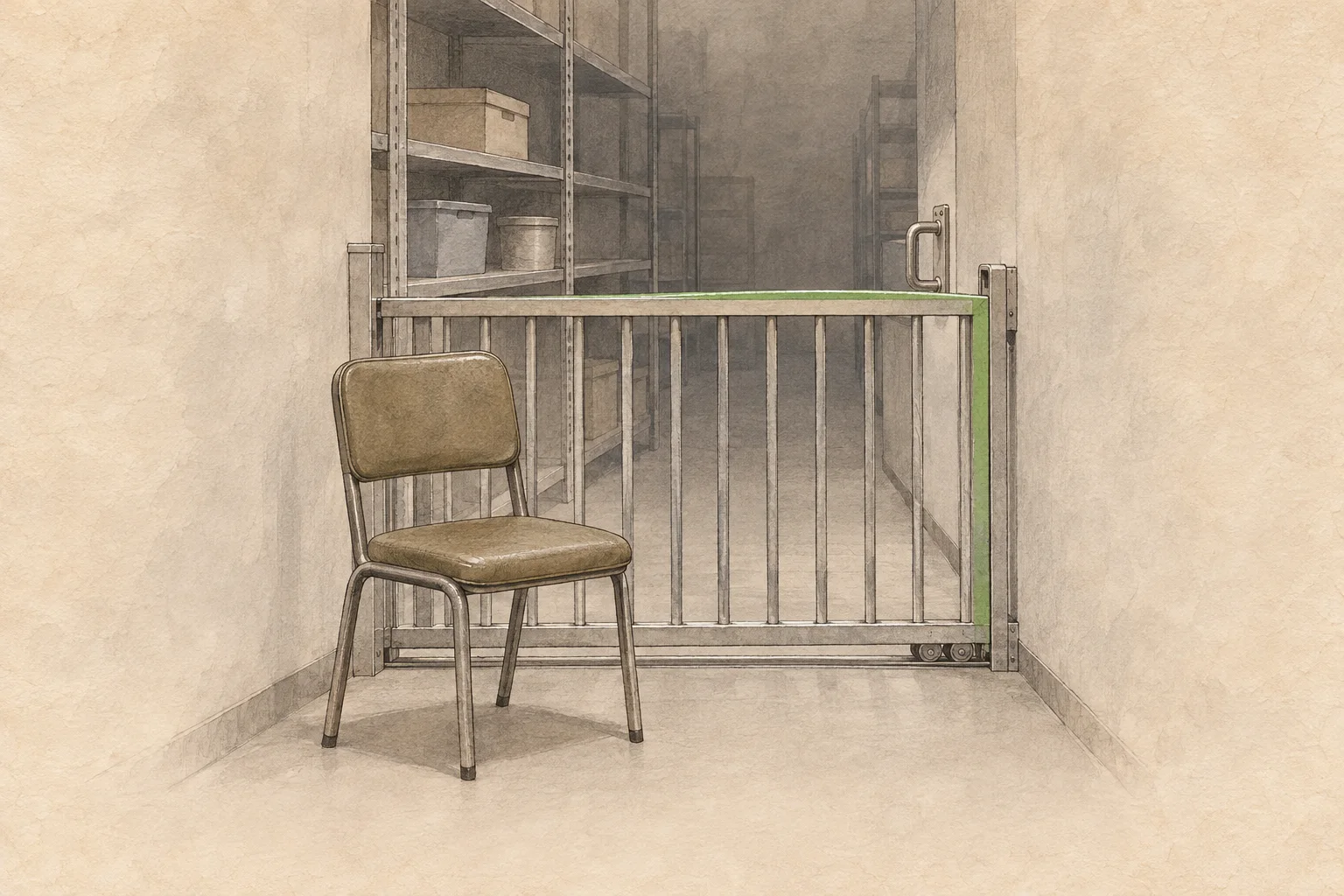
Restraint in these records is never one thing and never self-justifying. It is code that still blocks, an instruction, a principle applied at a gate, a decision about what may be printed, a sentence withdrawn from an advertisement, a small control on screen, a gap in an automated flow, a calendar date, an empty chair and a person hesitating at a desk. Each delays something, protects something, and costs someone waiting and someone work again.
One caution governs that restatement. Three features recur in every scene: an element named as missing, a lens on cost, and a condition under which the reading would be revised. They recur because ARCHON's eight-lens template gives them to every scene, as section 6.2 explains. The repetition is the studio's method, not a finding about organisations.
What counts as a finding is narrower, and it comes from four places: each scene's own record sentence; each scene's first lens, the only one ARCHON marks as record-inspired; each scene's own revision condition; and this study's own instruments — the two-part test of section 2.4, the typology of Chapter 11, the two costs of section 12.1, the account of outcome records in section 12.4 and the removal criteria of section 13.6. Everything else in the study is framing, quotation or interpretation.
To those four places the study adds a fifth, the decision ledger of section 11.8, which reads the same two fields of every scene in ARCHON's library and counts what two codings of them agree on. With it the study states a thesis rather than only a set of distinctions: a restraint can claim to hold rightly only when its reason, and the condition of its removal, are kept where those who wait under it can see them and invoke them (section 13.9). The ledger finds the records short of that condition in the same places across the library. A condition for lifting or narrowing a restraint is named in most scenes, but applying it rests with whoever holds the restraint or with a third party; the scene's own record says why its restraint exists in 27 of the 186 scenes; and none of the 152 scenes that show a restraint meets the condition. The one scene that meets it on any reading is a scene in which those who hold the restraint and those who wait under it are the same people. That is not a verdict on any scene. It is a condition the records do not meet, and section 13.10 sets out what the thesis concedes to the eight strongest objections to it.
14.3What the Ten Records Show on Their Own Terms
Each scene's first lens names a structure, and the names are worth setting beside the scenes because they are the only interpretive claims in this study that start from the record rather than from a supposition. They are, in the order the chapters give them: an old program exercising prohibitory authority in place of an organisation that has forgotten; the question of who may change the sales screen, at stake even in a request that revises presentation; a centre's return authority serving as a boundary that refuses information debt handed down from the previous stage; provisional information on a work order becoming a costly thing to reverse once printed on a label; a single sentence in an ad becoming a promise logistics must carry; a small state-change button holding broader sales-stoppage authority than expected; the name automatic hiding mid-process failures in a normal flow; a meeting convened quickly creating an approval debt for someone else; a superior's absence holding a subordinate's time even without an order; and the enforceability of a payment promise depending not only on the amount but on the time when the approver is available. Each is ARCHON's reading of 20 September 2026, marked correctable. None of them is a report of what happened, and none of them settles who was right.
The revision conditions are the third source of finding, and they are specific in a way the template is not. Each scene names one thing that would change its reading, and the ten do not name the same thing. The table below paraphrases them; the sentences themselves are quoted in section 13.2.
| Scene | The condition the studio's first reading names |
|---|---|
| Journal-Entry Lock | A control whose purpose has disappeared is not kept merely from inertia |
| Purchase-Page Image | Repeat replacement that is already delegated work should not be re-approved each time |
| Unscheduled Goods Return | A pre-agreed exception must not leave the field carrying blame for breaking the rule |
| Label Issuance Stop | Items whose production site is confirmed should not be held by a blanket stop |
| Same-Day Delivery Copy | If same-day delivery still holds for some products, the scope is distinguished rather than deleted |
| Option Sold-Out | A stop that is normal operation for one option is not to be described as a full stoppage |
| Unsplit Order Form | If the delay is caused by stock, repairing intake logic will not solve it |
| Absent Delegate | If an outline itself settles an external commitment, the discussion is deferred too |
| Hesitating to Leave | If on-site response is genuinely needed, the scope of waiting and the handover are redefined |
| Holiday Transfer | If an alternative approval route exists, payment is not arranged around one person's working day |
What these ten conditions show is a finding about these readings and not about the template: each restraint, read closely, yields its own condition for when it should stop, and the ten conditions are not the same. They are the studio's conditions, attached to its own readings, not conditions the people in the scenes are recorded as having set. The ledger of section 11.8 shows the other side across the whole library: a scene's record seldom says why its restraint exists, and applying a condition of removal rests with whoever holds the restraint. The distance between the two is the thesis of section 13.9 in small: a condition of removal can be written down for every one of these restraints, by a reader of the scene, and none of the records shows it written where those who wait can see it and invoke it. That is a modest finding. It is also the one that matters most for anyone who works inside a restraint, because it can be acted on without this study deciding anything for them.
14.4What the Tradition Gave, and Where It Failed
The tradition gave two things: the shape of a delay and the weight of a removal. A delay is not an empty interval; it has a structure and a cost, and work is done inside it, as Agamben's reading of the time that remains suggests (section 3.1). A removal is not housekeeping: the passage ends the holding in a destruction rather than a relief, and on Cacciari's reading the removal frees the good with the bad. Augustine (section 1.4) confesses that he does not know what the letter means, and this study reads that confession as leaving open the possibility that a restraint may be real without anyone being able to name its holder; the further claim that naming the holder wrongly carries costs of its own is this study's reading and not Augustine's.
The tradition failed in two directions at once. It justified holding by what it postponed. In Schmitt's account of the Christian empire of the Middle Ages the empire's continuity rests on the katechon, the power able to restrain the coming of the Antichrist and the end of the present age, and this study reads that idea as allowing whatever order holds to be justified by what it postpones, which is this study's reading rather than a claim of Schmitt's, and section 2.6 set out the scholarship that refuses that justification its innocence: Peterson and Blumenberg contest the ground of political theology itself, and Hell reads Schmitt's katechon as an imperial theology. Carl Schmitt served the Nazi regime from 1933, and critics read his theory of the exception in that light. The katechon reading of The Nomos of the Earth is a separate matter from that sentence, and this study treated it separately; what this study refused to carry into an office is that reading's justification by postponement. And the tradition inflated small holdings into cosmic ones. Section 3.4 named where it fits a working scene badly — a small configuration error, a missing intermediate output, a calendar constraint — and adopted the rule the study followed after it: where the tradition flatters a restraint, show the cost on the other side. Taubes and Esposito (section 3.6) sharpened the questions without escaping either failure: Taubes asks from whose side a holding is judged, Esposito shows a protection that keeps within it what it protects against, and both fit the ordinary scenes only in part.
14.5From Empire to Office: the Study of Organisations and the Other Maps
Chapter 4 carried the idea into the office through Weber's official who executes, Simon's decisions drawn from premises, and March and Simon's performance programs, Perrow's systems of interactive complexity and tight coupling, in which accidents come in time however well they are run, Weick's structure of meaning and Chesterton's fence, and gave the summary the scenes were read with: a restraint in a workplace is, at different times and sometimes at once, a performance program that keeps working after its makers are gone, a buffer, a role, and a fence whose reason may be gone. Sections 4.6 and 4.7 set beside them what the study of organisations already knows. Merton's displacement of goals, Kaufman's red tape as the residue of protection, and Meyer and Rowan's structures kept for legitimacy give three different accounts of a rule whose reason has gone, which Chesterton's fence alone cannot tell apart. Vaughan's normalisation of deviance and Reason's latent conditions show that a rule observed exactly may have stopped protecting. Lipsky, Hirschman and Edmondson place the cost of a restraint at the front line and in the silence of those who stay. Part II read each pair of scenes beside the works that fit them, and named where they fit badly.
Chapter 5 added four maps that the European line does not contain. Sun Tzu makes knowledge the condition of a useful stop: "If you know the enemy and know yourself, you need not fear the result of a hundred battles." Han Feizi gives a clear account of who holds a stop and refuses to rely on the virtue of subordinates; Laozi gives the possibility that restraint is the decision not to add another control; Machiavelli gives the rule that a lord who must hold power cannot, nor ought he to, keep faith when such observance may be turned against him and the reasons that caused him to pledge it exist no longer, and must avoid those things which will make him hated or contemptible. Section 5.5 refused all four as verdicts, since each flatters restraint in one direction and warns against it in another.
14.6What This Study's Own Instruments Show
Five instruments are this study's rather than the tradition's, and what they show is shown of these ten records. The two-part test of section 2.4 separates restraints with a living author from restraints without one: the journal-entry lock acts with no one to ask, while the purchase-page prohibition has an author whose scope can be sought. The typology of Chapter 11 sets the ten scenes against four axes — where a restraint comes from, who can see its boundary, how far the stop reaches and how firm it is — as a working instrument in which no cell makes a restraint right or wrong. The two costs of section 12.1, the cost of stopping and the cost of reversing, travel in different directions and land in different hands, because a stop can be lifted while a printed label or a payment cannot be unsent. The account of outcome records in section 12.4 gives the general point that matters for any organisation that keeps records of its decisions: a record built from outcomes will over-credit the choice that preceded a good result and hide the labour that propped it up. The fifth instrument, the working list of removal criteria, follows.
14.7What the Records Show About Removal
Chapter 13 reads the clause this study is named for — "until he be taken out of the way" — for the removal rather than the holding, and keeps apart two objects of removal: the control or person that holds, and the reading that describes it. A reader can withdraw a reading; only the people in an organisation can withdraw a restraint. Section 13.6 draws seven removal criteria from the records rather than from theory: the purpose of the control has gone; the boundary it protects has been verified as gone; the cost of holding now exceeds the cost of the harm it holds back, and the bearer of that cost has been named; an alternative route exists and is in use; the people who must act within the restraint cannot see what it protects and cannot find out; the restraint has become a surface on which one person holds another's time without an order; an exception has become the standard without a decision. Section 13.8 sets the list beside the study of rules, and section 13.7 says what none of the criteria does: none makes removal right in general, and the decision belongs to the people in the organisation.
Removal is not housekeeping. The passage says that what is held back is "that Wicked", and Cacciari's reading, which this study extends, adds that removal frees the good along with the bad. Between those two the ordinary case in these records stands: a lock is released, a gate opens, a label is printed, a promise is reinstated, a person goes home. Each of those acts lets something through, and this study does not say whether what comes through is welcome, because the records do not say.
14.8Contributions, Limits and Further Work
This study claims four contributions, and each is narrower than the tradition it draws on. The first is a change of scale. The scholarship set out in sections 1.6 to 3.6 reads the katechon at the scale of the end of days, of empires, of legal orders and of political communities; Schmitt carried it into the law of nations, and Cacciari and Esposito into political philosophy. This study carries it into the single working scene — a lock, a gate, a label, a calendar — and finds that the idea survives the change of scale in one form only: as Cacciari's functional reading, which this study has marked at every use as its extension and not as what the letter says. What does not survive is what this study read as a justification drawn from it by postponement. A restraint in an office that is justified by what it postpones is justified whatever it does in the meantime, and the scenes show who pays for that.
The second contribution is the thesis and the test that comes with it. The thesis takes its negative from the tradition, in which the power to end a holding rests with the holder, and its positive from the study of law and organisations: Hart's rules of change, Fuller's publication and congruence, Barnard's acceptance, Tyler's fair procedure, Bovens's forum, Adler and Borys's rules that show their reasons. What is new is to ask the question of a whole library of records at once, with the hypotheses written down before the coding, and to report where the answer is unclear as well as where it is clear.
The third contribution is the typology of Chapter 11, and section 11.7 sets it beside the sortings of rules that organisation studies already has: Gouldner's three patterns of rules, Adler and Borys's enabling and coercive rules, Merton's displacement of goals, Kaufman's red tape. Its axis of visibility is close to what Adler and Borys ask when they ask whether a rule shows its reasons. What it adds is to read that visibility off the records themselves, from the element each record says it cannot establish, and to pair it with the record's own condition for revision. What it lacks is what those sortings have: observation of working organisations over time.
The fourth contribution is the working list of removal criteria in section 13.6. Organisation studies has a long account of how rules outlive their reasons and how safety drifts, from Merton and Kaufman to Turner and Vaughan, and Chesterton's fence puts the question removal must answer first. The list does not replace that account. It differs in where it comes from: it is drawn from the conditions the records attach to their own readings, so that a criterion for removing a restraint is the same kind of statement as a criterion for withdrawing a reading of it.
The limits are those set out in sections 0.6 and 0.10, and they bind every claim above. The ten scenes are a purposive selection, not a sample. The ledger sets them in their library, but it counts what ARCHON's records say, not what happens in workplaces; its two codings are one model run twice, which agree on the scene's reason in 71% of the scenes and on the boundary in 63%; a larger model of the same family read no differently, and readers of two other families, on 40 scenes, agreed with each other better than with the codings, found a restraint in the record itself in only about half of them, and agreed least on the boundary; the codings were made twice, the second time without the studio's frame and after the first counts had been seen; and its hypotheses are supported only when what the codings inferred is counted. The records are anonymised summaries a sentence or two long, and nothing beyond them can be checked. Seven of the eight lenses suppose rather than report. The tradition is read in a fixed list of works, much of it in translation, and the scholarship is reported at the level of each work's main argument rather than engaged page by page. The whole book is an artificial-intelligence expansion of the records, made without fieldwork, without interviews and without access to the people in the scenes. Its findings are findings about these ten records as published: dated, and correctable.
Four lines of further work follow from those limits, and each would test this study rather than extend it. The first is to code the ledger again on the same registered fields with readers of another kind, people above all, on every scene rather than a sample, and to see whether the strict count still leaves the hypotheses unclear and whether the cells of hands and boundary can be settled at all from records of this length. The second is observation: the typology's axes, and above all the visibility of a boundary, could be checked against restraints observed in organisations over time, with the people who hold them and the people who bear them. The third is the removal criteria: an organisation that writes a reversal condition down with each restraint, as this study proposes, would produce the record that shows whether the criteria pick out the restraints that should go. The fourth is the letter: if one reading of the restrainer were to win general agreement among its scholars, the use this study makes of the open place in the text would have to be reconsidered, since that use rests on the place being open.
14.9What to Take Back to Work
What is left is small enough to carry. Four questions, from section 1.5 and restated in organisational terms in section 2.5: what restrains here; what does it protect; what does it cost and who pays; what would make it go. And one discipline, drawn from the revision conditions and from the memory lens: write the reversal condition down with the decision, in the same place, at the same time, so that the person who inherits the decision can see when it should be revisited rather than simply obeyed.
The findings that support that discipline are modest and they are these. Each restraint in the records, read closely, yields its own condition for when it should stop, and none of the records shows that condition kept where those who wait can invoke it. Each first lens names a structure that the record alone would not have made visible: an authorless prohibition, authority over a sales screen, information debt refused at a gate, information costly to reverse once printed, a promise carried by logistics, a small control with wide reach, a success indicator covering unfinished work, an approval debt created by speed, time held by an absence, a payment promise bound to an approver's calendar. The two costs of holding travel in different directions and land in different hands. A record built from outcomes will over-credit the choice that preceded success. And a reading, like a control, is kept honest by the condition attached to it that says when it should be withdrawn.
Restraint, on this evidence, is not good or bad in general. It is a set of choices, made by people, each of which can be revised. The lock, the rule, the refusal, the button, the missing output, the withdrawn promise, the calendar and the absence each hold something back, and each holds back the remedy along with the harm. Whether any of them should be taken out of the way is a decision for the people who live with its boundary, its cost and its condition. What this study offers them is not an answer but a way of writing the question down before the answer is forgotten.