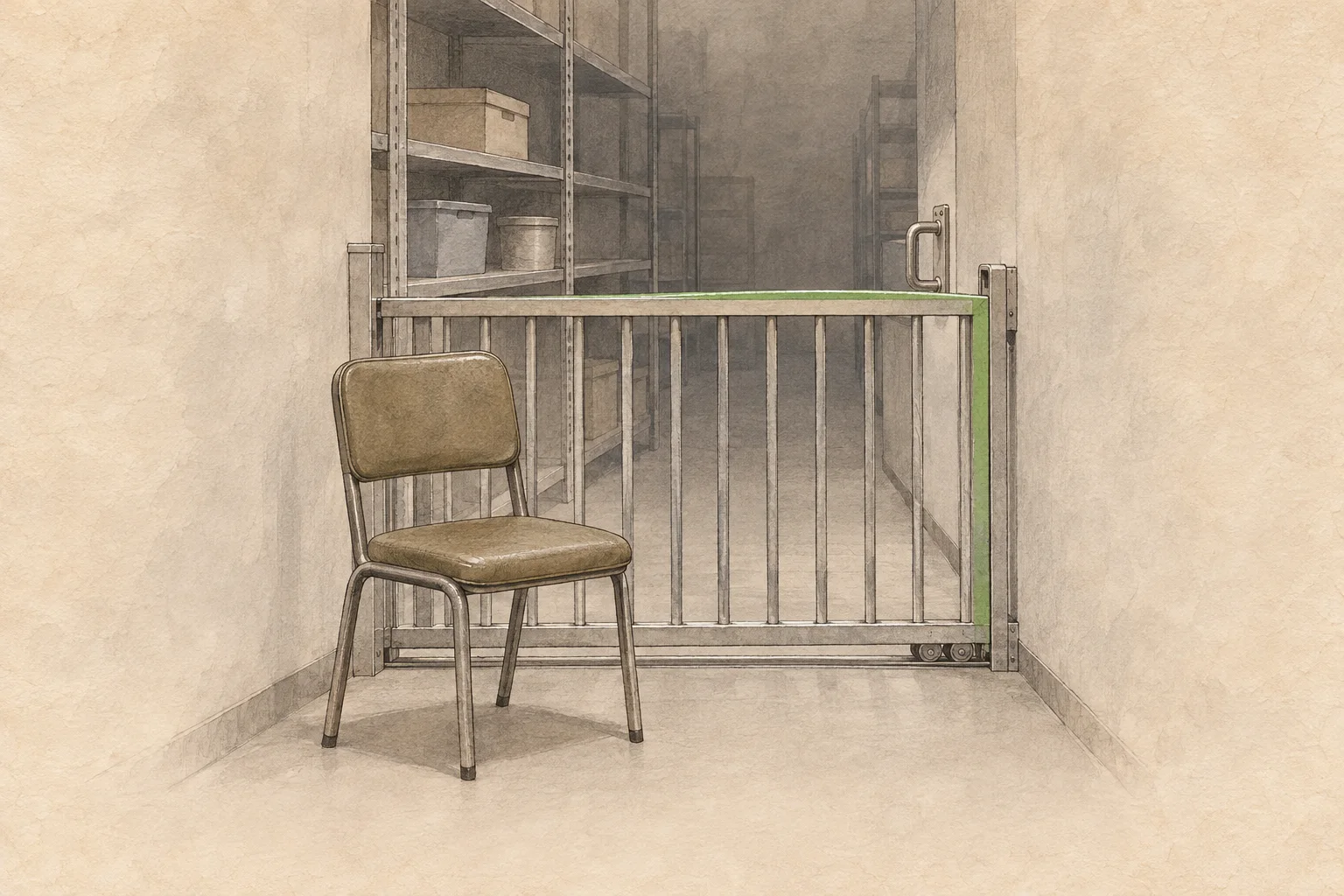
Chapter 6 took restraints that were inherited: a program that still blocks approvals although its reason is out of memory, and an instruction about images whose scope no one could name. This chapter takes restraints that are chosen at the working moment: goods to which a principle of return is applied, and labels withheld from the printer until a check is done. Both are refusals. Both sit at a threshold — the place where something crosses from one layer of an organisation into another — and the records do not say who holds either refusal. The question this chapter cannot answer for anyone is whether each refusal protected what it was meant to protect.
7.1Goods Without a Schedule
Synthetic scene. The roles below are set only to make the record readable: a receiving logistics centre at a physical door, where goods arrive, and an inbound exception approver whose role appears only in ARCHON's lens cards, not in the record. The roles add no event to the record.
There was a small volume of goods that had been received physically but had no scheduled information, and the principle that unscheduled inbound receipts are subject to return was presented.
Read slowly, the record is short and the principle it turns on is not. Goods arrived. They had no scheduled information behind them. A principle was presented that such receipts are returned. The record does not say who presented the principle, why the information was missing, or what happened to the goods afterwards. This study will not supply any of those things.
What the scene does establish is where the refusal sits. It sits at the lowest execution layer — the layer that touches the goods — and it faces outward toward whoever sent them. Chapter 6 described a lock whose reason could not be remembered accurately and an instruction whose scope no one could name. Here there is a principle in force and an approver who can be asked whether this case is an exception. Both refusals are recorded as decisions taken at the working moment rather than as inherited prohibitions.
The first of this chapter's two ideas comes from the Han Feizi, the classical Chinese political text introduced in Chapter 5 through its chapter "The Two Handles". The image there is simple: whoever rules holds two instruments, one to give and one to take away, and the relationship between ruler and subordinate is held by whoever holds both. The text's warning is equally simple — that power is lost when either instrument is lent to someone else, because the borrower can then use it against the lender. Applied at a gate, the idea asks who holds the instrument of refusal. In this scene this chapter reads the instrument as held by a receiving centre that can decline to accept what arrives, and by an approver who may authorise an exception — a role that appears only in ARCHON's lens cards, not in the record. Chapter 7 will return to that arrangement in 7.5, where the gain and the risk of holding the instrument at the executing layer are set out side by side.
The second idea, set out in Chapter 4, comes from Charles Perrow's Normal Accidents: Living with High-Risk Technologies (1984), which argues that system accidents come in time in systems whose parts interact in unexpected ways and are tightly coupled, and that safety devices and redundancy add complexity and can themselves cause accidents. That such devices hold work back at a price is this study's reading of Perrow, not his phrase, and it is not repeated here. The gate in this scene is not one of Perrow's high-risk technologies, and the fit is therefore partial. What survives the transfer is the asymmetry: a stop is cheap to apply and expensive to undo, and the cost of undoing falls on whoever is nearest the stoppage.
7.2The Eight Lenses on the Return
Seven of the eight lenses below are marked Hypothetical in ARCHON's record; they suppose what could follow if certain conditions held, and do not report what happened. The first is the studio's reading, dated 2026-09-20 and marked correctable. Every element of the return is bracketed by one named gap: the studio lists as missing the reason delivered goods and scheduled information diverged. Lenses two to eight follow one template across all ten scenes of the library, with only the roles and that missing element changed, so they are quoted here only where they differ. The roles this scene supplies are the receiving logistics centre and the inbound exception approver; the revision condition carried in all eight cards is quoted at the end.
Starting from the record. The question puts two readings of the same principle before the reader:
Is the logistics principle of returning goods that arrived unscheduled stubbornness, or an authority to refuse information debt?
The structural reading takes the second while keeping the first alive as a possibility to be checked:
The center's return authority can serve as a boundary that refuses the information debt handed down from the previous stage
A principle of return can refuse to absorb information someone else failed to supply, or it can stop thinking at the door. The structural reading names what the centre's return authority does when it sends goods back: it hands the burden to the stage that produced the divergence. Whether that refusal is also stubbornness the judgment leaves open, asking whether the principle accepts none of the differences of reality at all. Its three options — isolating the unscheduled volume, recording an urgent exception with its reason and responsibility, testing a small scale first — each carry a gain and a risk folding back onto the same unnamed cause. The judgment also reports what the published record does not contain: a small quantity sent by headquarters with a different item number.
The threshold of information.
To the receiving logistics center, the reason delivered goods and scheduled information diverged is invisible — who should disclose it first?
Its revision condition reads a difference the receiver could already see as access and interpretation rather than non-disclosure. The lens shows that a refusal at a gate may be correct while the centre cannot see what it protects.
Authority to stop.
Who should hold the authority to say “wait” in the principle for returning unscheduled incoming goods?
Its revision condition narrows the hold and the release deadline if a temporary hold causes greater harm or collides with another decider's authority; its roles place the hold with the receiving logistics centre and the release with the approver. The lens shows who may say no inside a principle already in force.
The cost of rollback.
If the person who decided to “isolate unscheduled volume and cross-check with headquarters” and the person who handles the aftermath are different, what must be recorded together?
Its revision condition holds that work arising from changes unlookable at the time is not attributed to the decider as cost shifting; its roles separate the inbound exception approver, who decides, from the receiving logistics centre, which cleans up. The lens shows whose time pays while the gap stays open.
A one-time condition.
principle for returning unscheduled incoming goods — Is it acceptable to skip the verification procedure once because it is urgent?
Its revision condition withdraws the permission if an irreversible promise arises even at small scale; its roles name the approver as the one who must specify any exception. The lens shows that urgency and pressure to avoid review look alike from the gate.
Results and luck.
If the principle for returning unscheduled incoming goods ended with a good result, can it be said that the choice was right?
Its revision condition raises confidence only where the same difference repeats across cases that match the conditions; its missing element decides the lens, since a clean result may mean the divergence was understood or only that nothing surfaced. The lens shows that a good ending cannot certify the refusal that produced it.
What to leave for the next person.
Even after the inbound exception approver changes, can the basis for judgment on the principle for returning unscheduled incoming goods be restored?
Its revision condition links rather than duplicates where the reasons already exist in another record; its roles pair the approver who leaves with the next person in charge, who inherits only the result and the completion mark. The lens shows what a completion mark can be made to say — that the reason has been confirmed when only the mark has.
Evidence that reverses the judgment. The question quotes the studio's own reading back:
When should the interpretive claim “the center's return authority can serve as a boundary that refuses the information debt handed down from the previous stage” be withdrawn?
The scene's revision condition, carried in all eight cards, is quoted here:
For a pre-agreed exception, responsibility for rule violation is not attributed to the field after the fact.
The lens shows what would change the reading — a confirmed record that a warning about the divergence was delivered but ignored, shifting the weight from missing information to exercised authority — and that such material has not arrived.
Every later lens asks a version of the first question: is this refusal carrying a burden back to the stage that created it, or has a rule stopped short of a question nobody has asked? The record cannot decide, because the reason the goods and the scheduled information diverged is the one element missing. That gap blocks the centre from knowing what it is refusing; it blocks the small-scale test, since reversal cannot be judged without knowing what the goods were doing there; it blocks the good-outcome question and the handover, since a completion mark can be read as verification of a cause never verified; and it blocks the last lens. Of the eight, the threshold of information bears most on this scene, because the studio's reading is a claim about information; the cost of rollback runs close behind, since it can measure the waiting though it cannot explain it. The first lens is the only one grounded in the record as it stands; it sets the tension rather than resolving it. No lens closes the gap.
7.3Labels Held Back
Synthetic scene. The roles below are set for reading the record only: a production specification confirmer who approves what a work order says, and a label issuance handler who prints what attaches to a physical item. The stop shown here is a decision about what gets attached, not about what gets made.
Since the origin can change depending on the production manufacturer, it was decided not to confirm it and not to issue labels before verification.
The reason given in the record is a reason about variability, not about any error that has already happened. The production manufacturer, and therefore the origin, can change; the decision that follows is not to guess and not to print until the check is done. Nothing in the record reports a bad label, a mix-up or a delay. The scene records a rule chosen in advance.
The difference the scene turns on is physical. Chapter 6's lock and Chapter 7's return both concern flows — approvals that can be stopped and reopened, goods that can be held and sent back. A label is different. A gap in a document is corrected in place. Wrong information attached to an item is a different cost, because the item carries it forward and everything that follows the item inherits it. The label scene is therefore a refusal at the point where provisional information would otherwise become a physical fact.
Herbert A. Simon's Administrative Behavior (1947), set out in Chapter 4, studies administration as decision-making: a decision is drawn from premises, of value and of fact, and an organisation shapes its members' decisions by setting those premises through authority, communication, training, the criterion of efficiency and identification with the organisation. If stored routines are meant, the word "programs" belongs to March and Simon's Organizations (1958) and is not ascribed to the 1947 book. The stop recorded here is a premise of that kind. It is also a premise about the shop floor's reach: once printed instructions cannot easily be reversed at the layer that received them, so the timing of confirmation matters more than the wording of the check. Perrow's account of tightly coupled, interactively complex systems, discussed in Chapter 4 and used again in 7.5, applies here with the same partial fit, and any account of interlocks is this study's own reading: an interlock that stops a step protects the step, while the cost of the stop falls on whoever was about to proceed.
7.4The Eight Lenses on the Stoppage
Synthetic scene. The roles below are set for reading the record only: a production specification confirmer who approves what a work order says, and a label issuance handler who prints what attaches to a physical item.
The first lens is the studio's reading, dated 2026-09-20 and marked a correctable interpretation; the other seven are suppositions that report nothing. Every card is built around one named gap: whether the work order information matches the actual production site. One revision condition recurs: no blanket hold on items whose production site is already confirmed.
The first lens asks when provisional information becomes costly to reverse:
If a work order's origin is unconfirmed and a label is printed, when does the provisional information become a costly thing to reverse?
Its reading answers in one line:
once a work order's provisional information is printed, it becomes a costly thing to reverse
Its three acts link origin confirmation to label issuance approval, hold only items whose origin can still change, or test a small scope. The restraint is chosen at the moment provisional information becomes physical: narrower than a stored system lock, but harder to undo once printed.
Information Threshold. Its question:
Work order information that is not visible to the label issuance handler: whether it matches the actual production site, and who must disclose it first?
If whether the work order information matches the actual production site is not passed on, even the instruction “link origin confirmation to label issuance approval” can mean something different.
The revision condition checks whether the handler could already see the same basis, separating a difference in access from a failure to disclose. The gap here is disclosure: the handler can be told to wait without being told what the wait protects.
Authority to Stop.
In Stoppage of Label Issuance for Work Orders with Unconfirmed Origin, to whom should the authority to say “hold on” belong?
It separates a hold limited to specific signs from a transfer of final authority, and warns that a hold of undefined scope becomes an opaque confirmation authority that stalls other teams. The revision condition narrows the hold if it causes greater harm or conflicts with another decider's authority, so the stop can be held at the gate without becoming a permanent veto.
Cost of Reversal.
If the person who decided to “link origin confirmation to label issuance approval” and the person who handles the aftermath are different, what should be recorded together?
One must distinguish whether whether the work order information matches the actual production site was verifiable at the time from circumstances that arose after the decision.
The companion sentence keeps the handler's waiting out of any account of personal diligence, and the revision condition declines to attribute follow-on work to a decision-maker when it arose from changes that could not have been predicted. Reversal here is carried by the layer that holds the item.
A One-Time Condition.
Stoppage of Label Issuance for Work Orders with Unconfirmed Origin — can the verification procedure be skipped once because it is urgent?
The card's test is reversibility: a printed label cannot easily be taken back, so urgency cannot stand in for verification. Its revision condition withdraws the permission if an irreversible promise arises even in a small scope.
Results and Luck.
If Stoppage of Label Issuance for Work Orders with Unconfirmed Origin ended with a good result, can it be said that the choice was right?
Separate whether the choice was made knowing whether the work order information matches the actual production site from the case where no problem happened to emerge without knowing it.
Its revision condition raises confidence only where the same difference repeats across cases meeting the conditions. The record states a decision and not a result, so no comparison of outcomes exists; the handler's extra labour would count as one cause of any success.
What to Leave for the Next Person.
Can the basis for the judgment on Stoppage of Label Issuance for Work Orders with Unconfirmed Origin be restored after the production specification confirmer changes?
do not place a blanket hold on items with confirmed production sites
The card warns that a new person in charge may take a completion mark as though the match had been verified; what must be handed over is the reason for the choice and the conditions that would reopen it. The revision condition connects existing records rather than creating new ones.
Evidence That Overturns the Judgment.
When should the interpretation “once a work order's provisional information is printed, it becomes a costly thing to reverse” be withdrawn?
do not place a blanket hold on items with confirmed production sites
The revision condition refuses to apply a later explanation as the basis for a past judgment. A confirmed record that a warning about the match was delivered but ignored would shift the weight from missing information to the exercise of authority; neither direction is decided here.
Across the eight lenses the tension is how wide the stop should be. Wide, it protects every item whose origin is unverified and charges the shop floor for doubt it cannot see; narrow, it lets unverified information onto an object that carries it forward. The studio's own reading sits between them. The named gap blocks all eight at once: without it the handler cannot learn what a wait protects, a small scope cannot be judged reversible, a delay cannot be separated from what was knowable at the time, and a good result cannot be told apart from luck. No card fills it.
Read beside Simon's account of decisions drawn from premises that an organisation sets for its members, and beside Perrow's safety devices and redundancy as buffers that hold work back at a price, the Cost of Reversal card asks who absorbs the undoing. It puts the handler's waiting beside the decision rather than under diligence, matching the first lens's judgment that the shop floor has little authority to reverse printed instructions. The first lens names what undoing costs, disposal, reissuance and the management of mix-ups once a label is printed; only the Cost of Reversal card asks who absorbs it.
7.5Refusal Read Through the Tradition
Han Feizi and the handles. The two refusals in this chapter each hold an instrument at an executing layer, and this chapter reads the instrument of refusal as held where the object is touched. Neither record names a holder: the return's record says only that a principle was presented, and the label's record says only that a decision was taken. The roles this chapter works with — a receiving logistics centre that handles the goods, and a production specification confirmer linked to label issuance approval — come from the synthetic scene and the conditions the lenses suppose. Refusal held at the gate is therefore a hypothesis this chapter reads into the scenes, not a fact the records report.
The gain: a problem found at the gate can be held at the gate, and the time between finding it and blocking its spread is short. The corresponding risk, in Han Feizi's terms, is that handles lent or held wrongly stop being instruments of rule and become instruments of leverage. Here refusal itself becomes a lever: a centre that can refuse without stating a basis can slow a sender for reasons nobody outside the centre can see, and a handler who can withhold a label can push a confirmation upward by doing nothing. Han Feizi's chapter "The Two Handles" names the two handles as punishment and favour, and warns that the ruler who puts down his claws and teeth and lets the other use them will in turn be subdued; that the text distrusts motive altogether and asks only who holds the handles is this study's own interpretation, not the chapter's claim. The studio's own judgment keeps the motive question open by asking whether the principle accepts none of the differences of reality at all, which is not a question about interest.
Perrow and the cost of attachment. Perrow's argument, set out in Chapter 4, is drawn from technologies with tight coupling and interactive complexity, where a small failure propagates quickly; that such devices protect at a price is this study's reading of him. Neither scene here is such a system, and a mundane gate decision should not be dressed as world-holding power. What survives is the asymmetry of attachment. In the return scene, the thing that must be undone is a physical receipt already at the door; in the label scene, it is a printed instruction already on an item. In both cases the undoing is more expensive than the doing, and in both the cost falls on the layer that holds the object. That extension cuts against the habit of treating every stoppage as a fault.
Sun Tzu and knowledge. A stop is only as good as the knowledge behind it; Chapter 5 set out Sun Tzu's working rule in the Giles translation of 1910. Both refusals here are knowledge-limited in different ways. The centre knows that the goods are unscheduled; it does not know why, and the record does not say it asked. The confirmer knows that the origin can change with the manufacturer; the record does not say what else was verified before the decision to withhold labels was taken. Where knowledge stops, a refusal can still be correct — refusing what cannot be identified is one of the oldest forms of caution — but the refusal cannot claim to know what it protects, only that it declines to accept what is unknown.
The katechon at the gate. Cacciari's account, applied without restating the passage: in holding back the lawless one the withholding power also holds back the end and the awaited coming, and can contain lawlessness only by taking some of it into itself. Both refusals here do exactly that. The return holds back a receipt that may be perfectly good; the label stop holds back work that may be entirely correct. A refusal that delays a bad receipt also delays a good one, and this study does not call either outcome right. What the idea adds is a way of describing the asymmetry of position. The refusal-holder gains time and certainty at the gate; the person who sent the goods, or the shop floor waiting to proceed, gains neither. Delay is delay, and the tradition offers no verdict on what is being held.
Gouldner and the kind of rule. Gouldner's patterns of rules make visible the social standing of each refusal. The return principle reads as punishment-centred: presented from above, applied at the lowest execution layer, so one side imposes on the other. The label stoppage reads closer to a representative rule, since both the production specification confirmer and the label issuance handler have reason to withhold labels whose origin is unverified — the handler bears the cost of printing what cannot be easily reversed, and the confirmer's authority depends on the check being done. Where the typology fits badly is what the records do not contain: they report a principle presented and a decision taken, not how the field received either.
Crozier and the zone of uncertainty. Crozier reads that in the organisations he studied those who control a zone of uncertainty hold power, and that impersonal rules shield people from one another's arbitrary power while making the organisation rigid. The fit to both scenes is close. The receiving logistics centre controls the zone around why delivered goods and scheduled information diverged — the reason the studio lists as missing from every card in this scene. The production specification confirmer controls the zone around whether the work order information matches the actual production site. In each case the refusal is shielded by a rule. Where it fits badly is scale: these records capture single moments and cannot show whether such a circle formed in either organisation.
Lipsky and the front line. Lipsky reads that front-line workers make policy through the discretion they use under rules and scarce resources, and that the people they serve bear its costs. Both refusals sit at the front line: the centre that handles goods at the door, and the label issuance handler who prints at the printer. What the reading makes visible is the direction of cost. When the centre returns unscheduled goods, the cost falls on whoever sent them. When the handler withholds a label, the cost falls on the shop floor waiting to proceed. Neither record names who bears these costs, because the records stop at the decision. Where the reading fits badly is that the records report principles and decisions rather than discretion as it happens: there is no moment in either summary where a worker weighs alternatives under pressure.
Reason and the layers of defence. Reason reads that accidents happen when the holes in successive layers of defence line up, and that many holes are latent conditions created far from the front line. Each refusal is a layer of defence: the return principle guards the door against unscheduled arrivals, the label stoppage guards the item against unverified information. The holes are already named in the records — the reason delivered goods and scheduled information diverged, and whether the work order information matches the actual production site — and Reason's observation is consistent with the studio listing each gap as invisible to the person who must act. Where the reading fits badly is that these refusals are deliberate choices to keep defences in place, not defences failing without warning.
What the scholarship adds and what it cannot. These readings add four questions to the two scenes: whether each refusal is supported by both sides or imposed on one; who controls what the other cannot see; where the cost of a refusal travels; and where the hole that makes a refusal necessary was made. These are questions the records raise in their own vocabulary — the missing elements, the cost assigned to a layer that did not create it, the boundary the person at the gate cannot see — and the scholarship gives them a language drawn from study. What none of them can add is what happened in either scene. The records report summaries: a principle was presented, a decision was taken, and the reasons, the outcomes and the costs are not recorded. The scholarship can say what to look for. It cannot supply what the records do not contain, and it does not decide whether either refusal was right.
7.6Refusals Compared
The two refusals sit on opposite sides of the same threshold. One returns what arrived: an inbound decision applying a principle of return to goods physically received with no scheduled information behind them. One withholds what would leave: an outbound decision at the printer, where a handler declines to attach information it cannot confirm. Both are recorded as decisions taken now rather than inherited prohibitions, and both raise the question of who can be asked for a reason, which the records do not answer.
The counts are the ledger's own fields, coded on 5 October 2026 without the studio's frame; a cell is settled when the two codings agree, unsettled when they do not.
| Cell (ledger) | Unscheduled goods returned | Labels withheld |
|---|---|---|
| Where the restraint comes from (source) | standing-rule-or-principle | decision-to-stop |
| Does the scene's record say why it exists (reason in scene) | not-said | stated |
| Is a condition for lifting it named (removal condition) | named | named |
| With whom applying it rests (removal by bearer) | the-holder-or-a-third-party | the-holder-or-a-third-party |
| Can those who wait see its boundary (boundary seen by bearer) | unsettled | yes |
| Who bears the cost of the waiting | the receiving logistics centre, and whoever sent the goods | the label issuance handler, and the shop floor |
The last row is not a ledger cell; it comes from this chapter. The cost-of-rollback lenses quoted in 7.2 and 7.4 assign the waiting to the centre and to the handler, with follow-on explanation and rework beside it. On who bears the cost the coders agreed in 175 of 186 (94%) cases, listing those nearest the stoppage 134 times as implied and 39 as stated, and the decider once. The ledger's tables give no bearer value for either scene; this chapter's reading of both matches the library's leading value.
Restraint itself: both coded yes, as are all ten of the scenes this study reads closely. On the library the coders agreed in 166 of 186 (89%) cases, listing yes 152 times — 106 as stated, 46 as implied — no 14 times, unsettled 20.
Source: agreed in 120 of 186 (65%). The library's largest source is a gap in a flow, implied 32 times and stated 6; neither scene falls in it. The goods scene is standing-rule-or-principle (implied 7, stated 4); the label scene decision-to-stop (stated 14, implied 8). Both are minority sources, and among the ten scenes the sources split six ways — standing-rule-or-principle 2, decision-to-stop 2, system-setting-or-code 2, a-person-absent-or-hesitating 2, calendar-or-deadline 1, gap-in-a-flow 1.
Reason in scene: agreed in 132 of 186 (71%). The library's largest value is not-said, 88 times and once more as implied, against stated 27 and unsettled 54. The goods scene is not-said and typical; the label scene is stated and atypical — the only one of the ten whose record says why the restraint exists (not-said 5, unsettled 4, stated 1).
Removal condition: agreed in 157 of 186 (84%), listing named 139 times as stated and 2 as implied, unsettled 29, not-named 3, not-applicable 13. All ten of the scenes read closely are named, as are both of this chapter's. Naming is not the scarce thing here; the question is what is done with a condition once it is named.
Removal by bearer: agreed in 115 of 186 (62%), the weakest of these cells. The library's dominant value is the-holder-or-a-third-party, implied 80 times and stated once, against those-who-wait three times as implied; unsettled 71, not-applicable 17, not-said 14. Both of this chapter's scenes carry it, as do eight of the ten; the cell the thesis turns on is also the one the codings agree on least. The study's own hypothesis, K2, reads: where a condition for removal is named, applying it rests with the holder or a third party, or the record does not say with whom, rather than with those who wait. Strictly counted, 9 cases support it, none against it, 160 unclear — the verdict is unclear; leniently counted, 92 support and 3 go against, a share of 97% of the decided cases.
Boundary seen by bearer: agreed in 117 of 186 (63%), listing not-said 72 times, unsettled 69, no 26, yes 5, not-applicable 13. The label scene is coded yes: on the record's terms, those who wait under the label stop can see what it protects and how far it reaches. The goods scene is coded unsettled: the ledger does not settle whether the centre can see the boundary of the return. Neither answer dominates in the library — not-said is the largest single value, unsettled close behind it.
On whether a reason is recorded at all, the coders agreed in 182 of 186 (98%), listing yes 174 as stated, yes 4 as implied, no 3 and no 1 — while the scene's own record does not say why in 88 cases. A reason recorded is not a reason kept where those who wait can see it. The ledger's hypothesis on the other side of that question asks whether a decision writes down in advance what would reverse it: 184 cases support it, 2 go against it, a share of 99%. All 186 cases carry a condition for revisiting their judgment, and only 2 of 186 (1%) state it with a number, a threshold or a time.
Read against the condition stated in section 13.9 — that a restraint in an ordinary organisation can claim to hold rightly only when its reason, and the condition of its removal, are kept where those who wait under it can see them and invoke them — the label scene sits closer than the goods scene, and both fail on the same part. The label scene carries a stated reason — the origin can change with the production manufacturer — and a boundary those who wait can see: the stop reaches labels for work orders whose origin is unconfirmed, and no further. The goods scene carries only the named condition: its record does not say why the principle exists, and its boundary is unsettled between the codings. The ledger's own test asks for all four at once — reason stated in the scene, removal condition named, that condition in the hands of those who wait, boundary visible to them — and is met by none of the library's scenes that show a restraint: 0 of 152 (0%), and 0 among the ten read closely.
What would have to be kept, and where: for the goods scene, the reason the goods and the scheduled information diverged — the element the studio lists as missing in all eight of its cards — kept where the receiving logistics centre can see it when it applies the principle; and the removal condition the studio's one-time-condition card already names, kept where the centre can invoke it rather than only where the approver holds it:
If the exception is permitted, the inbound exception approver must specify together the validity period, the work of the affected receiving logistics center, and the condition under which it stops again.
Where such things would be kept is this study's reading, not the record's.
Han Feizi's two handles warn that a handle held wrongly, or lent to someone else, stops being an instrument of rule and becomes an instrument of leverage; 7.5 reads that risk into both scenes — a centre that can refuse without stating a basis, and a handler who can withhold a label by doing nothing. Sharpened against the thesis, a refusal at the executing layer is strong precisely because it need not explain itself to those who wait, and a handle obliged to state a reason may be one the sender or the shop floor can negotiate away. Section 13.9 asks that the reason and the removal condition be kept where those who wait can see and invoke them; keeping is not handing over on request. The label scene proves the point: its reason is stated in the record, and the stated reason gives the shop floor nothing it could use to override the stop — it says why the stop exists, not how to undo it. A boundary visible to those who wait, with the condition of removal resting elsewhere, is a restraint that can be understood and cannot be invoked. Where the reason cannot be shown at all, as in the goods scene, the handle is unaccountable in both directions: it can slow a sender for reasons nobody outside can see, and it can be applied to a case it was never meant for. A handle held in the dark is not a handle held firmly.
The question both scenes raise is who is made a rule-breaker by an exception agreed elsewhere. The return's judgment raises it directly: an exception agreed but not communicated to the field leaves logistics to bear the position of a rule violator on its own. The label scene holds a parallel risk: the confirmer decides not only what is made but which explanation is attached to an item, and the shop floor has little authority to reverse printed instructions. No record in either scene reports such an exception; the return's judgment raises it only as a condition under which its reading would change. A refusal at the lowest layer may be accurate, and the person applying it may still be blamed for it. Eight of the ten scenes place the condition of removal with the holder or a third party; across the library the codings differ in 71 cases and the record says nothing at all in 14.
In the lenses' suppositions the person who must act cannot see the fact that decides the case: the centre cannot see why its goods diverged from the schedule, the handler cannot see whether the work order matches the site. What may a person do at a gate when the boundary of the refusal is invisible to them, and who must disclose it first?
Both readings are dated and correctable: ARCHON's judgments for these scenes carry a status naming each reading revisable, and the readings through the tradition are this study's own interpretation. This chapter's business is narrower: a refusal at a threshold protects something real, costs something real, and can be revisited for reasons the person who applied it may never have been told.