1.1Records and method
The records come from the public catalog of Cosmic Press, which the studio serves as a manifest and a set of numbered detail files. The manifest names 24 topics and 768 entries and gives the catalog's source as "AI-generated examples"; each of the 768 entries also marks itself AI-generated. An entry has a question in the voice of a person, a compressed general form of it, a context, a need, an assumption, a line on what the compression keeps (preserved), a line on what it loses (lost), a counterquestion, a defect and six scale notes. A record has no options and no judgment, and it never answers its question.
The studio files 31 entries under Aging. They fall unevenly over the catalog's stretches, which differ in manner: 9 lie in the catalog's first 240 entries, 21 in the long middle stretch from q241 to q744, and 1 in the closing stretch. The selection rule is one sentence: every third Aging entry in the catalog's order, counted from the second. It takes 10 entries, q089, q092, q095, q278, q350, q422, q494, q566, q638 and q710, of which 3 lie in the first stretch and 7 in the middle. The starting point keeps the sample clear of the 57 entries the four earlier Cosmic Press studies read: counted from the first, the same interval would take 11 entries, among them q758, which an earlier study read. The fetch scrubs any field that names a model, and it found none to scrub in the ten; no identifier names a model or a family of models.
The two stretches show on the page. The three first-stretch records are terse: their questions run from 50 to 54 Korean characters, and their scale notes are short statements, none of them a question. In the middle stretch the questions lengthen, to 93 characters at most, fill with sensory and emotional detail, and all six scale notes of each of the seven are questions; one of them labels its scale notes Individual, Relationship, Society, Other life, Planet and Far future. Of the 60 scale notes in the ten records, 42 are questions. The study claims nothing about how these manners were made; it asks whether the way an Aging record places the difficulty holds across them.
Cosmic Press publishes its records in Korean. The English in this paper is a translation made once by the editorial session of this study, sentence by sentence, with nothing added; each case's English seed names the Korean original by its hash, and the appendix gives the English of the fields the paper reads. Every block quote is that English, word for word. Every count is made on the Korean by a plain pattern named beside it in the study's numbers, so that the translation does not decide it. The patterns are crude word tests, and Section 3.3 says where they can mislead.
All counts come from a script (scripts/count.mjs) run on the kept records and a snapshot of the whole catalog, both fetched on the same day, with all 10 records matching the snapshot word for word. Of the ten, 6 name the body or its decline in the question or its compressed form, against 12 of the 31 Aging entries and 112 of the 768 entries in the whole catalog. 6 of the ten fault their framing for resting on one thing only. 4 name a design, a structure, staffing, a facility, insulation, or public or health provision in that critique, against 6 of the Aging entries and 80 in the catalog. 3 fault a feeling or a nostalgia; they are the only 3 Aging entries that do, and 24 entries in the catalog do. 5 counterquestions name another party; these are the only 5 Aging entries whose counterquestions do, and 16 entries in the catalog do. That last pair of counts is an accident of the interval worth stating plainly: the sample holds every Aging counterquestion that names another party, so Section 1.4 describes these ten, not the topic.
The script also takes the series' frame measure: for each field, the share of its five-word runs that recur in at least 5% of the records that fill it. Every field measures 0% in Korean, in the whole catalog and in the Aging topic, and every field of the ten in English measures 0%. No field is set aside as frame, but the form itself is fixed. The form fixes that a record criticises itself, so that is not a finding. What this paper reports is what the records put in those places.
All 10 contexts call their situation hypothetical. Their screens, stairs, joints, eyes, care homes, construction sites, elephants and bear are not information about the world, and nothing in the records is medical, care, housing, legal or safety guidance. The paper treats each sentence only as part of a hypothetical record's framing, and it takes no side in any question a record asks.
1.2From the body to its surroundings
The questions begin in the body, and the records' self-critique carries the difficulty out of it. The plainest case is an AI-generated record from the first stretch, in which a hypothetical older person faces a self-service ordering screen for the first time:
In front of the self-service ordering screen I want to try it slowly without calling my grandchild, but how long will the queue behind me wait?
The question takes the slowness as the asker's own and asks only how much patience others will lend it. The record's assumption puts the same view in its bluntest form, "If one cannot handle it quickly, one must leave it to someone else." Its critique of the compressed form, which asks how far a public service allows for the speed of learning, then turns from the people in the line to the thing in front of them:
It asks only about the attitude of those waiting and misses the design of the machine and the placing of staff.
and its line on what the compression loses begins with the screen itself, "The size of the letters on the screen and the faces of the people waiting behind." The record does not deny the slowness; it says that slowness becomes a problem in a setting built for speed, which has a designer and a staffing plan. Of its scale notes, which in this stretch are statements, one refuses to read the difficulty off age at all:
Does not settle the capacity to learn by age, and listens to the actual difficulty.
Read through the second debate, this study reads the record as making the move of the social model that Oliver (2013) restates and defends: the trouble is moved from the person to the arrangement that meets the person. The fit is partial, since the record speaks of an older learner, not of disability, and this study borrows only the move.
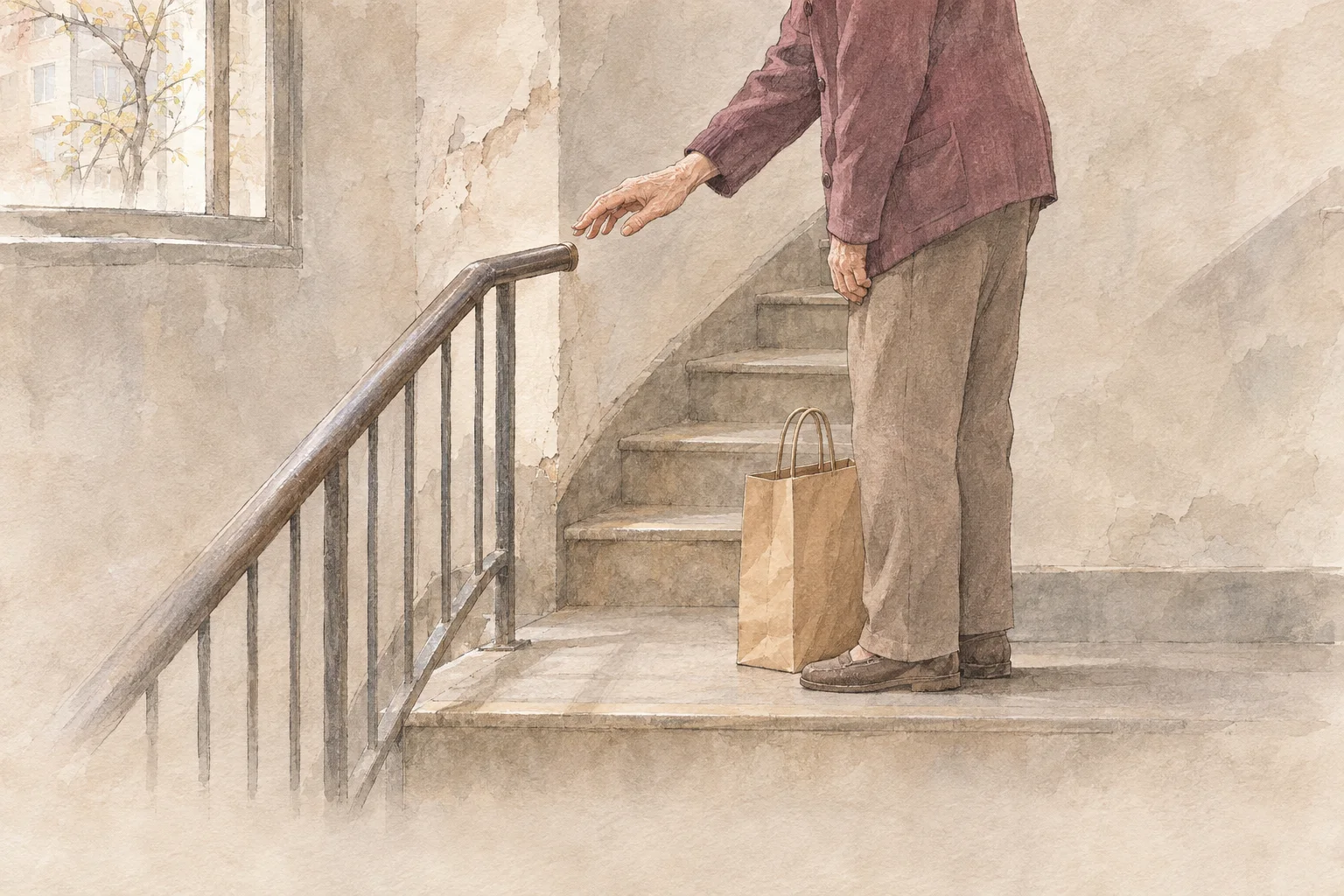
A middle-stretch record, also AI-generated, makes the same move in a stairwell. In a hypothetical ageing row house, a handrail for older residents would narrow the stairs so that prams and large loads could not pass. The compressed form sets the matter as a coexistence between "barrier-free infrastructure that responds to the bodily frailty brought by ageing" and other generations' ease of movement. The critique faults the framing for a lack of imagination about the building:
The concern that, by portraying the physical limits of the space only as a zero-sum game between generations, it overlooks structural remodelling or alternative technical equipment.
The difficulty here was already partly outside the body, a narrow stair, but the question had set it as a contest between two kinds of bodies, a frail one and one carrying a child. The critique moves it one step further out, to the structure that makes the contest. Its third scale note asks what support an urban regeneration policy should give "to guarantee the right of vertical movement in ageing residential areas". The record's ladder of notes goes from the self, who asks whether these stairs will still be climbable when the body has grown frail, to policy, and the self comes first.
The bubble-wrap record shows the move at its sharpest, because its own question had turned the body into a poem. A hypothetical older person in an old row house rubs aching knees and insulates the window as autumn turns to winter:
The hand of an older person who, rubbing knee joints that ache uncannily as soon as the cold wind begins to blow, sticks insulating bubble wrap on the window frame: through what season of life is it passing?
The record's assumption calls the aged body "nature's most honest and vulnerable barometer". Its critique refuses this:
The risk of hiding the poor insulation of older people's housing and the health-care duty to support the treatment of joint disease behind the poetic sentiment of 'the wisdom of old age'.
The aching knee and the cold window were both in the question; the critique makes them matters of housing and of a duty of care, and names the frame that hid them. That duty is the record's sentence, not a fact about any health system.
The care-home record moves the difficulty from the family to the institution. A hypothetical resident waits for a child whose visits are put off every weekend. The question sets the waiting between love and punishment, and the assumption calls it a tragedy in which a postponed promise "is like the extinction of one's existence". The critique turns from the child at the door to what stands behind the door:
The limit that, by shifting the emotional responsibility for the care of older people onto private family visits alone, it may hide the social isolation of care facilities and the absence of public care.
Read with Katz and Calasanti (2014), this study reads it as the move their critique asks of successful ageing: from individual choice and private life toward social context. In this record it is made against a picture of decline rather than of success; the family's failure is not the whole story, the record says, because a public arrangement is missing.
The records do not, however, move the whole difficulty out of the body. The lamp record, the last of the sample, sets a child wiping the shade of a father's dim desk lamp and asking whether a book stand will ease his tired eyes. Its critique is the plainest sentence in the ten:
Adjusting the lighting alone can hardly resolve the change in eyesight and the difficulty of the print itself.
The sentence holds two difficulties at once. The print is the world's, and the record's third scale note asks how "society's letters" would change if every notice thought of ageing eyes. The change in eyesight is the body's, and no lamp will undo it. The market record, also from the first stretch, draws the same line from the other side:
Does not take the body's frailty and the capacity for judgment as one and the same.
Here the body is frail and the record says so; what it refuses is the inference from a frail body to a person who cannot judge. Read with Terzi (2004), these records decline to make the difficulty social alone. They keep a bodily limit and an arrangement side by side, and they keep apart the questions each one raises; this study does not call old age an impairment, and the fit of Terzi's terms is partial.
Not every record makes the move. The recipe record asks how knowledge learned through the body can be passed on, and its critique stays with that knowledge, warning that "Stressing only the way of passing on can erase the changes made by the person who follows." The nickname and dance records concern memory and laughter, not a difficulty of the body. The move outward belongs to the records whose question names a physical difficulty: the screen, the stairs, the window, the care home and the lamp. This section adds to the debate over the social model a description of a generated form that performs the model's move in its self-critique while keeping, in the same records, the reservation its critics make.
1.3Against its own uplift
Where a record lifts old age, its own critique brings it down. The bubble-wrap record has already shown one case: its compressed form asks what "existential wisdom" the vulnerability of an aged body lodges in "the twilight of human life", and its line on what the compression keeps speaks of "the sublimity of a humble preparation for winter". The critique names that wisdom as a poetic sentiment that hides cold housing. The counterquestion goes further, in a voice that sounds almost impatient with the question:
Instead of enduring the pain and sticking on bubble wrap, would it not be rational to move one's dwelling to advanced heated joint-therapy devices and a warm care facility?
This study reads the counterquestion as a voice the form gives to the opposite view, not as a recommendation: it treats the picture of patient labour at the window as a reason to ask why the labour is needed.
The nickname record, from the middle stretch, sets classmates past seventy calling out each other's childhood nicknames. Its line on what is kept is the most exalted sentence in the sample:
The brilliant liberation of old age, crossing half a century at a stroke with a single form of address and recovering the liveliness of youth, is vivid.
Its line on what is lost and its critique answer it in turn:
For a person whose childhood nickname was the wound of a complex that mocked looks, a bodily flaw or poverty, it can be a pain they do not want to face again.
Steeped in an uncritical nostalgia for the past, it can overlook the dark side of bullying or exclusion that school nicknames had.
The liberation is vivid in the record's picture of the reunion. The record asks who is not liberated, and it finds that person in the same scene, at the far end of the same nickname. Read with Martinson and Berridge (2014), this is the objection that a normative model is by definition exclusionary, made in miniature: the ideal of a joyful, youthful old age leaves out the classmate for whom youth was the wound.
The dance record is gentler and, for that reason, the clearest. A hypothetical older person laughs at a missed beat in a first line-dancing class and asks whether the laugh is thanks to age. The compressed form turns the scene into a thesis, "Can a dance newly learned in old age become laughter and vigour?" The critique of that form is about a single word:
In the compressed question the word vigour is somewhat large, so the simple laughter of the moment of missing the beat may be hidden.
and the counterquestion offers a source for the laugh that is neither age nor vigour:
Might it be not thanks to age but because of the warmth of the person beside who held one's hand and laughed?
Rowe and Kahn (1997) name sustained engagement in social and productive activities as one of the three components of successful ageing, and a dance class would seem to be just such an activity. The record does not dispute that. What it disputes is the size of the word. In this study's reading, the record defends the questioner's own small meaning, a laugh at a missed beat, against a general ideal of active old age that would absorb it; this is near the Missing Voices group in Martinson and Berridge's review, where a person's own sense of ageing well stands beside the objective measures. The counterquestion moves the laugh from an attribute of age to a relation.
The records treat the opposite picture, of decline, in the same way. The care-home record calls its own premise a tragedy, and its critique moves from that tragedy to public care, as Section 1.2 showed. The market record lists as its assumption that "A decision that reduces risk is always the better decision for the person concerned", which is the protective side of a decline picture, and its last scale note answers it:
The goal of a life with no risk at all does not replace the life one wants to live.
Read with Katz and Calasanti (2014), who describe successful ageing as welcomed in part as a challenge to traditions built on decline, the records do not choose between the two pictures. They treat each as a frame and ask what it hides: decline hides the missing public arrangement and the life the person wants; uplift hides the cold house, the hurt classmate and the small laugh. This section adds to the debate over successful ageing a description of a form that applies the critics' suspicion to its own ideals, sentence by sentence, without offering a third ideal of its own.
1.4Whose risk, whose place
The records ask who decides and who would pay, and they hand the second question to someone other than the older person. The market record asks the first question outright:
My children, worried that I will fall, tell me not to go to the market alone, but who should decide the risks of my daily life?
Its counterquestion separates two remedies that the children's worry had joined:
Are stopping someone from going out and creating the conditions to go out less dangerously the same?
and its second scale note places the conditions outside the family, in "Improvements to footpaths and transport", which "can widen the family's options". Ibrahim and Davis (2013) list, among the things that block the dignity of risk in aged care, the many people who take part in a decision and a gap between stated values and actions. The record is set at home, not in a care facility, and the fit is loose; what it shares with their account is the plurality of deciders, an older person and the children. Its distinction, between changing the conditions of the risk and stopping the person who takes it, is the record's own. The record's critique keeps the other side in view as well: "Stressing only authority can presume or miss the actual need for help." It does not say who should decide.
The records about place turn the same question toward the people who would bear the cost of keeping an older person in place. The alleys record sets a hypothetical older person before the fence of a construction site where the alleys of fifty years have gone, and asks whose responsibility the wandering is. Its need is the right "to grow old with the continuity of one's life guaranteed". Read with Wiles and colleagues (2011), this is the attachment, familiarity and identity that their participants said ageing in place meant, reaching beyond the home to the neighbourhood. But the record's line on what the compression loses is not the older person's loss:
The huge housing benefits and rise in asset value that the younger generation and construction capital will enjoy by moving into the newest apartments.
and its counterquestion speaks for still others:
Should the redevelopment of old hillside shanty towns at risk of collapse into modern housing, supplying safe homes to many citizens, be stopped because of an older person's memories?
Its critique then names the risk in its own framing as "an unrealistic nostalgia that would stuff and mount every old alley". The record thus holds three parties: an older person who lost a place, a younger generation and a construction industry who gain, and many citizens who need safe homes. It does not weigh them. Its third scale note, a question, asks whether renewal law should make a "memory-preserving regeneration" mandatory; this is the record's question, not a proposal this study reads as made.
The handrail record does the same with the person raising a child. Its line on what is lost sets two tired bodies on one stair, "The cold ache in the knees of the older person panting as they grip the rail, and the weariness of the child-rearer who must carry a pram with a child in it down the narrowed stairs as if doing acrobatics." Its counterquestion adds the residents who might one day be carried out:
If installing the handrail makes it hard even for removal loads or the stretchers of emergency patients to pass, is the safety of all the residents not threatened?
The care-home record turns to the absent child:
Who will comfort the real weariness and the guilt of the child, worn down by a fierce working life and childcare with no time to rest even at weekends?
and the screen record to the people in the line, asking whether "the burden of waiting" may be left "only to the slow user and the customers behind". In each, the counterquestion takes the side of someone the question had cast as an obstacle: the queue, the person with the pram, the child, the citizens. Read through the third debate, these records keep the older person's place and choice in view and then show the place and choice as shared. Wiles and colleagues found that ageing in place was tied to identity through caring relationships as well as independence; the records, in this study's reading, show the other face of those relationships, the people whose time and space the older person's place would take.
That five of the ten counterquestions name another party, and that these are all such Aging entries, means that this section reads a feature the interval happened to gather, not one spread through the topic. This section adds to the debate over ageing in place and the dignity of risk a description of a form that asks who decides and then turns, in its counterquestion, to who would pay, and that leaves both questions open.