3.1Discussion
Ten AI-generated records, every third Aging entry in catalog order counted from the second and each set in a hypothetical situation, have been read for three things: where the difficulty of growing old is placed, what happens to the pictures of old age in the records' own sentences, and whom the records bring in as deciders and as payers. The answer comes in three parts.
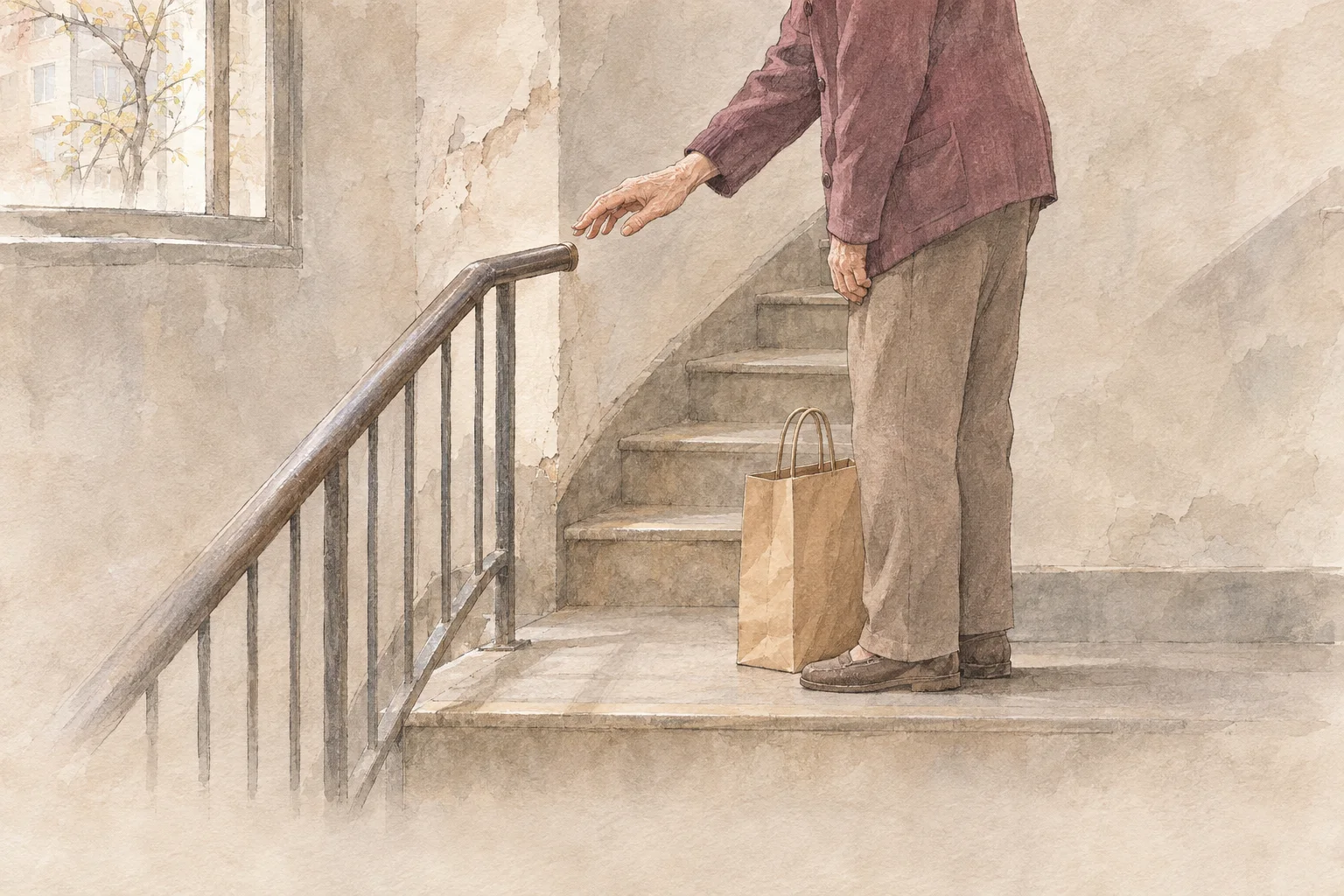
The first part concerns the place of the difficulty. The questions begin in the body or in a small task taken on for it, a slow learner at a screen, aching knees at a cold window, tired eyes under a dim lamp, and the self-critique carries the difficulty out to machines, stairwells, housing, public care and print. In this study's reading, that is the social model's move, and Oliver's restatement of the model is the lens. Read with Terzi, the records also refuse to finish the move. A lamp cannot fix the change in eyesight; a frail body is not a failing judgment. The difficulty is split between body and surroundings, and the split is kept.
The second part concerns the pictures of old age. The heightened sentences, about a winter's wisdom, a reunion's freedom and a dancer's vigour, each meet a correction from the same record: a cold house stood behind the wisdom, a hurt classmate behind the freedom, a small laugh behind the vigour. Where a record's premise is a picture of decline, a tragic waiting or a protective rule that less risk is always better, its critique and scale notes answer that too, with public care and with the life the person wants to live. Read with Katz and Calasanti, and with Martinson and Berridge, the records apply the critics' suspicion of a normative ideal to both ideals at once, and they offer no third.
The third part concerns who decides and who pays. The market record asks who should decide an older person's risks and separates stopping a person from changing the conditions of the risk. The other records' counterquestions speak for the queue, the person with a pram, the tired child and the citizens who need safe homes. Read with Wiles and colleagues and with Ibrahim and Davis, the records widen the circle of people who share an older person's place and risk. They do not say who should decide or who should give way.
Put together, the three findings describe a form that is suspicious of its own framing in a consistent direction. It moves a difficulty from the person to the arrangement, then stops short of erasing the person. It lifts old age and lowers it again. It gives the older person a claim and then gives the claim's cost a voice. That balance belongs to the form; it is not a judgment. A reader may take it as a strength, since no party drops out of view, or as a limit, since none of the arrangements the records name is given an owner and none of the claims a weight. The paper does not choose between those readings.
3.2Contributions
The paper makes three contributions, stated here as it stated them at the start. First, it describes how a generated record form places the difficulty of growing old: its questions place it in the body and its owner's tasks, and its self-critique moves it into the surroundings while keeping the body in view. In the terms of the second debate, the form performs the social model's move and keeps its critics' reservation in the same record. Second, it describes what the form's self-critique does with ideals of ageing: it treats an uplifting picture and a declining one alike as frames that hide something, as the critics of successful ageing treat a normative model. Third, it describes how the form handles place and risk: it asks who decides, and its counterquestions turn to the people who would pay, leaving both questions open. All three contributions concern how this record set frames questions about growing old. None says how any older person should live, what any family should decide or how any building, service or city should change.
3.3Limits
The sample is ten of the studio's 31 Aging entries, drawn by a fixed interval from a starting point chosen to avoid an entry read before; another start would give another ten, and the closing stretch, with its one Aging entry, is not represented. The sample also happens to hold every Aging entry whose counterquestion names another party, so the third finding describes these ten records and not the topic. The records are AI-generated and their situations hypothetical, so the paper can describe only the record set's framing, not how older people or their families think, feel or fare. The English is this study's own translation; the counts are made on the Korean to keep the translation from deciding them, but the readings and the block quotes are in English, and a different translation could shade them, above all in the records' heightened sentences about wisdom and liberation. The counts rest on crude word tests, which can catch a word used in passing, so the paper leans on close reading and uses the counts only to place the ten in the topic and the catalog. The frame measure finds no repeated runs, but the form itself is fixed, and that a record criticises its framing at all is guaranteed by the form, not found. Finally, the works are used as lenses on short generated texts, a use their authors did not intend. Oliver and Terzi wrote about disability, not ageing; Wiles and colleagues spoke with older people; Ibrahim and Davis wrote about residential care. In each case the fit is this study's reading.
3.4Further research
Three extensions would test the findings. The first is to read the remaining Aging entries, and above all the closing stretch's one entry, to see whether the move from body to surroundings and the puncturing of uplift hold where the counterquestions do not speak for another party. The second is to read the same devices in a neighbouring topic of the catalog, such as Care or Home, to see whether the split between body and surroundings is particular to questions filed under Aging or belongs to the form wherever a body appears. The third is to compare these generated records with questions written by people about their own ageing, read in the same fields, to see whether a human question keeps the same split between body and surroundings, or draws the line elsewhere.