0.1The question and the claim
When a person grows old and something becomes hard, the difficulty can be told in two ways. It can be told as a fact about the body: the knees ache, the eyes blur, the hands are slow on a new machine. Or it can be told as a fact about the world the body meets: the print is too small, the stairwell too narrow, the screen too quick, the housing too cold. The first makes the difficulty the older person's to manage; the second makes it something a builder, an operator, a council or a family could change. A question about growing old can move between the two without saying so, and it can carry a picture of old age as well: decline, in which old age is loss, or uplift, in which it is wisdom, freedom or late vigour.
This paper studies a set of records that put questions about growing old in a person's voice and then, in the same record, say what that way of putting the question leaves out. The records come from Cosmic Press, a studio in the RISCON family whose public catalog holds AI-generated questions. Each record pairs a question with notes on its own framing: a compressed general form, an assumption, what the compression keeps and what it loses, a counterquestion, a defect and six scale notes. No record answers its question or carries a judgment. All are made by AI and describe invented situations, so they are not evidence about older people, care homes, joints, eyesight or cities, only about how this record set frames a question about growing old.
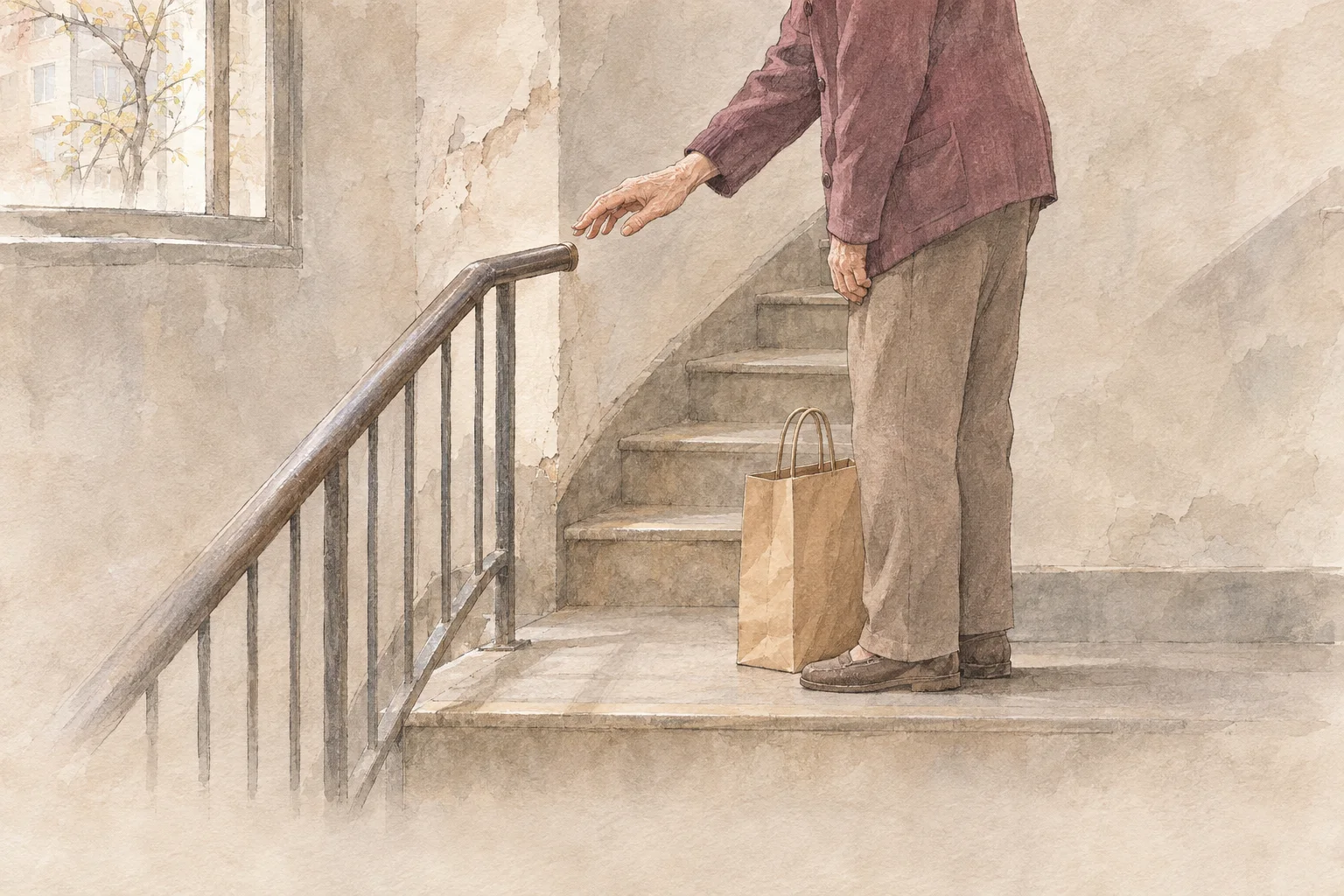
The paper reads ten of the studio's Aging questions, taken at a fixed interval across the catalog. In them hypothetical people learn an ordering screen, write down a recipe, are told not to go to the market alone, argue over a handrail, wait for a visit, insulate a window, lose an old neighbourhood, meet old classmates, dance for the first time and wipe a father's lampshade. The paper's question is this: when a record files a question under Aging, where does it place the difficulty of growing old, in the ageing body or in what surrounds it, and what does the record's critique of its own framing do with the pictures of old age its sentences carry?
The claim has three parts. First, in this study's reading, the questions put the difficulty in the ageing body and in a small task that its owner, or a relative, takes on. Their self-critique moves the difficulty outward, to a machine and its staff, a stairwell, housing, public care and the print, but not all of it: the body stays in view, as an eyesight no lamp can fix and a frailty that is not a loss of judgment. Second, where a record's own sentences lift old age into wisdom, liberation or vigour, its critique punctures that lift, treating the uplifting picture as one more frame that hides something. Third, the counterquestions often speak for someone other than the older person, someone who would bear the cost of the change the question wants.
The contribution is a description of how a generated record form handles the step from a body's difficulty to its remedy, and of how its built-in self-critique treats the ideals of ageing that run through its own sentences. The description concerns how this record set frames questions. It says nothing about how any older person should live, how any building should be changed or what any family should decide.
0.2Three debates
The first debate is over successful ageing. Rowe and Kahn, Successful Aging (1997), begin from the growth in the number of older persons and set out a concept with three components: the avoidance of disease and disability, the maintenance of high physical and cognitive function, and sustained engagement in social and productive activities. They hold that the stage is set for interventions to raise the share of the population that ages successfully. Freund and Baltes, Selection, Optimization, and Compensation as Strategies of Life Management (1998), study a related idea at the level of the person: people in a Berlin sample who reported selecting, optimizing and compensating as ways of managing their lives scored higher on subjective well-being, positive emotions and the absence of loneliness, and the link held after other measures of mastery were controlled. Against the first of these works, Katz and Calasanti, Critical Perspectives on Successful Aging: Does It "Appeal More Than It Illuminates"? (2014), grant that successful ageing is one of gerontology's most successful ideas and that it was welcomed as a challenge to ageist traditions based on decline. They then set out its limits: its assumptions about individual choice and lifestyle, and its inattention to social inequality, health disparities and age relations. Martinson and Berridge, Successful Aging and Its Discontents (2014), sort the critical literature into four groups, among them one that adds older people's own meanings to the established measures, which they call Missing Voices, and one that calls for frameworks that intervene at the structural contexts of ageing. Their reading is that a normative model is by definition exclusionary. The debate gives this paper two questions: does a record treat a difficulty as the person's to manage or as a matter of its social context, and what does it do with its own ideal of a good old age?
The second debate is over where disability lies. Oliver, The Social Model of Disability: Thirty Years On (2013), looks back, thirty years after the book that introduced the social model, restates what it was and its potential for improving disabled people's lives, and treats the criticisms of it as unfortunate, with damaging effects at a time when benefits and services are being cut. Terzi, The Social Model of Disability: A Philosophical Critique (2004), offers one such criticism. In conceiving disability as caused by society alone, she argues, the model gives a partial and in part flawed account of the relation between impairment, disability and society, one that limits its own aim of inclusion; yet she also holds that it remains an important reminder that inclusion is a moral issue. The debate was not made for ageing, and this paper does not treat old age as disability. It uses the debate for one distinction it sharpens: between the difficulty that is the body's and the difficulty that the surroundings make. The question for the records is where they put the line, and whether they put it on one side alone.
The third debate is over place and risk. Wiles and colleagues, The Meaning of "Aging in Place" to Older People (2011), asked older people in two New Zealand communities what ageing in place meant to them. Their participants wanted choices about where and how to age in place, valued attachment, security and familiarity in homes and communities, and tied ageing in place to identity both through independence and through caring relationships. Ibrahim and Davis, Impediments to Applying the 'Dignity of Risk' Principle in Residential Aged Care Services (2013), name four things that stand in the way of letting residents of aged care take risks of their own choosing: their fluctuating capacity to decide, the many people who take part in decisions, a gap between stated values and actions, and fear about the legal duties of care providers. This debate bears on the records in which an older person's place or an older person's risk is at stake: the market, the stairs, the alleys, the care home.
The three debates meet at one point, the point this paper studies: the step from a difficulty in an ageing life to the question of what should change and who should decide. Freund and Baltes study the person's own strategies, and Katz and Calasanti fault the Rowe-Kahn paradigm for its assumptions about individual choice; the social model that Oliver restates, as Terzi describes it, treats disability as socially caused, and Terzi warns against locating it on one side alone; Wiles and colleagues, and Ibrahim and Davis, ask who chooses the place and the risk. The records do not engage any of these works. The paper uses the works as lenses on the records' form, and says where a lens fits badly.
0.3Where the records bear and where they cannot
The records can show how one record set frames a question about growing old, what it says its own framing leaves out, and whom its critique brings into view. They cannot show what older people feel, how real stairs or screens or care homes work, or whether any measure the scale notes mention would help anyone. When this paper reads a record against Rowe and Kahn or against Oliver, the reading is this study's, and it tests a lens on a text, not a theory on a population. The method, the selection rule and the counts are set out in Section 1.1; the three findings follow in Sections 1.2 to 1.4; the conclusion says what the findings add, where they stop and what could test them further.