The eleven scenes this paper read, in the order of its case list. Each is a GAEKJU synthetic scene: written for comparison, in GAEKJU's words, and not testimony from its trade; written in Korean, and the English is this study's translation, labelled as such in each case. For each scene the appendix gives its title, setting, scene, lines of talk, evidence, three readings, judgment, counter-condition and proposal, word for word. One sentence of each scene's evidence is left out, and the sentences kept stand as the scene has them.
The unanswered readings
A GAEKJU synthetic scene of the kind of talk "Looking up", set in the 2020s, in this study's English.
When no answer follows a raised alarm, what does the shift lead decide?
Operating shift room at a power plant
The shift lead passes the changed equipment readings accurately to headquarters. When no answer has come by the time of the shift change, the shift lead asks whether the next crew should wait. The shift lead first checks who can make an interim decision.
The readings have gone up. If the answer is late, who makes the interim call?
I'll leave it in the handover so the next crew sees the same question.
At a power plant, a delayed answer and the time of the shift change are bound together. It does not describe any actual equipment failure or operating decision.
No answer means agreement with the present state.
The shift lead has to take on every interim decision.
The deadline for an answer and the interim authority have to be checked first.
Even when an accurate report goes up, if the answer is late the burden of deciding stays below. Rather than reading silence as approval, it is safer to check the deadline for an answer and the interim authority. (as of 2026-09-25)
If the deadline for an answer and the interim authority to decide are already clear and the next shift knows them too, the claim that the delayed answer moved the burden downward weakens.
Put the deadline for an answer and the interim authority to judge together in the shift documents. The automatic judgment assigns evenly the times at which questions still waiting are handed to the next shift.
The promised review
A GAEKJU synthetic scene of the kind of talk "Looking up", set in the 2020s, in this study's English.
Whom does the coordinating teacher's 'I will review it' keep waiting?
Teachers' office at an elementary school
The coordinating teacher hears the teachers' requests to change lessons and says the requests will be taken to the principal. To the teachers, the answer given is that it will be reviewed. While the schedule stays blank, the teachers cannot remake their materials, and the coordinating teacher waits for the answers from above and from below at once.
I will review it. I'll also check when I can give you an answer and come back.
I'll have the materials ready for that time. For now I'll leave only the blanks.
At a school, lesson materials and the approval schedule move together. It is not a claim about actual school procedure.
The problem is the structure that left the decision to the coordinating teacher.
To say it will be reviewed is a sufficient answer.
Those words cannot share out the waiting time above and below.
In the coordinating teacher's words there is less an intent to avoid responsibility than the trace of a decision not yet made. Not being able to tell when the waiting ends tilts the teachers' preparation time. (as of 2026-09-25)
If the teachers can prepare their lesson materials as planned even after the answer that it will be reviewed, and there is no rework, the judgment about the burden of waiting weakens.
Give the teachers the expected time of approval together with the range they can prepare in the meantime. Do not push the delay of the decision above onto the explaining labour of the coordinating teacher alone.
The changed loading order
A GAEKJU synthetic scene of the kind of talk "Looking up", set in the 2020s, in this study's English.
Does the checking crew's grumbling send the loading order back as a question?
Container checking crew at a port
The head checker grumbles offhandedly to a colleague that the loading order keeps changing. A checker points out that the confirmation for one cargo has not come yet. The head checker turns that remark into a question about the confirmation still missing and passes it to the operations room.
The order's changed again. If the reason were known, hands would go in vain less often.
The confirmation for this cargo isn't here yet. Let's ask about that first.
At a port, confirmations and the loading order are bound together. No actual loading delay or performance is set.
The grumbling is a wasteful reaction to a change of order.
The grumbling is a channel for discovering the missing confirmation.
The discovery is owed to the checker's separate check of the papers.
The grumbling itself cannot fix the order. Only when the colleague's information about the confirmation joined it and it became a concrete question could it go up. (as of 2026-09-25)
If, even without the colleagues' talk, a missing confirmation always reaches the operations room at the same point, the grumbling's role as a question is small.
Open a channel between checking and operations for asking about unconfirmed papers. Set the operations room's time for answering together with the checking crew's time for confirming.
The fax margin
A GAEKJU synthetic scene of the kind of talk "Looking up", set in the 1990s and the 2020s, in this study's English.
As reports to head office moved onto screens, did the branch manager's questions remain?
A bank branch's reporting room in the 1990s
In the 1990s a branch manager writes questions about a customer's circumstances in the margin of a faxed report. Later, similar matters are entered into set fields on a screen. Entering the numbers became faster, but the field for attaching a question is narrow.
The numbers are right. I'll have to write one more line about the customer's circumstances.
The fields on the screen are narrow. I'll also look for a place where the question can reach.
The difference between a paper margin and a fixed input field is an assumption of the bank-branch reporting scene. It is not an observation of an actual institutional change.
The fields on the screen push out questions about customers' circumstances.
Whether the questions disappeared needs a look at head office's record of answers.
A fixed screen makes comparison between branches easier.
When the form changes, the place where a question can be written changes. Rather than concluding that the questions decreased, this scene makes one check which questions head office answered. (as of 2026-09-25)
If, after the switch to screens, the branch managers' free questions were still recorded as often and got answers, the judgment that the channel for questions narrowed is wrong.
Beside the set fields, keep a place where the grounds of the branch manager's judgment can be opened and read. Do not leave the time for head office and branch to exchange answers to one side only.
The experiment left out
A GAEKJU synthetic scene of the kind of talk "Looking up", set in a year supposed for 2030, in this study's English.
The experiment left out of the results table makes the next research question.
Results review room at a national research institute, 2030
An automatic judgment picks only the clear results from many experiments and makes the results table. The lab head asks that the experiments that gave no answer be put into the judgment as well. A researcher explains that such an experiment was the starting point of the next research question.
The experiments that gave no answer have been left out too. Where did the next question come from?
It began in that experiment. I'll show you the questions that followed from it as well.
An experiment without an answer can make the next question even if it is left out of the results table. It is a future scene and not actual research results.
The experiment without an answer is also grounds that made the next question.
Putting in every experiment equally blurs the focus of the judgment.
Only clear results should go up, for the results table to be readable.
The lab head's words are not a complaint to mark the results down; they bring out where the next question came from. Rather than listing every experiment without an answer, one should look at the cases linked to follow-up questions. (as of 2026-09-25)
If the experiments without answers led to no follow-up question and no change of method at all, the claim that the omission from the results table changed the judgment shrinks.
The automatic judgment picks the clear results together with the experiments without answers that gave rise to follow-up questions. It lets the lab head and the researcher each have a share of time to explain their grounds.
The trees not ready
A GAEKJU synthetic scene of the kind of talk "Holding out", set in the 2020s, in this study's English.
What does the arboretum foreman's 'not yet' ask of the event schedule?
Opening preparation crew at an arboretum
Those who run the arboretum decided to open a new section on the day of an event. The planting foreman says it is not now, since the state of the moved trees needs more watching. The person in charge of operations discusses separately the section to show visitors and the planting schedule.
I know the event date, but this tree is not yet.
Then let's look first at the sections we can open. I'll take on explaining to the visitors as well.
At an arboretum, the time trees take to recover and the date of an event flow differently. No actual planting or opening result was observed.
The foreman's 'not yet' delays the preparation for the event.
'Not yet' is information that the trees' time and the event date are out of step.
Until the state is checked directly, the extent of the opening cannot be set.
The foreman's words do not turn visitors away; they are a question that sets the time the trees take to recover against the date people set. Which sections can open needs a separate check. (as of 2026-09-25)
If the trees recover fully by the opening day and there is no extra burden of care, the reading of a tilt in the schedule is wrong.
The automatic judgment divides the sections visitors can enter from the sections that must wait longer for planting, and picks the order of opening. Do not pile the time for guiding visitors and for caring for trees onto one group only.
The bus held back
A GAEKJU synthetic scene of the kind of talk "Holding out", set in the 2020s, in this study's English.
Does the bus depot's 'this bus can't go out' protect the service?
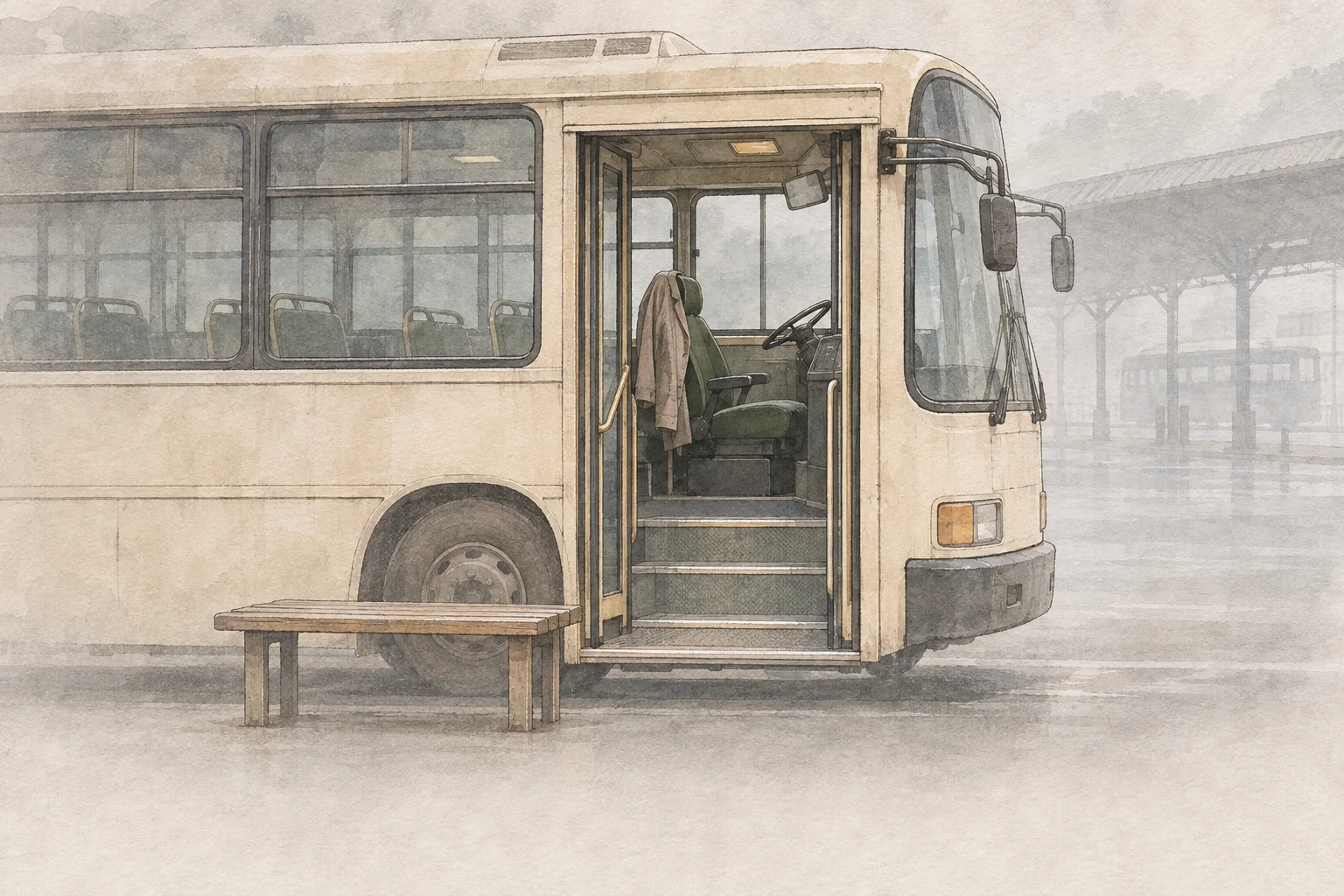
Departure line at a city bus depot
On a bus about to depart, the driver hears a sound unlike the usual one. The dispatcher worries about the time of the first bus. The driver asks for time to check it together with the mechanic.
This bus can't go out now. It sounds different from usual.
The first bus is at stake. I'll have maintenance check it and look at a replacement bus as well.
At a bus depot, the time of departure and the state of the vehicle matter at the same time. No actual breakdown or accident is set.
Refusing to depart disrupts the service.
Stopping briefly to check can lower the risk to passengers.
Without looking at the cause of the sound, neither cost can be concluded.
The driver's words are a question asking for a check rather than a declaration of putting down the work. Only by looking at the cause of the sound can the value of delay and of safety be compared. (as of 2026-09-25)
If the maintenance check finds no cause and only departure delays under the same conditions repeat, the information value of the refusal falls.
Reflect the time for the maintenance check in dispatching and open the option of a replacement vehicle along with it. Allot time for explaining a delay of the first bus to the dispatcher as well.
The photo's time
A GAEKJU synthetic scene of the kind of talk "Holding out", set in the 2020s, in this study's English.
What does the loss adjuster's objection leave behind, delay or accuracy?
Settlement room for insurance loss adjusting
Just before putting forward a settlement proposal, the loss adjuster objects that the time on one photograph does not match. The supervisor says the policyholder will have to be told the reason for waiting. The two set the scope of the further check and the time of the answer together.
The photo's time doesn't match. This part needs a closer look.
We have to cut the policyholder's waiting too. Let's set the scope of the check and when to answer together.
In insurance settlement, a delayed answer becomes the policyholder's burden. No actual payment result is assumed.
The objection lowers the risk of settling on wrong grounds.
The scope of the check has to be narrowed and a time for the answer promised, for the two to be seen together.
The objection is a cost that delays the settlement.
Even if the adjuster's objection is right, the time of the person waiting is a cost. The moment the photo to check and the time of the answer are set, the gain of the question and the cost of the delay can be handled together. (as of 2026-09-25)
If the time on the photo did not affect the settlement judgment and the further check only delayed the answer, the value of the objection has to be reduced.
Set separately who will check the photo and when the policyholder will be answered. Secure time to tell the policyholder in advance how long the wait will be.
The stuck episode
A GAEKJU synthetic scene of the kind of talk "Holding out", set in the 2000s and the 2020s, in this study's English.
On what condition does refusing a deadline become a negotiation instead of a halt to the series?
Serialisation meeting at a webcomic studio
It is supposed that in the early days of digital serialisation, even when a creator said a deadline was hard, there was rarely a place to discuss a replacement episode. In today's studio meeting, the chief editor asks which part of the manuscript is stuck. The production lead proposes that the scenes finished first can be moved to the next episode.
I can't deliver this episode as it is. I'll show you the stuck scenes first.
The finished scenes can be saved. Let's work out the order of the next episodes together.
In webcomic serialisation, the splitting of episodes and the promise to the platform are bound together. The comparison of eras is imagined and is not to be read as a claim about the industry's history.
Whether negotiation is possible depends less on the creator's character than on the authority to change episodes.
Refusing a deadline is an act that breaks the promise of the series.
The refusal brings out the stuck scenes and gives a chance to adjust.
A refusal does not at once become a negotiation. Only when the chief editor and the production lead have the authority and the time to adjust the order of episodes do the stuck scenes turn into an alternative. (as of 2026-09-25)
If, even with enough authority to change episodes, the talks after a refusal always end in a halt, some other condition separated negotiation from halting.
Pick the option of dividing the finished scenes and the remaining work between episodes. Do not pull the creator's remaining time forward all at once; fit it to the editing schedule as well.
The missing inspection
A GAEKJU synthetic scene of the kind of talk "Holding out", set in a year supposed for 2030, in this study's English.
The 'wait' a supervisor called out before an automatic design change.
Meeting on a design change under construction supervision, 2030
An automatic judgment puts forward a plan for the design change with the shortest schedule. A deputy of the supervision body stops it, saying the inspection time for one floor is missing. The builders check together which work moves back if that time is put in.
Wait. The inspection time for this floor is missing.
We'll put that time in and look at the work that moves back as well.
In construction, inspection time and the order of work push and pull against each other. It is a future supposition and there is no actual design result.
The supervisor's stop brings back the missing inspection time.
Even with the inspection put in, the whole sequence of work has to be compared again.
The shortest schedule is the best choice.
The deputy's 'wait' is not a refusal of speed; it questions the time missing from the plan. Which work to move once the inspection is put in has to be compared together with the builders. (as of 2026-09-25)
If the inspection time was already in the schedule and the deputy's point makes no actual difference to the work, the judgment of a missing condition is wrong.
The automatic judgment picks again an order of work that includes the inspection time. It divides the waiting and starting times so that the added time does not pile onto one partner firm only.
The next visit
A GAEKJU synthetic scene of the kind of talk "Holding out", set in the 2020s, in this study's English.
What does the technician's 'I can't take the next visit' tell?
Assignment room for home-appliance repair technicians
A home-repair technician tells the person assigning the jobs that the next booking is hard to take. The technician adds that time is needed to check the parts from the earlier repair again. The person assigning looks at the customer's waiting and the technician's time for a return visit together.
I can't take the next visit right now. I have to look at the parts at the last house once more.
I'll put that time into the booking sheet first. I'll let the next customer know the time again as well.
In home repair, travel time and the time for checking again do not show well in the booking slots. No actual repair results for customers are assumed.
These are the words of a technician trying to avoid work.
The refusal tells of the time for checking again that the booking sheet left out.
The new customer's waiting also has to be counted as a separate cost.
The technician's words are hard to read only as turning away the next customer. If the booking sheet could not hold the time to recheck for the earlier customer, the two customers' times have to be rearranged together. (as of 2026-09-25)
If no recheck is needed and the travel time is enough, yet the same refusal repeats, a reason outside the booking sheet has to be asked.
Assign the recheck time for the earlier repair separately from the time for the new visit. Do not leave one technician to take on two customers' waiting at once.