1.1The question
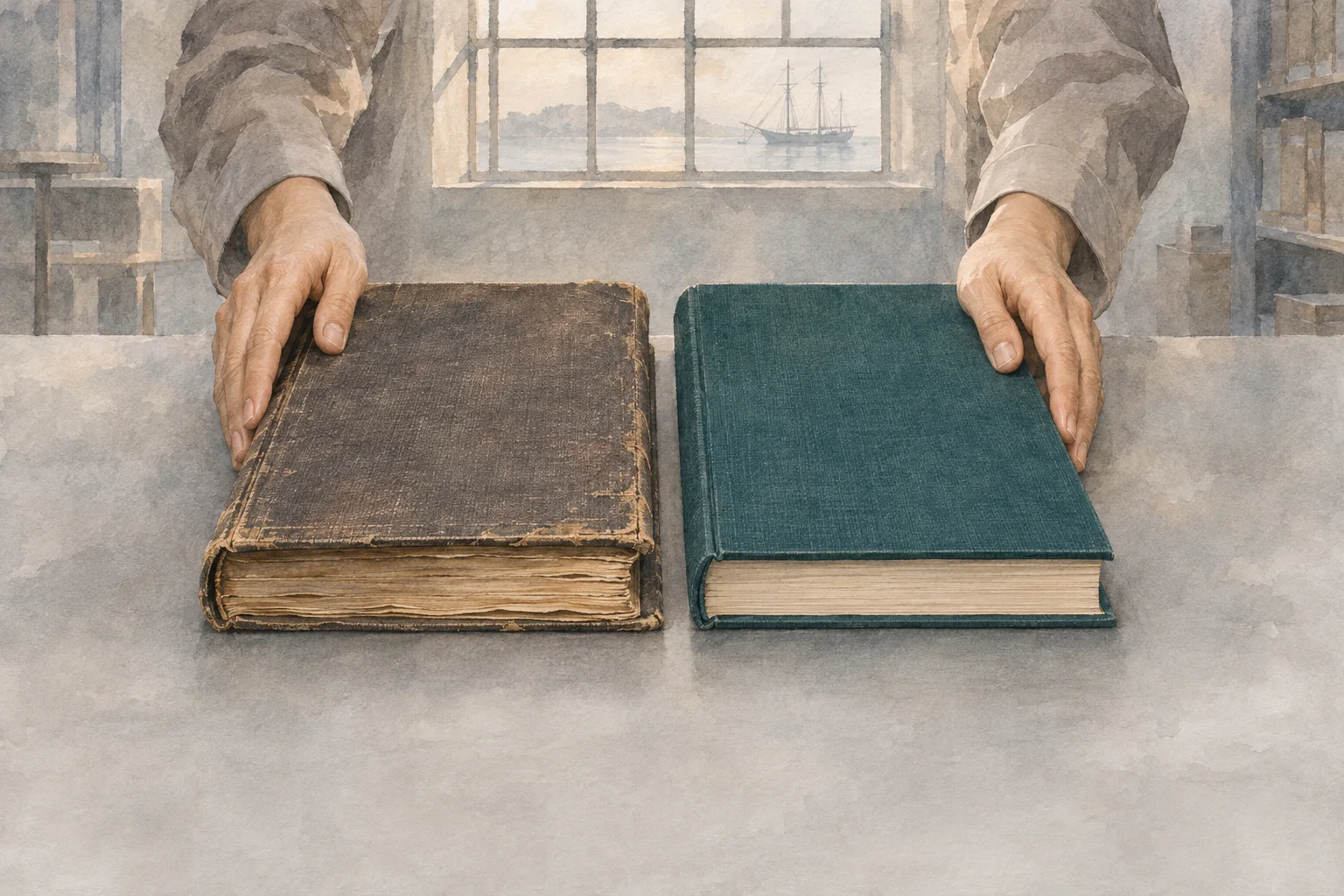
A merchant writes down, before each voyage, why the ship is being sent and what might go wrong. A ship is lost to a storm. The merchant's partner says the judgment was wrong. A trading desk, after a large loss, writes a review concluding that the signal was clear at the time; the record made before the trade says almost nothing about why it was taken. These are the two scenes this article reads. Both are synthetic records written for a decision platform. They ask one question in two times: when an outcome is known, how should the decision that preceded it be judged?
The question here is narrower. It asks whether a reason written before the outcome survives the kind of retelling that Charles Mackay's account of the South Sea Bubble shows at work. Mackay did not write about logs or post-mortems. He wrote, in a book published in 1841 and revised for later editions, a popular history of financial and other manias, and he told the story of a collapse that was by then more than a century old. His chapter is useful for this question for a reason that has nothing to do with whether his facts are right. It is a sustained example of a story told after the end is known, in which the people who warned are prophets, the people who bought are deluded, and the people who ran the scheme are robbers, and in which, here and there, the teller lets in material that does not fit.
1.2The contribution
The contribution is to read the literature on hindsight and outcome bias through the way episodes are narrated rather than through the way individuals rate them. Fischhoff (1975) and Baron and Hershey (1988), as their reading notes give them, describe judgments made by people who know an outcome. Mackay's chapter shows what such judgments look like when they become a story: which voices the story keeps, which it calls foresight, and which documents it treats as proof. A narrative is the form in which most decisions are judged after the fact, by partners, committees and historians, and it has features a rating does not. It chooses a beginning. It gives reasons to actors. It decides who is in the story at all.
The second contribution is smaller. WSTiger's two records, written as one thread under the title the English translation renders as "The Outcome Rewrites the Reason", each offer three ways to judge a decision after a loss, and the three map onto the three positions in the literature. Reading them with Mackay open shows that the records are clear about what a prior record protects against and much less clear about what would show that the prior record itself was incomplete. Their revisit conditions turn on whether signals were "knowable" or "clear" at the time, which is the very judgment hindsight distorts.
Mackay is used throughout as a record of how the South Sea episode was told, not as a source of numbers or of facts about 1720. Where his sentences contain figures, they are quoted as part of the telling, and nothing in the argument rests on them.
1.3The debate joined
Three positions are set out in the next section.
The first holds that knowledge of an outcome distorts the judgment of the decision that led to it. Fischhoff (1975) argues that people who are told how events turned out judge that outcome more likely than they would have without knowing it, and do not realise that the knowledge changed their judgment; he calls the effect creeping determinism. Baron and Hershey (1988) argue that people rate the same decision, made on the same information, as better when its outcome was good than when it was bad.
The second position, as this article assembles it from two works whose notes do not use these words, treats outcomes as the test of judgment once they are counted over many decisions. Brier (1950) proposed a score for probability forecasts, the mean squared difference between the forecast probabilities and what happened, which a forecaster cannot improve by stating anything other than the probability believed. Tetlock (2005) studied experts' forecasts over a long period and found them poorly calibrated.
The third position doubts that a record made before the decision is the clean remedy the first position might suggest. Power (2004) argues that risk management turns towards the reputational and legal risks of the organisation and its managers, so that defensive documentation can take the place of judgment. Clarke (1999) argues that organisations write plans for catastrophes they cannot control, plans that could not work as written but persuade others, and the organisation itself, that the risk is under control.
The grouping of these works into three positions, and every application of them to Mackay and to the records, is this article's own. The authors are credited only with what their works are noted as arguing; the rest is the article's claim.